
If your shop isn't showing up when a driver searches for brake repair, check engine diagnostics, or “auto repair near me,” you're not losing vague “traffic.” You're losing repair orders that are ready to book now.
That's the mistake most shop owners make with local SEO for auto repair shops. They treat it like a website chore. It isn't. It's a lead system tied directly to calls, direction requests, and high-intent service bookings. A clean shop, good technicians, and honest work still matter. But if Google can't see and trust your business, the customer never gets far enough to care.
A basic website won't fix this. Neither will a half-finished Google Business Profile, scattered directory listings, or one generic “Services” page. You need a system built around how real customers search when something is wrong with their car and they need help nearby.
If you want to know where your visibility is leaking and which jobs your competitors are taking from you, request a strategy review before another busy week passes.
Table of Contents
- Why Your Competitor's Phone Is Ringing and Yours Isnt
- The Blueprint for a Local Lead Generation System
- Your Google Business Profile The Digital Front Door
- Building a Website That Converts Clicks Into Customers
- Thinking Like Google How to Win with Authority and Trust
- Your 90-Day Action Plan to Dominate Local Search
Why Your Competitor's Phone Is Ringing and Yours Isnt
A driver hears grinding when they brake, grabs their phone in the parking lot, and searches for help. Google shows a map, a few nearby shops, reviews, hours, and a call button. Your competitor gets the tap. You get nothing.
That isn't bad luck. It's a visibility problem.

Search behavior is heavily local. 97% of consumers search online for local businesses, 46% of Google searches have local intent, and more than 60% of local searches happen on mobile devices, according to 253 Media's overview of SEO for auto repair shops. For an auto repair shop, that means Google Maps and mobile search are where buyers decide who gets the call.
Your website isn't the problem. Your discoverability is.
A lot of shop owners say the same thing: “We already have a website.” Fine. But a site that doesn't rank locally, doesn't support your Google Business Profile, and doesn't match real search intent is just an online brochure.
What costs you work:
- Weak map visibility means you don't appear where emergency searches happen.
- Incomplete business data makes Google less confident about your shop.
- Generic service pages fail to match searches like brake repair near me or engine diagnostics in your city.
- Inconsistent listings across directories muddy your local signals.
Practical rule: If a customer can't find your shop in under a minute from their phone, your competitor is taking the job.
That's why local SEO for auto repair shops should be treated like sales infrastructure, not marketing decoration. When someone searches with location and urgency, they're already deep in the buying cycle. They don't need education. They need a trustworthy nearby option.
The missed opportunity is bigger than most shop owners admit
A customer with a dead battery, AC issue, or brake problem usually isn't comparing ten websites. They're picking from the few businesses Google puts in front of them. If you're outside that group, you're invisible at the exact moment money is on the table.
Most agencies still don't understand this. They talk about traffic. You need booked jobs.
If you want a broader view of how local search systems create demand for service businesses, this guide on local SEO for home services is useful. The principle is the same. Visibility drives calls. Calls drive appointments. Appointments fill bays.
If your shop isn't consistently surfacing in local search, fix that now. Waiting only gives your competitors more time to collect the calls that should have gone to you.
The Blueprint for a Local Lead Generation System
Local SEO for auto repair shops works when you stop treating it as a list of disconnected tasks. Your Google Business Profile, website, reviews, citations, and paid traffic all need to support the same goal: get the right customer to call when they need service. It's the same system we build through our Miami local SEO services.
That's the system. Not rankings for their own sake. Not vanity metrics. A repeatable flow of local leads.
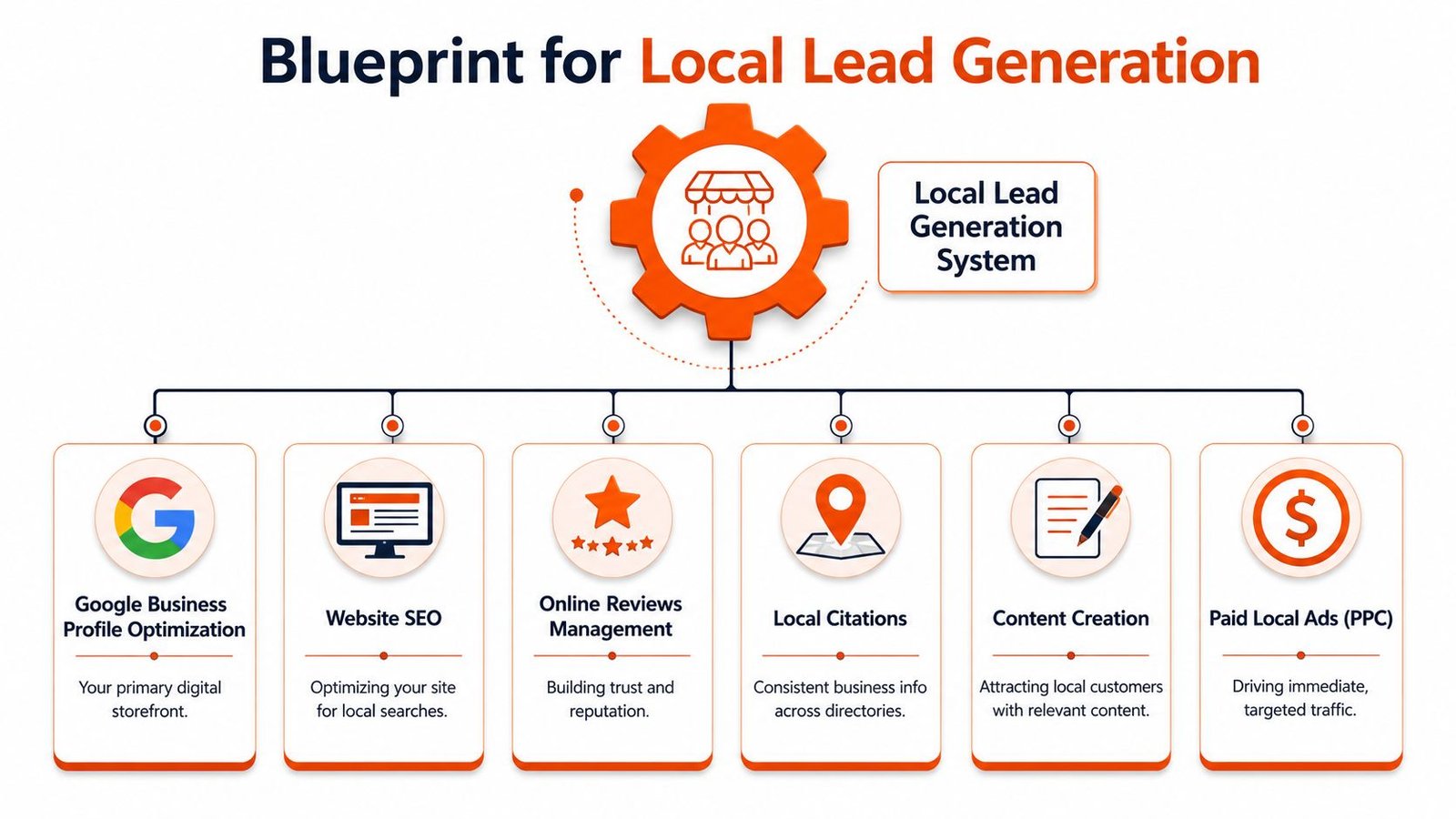
The four parts that have to work together
Here's the structure that produces inquiries:
Google Business Profile
This is your front-line asset for map visibility, calls, directions, and service discovery.Service and location pages
These pages catch searches that are specific, urgent, and highly commercial.Citation consistency
Your business name, address, and phone number need to match across directories and platforms so search engines trust your data.Review generation and response
Reviews influence both buyer confidence and local prominence. A quiet review profile makes an active shop look inactive.
A lot of businesses bolt one of these on and ignore the rest. That creates gaps. The searcher might find you, then hesitate because the profile looks thin. Or they click through and land on a weak page that doesn't answer their exact need. Or they see inconsistent business information and move on.
A lead system also depends on what happens after the click
Even strong local visibility falls apart if your phone process is sloppy. Shops miss calls during lunch, after hours, or while the front desk is buried. That's why operational follow-through matters just as much as SEO structure. If you want a useful example of where this is heading, take a look at how AI transforms automotive call handling. It's relevant because local search only creates opportunity. Your intake process decides whether that opportunity turns into revenue.
A local SEO campaign that drives calls into a weak phone process will expose problems, not solve them.
Don't build a prettier website. Build a capture system.
Most agencies still pitch auto shops on aesthetics first. That's backward. You need pages, profile assets, and conversion paths designed around service demand.
That includes:
- Fast mobile performance so urgent searchers don't bounce.
- Clear booking and call actions on every key page.
- Service-specific content instead of one bloated services page.
- A review workflow that runs every week, not whenever someone remembers.
- Optional paid support for immediate visibility while SEO compounds.
If your current site was built without lead flow in mind, this breakdown of how to build a lead generation website will help you spot the structural problems fast.
The shops that win locally aren't always the biggest. They're the easiest to find, the easiest to trust, and the easiest to contact.
Your Google Business Profile The Digital Front Door
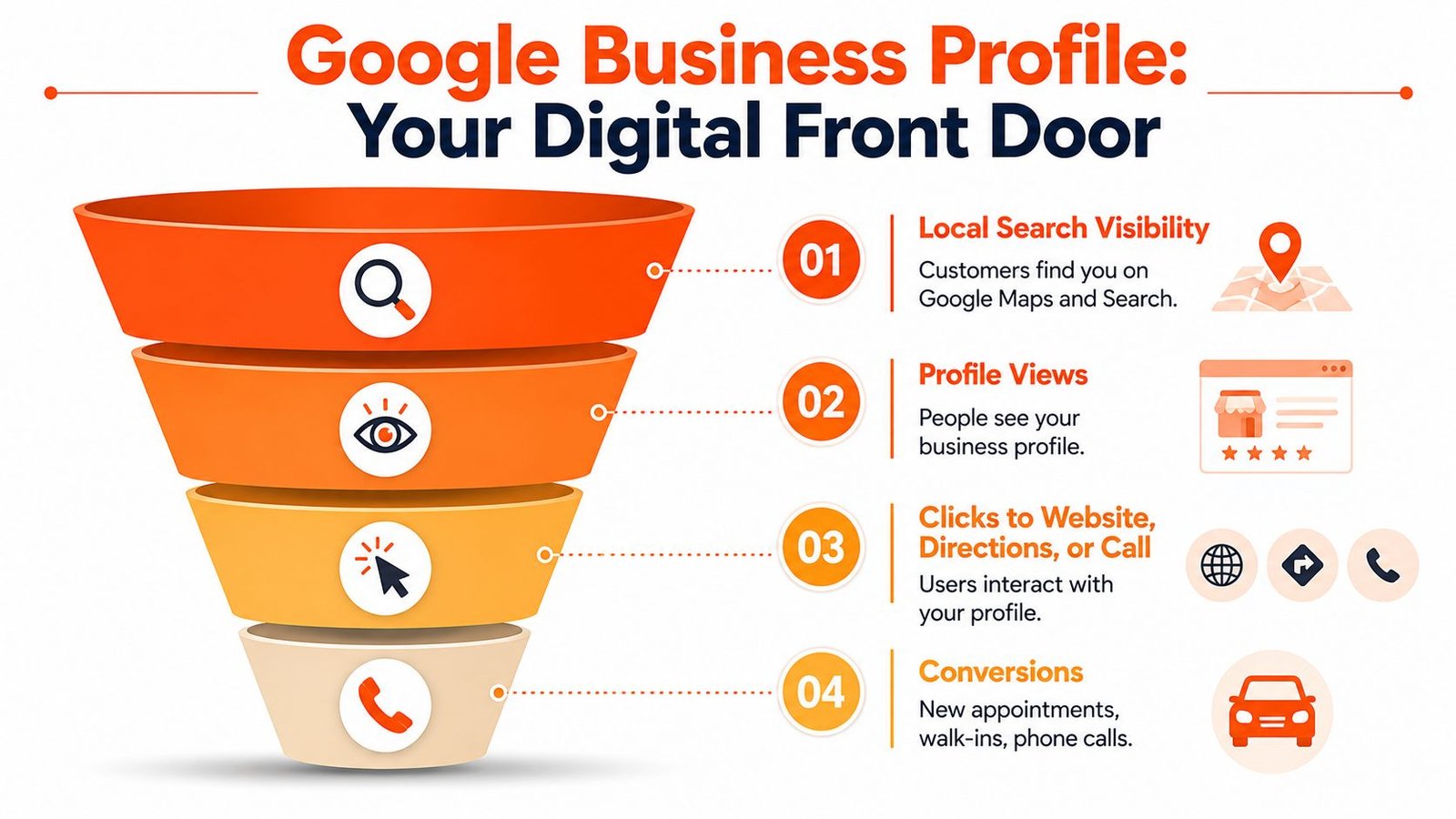
A driver searches “brake repair near me” at 7:10 a.m. Your shop is close. Your competitor is close. Google shows both profiles. One listing looks active, specific, and easy to trust. The other looks half-finished. The call goes to the shop that gave Google and the customer a clearer answer.
That is what your Google Business Profile does. It does not exist to “improve visibility.” It exists to turn high-intent local searches into booked repair work.
Set the right category and service signals
Start with the basics, because Google will not guess your business model for you. Your primary category should be Auto Repair Shop. Your secondary categories should reflect the work you want more of. If diagnostics and brake work produce better tickets than oil changes, your profile should make that obvious.
Many shops waste demand. They choose broad or inaccurate categories, leave service fields thin, and upload weak photos. Then they complain that cheap jobs come in while profitable work does not.
Your profile should include:
- A business description that states your city, your core services, and the vehicles or repair problems you handle
- Real shop photos showing the exterior, bays, front desk, team, and active repair work
- Service entries for your money services, such as brakes, diagnostics, AC repair, batteries, suspension, and maintenance
- Accurate hours, phone number, and website details that match everywhere your business appears online
Here's a useful visual reference before you optimize further:
Turn profile views into calls
A strong profile removes friction fast. A weak one forces people to keep searching.
Use the Q&A section to answer the questions that block calls. Do you work on BMWs? Do you offer same-day diagnostics? Can someone get a state inspection today? Do you handle fleet vehicles? Put those answers in the profile, where buyers and Google can see them. Add Google Posts for seasonal services, urgent issues, and current promotions so the listing does not look abandoned.
Voice search matters here too because people ask for help in plain language, especially on mobile. A searcher says “where can I get my brakes checked today” or “auto repair shop open now near me.” Your profile should match that intent with clear services, complete information, and direct answers. Review DialNexa Labs on voice optimization if you want a better view of how those spoken searches are phrased.
Shop-owner test: If someone lands on your profile with a brake problem, dead battery, or check engine light, can they confirm you handle it and call you in under 30 seconds?
Reviews belong inside the profile strategy
Reviews are not a side project. They influence whether a searcher trusts you enough to call, and they shape how active your profile looks.
A neglected review section sends the wrong message. Fresh reviews that mention specific jobs, turnaround time, honesty, and communication help you win the click and the call. Ask after completed work. Send a text follow-up. Respond to every review like the owner is paying attention, because that is what buyers are judging. If your team is inconsistent, build a repeatable process for customer feedback collection.
Your Google Business Profile should look like a busy, credible shop that knows exactly what it wants to be found for. If it looks unfinished, you are handing high-margin repair jobs to the shop down the street.
Building a Website That Converts Clicks Into Customers
A driver searches “brake repair near me,” taps your site, lands on a vague services page, and leaves in ten seconds. That is not a traffic problem. It is a revenue leak.
Your website should do one job first. Turn local search clicks into booked repair work. If your pages are broad, slow, and unclear, you are forcing ready-to-buy drivers to keep shopping until they find a shop that answers their problem fast.
Build pages for the jobs you actually want
Shops lose leads when they cram every service into one generic page. A customer with a check engine light wants confirmation that you handle diagnostics in their area, what happens next, and how to call now. Give them that exact page.
AutoLeap's guidance on local SEO for repair shops supports this structure: create dedicated pages for high-intent service and location combinations, then use schema markup so Google can classify those pages correctly. Keep LocalBusiness schema on the homepage and add AutoRepair schema to the relevant service pages.
Examples:
- Brake repair in Miami
- Check engine light diagnostics in North Miami
- Oil change in Aventura
- AC repair near Downtown Miami
This is how you stop chasing “more traffic” and start pulling in the jobs that produce real margin.
A single services page blurs everything together. Dedicated pages let you match the search, explain the problem, and give the customer a clear next step.
What each page needs to produce calls
A service page should answer three questions within seconds. Am I in the right place. Does this shop fix my problem. How do I contact them right now.
Build each page with that standard:
- A clear H1 with the service and location
- Opening copy that names the problem and your repair capability
- Local proof, such as your address, service area, nearby landmarks, or city references
- A strong call to action near the top, with another one lower on the page
- Trust signals, including certifications, warranty details, brands serviced, or short review snippets
- Schema markup so search engines can understand the page type and relevance
Ranking is only half the job. The page also has to convince a stressed driver that your shop is the right call.
Mobile layout matters more than most shop owners realize. If the phone number is hard to find, the tap-to-call button is buried, or the page forces extra steps, you lose calls you already paid for with your SEO work. Review the SnapDial business phone conversion guide if you want a practical benchmark for call-first mobile design.
If your current site looks decent but does not produce calls, it was built for appearance, not lead capture. A site built around website design for local business should support speed, local intent, trust, and action on every high-value page.
Thinking Like Google How to Win with Authority and Trust
Google doesn't rank the shop owner who wants leads the most. It ranks the shop it trusts to satisfy the searcher.
That trust comes from consistency, proof, and relevance. If your profile says one thing, your website says another, your directory listings are inconsistent, and your review activity looks flat, Google has no reason to push you ahead of a cleaner competitor.
Trust signals that actually move local visibility
Start with the signals that validate your business across the web.
Reviews
Ask for them steadily, respond to them promptly, and don't leave negative feedback unanswered. Customers read your responses as much as the review itself.Citations
Keep your name, address, and phone number identical across major directories. The verified guidance from 253 Media specifically points to consistency across platforms such as Yelp, Apple Maps, BBB, Yellow Pages, RepairPal, and Angi, along with complete descriptions, service-area definitions, quality photos, page speed under 3 seconds, and LocalBusiness schema on the site. I'm not repeating the earlier local search numbers here. The operational advice is what matters now.Local links
Earn mentions from real community sources. That can come from sponsorships, business associations, local events, or partnerships that make sense in your market.
A lot of shops ignore this because it feels less exciting than redesigning a website. That's a mistake. Google uses these external signals to verify that you're a real local business with real community presence.
Why emergency intent beats generic traffic
Most agencies still chase broad terms like “auto repair.” That's lazy strategy.
The better play is to organize content around urgency and repair intent. Upswell Marketing's analysis of common auto repair SEO mistakes makes this point clearly: most guides miss how to optimize for high-intent, emergency searches like “brake repair near me,” and the smarter approach is to structure content around service urgency and repair intent, not just city modifiers.
That means you need pages and FAQs built around problems like:
- Car won't start
- Brakes squeaking or grinding
- Check engine light on
- Battery replacement near me
- AC not blowing cold
Generic traffic fills reports. Urgent intent fills bays.
Prepare for AI search now
Search is shifting. Customers still use Google Maps, but they also ask conversational questions and rely on summarized answers. If your site is vague, thin, or poorly structured, you'll miss that layer of discovery too.
That's where clean entities, schema, concise service definitions, and FAQ blocks start to matter more. If you want the deeper framework behind this kind of credibility building, this guide on E-E-A-T in local SEO for Miami businesses is a useful reference.
You don't need more “content.” You need content that proves relevance, trust, and local service capability.
Your 90-Day Action Plan to Dominate Local Search
A shop owner usually hits this point after the same frustrating week. Good technicians. Solid work. Empty gaps in the schedule, while a weaker competitor keeps getting the brake jobs, AC repairs, and check engine light calls. That gap is not random. It comes from a broken local lead system.
You do not need another vague marketing plan. You need 90 days of disciplined execution tied to one outcome: more qualified calls for profitable repair work.
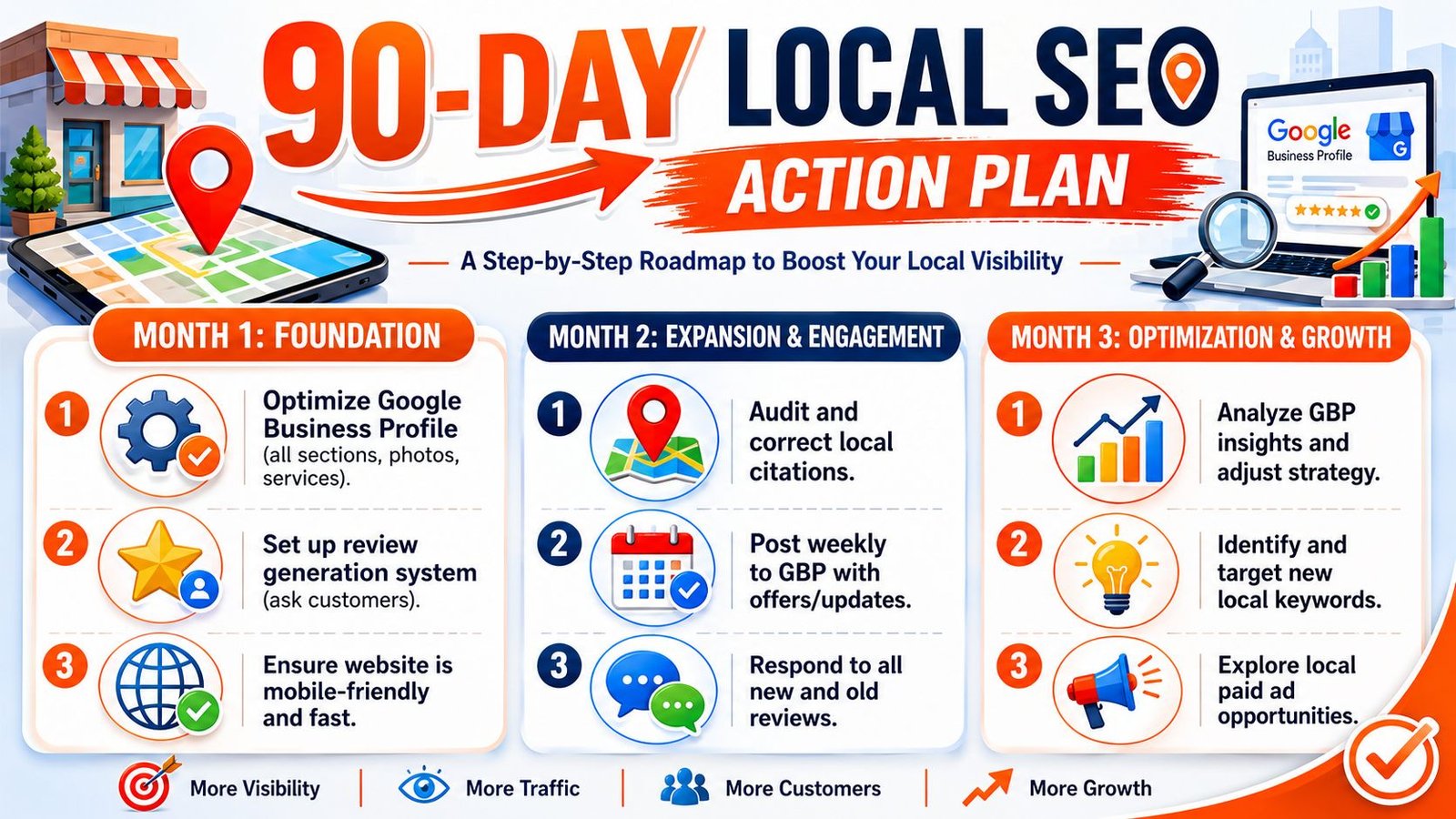
Month 1 foundation and cleanup
Month one is about fixing the leaks that suppress visibility and kill conversions before a customer ever calls.
Start with your Google Business Profile. Finish every field that affects local intent. Categories, services, service areas, hours, photos, attributes, and business description all need to be complete and accurate. Then check your business information across your website and major directories. If your name, address, phone number, or hours conflict, Google gets mixed signals and rankings stall.
Your site also needs to load fast on mobile. A driver searching for "brake repair near me" is not waiting for a bloated homepage to crawl open. Set up a review request process during this same month so every completed job creates another trust signal and another reason to click your listing over the next shop.
Get this month right, and the rest of the campaign starts to compound.
Month 2 page expansion and intent targeting
Month two is where shops either build a lead system or waste money publishing filler.
Create service pages for the jobs that produce revenue, not vanity traffic. Brake repair. Auto AC repair. Check engine diagnostics. Battery replacement. Transmission repair. Pair those pages with the towns or neighborhoods you serve, and write them to match how customers search when they need help now. The goal is not "more traffic." The goal is more calls from people ready to book.
Each page should make the next step obvious. Clear headline. Real local context. Strong call button. Trust elements. FAQs based on actual shop conversations. If a page cannot help a customer decide to call, it is not doing its job.
VIP TECH CONSULTING is one option shops use when they need help managing the moving parts, including local SEO, Google Business Profile work, website support, paid search, and reputation management. That combination matters because these channels affect the same result: whether your phone rings with the right jobs.
A local SEO campaign should create a direct path from search to service request to booked repair.
Month 3 authority and AI readiness
By month three, your base is in place. Now you strengthen the signals that help Google, Maps, and AI-driven search trust your shop for specific repair queries.
According to Local Falcon's guidance on future-proofing local SEO for auto repair shops, shops improve their visibility by tightening schema markup, keeping listings consistent, and building FAQ content that answers customer questions in plain language. That matters because search platforms increasingly pull direct answers from structured, credible pages.
Use this month to:
- Add or refine schema markup on your homepage, location pages, and core service pages
- Expand FAQ sections around repair symptoms, urgency, pricing questions, and service expectations
- Strengthen trust signals through steady review growth, owner responses, and citation accuracy
- Decide which high-value services need paid support to capture demand faster while organic rankings build
This is also the point where many shop owners get honest about the workload. Running an auto shop is one job. Building a predictable search-driven pipeline for high-margin repairs is another.
If you want local SEO to produce real business outcomes, treat these 90 days like an operating system. Fix the foundation. Build pages around profitable intent. Strengthen authority so your shop shows up where urgent customers are already looking.