
If you’re spending money on SEO, Google Ads, or Local SEO in Miami but still getting inconsistent leads, there’s a good chance you’re missing the most useful growth signal in your business. It’s not another dashboard. It’s not more keyword research. It’s customer feedback collection.
Right now, your customers are already telling you why they choose you, why they hesitate, and why they leave. They’re saying it in Google reviews, support messages, contact forms, chats, calls, and short conversations your team never records. If you don’t organize that feedback, you’re making marketing decisions with partial information. That usually leads to weak ad copy, poor conversion pages, and a Google Business Profile that doesn’t reflect what buyers care about.
If you want help building a system that turns customer feedback into stronger Local SEO and better lead generation, the fastest move is to schedule a strategy conversation.
Table of Contents
- Stop Guessing What Customers Want
- Turn Feedback into Your Best Marketing Asset
- Your Blueprint for Customer Feedback Collection
- Asking the Right Questions to Drive Growth
- From Insight to Action How We Get Results
- Your Competitors Aren’t Waiting
Stop Guessing What Customers Want
A lot of business owners are dealing with the same mess. One customer leaves a glowing Google review. Another sends a frustrated email. Your front desk hears one thing. Your sales team hears something else. Then you launch a campaign based on instinct and hope it lands.
That isn’t a marketing strategy. That’s expensive guesswork.

The real problem isn’t lack of feedback
Most companies don’t have a feedback shortage. They have an organization problem.
Common failure points are simple and damaging. Teams ask too many questions, fail to explain why the survey matters, and don’t segment respondents properly. On top of that, customer feedback response rates often fall in the 5% to 30% range, with roughly 50% considered exceptional in many contexts, according to Usersnap’s customer feedback guidance. If your timing is poor and your ask is irrelevant, your signal quality drops fast.
Practical rule: If you’re surveying everyone the same way, you’re not learning anything precise enough to improve lead generation.
Often, many local businesses lose the plot. A law firm in Miami asks every lead the same generic satisfaction questions. A med spa sends review requests at random times. A restaurant waits until a bad review appears publicly before paying attention. The issue isn’t effort. The issue is that nothing is connected.
What this costs your lead flow
When feedback is scattered, three things usually happen:
- Your ad messaging stays vague: You keep describing your service the way you want to describe it, not the way customers talk about it.
- Your Local SEO weakens: Reviews, service pages, and your Google Business Profile stop reinforcing the same themes.
- Your conversion rate suffers: Buyers don’t see their real concerns answered clearly, so they delay, compare, or leave.
That’s why customer feedback collection shouldn’t sit in a customer service silo. It should feed your SEO pages, your PPC campaigns, your review strategy, and your landing page decisions.
If your site already feels disconnected from what customers are saying, start with a smarter structure for feedback in website design. The goal isn’t to collect more noise. It’s to build a system that gives you clearer decisions.
Turn Feedback into Your Best Marketing Asset
Most businesses treat feedback like an internal report. That’s too small. Feedback should shape how you get found and how you convert.
When handled properly, customer feedback collection becomes marketing infrastructure. It sharpens your Google Business Profile, improves review velocity and response quality, gives you stronger ad angles, and helps you write pages that sound like the customer instead of the agency.
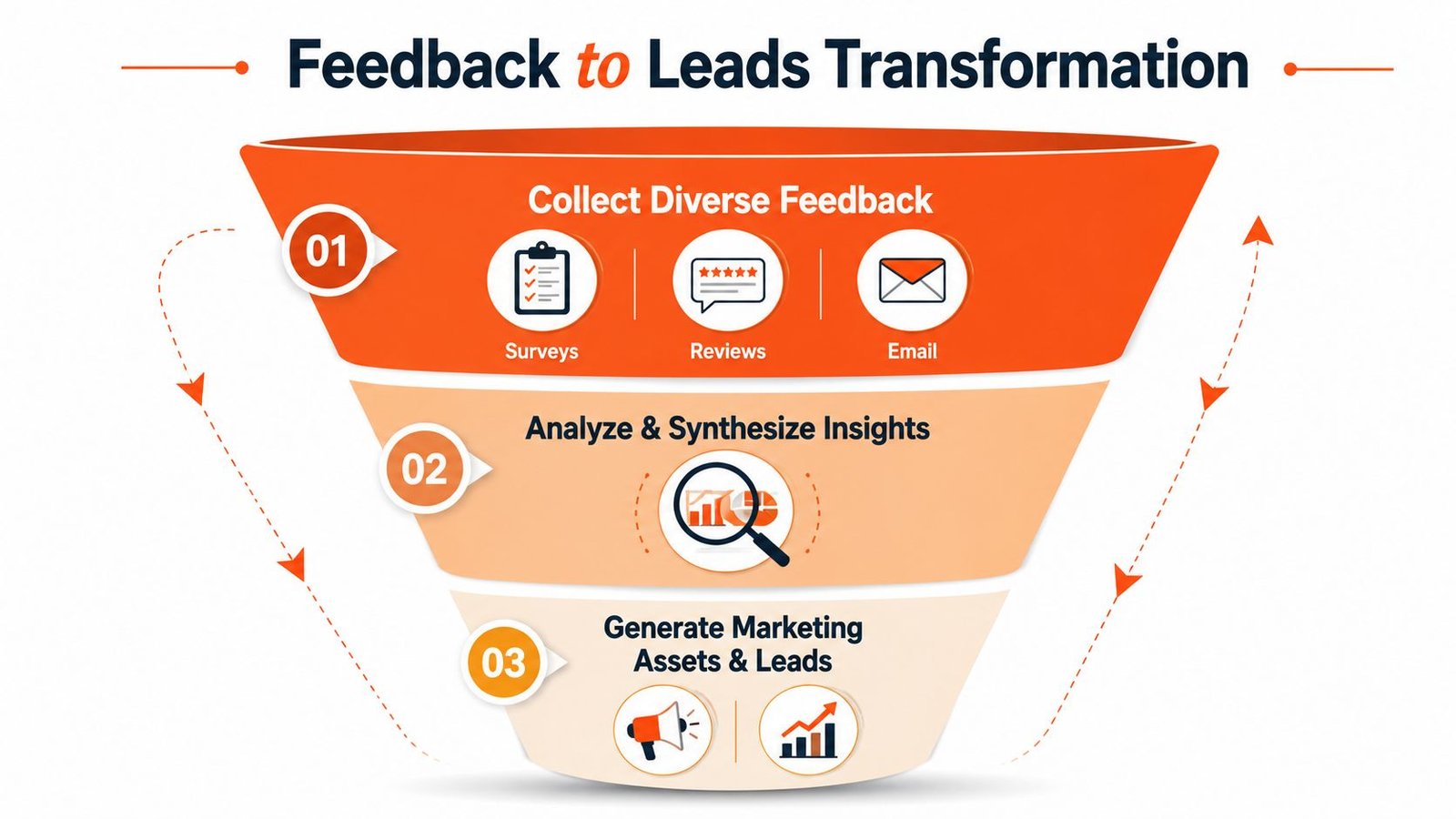
Feedback now affects visibility before the click
Search behavior has changed. People don’t just compare websites anymore. They compare summaries, reviews, map listings, and public sentiment before they ever visit your site.
In the age of AI-assisted search, customer feedback is part of your public conversion layer. Guidance highlighted by Appinio on collecting customer feedback points to the growing importance of social listening and sentiment analysis, because reviews, chats, and community conversations increasingly influence buying decisions before the visit.
That matters even more in local markets like Miami, where buyers often make fast decisions from:
- Google Maps results
- Google Business Profile reviews
- Branded search results
- Social comments
- Third-party review platforms
A business with stronger feedback signals often looks more trustworthy before the sales conversation starts.
For local companies trying to build stronger trust signals, this is closely tied to E-E-A-T in Local SEO for Miami businesses. Reputation, review quality, and consistent public sentiment support authority.
Here’s a useful visual on how that transformation works in practice.
Use customer language to strengthen SEO and ads
Good feedback gives you something more valuable than compliments. It gives you phrasing.
If customers repeatedly say things like “fast response,” “easy booking,” “clear communication,” or “finally someone who answered the phone,” that’s not just CX insight. That’s copywriting material for:
| Asset | How feedback improves it |
|---|---|
| Google Ads | Turns bland headlines into language buyers already use |
| Local landing pages | Adds trust-building phrases tied to actual service expectations |
| Google Business Profile | Reinforces service themes customers mention most often |
| Meta Ads | Helps creative focus on the pain points that trigger action |
Public feedback doesn’t just describe your reputation. It shapes whether the next customer contacts you at all.
This is why serious lead generation work can’t rely on assumptions. If you’re paying for traffic and still guessing at messaging, you’re paying tuition to learn what your customers would have told you for free.
Your Blueprint for Customer Feedback Collection
A working system isn’t complicated, but it does need discipline. Most businesses fail because they collect feedback randomly, ask too much, and never tie it back to a business goal.
The fix is simple. Build customer feedback collection around specific moments in the customer journey and route every signal into one process.
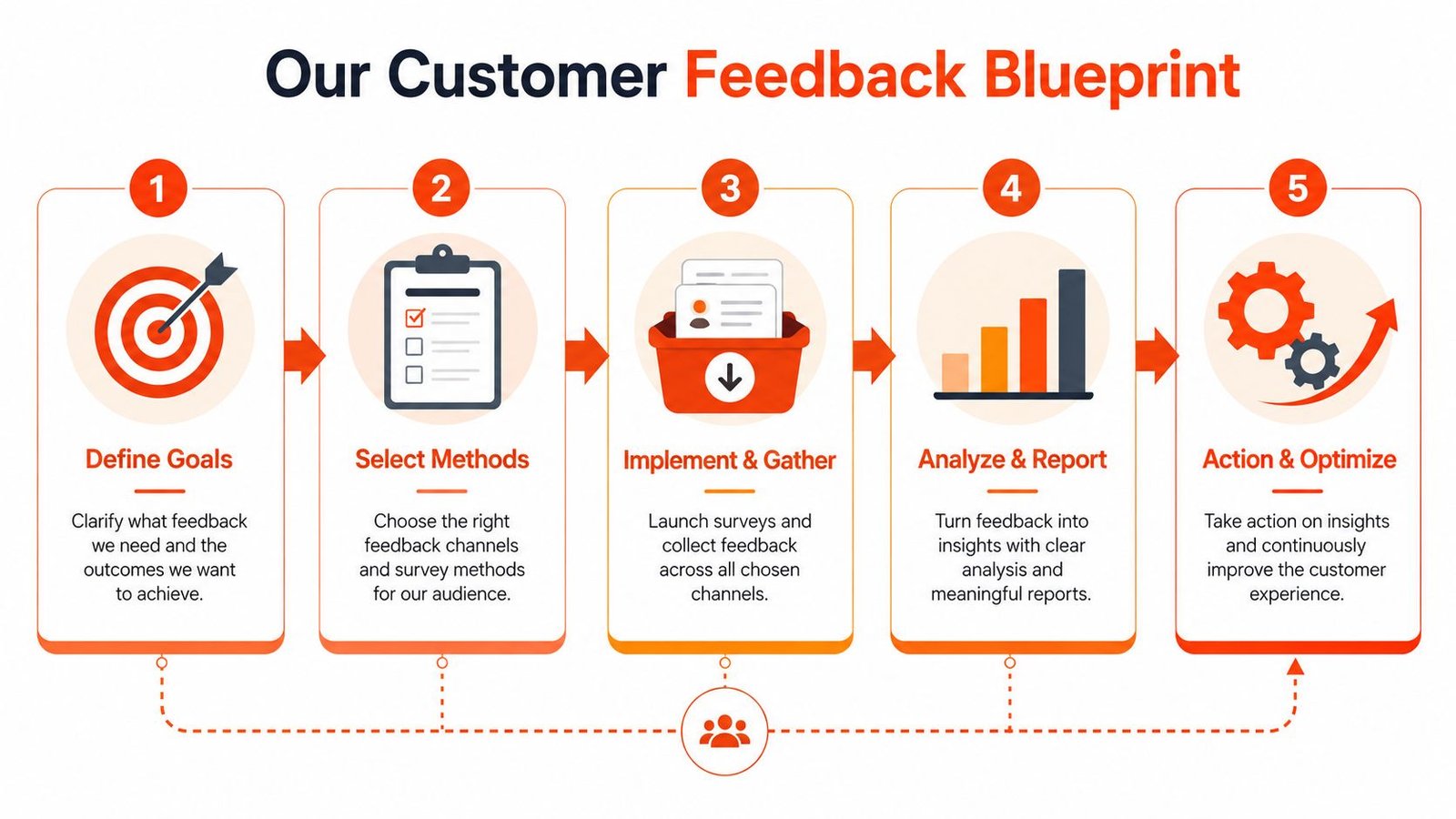
Build around moments not random surveys
Modern feedback programs use multiple channels, not a single survey tool. A 2025 Usersnap report found that customer feedback software was used by 60% of B2B companies and 56% of B2C companies, while interviews reached 55% of B2B, chat hit 50% of B2B, and product review platforms reached 39% of B2C companies, which shows why an integrated approach matters, as summarized in Usersnap’s State of CX report.
For local businesses, that means you shouldn’t rely on one feedback source. You need signals from:
- Post-service SMS requests: Strong for contractors, clinics, and service businesses right after completion.
- Post-purchase email prompts: Better for e-commerce and longer-form follow-up.
- On-site or in-app prompts: Useful when a visitor completes a booking, quote request, or checkout.
- Review requests: Essential for Google Business Profile visibility and trust.
- Support and call notes: Often the fastest way to spot recurring objections.
Collect feedback where the interaction happens. That’s where the signal is strongest and the response is most useful.
If you’re also managing social channels, review sites, and branded mentions, centralization matters for protecting your brand effectively online. Reputation doesn’t break in one place. It fragments across channels.
What a working system includes
This is the structure we recommend for businesses that want better Local SEO and lead quality:
- Automated review request sequences: Triggered by completed service, purchase, or successful support resolution.
- Google Business Profile monitoring: Reviews are tracked, categorized, and answered with a clear brand voice.
- Short touchpoint surveys: Built around actual moments like estimate delivery, appointment completion, or checkout.
- Theme tagging across channels: Reviews, chats, support issues, and form comments are grouped into patterns.
- Monthly messaging updates: Ad copy, landing page language, and FAQ content are adjusted based on what customers keep saying.
- Quarterly insight reviews: Leadership gets a practical read on what buyers value, what frustrates them, and what is hurting conversion.
Some companies use internal teams. Some use lightweight tools. Some use outside support such as CRM workflows, review management software, analytics dashboards, and service partners like VIP TECH CONSULTING, which offers digital marketing and web support services for local and e-commerce businesses.
If your website isn’t designed to capture and convert these insights, that gap will keep showing up in weak inquiry volume. A stronger lead generation website structure gives those feedback signals somewhere useful to go.
Asking the Right Questions to Drive Growth
Most feedback forms fail before the first answer comes in. They’re too long, too broad, and too lazy.
Customers won’t fill out a ten-minute questionnaire just so you can feel organized. If the survey isn’t relevant and easy, they’ll skip it. That’s why a high-quality workflow should be concise and triggered at the right moment. Industry guidance summarized by monday.com’s feedback collection recommendations advises limiting surveys to 3 to 5 questions, including one optional open-ended question, optimizing for mobile, and removing any questions already answered in your CRM.
Keep it short or people ignore it
Ask fewer questions. Ask better ones.
For a local service business, don’t ask for a giant satisfaction survey. Ask about the experience that just happened.
For example:
- After a completed service call: “Was our communication clear before and during your appointment?”
- After a quote request: “What almost stopped you from contacting us today?”
- After a purchase: “What was the main reason you chose us over another option?”
- After support resolution: “Did you get the answer you needed quickly?”
If you’re using text messaging in your follow-up flow, short prompts work especially well. This is one reason many operators look at a guide to maximizing SMS campaign ROI when refining customer communication touchpoints.
Questions that produce usable marketing insight
The best feedback questions do one of two jobs. They uncover friction or reveal buying language.
Try prompts like these:
| Goal | Better question |
|---|---|
| Improve Local SEO messaging | “What problem were you trying to solve when you searched for this service?” |
| Strengthen Google Ads copy | “What made our offer stand out to you?” |
| Fix conversion issues | “What information was missing before you decided?” |
| Improve reviews and reputation | “What part of the experience felt most valuable?” |
A weak question gets you vague praise. A strong question gives you language you can reuse on service pages, review response themes, and ad headlines.
If you’re trying to connect feedback with local visibility improvements, a practical local SEO checklist becomes useful. It helps tie customer sentiment to the pages and profiles buyers see.
If you’d rather stop guessing at forms, timing, and automation, contact a team that can build the workflow correctly and connect it to your lead generation goals.
From Insight to Action How We Get Results
Businesses often ask the wrong question. They ask, “Can I use a survey tool myself?” Of course you can.
The real question is whether you can turn scattered comments into profitable decisions consistently. That’s harder. Collecting responses is cheap. Translating them into SEO changes, review strategy, ad messaging, and conversion improvements is the work that matters.
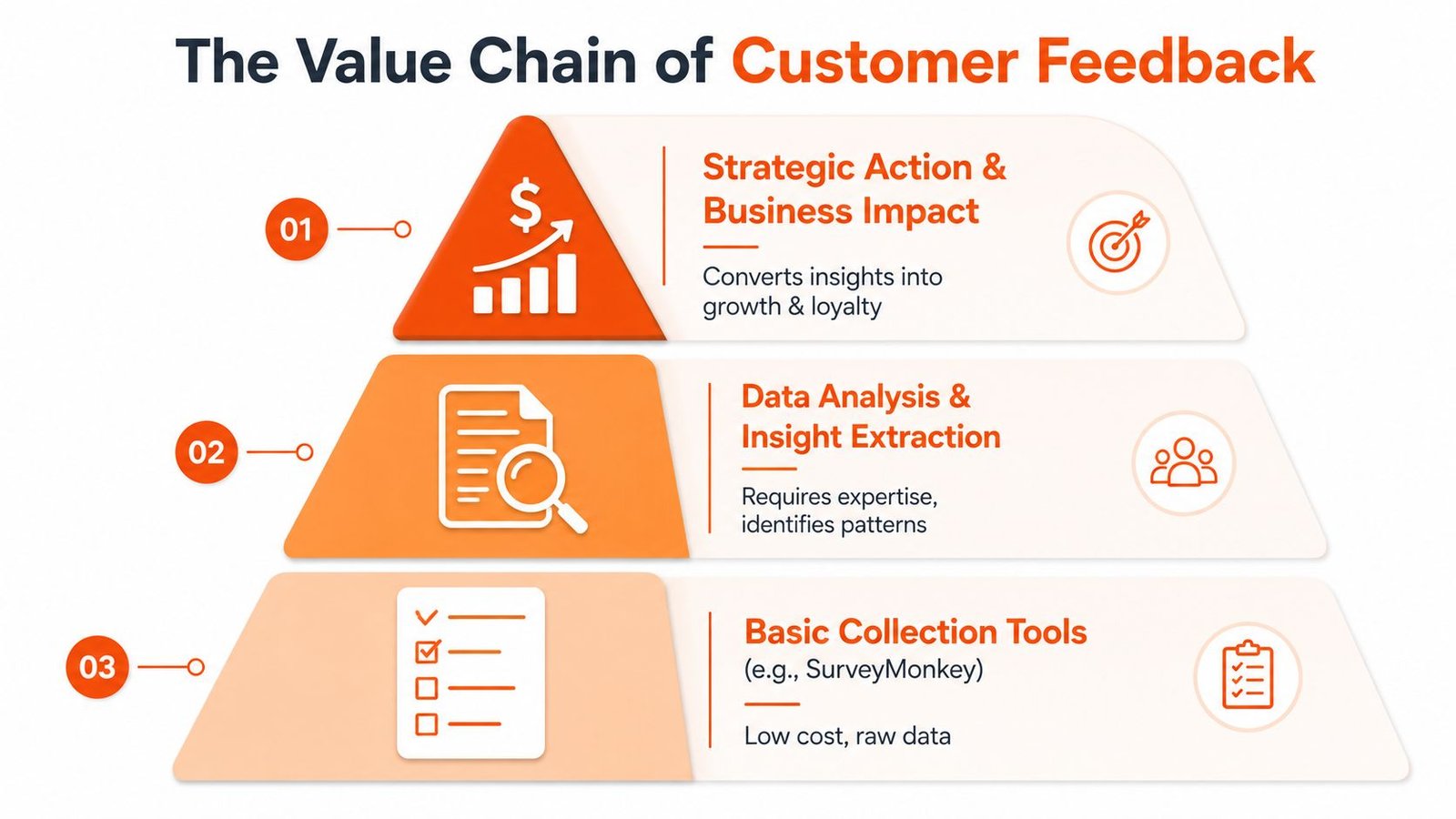
Tools collect data but they don’t create decisions
A structured feedback process matters because action matters. ICAgile’s 2025 guidance emphasizes a feedback-loop model where teams prioritize input, take action, and communicate changes back to customers using signals from surveys, reviews, and product analytics to improve retention and conversion, as explained in ICAgile’s customer feedback analysis guidance.
That means the process has to include more than collection.
A serious workflow should do all of this:
- Centralize inputs: Google reviews, survey responses, support notes, form comments, and chat transcripts belong in one reporting view.
- Identify recurring themes: One complaint is a story. Repeated complaints are a priority.
- Assign ownership: Marketing handles messaging gaps. Operations handles service friction. Support handles follow-up.
- Close the loop: If customers mention a problem repeatedly, the business updates the page, process, or response script and tells customers what changed.
For businesses that also depend heavily on public sentiment across social channels, a resource like ChurchSocial.ai’s guide to social analytics is useful because it reinforces the same principle. Visibility improves when you stop treating feedback as isolated comments and start reading patterns.
How action turns feedback into revenue
Here’s a real-world type of example that matters for local search.
A Miami restaurant keeps getting comments about parking confusion, reservation timing, and unclear entrance directions. None of those issues are “food quality” problems, but they still affect reviews, branded searches, and booking confidence. A smart response isn’t just replying politely. It’s operational.
The business can:
- Add parking guidance to the website.
- Update the Google Business Profile with arrival details.
- Rewrite confirmation messages to reduce uncertainty.
- Answer review themes publicly so future customers see clarity.
The gain doesn’t come from collecting the comment. The gain comes from removing the friction that the comment exposed.
The same principle applies to professional services and local lead generation. If feedback shows that prospects don’t understand your pricing model, your service area, or your response time, those are content and conversion problems. They belong in your marketing stack.
To measure those changes properly, your tracking has to be clean. That’s why many businesses end up tightening their reporting setup with a Google Analytics 4 implementation guide. Better feedback decisions need cleaner attribution.
Your Competitors Aren’t Waiting
If you ignore customer feedback collection, your competitors gain an advantage you handed them. They refine their messaging faster. They improve their reviews faster. They fix friction before you even notice it. Then they show up stronger in Google Maps, stronger in local search, and stronger in the buying conversation.
This is not just a CX exercise. It’s a lead generation system.
In a market like Miami, buyers move fast. They compare options quickly. They look at reviews, search results, and business profiles before they commit. If your business isn’t learning from customer language and acting on it, you’re wasting ad spend and leaving conversion opportunities on the table.
You don’t need more random feedback. You need a system that connects customer insight to Local SEO, Google Ads, reputation management, and website conversion.
The businesses that win don’t ask for more opinions. They build a process that turns feedback into action.
If you want a practical plan for turning reviews, surveys, and customer comments into better Local SEO, stronger ad messaging, and more qualified leads, talk to VIP TECH CONSULTING. Book a strategy session and get a clear path forward before your competitors take more of the market.