
If your Miami business isn’t showing up when someone searches for your service near them, you’re not just missing traffic. You’re losing calls, quote requests, and booked jobs to competitors who look more credible to Google.
That usually isn’t because they offer a better service. It’s because their local SEO sends stronger trust signals. In 2026, that means E-E-A-T in Local SEO: Building Authority for Your Miami Business isn’t a nice extra. It’s the filter Google uses to decide who deserves visibility.
A business owner in North Miami, Brickell, Coral Gables, or Doral can see this every day. Search your service, look at the Map Pack, and you’ll notice the same pattern. The businesses getting the clicks usually have stronger reviews, clearer proof of real work, better local references, and a website that looks like it was built by people who understand the market.
If you’re already comparing agencies or looking for local SEO help, this is the right time to fix it. You can start by reviewing what a focused local SEO strategy for Miami businesses should include, then compare that against what you’re doing now.
Table of Contents
- Your Miami Competitors Are on Google Maps Are You
- The E-E-A-T Playbook That Wins in Miami
- Transform Your Google Business Profile Into a Customer Magnet
- Building Authority with Hyper-Local Website Content
- Off-Page SEO Securing Your Authority Across the Web
- Measuring Local SEO Success Beyond Rankings
- Your E-E-A-T and Local SEO Questions Answered
Your Miami Competitors Are on Google Maps Are You
A lot of Miami business owners are in the same position. They search their main service, see three competitors in the Map Pack, and realize those businesses are getting the calls first.
That’s the cost of weak local authority. Your website can be live, your services can be solid, and your team can do excellent work. If Google doesn’t trust your business enough to feature it locally, buyers never make it far enough to judge your quality.
Why visibility drops even when your site looks fine
Miami is crowded. You’re not competing against one company down the street. You’re competing against established local brands, aggressive lead-gen sites, directories, and businesses that have spent years stacking local trust signals.
A common mistake is assuming basic SEO is enough. It isn’t. Thin city pages, copied service copy, stock photos, and vague claims about being experienced don’t hold up anymore.
The problem got sharper after Google’s updates targeting low-value content. Post-March 2025 Google updates have led to AI-generated content penalties hitting 40% of local websites, and sites lacking genuine human signals can see E-E-A-T scores drop by 25-50%, according to the source cited by Local Dominator’s E-E-A-T for local SEO analysis.
Practical rule: If your local pages could belong to any agency, contractor, law firm, or restaurant in any city, Google has no reason to rank them over a real Miami brand with visible proof.
What Google is trying to identify now
Google isn’t looking for who says they’re trustworthy. It’s looking for who proves it.
For a Miami business, that usually means:
- Real local activity through project photos, neighborhood references, and proof of service in areas like Wynwood, Kendall, Aventura, or Coral Gables
- Business legitimacy through consistent contact information, reviews, and matching details across the web
- Clear expertise through useful service pages, named contributors, and industry-specific content
- Community relevance through local mentions, partnerships, and citations tied to Miami
Businesses that ignore this stay invisible longer than they expect. Businesses that fix it give Google what it needs to rank them and give buyers what they need to trust them.
If you’re already seeing competitors take the Map Pack while your business sits below them, the issue usually isn’t effort. It’s execution.
The E-E-A-T Playbook That Wins in Miami
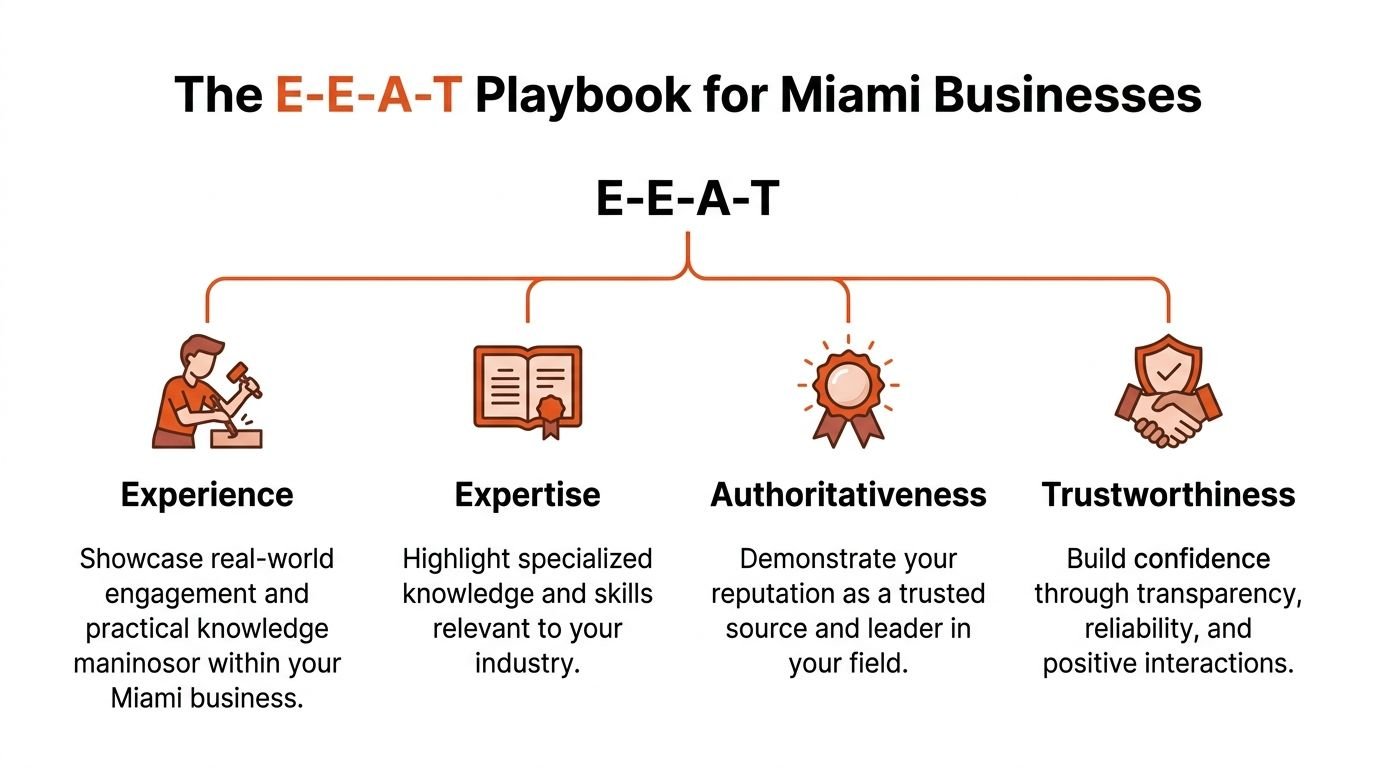
E-E-A-T sounds abstract until you connect it to leads. Then it becomes practical fast.
In local SEO, Experience, Expertise, Authoritativeness, and Trustworthiness are how Google decides whether your business looks real, credible, and locally relevant. Businesses that implement effective E-E-A-T strategies in local SEO achieve an average 40% increase in local search visibility within six months, according to research cited in Jasmine Directory’s analysis of E-E-A-T for local SEO.
Experience has to be visible
Experience isn’t a slogan. It’s evidence.
If you’re a Miami service business, Google and your prospects both want to see actual work. That can mean before-and-after photos, project timelines, neighborhood-specific examples, or case studies tied to real services.
A restaurant marketing page works better when it shows actual campaign assets, reservation growth strategy, location context, and real photos from a Miami hospitality client. A law firm page works better when it references real practice areas, actual attorney profiles, and local office details.
What doesn’t work:
- Stock-heavy pages with no local proof
- Generic city swaps where “Miami” is dropped into the same template used for ten other markets
- Case study pages that say a business helped clients but show no substance
A useful way to pressure-test your content is to compare it against examples outside your industry that still win on specificity. For instance, if you want to see how focused pages reveal opportunity, you can discover SEO opportunities with NameSnag and study how concrete business details create stronger local relevance.
Expertise must be attached to real people
Expertise is often where many local businesses fall short. Their website speaks in a polished brand voice, but no one can tell who wrote anything, who knows the subject, or why the business should be trusted.
That weakens both rankings and conversion.
Your site should show:
- Named contributors on articles and resources
- Professional credentials where relevant
- Service-specific knowledge that reflects actual work, not recycled blog copy
- A clear editorial process for advice, guides, and landing pages
For businesses building content consistently, a structured process matters. A documented content marketing strategy for local growth helps turn service expertise into pages that can rank and convert.
Authority comes from local recognition
Authority is what other sources say about your business.
In Miami, that can come from citations in the Miami-Dade Chamber of Commerce, mentions in local media, listings in respected directories, and references from organizations people in your market know. A citation on a random low-quality directory won’t carry the same weight as a legitimate local or industry mention.
Authority also comes from consistency. Your business details, services, and market positioning need to match across your website, Google Business Profile, and off-site listings.
A business can’t look established in Google Maps if its web footprint looks fragmented everywhere else.
Trust is what converts the click
Trust is the final screen. You can earn an impression and still lose the lead if your presence feels off.
Trust usually breaks when businesses have weak reviews, outdated location details, thin contact pages, or websites that feel anonymous. It grows when buyers find a professional site, current information, clear proof of service, and reviews that sound like real customer experiences.
Execution, rather than theory, is paramount. Some teams handle parts of it internally. Others use an outside partner to manage the moving pieces. For example, VIP TECH CONSULTING provides local SEO, Google Business Profile optimization, reputation management, content, and technical implementation for Miami businesses that need all of those signals aligned on one system.
Transform Your Google Business Profile Into a Customer Magnet
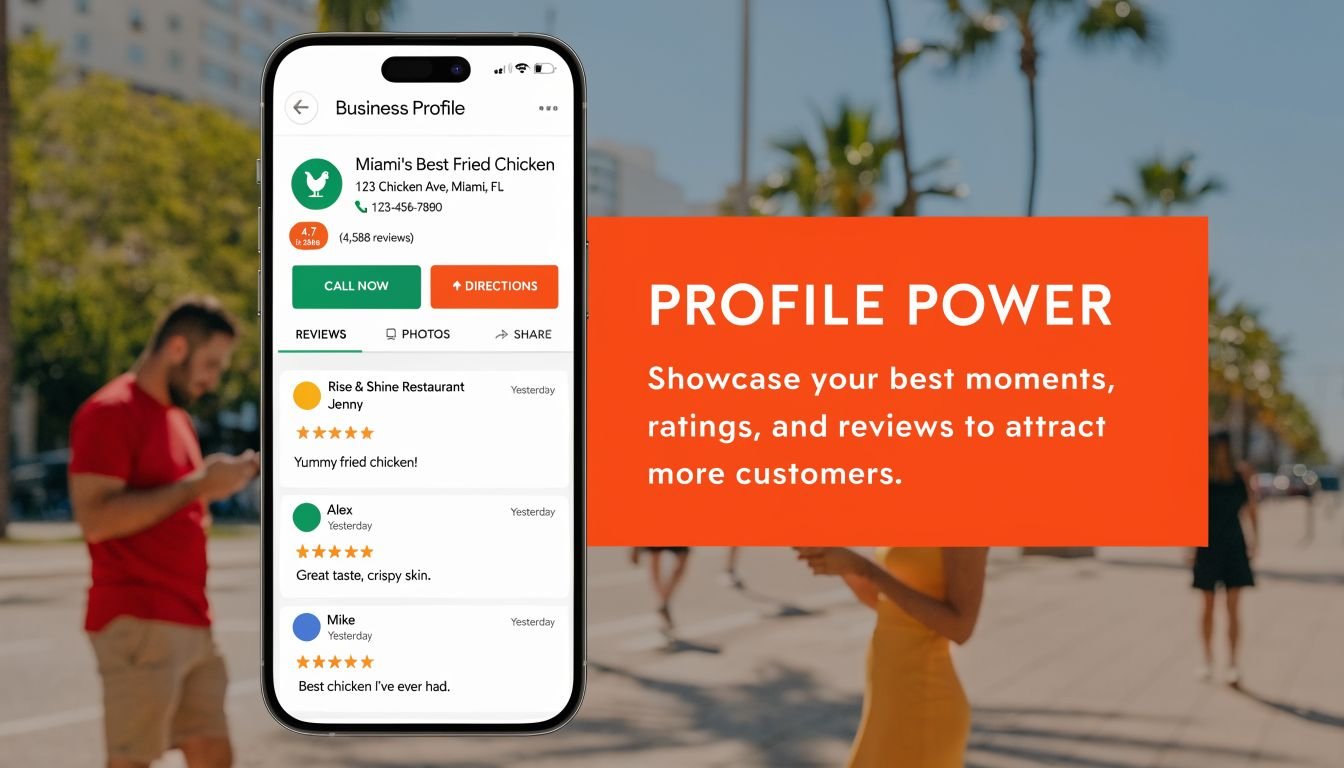
Your Google Business Profile is often the first sales page a local prospect sees. Not your homepage. Not your About page. Your profile.
That means a weak listing doesn’t just hurt visibility. It lowers confidence before the click even happens.
A complete profile is only the starting point
Most business owners fill out the basics and stop. That’s why their listing looks flat next to stronger competitors.
A properly optimized Google Business Profile should include more than business hours and a phone number. It should support trust, relevance, and action.
That usually includes:
- Correct primary and secondary categories that match the service offering
- Accurate service descriptions written for humans, not stuffed with keywords
- Updated hours and service areas that reflect current operations
- A review-ready setup so customers can leave feedback without friction
- Service and product sections that help qualify clicks before someone calls
For restaurants and hospitality brands, visuals matter even more. If you want a practical benchmark for image presentation and listing quality, this guide to better restaurant Google listings is useful because it shows how presentation affects first impressions at the profile level.
Reviews, photos, and Q and A do the heavy lifting
The strongest profiles don’t look managed. They look active.
That means fresh photos, detailed reviews, clear answers, and proof that the business is operating now, not just sitting online. Businesses with 4.9-star ratings and over 150 detailed Google reviews are cited in the verified data as showing stronger user engagement and conversion signals in local SEO contexts, within the broader E-E-A-T framework covered earlier.
What matters most inside the profile:
- Detailed reviews that mention the service, location, or outcome
- Real photos of jobs, teams, storefronts, service vehicles, menus, interiors, or completed projects
- Owner responses that sound thoughtful and specific
- A built-out Q and A section that answers the real objections customers have before contacting you
Good Q and A entries often cover issues like:
| Question type | Why it matters |
|---|---|
| Service area questions | Helps buyers know whether you serve their neighborhood |
| Pricing and quote questions | Filters out low-intent clicks and improves call quality |
| Booking and response expectations | Reduces hesitation |
| Specialty service questions | Captures high-intent searchers comparing providers |
What works: answer questions a serious buyer asks before calling.
What fails: treating GBP like a directory listing instead of a conversion asset.
A full local strategy should connect your profile to your site, reviews, and local landing pages. That’s why businesses looking for sustained lead flow usually move beyond one-time setup and into ongoing local SEO services for small businesses.
Later in the process, video can help teams standardize review requests, posting habits, and profile maintenance. This walkthrough is a good reference point for how listing optimization fits into local visibility:
Posts and service details keep the profile active
Google Posts won’t save a weak profile, but they help a strong one stay current.
For Miami businesses, good post topics include:
- Recent completed work in a named neighborhood
- Seasonal offers tied to local demand
- New service launches with a clear call to action
- Event participation or community involvement
- Short trust-building updates that show the business is active and responsive
The important part is substance. A real project update from Brickell or North Miami Beach says more than a generic promotional graphic with no context.
Profiles that perform well usually aren’t lucky. Someone is maintaining them with intent.
Building Authority with Hyper-Local Website Content
Your website should do one thing clearly. It should prove that you’re the right business for the right customer in the right Miami-area location.
Many local sites fail because they try to rank one generic service page for an entire metro area. That leaves Google with weak local relevance and leaves buyers with weak reasons to trust the business.
Generic service pages don’t win in Miami
A page titled “SEO Services” can help. A page built around “Local SEO Services in Miami” with neighborhood context, proof, FAQs, and relevant internal links does much more.
The same logic applies across industries:
- “Personal injury lawyer” is broad
- “Personal injury lawyer in Brickell” is local
- “AC repair” is broad
- “AC repair in Coral Gables” gives Google and the visitor far more context
The page has to earn that specificity. It should include local references, service details, buyer objections, and proof that the business operates there.
A good mental model is to study location-aware service pages in unrelated but competitive home-service categories. This guide for modern yard transformation is useful because it shows how service intent and place-based relevance can live on the same page without sounding forced.
Author pages and schema separate experts from anonymous sites
Technical implementation starts to matter.
Industry data shows that pages with author credibility markup such as Schema.org Person data rank 23-35% higher for competitive local service keywords, and 64% of Miami service agencies omit this signal, according to Dean Romero’s analysis of E-E-A-T SEO practices.
That matters because many local websites still publish content with no visible author, no credentials, and no structured person data. To Google, that can look anonymous. To a buyer, it often feels generic.
A stronger setup includes:
- Dedicated author pages for key specialists
- Visible bylines on articles and guides
- Schema.org Person markup tied to author profiles
- Professional credentials and experience summaries
- Internal links between authors, service pages, and supporting resources
This is also where content and technical SEO meet. Businesses trying to increase non-paid visibility often need both better page strategy and stronger site structure. A focused plan to increase organic traffic with SEO improvements usually starts there.
Local proof beats polished copy
High-authority local pages don’t read like ad copy. They read like they came from a business that works in the market.
That means including elements like:
- Neighborhood-specific case examples
- Testimonials tied to real service categories
- Clear service radius language
- FAQs about local logistics, timelines, or expectations
- Photos that match the market and service
The fastest way to weaken E-E-A-T is to hide behind polished language when proof should be doing the work.
A Miami page shouldn’t sound like it was written for Orlando, Dallas, and Phoenix at the same time. The more local the buying decision, the more local the proof needs to be.
Off-Page SEO Securing Your Authority Across the Web
A business doesn’t become authoritative because its website says so. Authority grows when the rest of the web confirms the same story.
That’s why off-page SEO still matters. Not the spam version. The authentic version built on accurate citations, local references, reviews, and credible mentions.

NAP consistency is still a ranking problem
If your business name, address, or phone number changes from platform to platform, Google gets mixed signals.
This is more common than most owners realize. 73% of local businesses have Name, Address, and Phone inconsistencies across key platforms, and those errors can reduce Map Pack rankings while lowering click-through rates by an estimated 25-40% in competitive markets, according to Acceseo’s review of E-E-A-T and NAP consistency.
That means every variation matters:
- Suite numbers
- Abbreviations
- Old tracking phone numbers
- Different business naming formats
- Outdated directory listings
A serious cleanup usually covers your website footer, contact page, Google Business Profile, Apple Maps, Yelp, chamber listings, and industry directories.
The right citations matter more than volume
A hundred weak listings won’t offset a messy local footprint.
For Miami businesses, stronger citations often come from places like local chambers, respected business directories, niche industry platforms, and local media references. Relevance matters. Editorial quality matters. Local association matters.
A practical off-page stack often includes:
| Signal | What it should do |
|---|---|
| Local chamber listings | Confirm market presence |
| Industry directories | Reinforce category relevance |
| Media mentions | Build brand authority |
| Trusted map and business platforms | Strengthen local entity consistency |
This is also why reputation management belongs inside local SEO, not outside it. Reviews, responses, and branded search perception all reinforce trust. Businesses trying to fix that layer usually need a formal online reputation management process, not occasional review replies.
Local links should come from real relationships
The strongest local links rarely come from link schemes. They come from business activity.
For Miami companies, that may include:
- Sponsoring a neighborhood event
- Joining a chamber or business association
- Being featured by local publications
- Partnering with complementary local businesses
- Supporting a school, nonprofit, or community initiative
Those links tend to hold up because they reflect actual relationships. They also produce the kind of local brand signals that generic backlink campaigns miss.
If an agency can’t explain where your local links will realistically come from in Miami, they probably don’t have a local authority strategy. They have a checklist.
Measuring Local SEO Success Beyond Rankings
Rankings matter, but rankings alone don’t pay for marketing.
A business owner doesn’t need a report that says a keyword moved up if the phone didn’t ring, the forms didn’t come in, and the leads didn’t improve. The point of local SEO is business growth.
What to track instead of vanity metrics
The most useful reporting ties visibility to action.
For local campaigns, that usually means watching:
- Calls from Google Business Profile
- Direction requests and profile interactions
- Form submissions from local service pages
- Traffic to high-intent location pages
- Lead quality by service and area
- Review sentiment and review velocity
- Map Pack appearances for core terms
Those metrics tell you whether authority is turning into buyer behavior.
A Miami law firm may care most about consultation form submissions from location pages. A restaurant may care more about calls, reservations, and branded search actions. A home service company may care about quote requests from service-area pages and Google Business Profile calls.
Reporting should support decisions
Good reporting doesn’t drown you in dashboards. It helps you decide what to do next.
If a service page gets impressions but low conversions, the issue may be trust or offer clarity. If your profile gets views but weak engagement, the listing may need better photos, stronger reviews, or tighter categories. If one neighborhood page converts and another doesn’t, you may need sharper local proof on the weaker page.
A serious local SEO campaign should answer one question every month. Which actions created more qualified leads, and what should we improve next?
That’s the difference between activity and management. One produces reports. The other produces direction.
If an agency can’t connect local SEO work to calls, forms, booked consultations, or revenue opportunities, you’re not buying strategy. You’re buying motion.
Your E-E-A-T and Local SEO Questions Answered
Can I do this myself
You can handle parts of it yourself. Many business owners can update a Google Business Profile, request reviews, or clean up some page copy.
The issue is depth and consistency. E-E-A-T in local SEO isn’t one task. It’s content quality, technical structure, citation control, review strategy, on-page proof, and off-page authority working together. Most owners don’t have time to manage that while running the business.
DIY usually leads to partial fixes. Partial fixes rarely win in Miami.
How long does local SEO take
Foundational traction usually takes time. If you’re rebuilding authority, cleaning citations, improving site content, upgrading your Google Business Profile, and earning stronger local signals, results build over months, not days.
That’s also why choosing the wrong provider costs more than waiting. Bad local SEO delays momentum, creates cleanup work, and wastes the period when your competitors keep strengthening their positions.
Is this worth it for a small business
If local search matters to your sales process, yes.
When buyers search “near me,” compare profiles, read reviews, and visit websites before calling, authority directly affects who gets contacted. In a market like Miami, being absent from local search doesn’t make you invisible to everyone. It makes you invisible to the people ready to buy now.
The better question isn’t whether E-E-A-T is worth the investment. It’s how much business you’re comfortable leaving to competitors while your local authority stays weak.
If you’re ready to turn your visibility into calls, leads, and booked consultations, contact VIP TECH CONSULTING for a strategy conversation. If your business serves Miami and you need stronger Google Maps presence, sharper local authority, and a cleaner path from search to inquiry, now is the right time to fix it.