
local seo for home services is the difference between getting the call and watching a bigger, louder competitor take it.
If you run a plumbing, HVAC, electrical, roofing, or garage door business, you already know how this plays out. A homeowner has a problem. They grab their phone. They search “emergency plumber near me” or “ac repair in Miami Beach.” Then they call one of the few companies Google puts in front of them.
If your business isn’t visible in that moment, your trucks can be excellent, your techs can be reliable, and your service can be better than everyone else’s. None of that matters if Google can’t connect you to the search.
That’s why local seo for home services has to be treated like an operating system, not a side task. You need your Google Business Profile dialed in, your service area pages built properly, your reviews flowing, your citations cleaned up, and your paid local ads supporting the gaps. That’s how smaller firms in Miami and nearby markets can beat larger brands that rely on budget instead of precision. See how we approach local SEO in Miami.
Understanding Local Search Challenges
Most home-service companies don’t have a lead problem. They have a local visibility problem.
The issue usually starts with a bad assumption. Owners think a basic website and a claimed Google listing are enough. They aren’t. In 2025, 81% of consumers turn to Google to find local service businesses, especially in categories like plumbing, HVAC, and electrical work, according to Black Tie Marketing Group.
That means Google is your storefront long before a customer sees your truck.
Why home-service companies lose local leads
I’ve seen the same pattern across local markets. A company serves multiple neighborhoods, but the website only has a homepage and a generic services page. Their Google Business Profile has old photos, incomplete categories, and no process for getting reviews. Their business information also varies across directories.
Then they wonder why they’re invisible for searches that should belong to them.
Common failure points look like this:
- Weak local relevance: Your site says “we serve South Florida,” but the searcher wants “drain cleaning in Aventura.”
- Thin trust signals: Few reviews, slow review responses, and incomplete profile details tell Google you’re not the obvious choice.
- No neighborhood targeting: You serve Coral Gables, Kendall, North Miami, and Miami Beach, but your site gives Google no distinct page for any of them.
- No paid support: Organic rankings take work. If you’re not using local ad coverage where needed, competitors can crowd you out.
Local search rewards businesses that remove friction. Clear service areas, strong reviews, complete profiles, and direct calls to action beat vague branding every time.
What winning looks like
A strong local presence does three things at once:
| Area | What Google sees | What the customer sees |
|---|---|---|
| Google Business Profile | Relevance and trust | Ratings, photos, hours, service info |
| Location pages | Geographic coverage | “Yes, they serve my area” |
| Conversion setup | Usability signals | Fast contact, easy quote request, tap-to-call |
If you want local seo for home services to produce booked jobs, stop thinking in terms of rankings alone. Think in terms of visibility plus trust plus conversion.
The companies that win local search aren’t always the largest. They’re the ones that make it easy for Google to understand where they work, what they do, and why customers choose them.
Optimizing Google Business Profile
Your Google Business Profile is the center of your local presence. If it’s sloppy, the rest of your strategy struggles.
For home services, that profile influences discovery, map visibility, review perception, calls, and direction requests. According to The Home Care University, Google Business Profile optimization drives 70% of local SEO visibility for home services; companies that automate review requests and respond within 24 hours often see a 0.5-star rating boost and 200% local ranking gains.
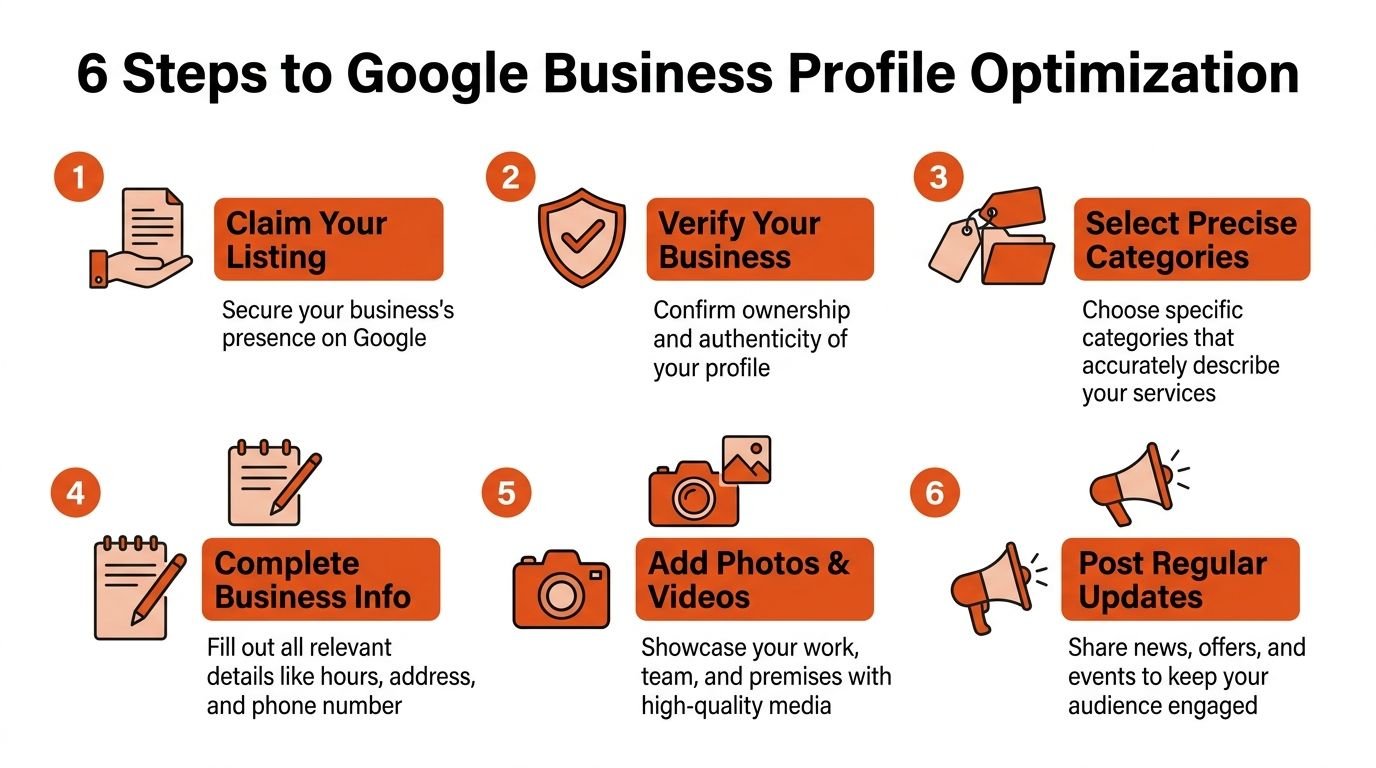
Start with the visual roadmap below.
Get the fundamentals right first
Claim and verify the listing. Then make sure your business name, address, and phone number match your website exactly.
Don’t improvise your categories. Pick the most precise primary category for your main service, then add relevant secondary categories for adjacent offerings. A plumber that also handles emergency work, water heater installs, and drain cleaning shouldn’t leave those signals vague.
Then complete every field that matters:
- Business hours: Include holiday updates when needed.
- Service areas: List the cities or radius you cover.
- Business description: Write it for clarity, not fluff.
- Services and products: Add detailed service entries where applicable.
- Photos: Show trucks, staff, jobs, and branded work in the field.
If you need a practical reference on profile optimization workflows, this guide on Google My Business optimization for local visibility is useful even outside the restaurant category because the profile principles are the same.
Reviews are not optional
A lot of owners still treat reviews like a nice bonus. That’s a mistake.
Your review pipeline should be operational, not occasional. Ask after completed jobs. Send the request while the experience is still fresh. Make the review link easy to use from a phone.
Then respond to every review. Quickly.
A good response does more than thank the customer. It reinforces service quality, location relevance, and professionalism. It also sends a signal that the business is active.
Practical rule: If a customer was happy enough to thank your technician in person, they’re often willing to leave a review if you ask the same day.
Post updates and answer questions before prospects ask them
Most profiles sit untouched for months. That tells Google and prospects the business is asleep.
Use posts to highlight:
- Seasonal services: AC tune-ups before heat waves, drain checks before storm season.
- Offers or promos: Keep them simple and service-driven.
- Recent jobs: Before-and-after context works well.
- Availability cues: Emergency service, weekend scheduling, or same-day response.
Pre-fill the Q&A section with common questions. Customers want to know whether you serve their area, offer emergency support, or provide specific repair types.
A short walkthrough can help your team understand what a healthy profile should include:
What I’d fix this week if your GBP is underperforming
If your profile isn’t generating enough calls, do these first:
- Audit NAP consistency across your site and major directories.
- Replace weak photos with real jobsite and team images.
- Tighten categories so Google understands your core service.
- Launch a review request system by text or email after every completed job.
- Answer every review and Q&A entry without delay.
This is the part of local seo for home services where small details create outsized gains. Most competitors don’t lose because they lack a profile. They lose because they leave it unfinished.
Creating Service Area and Location Pages
A generic homepage won’t rank well across every city and neighborhood you serve. Google needs page-level evidence.
If you want calls from Miami Beach, Coral Gables, North Miami, Kendall, Aventura, or Fort Lauderdale, build pages that speak directly to those places. That’s how local seo for home services expands beyond one central listing.

According to 1SEO, hyper-local location pages outperform generic service pages by 3x in click-through rates for “near me” queries; businesses using this approach see a 60% increase in calls within six months.
What a good location page includes
A real location page is not a city name swapped into copied text.
It needs unique local context. If you serve Miami Beach, mention the area naturally. If you work in Coral Gables, reflect the service realities of that market. Add useful details that show your team works there.
Each page should include:
- A clear H1: “Emergency Plumber in Coral Gables” is stronger than “Service Area.”
- Service-specific copy: Explain the jobs you handle in that area.
- Local references: Neighborhoods, landmarks, or known service zones.
- Consistent contact info: Keep your core business information easy to find.
- Strong CTA placement: Quote request forms and phone prompts belong above the fold and again lower on the page.
Avoid duplicate city pages
Many companies sabotage themselves with this approach.
They build ten pages with the same paragraphs and swap only the city name. That doesn’t create local relevance. It creates thin, repetitive content that won’t hold up.
Use this test. If you removed the city name from the page, would the content still feel identical to the others? If yes, rewrite it.
A better structure looks like this:
| Page element | Bad version | Better version |
|---|---|---|
| Intro copy | Generic company summary | Service problem tied to that city |
| Proof | Reused testimonials | Testimonials mentioning that area |
| FAQ | Same questions everywhere | Questions based on local demand |
| CTA | “Contact us today” | “Book service in Miami Beach” |
Smaller service companies can beat larger brands in local search by being more specific. Broad coverage pages look impressive to owners. Specific pages win calls.
Build pages around actual service geography
Don’t create pages for places you barely serve. Build around the areas your team can reliably cover and where you want more jobs.
A practical rollout might look like this:
- Core city pages: Major municipalities you serve consistently
- Neighborhood pages: Smaller zones with meaningful demand
- High-intent combinations: Emergency, repair, install, maintenance paired with place names
This works even better when your paid campaigns mirror the same geographic structure. If you’re running geo-targeted campaigns, this guide on Google Ads location targeting is a useful companion to your organic location page strategy.
The point is simple. One generic site can’t own every micro-market. A page network can.
Enhancing Service Pages with On-Page SEO and Schema
Location pages help you rank by geography. Service pages help you rank by intent.
If someone searches “water heater repair,” “ductless AC installation,” or “electrical panel upgrade,” Google needs a page that focuses on that exact job. Your homepage should not carry that burden.
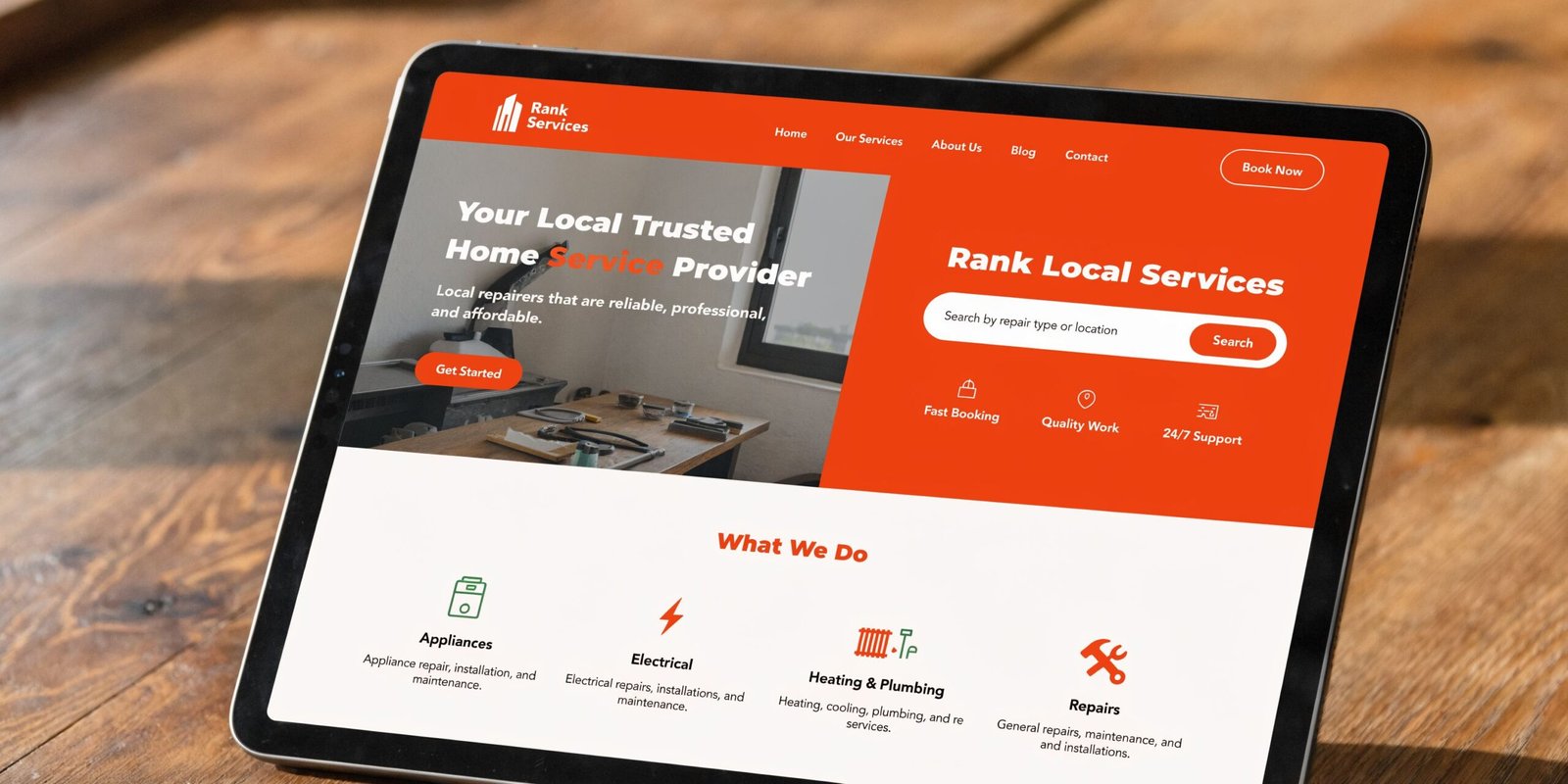
Write pages for search intent, not for your brochure
A service page should answer four questions fast:
- What do you do?
- Where do you do it?
- Why should the visitor trust you?
- How do they contact you right now?
That means each page needs a clean title, a useful meta description, a strong H1, scannable subheads, and internal links to related services and locations. If your metadata is weak, fix that first. This guide on writing meta descriptions for SEO covers the basics clearly.
Use real service language. “Tankless water heater installation in Miami” is better than “advanced residential plumbing solutions.”
What to optimize on every core service page
Here’s the checklist I use when reviewing home-service sites:
- Title tag: Include the service and local modifier naturally.
- Meta description: Make it specific and action-oriented.
- Header structure: Keep one H1, then use H2s and H3s to organize details.
- Body copy: Address symptoms, process, service areas, and next steps.
- Internal links: Point to supporting location pages and adjacent services.
- Images: Use real project photos with descriptive alt text.
- CTA placement: Put calls, forms, and quote prompts where mobile users can reach them quickly.
One often-missed upgrade is better phone conversion. If your business relies on calls, adding click-to-call functionality can reduce friction for mobile visitors who want help immediately.
Schema helps Google understand the page
Structured data doesn’t replace content, but it sharpens Google’s understanding of what your page represents.
For home-service businesses, the most useful schema types are usually:
- LocalBusiness
- Service
- FAQPage when the content supports it
- Review where appropriate and implemented correctly
Schema should reflect real business details. Use it to clarify your business type, service area, contact data, and offered services. If a page is about AC repair, the schema shouldn’t be vague. If a page targets a local market, your business details should align with the rest of your web presence.
A simple service-page framework that works
Use this page flow:
| Section | Purpose |
|---|---|
| Hero section | State the service and area clearly |
| Problem overview | Match what the customer is dealing with |
| Service details | Explain what you handle and how |
| Proof elements | Reviews, trust cues, recent jobs |
| FAQ block | Remove hesitation before contact |
| Final CTA | Push to call or request service |
If a homeowner lands on your service page and has to hunt for the phone number, the page is underperforming.
Where most pages fail
They fail because they sound corporate, thin, or interchangeable.
I’d rather see a simple page with clear service language, a visible phone button, strong internal links, and properly implemented schema than a flashy page full of vague claims. Search engines reward clarity. Customers do too.
If your service pages aren’t producing calls, stop adding filler. Tighten the page around intent, geography, trust, and action.
Building Authority with Citations Reviews Links and Paid Ads
Rankings don’t hold without authority.
Google wants confirmation that your business is real, trusted, and active in the market you claim to serve. For local seo for home services, that authority comes from four places working together: citations, reviews, local links, and paid local amplification.
Too many companies treat these as separate tactics. They’re not. They reinforce each other.
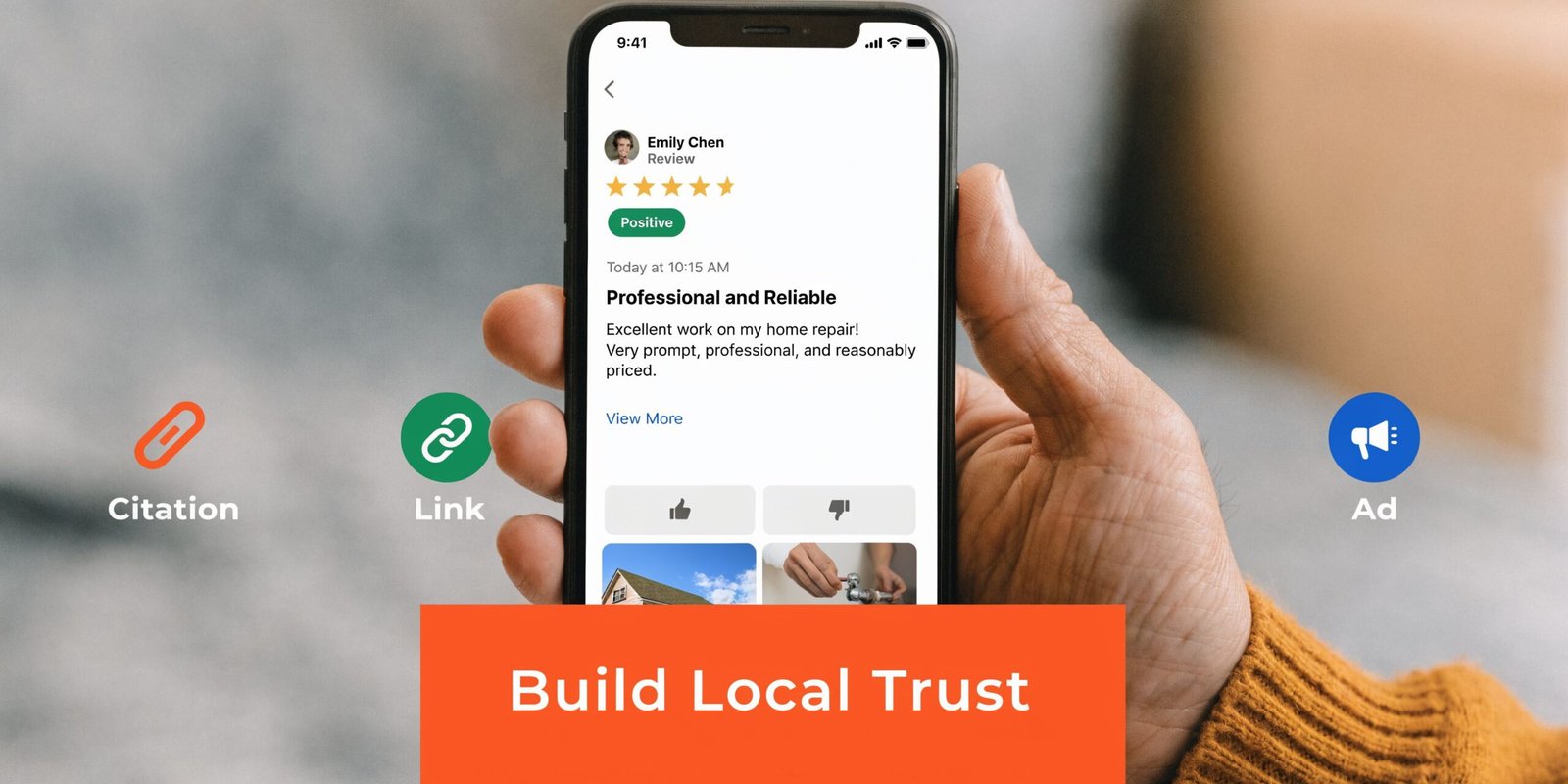
According to BrightLocal, local searches for home services lead to visits within 24 hours for the majority of users, with 83% of consumers using Google specifically for local business reviews, which is exactly why reputation management belongs at the center of your local strategy.
Citations are basic trust infrastructure
Citations are mentions of your business details across directories and local platforms.
This isn’t glamorous work, but it matters. If your business name, address, or phone number changes from one listing to another, Google gets conflicting information. So do customers.
Focus on accuracy first. Then expand coverage.
Your citation priorities should be:
- Primary platforms: Google, Yelp, Angi, and major business listings relevant to home services
- Local directories: Chamber listings, city business indexes, neighborhood guides
- Industry mentions: Trade associations or service directories that fit your category
- Cleanup work: Remove duplicates and outdated listings
If your team can’t stay on top of leads and follow-ups while fixing reputation and citation issues, a lightweight crm can help organize incoming inquiries without adding unnecessary complexity.
Reviews influence both ranking and conversion
Reviews do two jobs at once. They help Google assess trust, and they help homeowners decide whether to call you.
The mistake I see most often is randomness. A business gets a burst of reviews, then nothing for weeks. That pattern doesn’t build momentum. You need a steady system.
A better review process looks like this:
- Technician completes the job.
- Customer gets a simple review request shortly after.
- Team monitors new reviews daily.
- Every review gets a professional response.
- Issues get routed internally before they turn into public damage.
If your reputation process is weak, your rankings and conversion rate both suffer. For businesses that need a clearer framework, this resource on online reputation management for local businesses is worth reviewing.
Reviews are not just proof for prospects. They’re also recurring trust signals that support your entire local presence.
Local links should be relevant, not random
Forget spammy link building.
For home-service businesses, the strongest links usually come from local relationships and real-world involvement. A sponsorship, a community event listing, a neighborhood publication mention, or a local business association profile carries more local meaning than a pile of irrelevant backlinks.
Good local link opportunities often come from:
- Community sponsorships: Youth sports, neighborhood events, local nonprofits
- Business associations: Chambers, trade groups, regional directories
- Local PR: Coverage tied to seasonal service advice or community involvement
- Partnerships: Property managers, real estate offices, or local vendors
In Miami, this matters even more because neighborhoods behave like separate markets. A company that shows up in local conversations around North Miami, Miami Beach, and Coral Gables builds stronger geographic trust than one trying to rank with generic citywide messaging.
Paid ads help smaller firms close the gap faster
Many owners get stuck in old thinking with this assumption. They assume they must choose between SEO and paid ads.
Wrong. The strongest local growth comes from using both.
Organic SEO builds durable visibility. Paid local ads let you take immediate coverage where rankings are still catching up or where competition is aggressive. That combination is especially important for smaller firms competing against larger brands with broader name recognition.
Use paid local campaigns to support:
- Emergency services: High-intent, time-sensitive searches
- New service areas: Markets where organic pages are still gaining traction
- Peak seasons: AC, heating, storm prep, or urgent repair windows
- Brand reinforcement: Staying visible even when map rankings fluctuate
A smart setup keeps ad targeting aligned with your location pages and Google Business Profile signals. If your ads point to generic pages while your organic strategy targets neighborhoods precisely, you’re wasting momentum.
What I’d prioritize for a Miami home-service company
If I were auditing a Miami-area contractor today, my priorities would be simple.
First, clean up citations so the business data is consistent everywhere.
Second, install a review engine that runs after every job.
Third, earn local mentions through actual participation in the community, not outsourced junk links.
Fourth, layer in paid local campaigns around the service lines and neighborhoods with the highest booking value.
This is one area where a managed approach can save time. A provider like VIP TECH CONSULTING offers local SEO, Google Ads, reputation management, and related support in one workflow, which can help businesses keep organic and paid efforts aligned instead of fragmented.
Don’t separate trust building from lead generation
The biggest mistake in local marketing is treating authority work like branding and paid ads like lead generation.
That split is artificial.
Citations support trust. Reviews improve click decisions. Local links strengthen relevance. Paid ads create immediate reach. Together, they make your business easier to find and easier to choose.
That’s how smaller home-service companies outmaneuver larger competitors. Not by copying them. By being tighter, faster, and more locally credible.
Tracking Performance and Conversion Optimization
If you don’t track calls, form submissions, map visibility, and landing-page behavior, you’re guessing.
That’s expensive.
A lot of home-service companies invest in local seo for home services, then measure success by gut feeling. They ask the office manager whether “the phones seem busier.” That isn’t reporting. It’s noise.
Track the actions that actually lead to booked jobs
You need one dashboard that answers four questions:
| Question | What to track |
|---|---|
| Are we becoming more visible locally? | Map Pack presence, local keyword movement, Google Business interactions |
| Are people contacting us? | Calls, form submissions, direction requests |
| Which pages are producing leads? | Landing page conversions by service and location |
| Which channels deserve more budget? | Organic, Google Ads, Local Service Ads, branded search |
Use GA4, call tracking, Google Business reporting, and ad dashboards together. If GA4 isn’t configured properly, fix that first. This walkthrough on how to set up Google Analytics 4 is a practical starting point for cleaner attribution.
Small companies can win by measuring tighter
One underserved angle in this market is the combination of hyper-local, long-tail keywords and a hybrid organic-paid approach. According to Blueprint Digital, small businesses can gain 25% more leads by focusing on terms like ‘emergency AC repair in [city]’ and integrating Local Service Ads.
That only works if you measure by page, by area, and by intent.
If “AC repair Miami Beach” drives qualified calls but “HVAC company Miami” brings weak traffic, your reporting should make that obvious. Then you shift budget and content effort toward what books jobs.
Track lead quality, not just lead volume. Ten junk form fills can hide the value of three strong calls from the right neighborhood.
CRO fixes that usually move the needle
Conversion rate optimization for home services doesn’t need to be fancy. It needs to remove friction.
Start with these checks:
- Mobile-first contact options: Tap-to-call buttons, short forms, sticky contact access
- Trust signals near the CTA: Reviews, service areas, licensing language where appropriate
- Page-message match: Ads and local pages should reflect the exact service and area searched
- Fast routing: Don’t send emergency search traffic to bloated pages with weak CTAs
Then test one variable at a time.
Try changing:
- Headline wording on a service area page
- Button copy from generic wording to service-specific wording
- Form length if too many fields are slowing people down
- CTA placement higher on mobile pages
- Ad-to-landing alignment for emergency or high-intent services
Weekly reporting beats monthly guesswork
Monthly reports are fine for summaries. They’re too slow for decision-making.
Review performance every week. Look for:
- Which service pages got calls
- Which location pages assisted conversions
- Which ad groups produced quality leads
- Which neighborhoods are underperforming
- Which devices convert poorly
If one page gets traffic but no calls, that’s a page problem. If one ad group gets calls but poor lead quality, that’s a targeting problem. If mobile traffic bounces, that’s a usability problem.
You don’t need more data. You need cleaner decisions.
Conclusion and Next Steps
If you want more booked jobs from search, treat local seo for home services like a system.
Fix your Google Business Profile. Build real location pages. Tighten your service pages. Clean up citations. Generate reviews consistently. Earn local links that make sense. Then use Google Ads and Local Service Ads to cover the gaps while organic visibility grows.
That’s the practical path for smaller home-service companies that want to compete in Miami and beyond without getting buried by larger brands.
The next move is simple. Pick the highest-friction point in your funnel and correct it now. If your profile is weak, start there. If your city pages are thin, build them. If traffic comes in but calls don’t, work on conversion tracking and page UX.
The market won’t wait while you “get around to it.”
If you want a clear plan for improving maps visibility, local rankings, and qualified lead flow, contact VIP TECH CONSULTING and request a strategy session. A focused review of your Google Business Profile, location pages, ads, and conversion tracking can show exactly where you’re losing calls and what to fix first.