
If your business website looks good but doesn't generate calls, form fills, or booked appointments, you don't have a marketing asset. You have an online brochure.
That problem is common in Miami. A law firm has a polished homepage but no neighborhood pages. A restaurant ranks nowhere for local intent searches and forces users to hunt for reservations. A contractor runs ads to a generic services page that gives people five different buttons and no clear next step. Meanwhile, competitors show up in Google Maps, capture the call, and move on with the job.
If you're searching for how to build a lead generation website, you're probably past the awareness stage. You already know you need a site that brings in business, not just one that exists. The right move is to build around conversions, local search visibility, and lead handling from day one. If your current site isn't doing that, get a professional review before you spend more on traffic. A strong starting point is this website conversion guide.
Table of Contents
- Why Your Website Fails to Generate Leads and How to Fix It
- The Blueprint for a High-Converting Local Website
- Designing Your Website to Capture Local Leads
- Building the Technical Foundation for Lead Generation
- Activating Your Lead Machine with Local SEO and PPC
- Common Questions About Building a Lead-Generating Website
- Your Next Step to Getting More Local Customers
Why Your Website Fails to Generate Leads and How to Fix It
Most business owners think the problem is traffic. Often, it isn't.
The problem is that the website wasn't built to convert local intent into action. It was built to look acceptable, check a box, and say a few nice things about the company. That's not enough when someone searches for a service, compares three options in minutes, and calls the first business that feels credible and easy to contact.
The market has already made this clear. Websites are the primary lead generation tool for 90.7% of marketers, and companies with more than 40 landing pages can generate up to 7 times more leads, according to lead generation data published here. If your site has a homepage, an about page, and a generic services page, you're asking one or two pages to do the work of an entire sales system.
What usually goes wrong
A failing site usually has a predictable set of problems:
- Weak search intent alignment: The page doesn't match what the buyer searched.
- No clear next step: Users see too many options, or no obvious option.
- Generic service copy: Everything reads like it could belong to any business in any city.
- Poor local relevance: No location pages, no neighborhood signals, no local proof.
- Broken follow-through: Leads come in and no one handles them properly.
A pretty design doesn't solve any of that.
A lead generation website should answer three questions fast. What do you do, who do you do it for, and what should the visitor do next?
What a lead generation website actually does
A real lead generation website filters casual visitors from serious buyers and moves qualified people toward a call, quote request, consultation, reservation, or booking.
For a local business, that means the site must:
- Rank for the services and locations that matter.
- Build trust within seconds.
- Make contact frictionless.
- Route the lead to the right person fast.
That doesn't happen by accident. It takes strategy, local SEO structure, conversion design, analytics, and technical setup working together.
Here's the blunt truth. DIY sites usually fail because business owners focus on appearance and platform convenience. Buyers focus on speed, clarity, trust, and how fast they can get help.
The Blueprint for a High-Converting Local Website
Generic advice about B2B funnels misses the point for local service companies. A plumber, med spa, restaurant, personal injury lawyer, or HVAC company doesn't win online the same way a software startup does.
Existing guides focus on generic B2B funnels and ignore what local service businesses need most: Google Maps integration, appointment booking workflows, and geographic targeting, as noted in this local website gap analysis. If you're trying to win "near me" searches in Miami, that gap matters.
Generic websites lose local buyers
Local buyers don't browse the way national B2B buyers do.
They search with urgency. They compare based on distance, reviews, service fit, and how easy it is to book. They care about service areas, neighborhood familiarity, availability, and trust. If your website ignores those signals, Google has less reason to rank you and customers have less reason to choose you.
That applies beyond traditional service businesses. If you're in hospitality, short-term rentals, or local experiences, you still need booking logic, location relevance, and conversion-first page structure. If you want a practical example from that angle, this guide to designing your own rental website is useful because it shows how booking flow and trust signals affect conversions in a location-based business model.
The six parts that matter most
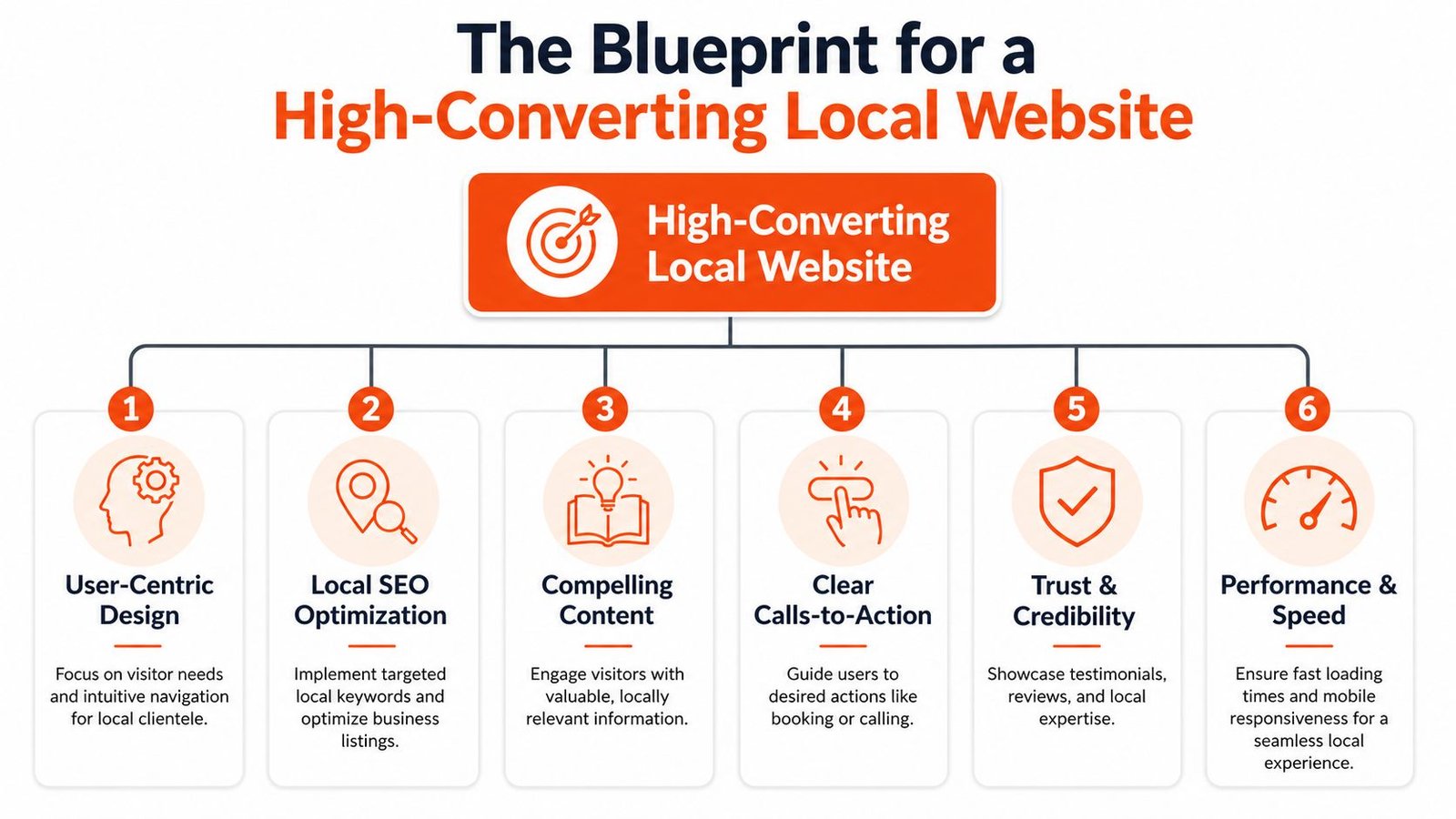
A high-converting local website needs six things working together.
| Component | What it should do |
|---|---|
| Local visibility | Help you appear for service and city searches, including map-driven intent |
| Focused landing pages | Match specific services, locations, and buyer needs |
| Clear CTAs | Push one primary action, not five competing ones |
| Trust signals | Reduce hesitation with reviews, proof, and local credibility |
| Fast performance | Keep mobile users from dropping before they act |
| Lead routing | Make sure inquiries reach the right team member quickly |
What that looks like in practice
For a local service company, the structure should usually include:
- Service pages: One page per core service, written for buyer intent.
- Location pages: City and neighborhood pages where you want visibility.
- Conversion pages: Dedicated pages for quote requests, consultations, or bookings.
- Proof pages: Testimonials, results, FAQs, and industry-specific trust content.
- Support content: Articles that answer questions buyers ask before they contact you.
Practical rule: If a page can't rank, persuade, or capture a lead, it probably shouldn't be in your main strategy.
Don't build around your internal org chart. Build around how people search and decide.
If you want a strong benchmark for what to review on the local search side, use a detailed local SEO checklist before you touch design or ad spend.
Designing Your Website to Capture Local Leads
Design is where most businesses waste time.
They argue about fonts, logo spacing, and whether the hero image feels modern. Meanwhile, key conversion questions get ignored. Does the page match the search? Is the next step obvious? Does the visitor trust you fast enough to act?
Start with the real customer journey
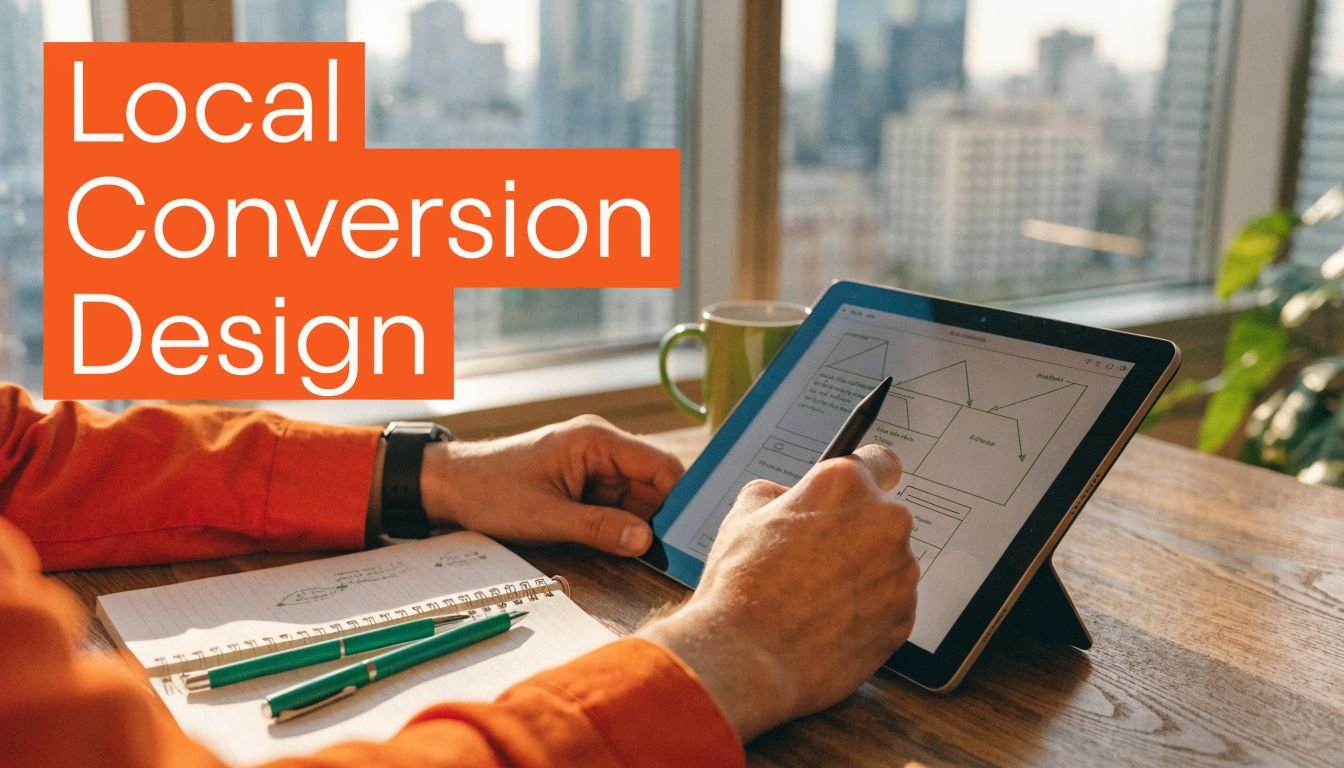
Before you design anything, map the path a buyer takes.
A Brickell restaurant customer doesn't land on your site thinking about your brand story. They search for the cuisine, compare options, check credibility, look at logistics, and decide whether to reserve. A law firm prospect searches for the exact practice area, scans reviews, checks whether you serve their area, and looks for a low-friction way to speak with someone.
That means every important page should be designed around a specific intent, not general brand messaging.
Use this planning sequence:
- Identify the search query the page is targeting.
- Define the buyer question behind that search.
- Decide the single action you want the visitor to take.
- Remove anything that distracts from that action.
A strong page framework includes a clear hero section, a direct CTA, supporting sections that reinforce the value, and interactive elements where they make sense. According to this conversion framework, a high-impact page with a clear headline and CTA, reinforced secondary pages, and interactive elements like quizzes can lift engagement by 35%, while personalized CTAs can boost clicks by 42%.
Build pages that make action easy
Most local websites ask too much of the visitor. They make people scroll for contact info, hunt for service details, or decode vague button text.
Don't do that.
A page that captures leads should include:
- A direct headline: Say what you do and where you do it.
- A visible primary CTA: "Book a Consultation," "Request a Quote," or "Reserve a Table" works better than "Learn More."
- A local trust layer: Reviews, badges, neighborhoods served, or relevant proof.
- A short path to action: Call button, form, booking calendar, or map directions.
Your homepage can support the brand, but your landing pages should close the gap between intent and action. That's why serious campaigns often rely on dedicated pages like a focused WordPress landing page instead of pushing every visitor to the homepage.
A better layout for local intent pages
- Above the fold: Headline, service area, primary CTA, phone number
- Mid-page: Benefits, process, trust signals, objections answered
- Lower page: FAQs, secondary CTA, local relevance, booking or form
Use trust in the right places
Trust signals matter, but placement matters too.
If your testimonials are buried near the footer, they won't help the anxious visitor deciding whether to call. Put proof near your CTA. Put reviews near your pricing or consultation offer. Put neighborhood and city references where local buyers expect them.
Use proof that matches the service. A restaurant should show reservation ease, ambiance, and diner feedback. A contractor should show service area clarity, project examples, and response reliability. A law firm should show practice-specific credibility and consultation confidence.
People don't convert because your site is pretty. They convert because the page feels relevant, credible, and easy to act on.
If this sounds more complex than dragging blocks around in a builder, that's because it is. Good design for lead generation isn't decoration. It's controlled persuasion.
Building the Technical Foundation for Lead Generation
A strong design still fails if the build is sloppy.
This is the part most business owners underestimate. They assume once the page looks right, the hard part is done. It isn't. Technical execution decides whether the site loads quickly, works on mobile, captures the lead cleanly, and sends that lead to the right system without breaking.
Pick the right platform for your business model
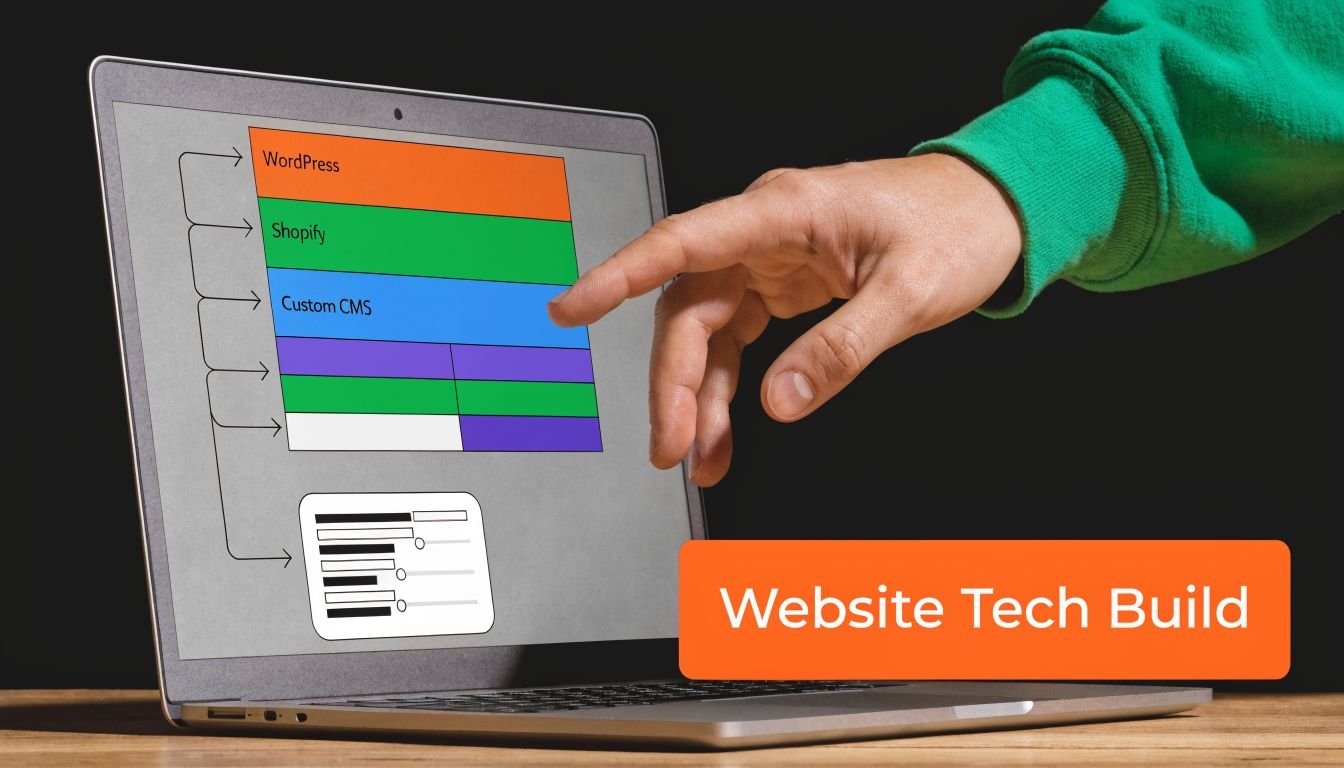
For most local service businesses, WordPress is the practical choice because it gives you flexibility for service pages, location pages, SEO control, forms, tracking, and custom integrations.
Shopify can work if your model includes product sales, bookings tied to commerce, or hybrid local and e-commerce behavior. But many service businesses force Shopify into jobs it wasn't built to handle well. That creates unnecessary friction.
The platform should support:
- Landing page creation without technical bottlenecks
- SEO control for titles, schema, internal links, and location targeting
- CRM and form integrations
- Call tracking and analytics
- Fast mobile performance
If you're evaluating whether your project needs custom development support beyond templates and plugins, resources on when to hire full-stack developers can help you understand where design ends and engineering begins.
Fix the friction that kills conversions
The build either earns leads or wastes them.
According to this lead generation website guide, you should implement above-the-fold CTAs, use short forms with 3 to 5 fields to reduce abandonment by 40%, and add exit-intent pop-ups to increase lead capture by 15% to 25%. The same guide notes that a site loading faster than 3 seconds is critical because 53% of mobile sessions are abandoned on slower sites.
Those aren't cosmetic details. They're conversion controls.
Technical fixes that matter immediately
- Short forms: Ask for name, email, phone, and one qualifying field if needed. That's enough for most local businesses.
- Action-oriented CTA copy: "Get Free Consultation Now" is better than "Submit."
- Mobile-first layout: Tap targets, forms, and buttons must work cleanly on phones.
- Smart pop-ups: Use them carefully for quote requests, booking prompts, or abandonment recovery.
- Fast page assets: Compress images, reduce script bloat, and avoid plugin overload.
Slow websites don't lose abstract "engagement." They lose real buyers who were ready to contact you.
Connect your website to lead handling
A lead form without routing is not a system. It's a leak.
When someone fills out a form, you need immediate delivery to the right inbox, CRM, or pipeline stage. If your office manager gets a vague email without context, or if a lead sits unassigned until tomorrow, you've already reduced your odds.
A proper setup usually includes:
| Technical layer | Why it matters |
|---|---|
| CRM integration | Keeps leads organized and prevents missed follow-up |
| Call tracking | Shows which pages and campaigns drive phone calls |
| Form tagging | Identifies service type, location, and source |
| Analytics setup | Measures calls, submissions, and booked actions |
| Automation | Confirms the inquiry and alerts your team fast |
Businesses in appointment-heavy industries already understand this. Even if your field is different, reviewing how structured workflows operate in tools like tutoring CRM software is useful because it shows how lead management, scheduling, and follow-up need to connect instead of sitting in separate tools.
Speed is not optional
You can have strong copy, clean design, and excellent SEO intent. If the site drags on mobile, you're still burning opportunities.
That's why performance work belongs in the build phase, not as an afterthought. Cache setup, script control, image handling, mobile testing, and template efficiency should be handled before launch.
If you want to pressure-test your current setup, review these website speed optimization tools and compare them against your live pages. Most businesses are surprised by how many technical issues are subtly suppressing conversions.
Activating Your Lead Machine with Local SEO and PPC
A lead generation website doesn't produce results just because it exists. It needs qualified traffic.
For local businesses, the two fastest routes are clear. Local SEO captures demand from people already searching. PPC puts you in front of buyers right now. The website sits in the middle and converts both.
Local SEO brings intent-driven traffic
Local SEO isn't just adding your city name to a title tag.
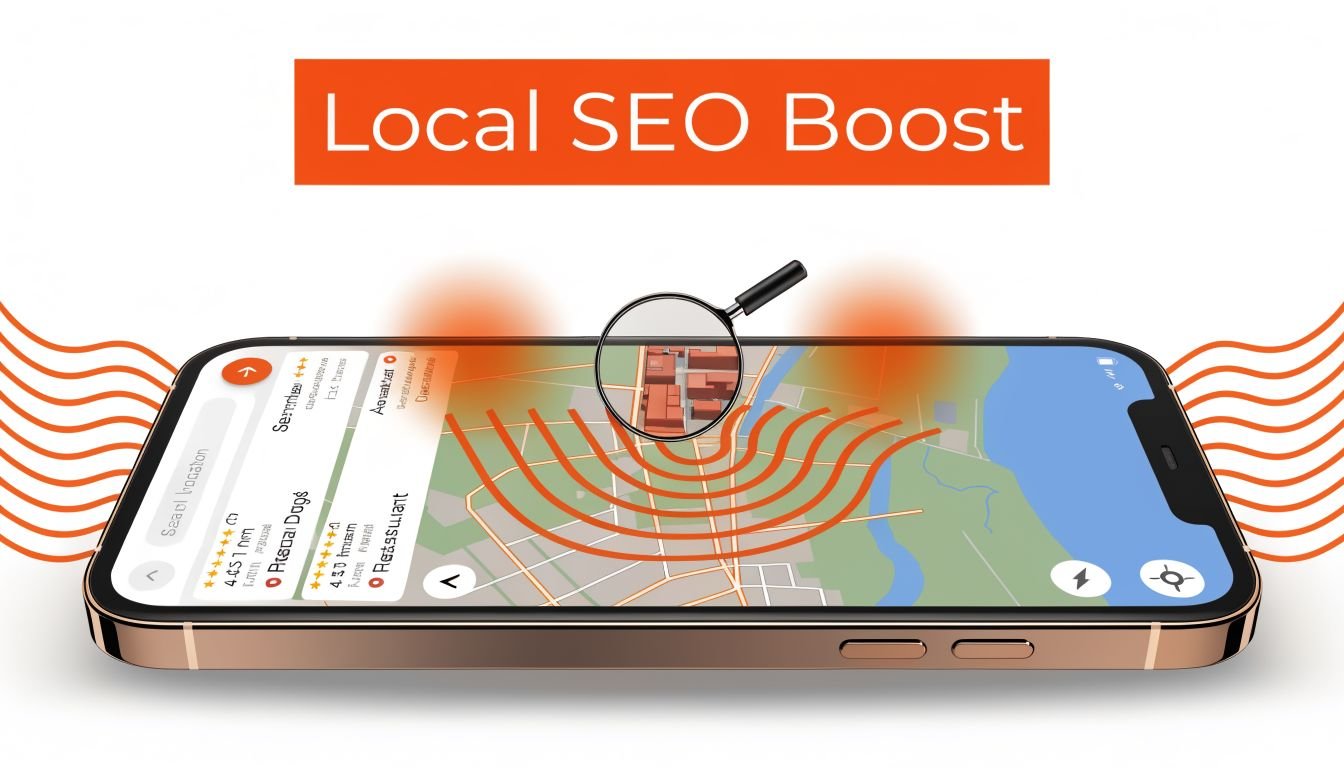
It means building service pages and location pages around actual demand, tightening internal links, aligning your Google Business Profile with the website, and making sure your site supports map visibility and local trust.
For Miami businesses, that often means going narrower than the city itself. People search by neighborhood, district, and service context. Brickell, Wynwood, Coral Gables, Aventura, North Miami, Downtown. Those modifiers affect who finds you and how likely they are to convert.
A strong local activation plan usually includes:
- Google Business Profile optimization
- Service-area and city-specific landing pages
- Review strategy and reputation support
- On-page local relevance
- Local link and citation consistency
If your business can qualify for them, Google Local Services Ads should also be part of the conversation because they can place you directly in front of high-intent local searchers.
PPC fills the pipeline faster
SEO compounds. Google Ads moves faster.
If you need leads while SEO pages mature, PPC is the logical complement. But sending paid clicks to a weak page is one of the most expensive mistakes local businesses make. You don't buy traffic first and figure out the funnel later. You fix the page, then scale.
Use paid search when:
- You need immediate visibility
- You're entering a competitive market
- You want to test service demand by area
- You need tighter control over lead flow
Video can help clarify how local search behavior and visibility work in practice. This overview is a useful primer before you build or rebuild your campaign logic.
Your website has to support both channels
SEO and PPC fail when the website forces every visitor into the same generic experience.
The page someone lands on from an emergency service ad should not feel the same as the page someone finds while researching options over several days. Match the page to the intent.
For SEO traffic, give people proof, local detail, and enough information to evaluate you. For PPC traffic, reduce distractions and move them quickly to one action.
If your ads are working but leads are weak, the landing page is often the problem. If rankings improve but calls don't, the offer or CTA is usually wrong.
The businesses that win local search don't treat the website as a final deliverable. They treat it as the conversion hub for every traffic source.
Common Questions About Building a Lead-Generating Website
Business owners usually ask the same three questions before they commit. Good. You should ask them.
How long until results show up
Some improvements show up fast. If your site has obvious friction, a better CTA, cleaner landing page, better form flow, and stronger routing can improve lead capture quickly.
SEO takes longer because rankings, local authority, and page coverage need time. PPC can drive traffic faster, but only if the landing pages are ready. That's why the right answer isn't "SEO or ads." It's usually a staged approach based on urgency, budget, and market competition.
Is a professional build really worth it
Yes, if lead quality matters.
A professional build isn't just about design. You're paying for strategy, search intent mapping, local structure, conversion logic, tracking, integrations, and testing. That's what turns a website into a working sales asset.
Cheap websites cost more than they look. They waste ad spend, rank poorly, create follow-up problems, and force you into another rebuild later.
Can you do it yourself with a cheap builder
You can. The better question is whether you should.
If your business depends on local leads, DIY usually creates hidden losses:
- Weak local structure: No serious location strategy
- Template limitations: Hard to build pages around intent and conversion
- Tracking gaps: No reliable view of what generates calls or forms
- Poor technical performance: Slow pages, bloated apps, mobile friction
- Broken follow-up: Leads don't route cleanly into a process
A builder is fine for a hobby site. It is not the safest move when missed calls and weak forms directly affect revenue.
What should a proper service include
If you're hiring a team to build this right, expect these deliverables:
- Discovery and strategy
- Keyword and SERP analysis
- Service and location page planning
- Conversion-focused design
- Technical build and speed work
- Form, CRM, and tracking setup
- Local SEO foundations
- PPC-ready landing pages
- Launch support and iteration
If an agency talks mostly about visuals and barely discusses traffic, conversions, and lead handling, keep looking.
Your Next Step to Getting More Local Customers
A website that doesn't generate leads is not neutral. It's actively costing you opportunities.
Every day your site stays weak, another local business gets the call, the form submission, the booking, or the consultation that could have gone to you. In a competitive market like Miami, waiting is expensive.
The right website does three jobs at once. It gets found, it builds trust fast, and it turns attention into action. That's the standard. Anything less is underperforming.
If you're serious about growth, stop treating your website like a design project and start treating it like a lead system. The smartest next move is a professional review of your current site, local visibility, landing pages, and conversion flow. You don't need more guesswork. You need a clear plan.
If you want expert help building a website that brings in calls, leads, and booked consultations, talk to VIP TECH CONSULTING. Their team works with Miami-area businesses that need stronger Local SEO, better landing pages, faster websites, and paid campaigns that convert. Book a free strategy session and get a direct review of what's holding your site back, what to fix first, and how to turn your online presence into a reliable lead source.