
Your website looks acceptable. It loads eventually. It has your logo, your phone number, maybe even a few service pages. But it isn't bringing in calls, quote requests, or booked appointments.
That's the problem.
If you're searching for website design for local business, you probably already know your current site isn't doing its job. You may be paying for SEO, running Google Ads, or trying to rank in Maps, yet visitors land on your site and disappear. That's not a traffic problem alone. It's usually a structure problem.
A local business website should work like a salesperson. It should move someone from search to trust, then from trust to action. If it doesn't, it's steadily draining the value of every click you earn or buy.
If you want a site that supports lead generation, not just your branding, request a consultation before another month of traffic goes to waste.
Table of Contents
- Why Your Current Website Is a Cost Not an Asset
- The Blueprint for a High-Converting Local Website
- Integrating Your Site with the Local Search Ecosystem
- Our Proven Process for Your Local Business Success
- Answering Your Questions About Professional Web Design
- See the Results and Schedule Your Strategy Session
Why Your Current Website Is a Cost Not an Asset
You pay for ads, ask past customers for reviews, keep your Google Business Profile updated, and still get weak results. Then a prospect lands on your site, hesitates for five seconds, and leaves. That is the problem.
Your website is supposed to turn attention into action. For many local businesses, it does the opposite. It slows down the sale, creates doubt, and forces ready-to-buy people to work too hard to call, book, or request a quote.
Pretty websites fail every day
A polished design does not fix a weak sales structure.
Local business owners get sold visuals because visuals are easy to present. Mockups look impressive in a proposal. Animations feel modern. Stock photography fills space. None of that matters if the visitor cannot answer three basic questions fast: What do you do, why should I trust you, and what should I do next?
Best Version Media makes the same point in its guidance on local website conversion features. Clarity, speed, and low friction support conversions better than decorative design choices.
A website that looks expensive but confuses visitors is still a bad sales tool.
Cheap web design usually creates expensive problems. The page loads slowly. The mobile layout breaks. Calls to action hide below the fold. Service pages stay vague. The site exists, but it does not help a local buyer make a decision.
If performance is part of the issue, start with this guide on how to improve website loading speed. Then address the bigger problem, which is the way the site is structured to drive action.
The island problem
A lot of local websites operate like isolated brochures. They are online, but they are disconnected from how people select a local provider.
Someone finds you in Maps. Someone else clicks a service ad. Another person searches for a specific service plus your city. They should not all land on the same generic experience and be expected to figure it out from there. That is where leads die.
A website becomes a cost when it fails to support the actions that matter most:
- Calls from urgent buyers
- Quote requests from comparison shoppers
- Bookings from mobile visitors
- Trust-building for people checking reviews, services, and local proof
This is the strategic mistake most articles miss. The issue is not that your site lacks a contact page. The issue is that the site has no conversion architecture. It does not guide different types of local visitors toward the specific action they are ready to take.
Run a quick test on your phone. Open your homepage and look at the first screen only.
- Can a visitor tell what you do immediately?
- Can they see the next step without hunting for it?
- Can they find proof that you serve their area and do good work?
- Can they act now without pinching, zooming, or scrolling through fluff?
If the answer is no, your website is draining value from every marketing channel feeding into it.
If you are reviewing tools that support local visibility around your website, you can explore Sight AI's local business solutions as part of that broader evaluation. Just do not confuse visibility tools with website strategy. Traffic helps only when the site is built to convert that traffic into calls, bookings, and quote requests.
The Blueprint for a High-Converting Local Website
A local website should not be built page by page. It should be built around buying intent.
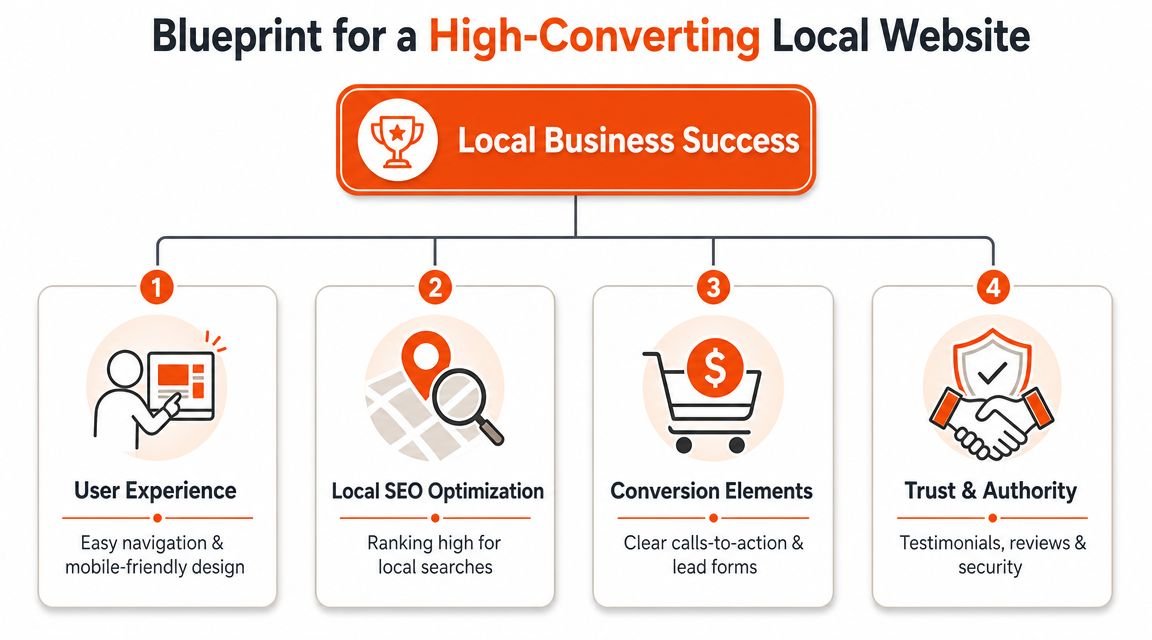
Start with conversion intent, not colors
The first mistake most agencies make is starting with design references. That's backwards.
The first question is simpler: what action matters most for your business? A call? A booking? A quote request? An order? If that answer isn't clear, the site gets built around aesthetics instead of outcomes.
For service businesses, practical guidance recommends a homepage that leads with a clear call to action, then supports that action with sections for services, testimonials, about, FAQ, and contact, as outlined in this service-business website guidance video.
That structure works because it mirrors how people evaluate a local provider. They want fast confirmation, proof, and an easy next step.
Later in your evaluation process, it also helps to compare tools that support local visibility. If you're exploring AI-assisted visibility workflows, you can explore Sight AI's local business solutions as one of the options in the broader local marketing stack.
A strong local website usually needs to guide at least three visitor types:
| Visitor type | What they need fast | Best page path |
|---|---|---|
| Ready-to-buy searcher | Phone number, trust, direct CTA | Homepage to call or quote form |
| Comparing options | Services, reviews, FAQs | Service page to proof to CTA |
| Local-intent searcher | Area relevance, service coverage | Location page to contact action |
The four pillars that matter
Some websites convert because they're built on the right system. Here's the system.
Discovery and strategy
Before design starts, define your audience segments, top services, priority locations, and primary conversion actions. A local plumber, med spa, law firm, and restaurant should not use the same page priorities.Conversion architecture
Navigation, CTA placement, forms, reviews, trust badges, guarantees, and service summaries have to work together. Visitors shouldn't need to hunt for the next step.Local SEO foundation
The site needs pages that support local queries, map relevance, and service intent. That means real service pages, real location relevance, and clean internal linking. Not a single generic “Services” page trying to rank for everything.Mobile speed and usability
Most local intent happens on a phone. If the menu is awkward, the page is bloated, or tap targets are frustrating, your site loses buyers before your offer gets a chance.
Practical rule: If a page can't explain the offer and present an action within seconds, it needs to be simplified.
What a conversion-first homepage actually includes
A frequent misstep for local businesses is that they put every message on the homepage and create noise.
A better homepage includes:
- A direct headline that says what you do and where you do it
- One primary CTA above the fold
- A short services overview with links to detailed service pages
- Visible trust signals such as testimonials, reviews, memberships, or guarantees
- A friction-reducing contact path with call, form, and map cues
- A localized credibility layer that shows you serve the area, not just the internet
If you want to see how these elements fit together into a full lead-generation system, review this breakdown of how to build a lead generation website.
A quick visual helps clarify the difference between a brochure site and a conversion-focused one:
Integrating Your Site with the Local Search Ecosystem
A local website doesn't win on design alone. It wins when it works with the rest of your visibility channels.
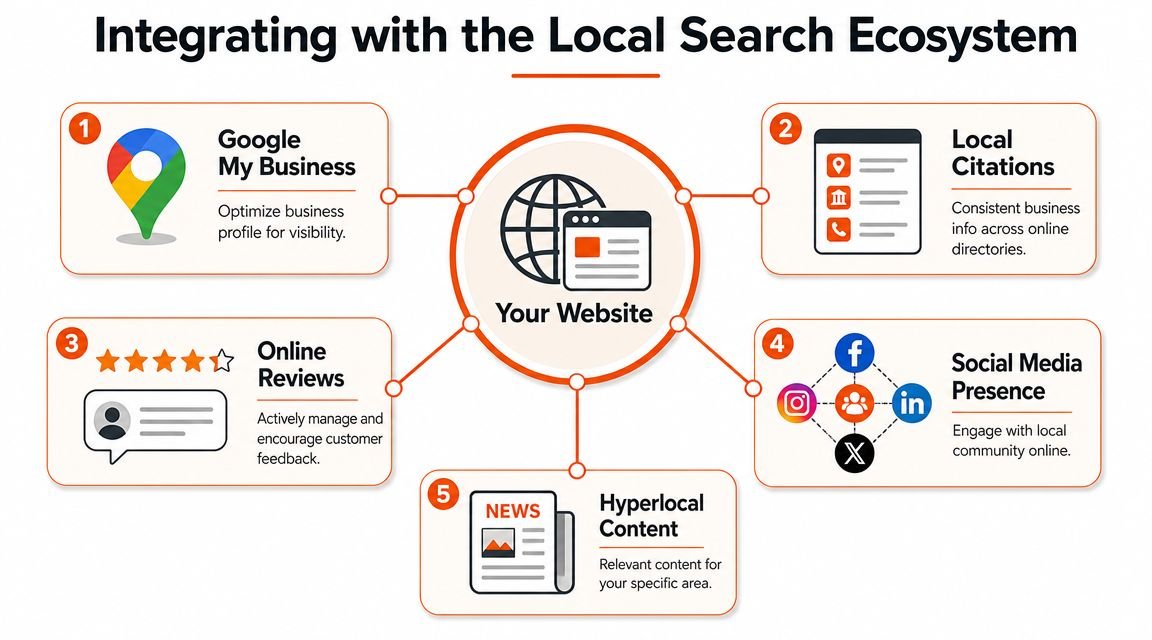
Your website should be the hub
Most businesses treat their website, Google Business Profile, reviews, and ads like separate projects. That's a mistake.
Your website should be the central hub that supports all of them. The service pages support search relevance. The location pages support local intent. The trust elements support conversion. The Google Business Profile should send traffic into that system, not to a weak generic page.
Generic website design for local business advice often falls short. It tells you to add contact info, use local keywords, and stay mobile friendly. Fine. But it rarely explains how the website should route different local visitors based on what they searched.
That gap matters. As noted in Miller Media's analysis of local-business web design strategy, most advice misses the location-specific conversion strategy behind local lead generation. “Near me” intent, branded searches, service-plus-city searches, and multi-location searches should not all land on the same kind of page.
Different local searches need different page paths
A person searching your brand name behaves differently from someone searching “emergency electrician near me.” Your website architecture should respect that difference.
Use this decision model:
- Homepage for branded traffic and broad credibility
- Service pages for high-intent solution searches
- Location pages for city or neighborhood relevance
- Dedicated landing pages for paid traffic with a single focused CTA
That structure improves the experience for users and gives your marketing channels somewhere appropriate to send traffic.
Your website shouldn't force every visitor through the same path. Local intent is not one-size-fits-all.
For businesses that want stronger map visibility and better organic alignment, your site structure should work directly with your local SEO strategy, not sit beside it.
Paid traffic fails when landing pages are generic
Local businesses swiftly waste money.
They run Google Ads to a homepage. The homepage talks about everything. The visitor wanted one service in one area and got a wall of general messaging instead. That click was expensive, and the page didn't respect the intent.
A profitable paid campaign depends on matching the ad promise to the landing page experience. If the ad offers drain cleaning in Miami, the page should show that service, that area relevance, trust, and a direct next step. Not a broad welcome message.
The same rule applies to Local SEO. Ranking is only half the job. The page still needs to convert.
Our Proven Process for Your Local Business Success
Most local businesses don't need more random marketing activity. They need a process that removes guesswork.
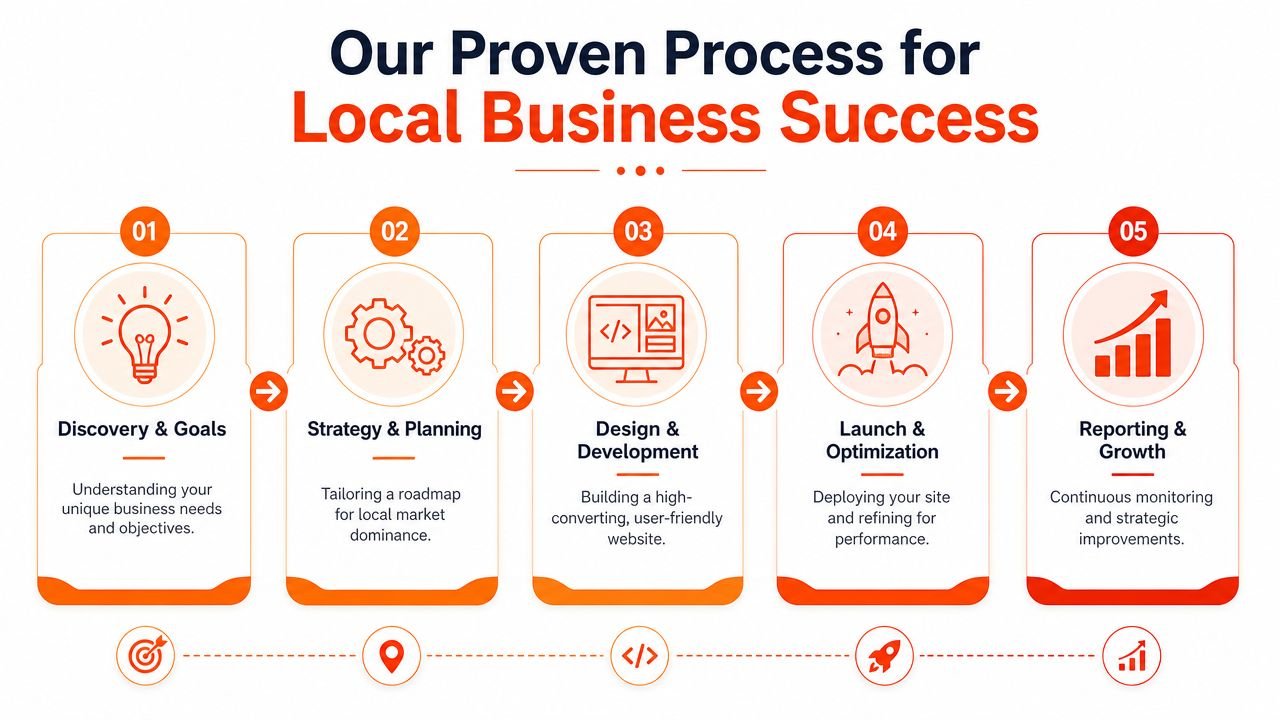
What we build and why it works
A high-performing local website starts with segmentation. Different visitors need different proof, different pages, and sometimes different CTAs. Guidance for local service websites highlights the importance of audience segmentation, clear paths through homepage, service pages, and location-specific pages, plus local trust signals like review integrations, service-area maps, and response-time guarantees in Muffin Group's practical website structure guidance.
That principle drives the process.
Instead of asking, “What pages do you want?” we ask better questions:
- Which services produce the best customers?
- Which locations matter most?
- Do people usually call, book, or request quotes?
- What objections stop them from contacting you?
- What proof closes the hesitation?
One practical option for businesses in South Florida looking for implementation support is this web designer in Miami service, which combines web design with broader digital marketing execution.
What's included
The process should feel clear before you sign anything. No mystery. No vague promises.
Local market analysis
We review your current visibility, competitor positioning, service priorities, and local search intent. This analysis often reveals weak page structures.Conversion blueprint
We map the key journeys. A first-time visitor from Google Maps should not experience the site the same way as someone clicking a paid ad for one service.SEO-oriented build
The site is structured around service pages, location relevance, internal links, and conversion actions. Not filler content. Not duplicate pages dressed up with city names.Trust and proof implementation
Reviews, testimonials, FAQs, guarantees, contact options, service areas, and proof elements get placed where they reduce hesitation, not buried on an afterthought page.Launch and performance refinement
Mobile experience, form flow, CTA visibility, and lead paths get tested. The launch is not the finish line. It's the start of measurement.
What owners usually underestimate: a website doesn't fail because one button is the wrong color. It fails because the whole journey was never designed around buyer intent.
Deliverables should be specific. At minimum, expect items like:
- Homepage strategy tied to one primary conversion goal
- Dedicated service pages for major revenue lines
- Location pages where local intent justifies them
- Lead forms and click-to-call paths built for mobile use
- Review and testimonial placement near decision points
- Google Business Profile alignment with site messaging
- Post-launch support so changes don't break performance
That's what reduces uncertainty and turns a website into a working sales asset.
Answering Your Questions About Professional Web Design
Is it worth the investment
You already know the answer if your current site gets traffic but not calls, bookings, or quote requests.
Professional web design is worth paying for when it gives each visitor a clear next step and supports the way local buyers make decisions. It is a bad investment when you pay for a prettier version of the same confusion.
As noted earlier, buyers research online before they contact a business. They also leave slow, clumsy sites fast. So the actual cost is not the invoice. It is the missed lead, the skipped phone call, and the ad click you paid for that went nowhere.
Use a simple test. If a site helps your business win more qualified inquiries, support sales conversations, and reduce wasted traffic, it is an asset. If it just sits there, it is overhead.
| Option | What you save upfront | What you risk later |
|---|---|---|
| DIY or cheapest bid | Cash today | Weak trust, lower conversion rates, more wasted traffic |
| Strategy-led build | More planning and higher upfront cost | Stronger lead flow and a site that supports marketing |
If you want a quick reality check, review an agency's portfolio of local business website and marketing work and look for clear service intent, visible proof near action points, and pages built to drive a specific action.
Can you do it yourself
Yes. You can publish a website yourself.
That is not the same as building a site that produces revenue.
The hard part is not choosing a template. The hard part is deciding what each page must do, which local search terms deserve their own pages, where trust signals belong, and how to reduce hesitation before someone calls or fills out a form. That is architecture. Website builders do not do that thinking for you.
DIY works for a placeholder site. It does not solve a broken lead path.
If your homepage tries to serve every service, every customer, and every location at once, people get lost. If your service pages do not answer the buying question behind the search, rankings alone will not save you. If your contact option is one generic form buried in the footer, you are making people work too hard.
How long does it take and what happens after launch
A good timeline starts with the business goal, not the launch date.
If your priority is phone calls, the site should be built around fast trust, obvious tap-to-call paths, and low-friction mobile contact. If your priority is quote requests, the form flow, service-page structure, and qualification questions need more planning. If your priority is bookings, the booking path has to be visible, credible, and easy on a phone.
That takes time. Not endless time. Enough time to get the structure right.
After launch, the job shifts from building to improving. You review where visitors hesitate, which pages produce leads, which calls to action get ignored, and where local traffic drops out before converting.
That usually means work like this:
- Tightening page copy where visitors stall
- Improving call and form visibility on mobile
- Adding landing pages for new services, offers, or ad campaigns
- Updating proof elements so reviews, photos, and trust signals stay current
- Fixing performance issues before speed or usability starts costing leads
A website that is supposed to drive local business cannot be treated like a one-time design project. It needs upkeep because your offers change, your competitors change, and customer expectations change.
See the Results and Schedule Your Strategy Session
You don't need another article telling you to “have a mobile-friendly site” or “use good design.” You need a website that supports how local customers find, evaluate, and contact your business.
The baseline has changed. In 2026, 83% of U.S. small businesses have a website, up from 64% in 2018, and 94% of first impressions are tied to website design, according to Network Solutions' 2026 small-business website roundup. That means having a website is no longer the advantage. Having a site that converts is the advantage.
What to review before you hire anyone
Before you hire an agency, ask for proof of thinking, not just screenshots.
Review their portfolio of past website and marketing work and look for signs of strategy:
- Do service pages have a clear purpose, or are they generic filler?
- Do location pages feel useful, or do they look duplicated?
- Are CTAs obvious on mobile, or buried after long blocks of text?
- Is trust visible near action points, or hidden on a separate page?
- Does the site appear built for SEO and paid traffic, or only for appearance?
If you don't see those elements, keep looking.
Your next step is simple
If your current website isn't producing steady calls, quote requests, or bookings, don't keep treating it like a branding exercise. Fix the architecture. Fix the conversion paths. Fix the connection between your site, Local SEO, and paid traffic.
The right move now is a strategy session focused on what's broken, what's missing, and what should be built next.
Every month you wait, your competitors keep collecting the searches, the clicks, and the customers your website should be converting.
If you're ready to turn your website into a lead-generation asset, book a strategy session with VIP TECH CONSULTING. We'll review your current site, identify the conversion gaps, and outline the next steps for a stronger local SEO and paid traffic foundation.