
If you’re searching for wordpress development miami, you probably already have a website problem, not a design problem.
Your site may look acceptable. It may even have a modern theme, a contact form, and a few service pages. But if it isn’t generating calls, quote requests, booked consultations, reservations, or store visits, it’s underperforming. In Miami, that’s expensive because the businesses showing up first in local search and Google Maps are taking the leads you should be getting.
A high-performing WordPress site should function like a lead generation asset. It should load fast, support local SEO, guide visitors to action, and make your paid traffic more profitable. If your current site can’t do that, it’s time to rethink the build, not just the colors.
If you want a practical framework before you hire anyone, review this guide to build a lead generation website. It will help you spot the difference between a site that looks nice and a site that generates revenue.
Table of Contents
- Why Your Miami Business Needs More Than Just a Website
- The Vetting Checklist How to Choose the Right Miami Agency
- Our Blueprint for a High-Performance WordPress Site
- The Local SEO Engine Driving Your WordPress Site
- WordPress Project Timelines and Pricing in Miami
- Launch Handoff and Ongoing Growth Support
Why Your Miami Business Needs More Than Just a Website
Most Miami business owners don’t need another brochure site. They need a site that supports search visibility, captures demand, and turns visitors into customers.
That matters because WordPress isn’t some niche platform. It powers over 61% of the CMS market, and Miami has over 239 WordPress companies in the region. Top-ranked developers charge $50 to $199 per hour, which tells you two things: the market is crowded, and expertise costs more when businesses need results that affect revenue, not just appearance (WordPress market and Miami agency data).
A pretty site can still lose money
A business owner usually notices the problem the same way. Traffic comes in, but inquiries stay flat. The homepage looks polished, but nobody clicks the main CTA. The mobile version loads slowly. The service pages are thin. The site says what the company does, but it doesn’t persuade anyone to act.
That’s not a web design issue alone. It’s a conversion and visibility issue.
If your competitors appear in map results, answer the searcher’s intent better, and offer a smoother mobile experience, they’ll win the lead before your page fully loads.
Your website is either helping your sales process or getting in the way of it.
What a revenue-focused website does differently
A revenue-focused WordPress build starts with business goals. It asks better questions.
- Lead path clarity: What should a visitor do on each page?
- Search intent matching: Does each service page align with what Miami customers are searching for?
- Mobile conversion flow: Can someone call, book, or request a quote without friction?
- Trust building: Do reviews, service details, and proof points appear where buyers need them?
Business owners who miss this often overpay twice. First for the original build. Then again for the redesign, SEO cleanup, speed fixes, and form troubleshooting that should have been handled from day one.
The real decision
You’re not deciding whether to “get a new website.”
You’re deciding whether to keep funding an online asset that doesn’t pull its weight.
The Vetting Checklist How to Choose the Right Miami Agency
Most agencies sound similar on the surface. They all mention custom design, responsive development, and SEO. That doesn’t help you choose.
What helps is forcing the agency to explain how they build a WordPress site that ranks locally, loads fast, and supports lead generation. Many agencies create slow websites with excessive plugins, and that matters because Google’s Core Web Vitals directly impact local search visibility. A high-performance WordPress site avoids plugin bloat, which is critical for mobile users making “near me” searches in Miami (plugin bloat and performance impact).
What to ask before you sign anything
Ask these questions directly. If the answers are vague, keep looking.
- Performance approach: How do you prevent plugin bloat and keep the site lean?
- Local SEO structure: How will the site architecture support rankings in Miami and surrounding neighborhoods?
- Content model: Are you building standard pages only, or will you create scalable structures for services, locations, or case studies?
- Conversion planning: Who decides the CTA placement, form strategy, phone click flow, and page hierarchy?
- Ownership and maintainability: Will my team be able to edit content without breaking layout or functionality?
- Post-launch responsibility: Who handles fixes, updates, testing, and growth work after launch?
A solid agency should answer with process, not slogans.
For a broader decision framework beyond WordPress, this breakdown of Amax Marketing agency selection tips is worth reviewing. It’s useful because it pushes you to evaluate strategy, communication, and fit, not just portfolio screenshots.
If you want a second checklist specifically designed for buyer intent, use this guide on how to choose a digital marketing agency.
Comparing WordPress Development Approaches
| Factor | Quick & Cheap (Template-Based) | Strategic & Performance-Focused (Custom) |
|---|---|---|
| Discovery | Minimal intake, rushed start | Business goals, buyer journey, and local search intent are mapped first |
| Site structure | Pages added as needed | Sitemap, URL hierarchy, and page purpose are planned intentionally |
| Plugins | Heavy reliance on many plugins | Only necessary tools are used, with custom solutions where needed |
| Speed | Often bloated and inconsistent | Built for lean performance and stronger mobile usability |
| Local SEO readiness | Basic title tags and plugin setup | Structure supports service areas, schema, and map visibility goals |
| Conversion strategy | Generic forms and layouts | CTA flow, trust elements, and page sequencing are designed to generate inquiries |
| Scalability | Hard to expand cleanly | Easier to grow across services, neighborhoods, and campaigns |
Practical rule: If an agency jumps into design mockups before discussing structure, search intent, and conversion flow, they’re solving the wrong problem.
The fastest way to make the wrong hire
Choose based on price alone.
That usually gets you a theme, too many plugins, unclear ownership, and weak local search foundations. It feels cheaper at the start. It usually isn’t cheaper once the site needs to be rebuilt, cleaned up, or replaced.
Our Blueprint for a High-Performance WordPress Site
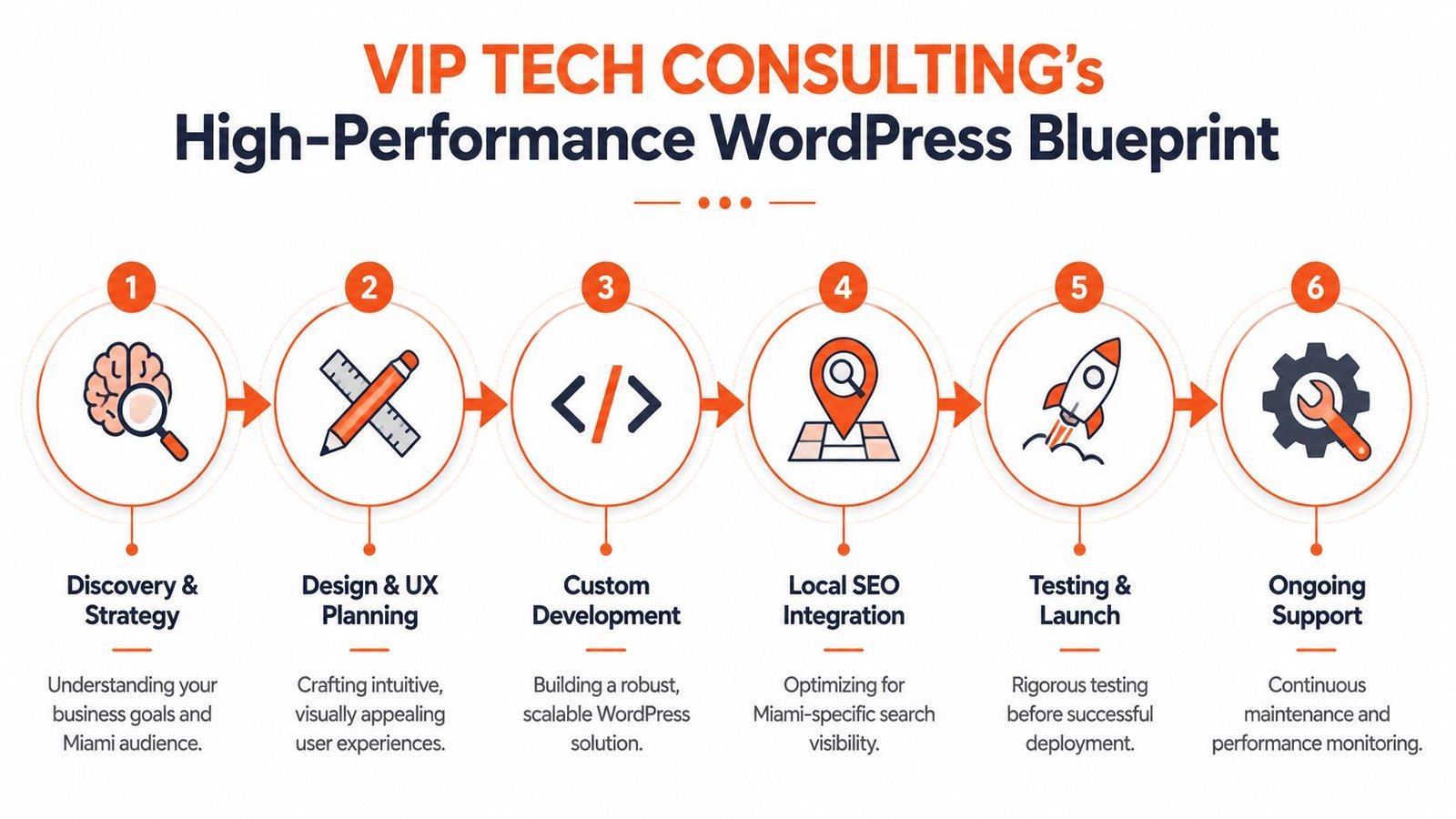
A serious WordPress project starts long before design. The strongest builds begin with architecture, because that’s where lead flow, scalability, and SEO performance are decided.
Industry documentation shows that most website rebuilds happen because the initial architectural and technical planning phase was rushed. A best-practice workflow dedicates 15 to 20% of the project timeline to discovery and architecture before design begins (WordPress process and architecture planning).
Why architecture comes first
Many Miami website projects go off track during this phase. The owner wants a fresh look. The agency opens a theme library. Pages get assembled quickly. Everyone feels productive.
Serious problems then emerge later. The URLs are messy. Service pages overlap. The site cannot scale into new neighborhoods. Plugins conflict. The forms do not route properly. SEO work becomes a patch job.
A disciplined build avoids that.
Before development starts, the project should lock down:
- Sitemap and hierarchy
- URL structure
- Core page goals
- Required integrations
- Plugin selection
- Scalability needs
- Performance constraints
- Local SEO dependencies
That’s the stage where smart agencies protect your budget.
What’s included in a serious build
The process should feel clear, not mysterious. When a firm can’t explain deliverables, timelines, and handoff expectations, the project usually drifts.
One option in Miami is VIP TECH CONSULTING, which offers WordPress development alongside SEO, Local SEO, paid media, and ongoing support. That matters if you want one team handling the site and the traffic strategy together, instead of separate vendors passing blame.
A high-performance WordPress project should include:
- Discovery and strategy: Business goals, target audience, service priorities, and conversion actions are defined before design starts.
- UX planning: Wireframes or content-first layouts should support phone calls, form submissions, bookings, and local trust signals.
- Custom development decisions: The build should use WordPress in a way that keeps editing simple while avoiding unnecessary complexity.
- Technical SEO setup: Clean indexing rules, crawlable structure, metadata control, internal linking logic, and schema readiness should be built in.
- Mobile-first testing: Forms, buttons, navigation, page speed, and layout behavior should be validated on real mobile devices.
- Launch QA: Redirects, analytics, tracking, lead routing, and browser checks should happen before the site goes live.
Don’t judge a process by how fast it starts. Judge it by how few problems it creates after launch.
If speed is already an issue on your current site, review these website speed optimization tools before approving any rebuild plan.
Ready to discuss your project with a team that looks at performance, SEO, and conversions together? Book a consultation and bring your current site, your goals, and the pages that aren’t converting. You’ll know quickly whether the problem is design, structure, or both.
The Local SEO Engine Driving Your WordPress Site
A WordPress site that isn’t built for local search will force your SEO team to work harder than necessary. That’s the part many business owners don’t hear during sales calls.
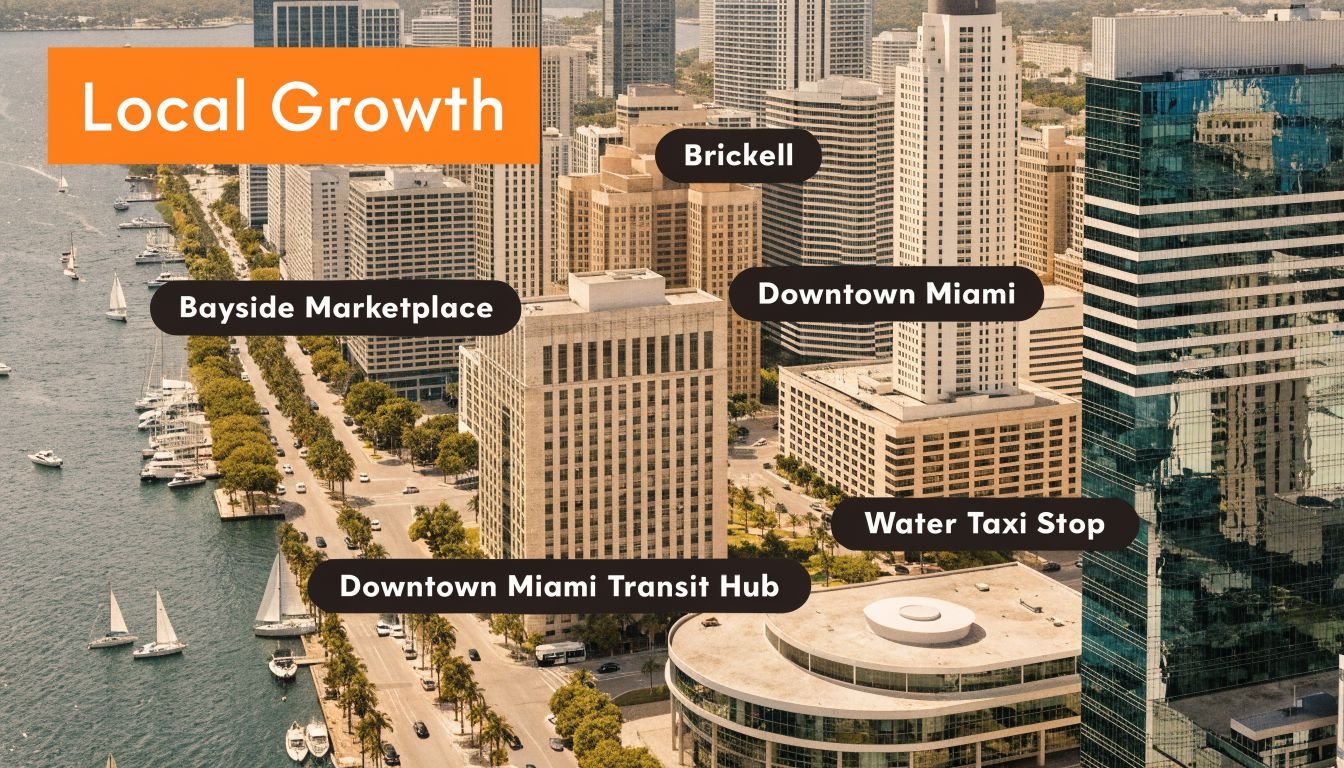
Most Miami agencies say they offer SEO, but they don’t connect WordPress architecture to outcomes like ranking in multiple neighborhoods or improving visibility in Google Maps. Advanced setups use custom schema and structured data to improve local visibility (WordPress architecture and Local SEO gaps in Miami agencies).
Architecture decisions that affect local rankings
Local SEO doesn’t start with title tags. It starts with how the site is built.
A strong WordPress build can support:
- Service-area page structures for different neighborhoods or city targets
- Custom post types that organize services, locations, reviews, or team bios cleanly
- Schema implementation for local business details, services, and review content
- Internal linking patterns that reinforce topic relevance and geographic signals
- Content templates that make expansion easier without turning the site into a duplicate-content mess
That’s how you create a site that can scale local visibility instead of forcing every SEO gain to come from brute-force content production.
If your website structure can’t support neighborhood targeting cleanly, your local SEO campaign will hit a ceiling.
For business owners comparing approaches outside the U.S., these Australian SEO growth strategies are useful because they reinforce the same principle. Technical setup and search visibility are tied together. Geography changes. The rule doesn’t.
What local businesses actually need
A restaurant, law firm, med spa, contractor, or consulting company in Miami usually needs more than “SEO optimization” as a generic service line.
They need a WordPress setup that supports:
- Google Business Profile alignment
- Consistent location and service information
- Map-driven landing pages
- Fast mobile experiences for near-me searches
- Clear local trust signals on key conversion pages
Here’s a practical overview of the kind of local search thinking your website should support:
If local visibility is your primary objective, a generic site build won’t cut it. You need web structure and search strategy working together. That’s exactly why many Miami businesses pair development with a focused Local SEO Miami service.
WordPress Project Timelines and Pricing in Miami
Most buyers ask two questions first. How much will this cost, and how long will it take?
That’s fair. It’s also where bad assumptions hurt business owners. If you compare a strategic build to a low-cost template project as if they’re the same product, you’ll make the wrong call.
What the market says about cost
Custom WordPress website projects for small to mid-sized businesses in Miami typically range from $8,000 to $20,000 (Miami WordPress project pricing). That range reflects the level of planning, technical work, and execution needed to build something that supports growth rather than just publishes pages.
The same source notes that WordPress developers in Miami command competitive compensation, with Miami-based developers earning an average of $105,000 annually, compared with a statewide Florida average of $78,000. It also notes that entry-level developers in Florida start at $63,375, mid-level professionals earn between $75,459 and $99,812, and senior-level developers can reach $105,000. For Miami specifically, a WordPress Developer with 3 to 5 years of experience earns an average base salary of $64,656, plus $3,440 in additional cash compensation, for a total of $68,096.
Those numbers matter for one reason. Skilled work costs more because the results are more critical. You’re paying for planning, implementation, testing, and reduced risk.
How to judge value instead of price
Don’t ask whether you can get a cheaper website. You can.
Ask what’s included, what problems are being prevented, and whether the build supports future growth without expensive rework.
A serious proposal should clarify:
- Project scope: Pages, templates, integrations, content migration, and technical setup
- Timeline: Discovery, approvals, development, QA, launch, and post-launch support
- Conversion work: CTA planning, forms, phone actions, trust signals, and lead routing
- SEO readiness: Crawlability, local page structures, metadata control, and structured data support
- Ownership: Hosting access, admin access, documentation, and training
Cheap projects usually become expensive when the site can’t support SEO, paid traffic, or future expansion.
If you’re budgeting now, compare your current site’s cost against missed opportunities. A site that wastes leads is more expensive than a proper rebuild. For local businesses exploring design and strategy together, this overview of web design in Miami Beach gives a useful reference point.
Launch Handoff and Ongoing Growth Support
A lot of agencies disappear after launch. That’s a problem because launch day isn’t the finish line. It’s the point where the website finally starts doing real work.
Business owners need clarity on what happens next. Who updates plugins? Who checks forms? Who fixes layout issues after content edits? Who handles speed drops, tracking issues, and SEO changes when the business expands into new service areas?
What a proper handoff looks like
A proper handoff should leave you in control without leaving you alone.
That usually includes:
- Admin training: Your team knows how to update pages, images, blog posts, and core content safely.
- Documentation: Key workflows, access details, and editing rules are documented.
- Launch validation: Forms, tracking, user paths, and critical pages are checked again after the site is live.
- Support path: You know exactly who to contact when something breaks or needs improvement.
Why growth support matters after launch
The strongest websites improve after launch because real user behavior reveals what to refine. CTA placement changes. service pages expand. Local landing pages get added. Paid traffic gets routed to custom offers. Reviews, FAQs, and conversion content need updates.
That’s why ongoing support matters. Not because your site should be fragile, but because your business won’t stay static.
If you want help deciding whether to manage the site internally or hand it off, compare your options with these DIY or DFY website support plans. It’s the simplest way to decide how much control, speed, and accountability you want after launch.
Your competitors are already competing for Miami searches, map visibility, and paid traffic clicks. If your site is slow, generic, or structurally weak, you’re handing those opportunities away.
If you want a WordPress site that supports SEO, improves local visibility, and turns traffic into qualified leads, book a strategy session with VIP TECH CONSULTING. Bring your current website, your target services, and the markets you want to win in Miami. You’ll leave with a clearer plan, a realistic scope, and a direct view of what needs to change before more leads slip to competitors.