
If your business isn’t showing up when someone searches for your service near them, you’re not dealing with a visibility problem. You’re dealing with a revenue problem. A prospect is opening Google Maps, comparing a handful of listings, and calling the business that looks closest, most credible, and easiest to trust.
That’s why learning how to rank in Google Maps matters so much. Not for vanity. For calls, booked jobs, form fills, and foot traffic. If you’re already looking at agencies, comparing local SEO providers, or searching terms like “SEO agency near me” or “local SEO services in Miami,” you’re close to a decision. Good. You should be. Every week you stay buried on Maps, a competitor gets the lead you should’ve had.
If you want a faster path to fixing that visibility gap, review a focused Local SEO service in Miami and compare what a real local search strategy includes before you hire anyone.
Table of Contents
- Your Competitors Are Taking Your Customers on Google Maps
- The Three Pillars of Google Maps Ranking
- Your Google Business Profile Is Your Digital Storefront
- Building Unshakable Trust with Reviews and Citations
- Connecting Your Map Listing to Your Website for Conversions
- From Invisible to Inevitable Our Proven Local SEO Process
Your Competitors Are Taking Your Customers on Google Maps
A customer in Miami searches for your exact service. They don’t know your brand. They don’t care how long you’ve been in business. They look at the top listings, skim reviews, tap the one that looks legitimate, and move on.
That call goes to your competitor.
This is lost revenue, not a marketing inconvenience
Google Maps isn’t just another traffic source. It’s where high-intent buyers make fast decisions. If you’re a law firm, contractor, med spa, dentist, restaurant, or home service company, many of your best leads come from people who are ready now. They aren’t researching for fun. They need a provider.
Practical rule: If you’re invisible on Maps, you’re training the market to buy from someone else.
Most business owners make the same mistake. They claim a Google Business Profile, add a few photos, write a short description, and assume time will do the rest. It won’t. Competitors who rank well usually aren’t luckier than you. They’re more disciplined.
They picked the right categories. They cleaned up their listings. They asked for reviews consistently. They tied their profile to a localized website. They kept going while everyone else treated local SEO like a one-time setup task.
Why most businesses stay buried
Some hire a cheap provider who uses stale tactics. Others try to do it themselves between running payroll, answering phones, and delivering the actual service. Both paths usually create the same result. An incomplete profile, weak trust signals, and no clear system for improving visibility.
If you want to gain strategic edge with benchmarking, study how stronger competitors present categories, reviews, service pages, and location signals before changing anything. This breakdown on how to gain strategic edge with benchmarking is useful because it pushes you to compare what influences decision-making, not just surface-level branding.
Here’s the blunt version of the problem:
- Set-and-forget profiles lose because Google wants current, complete, credible business data.
- Cheap SEO creates risk when providers stuff keywords, use irrelevant categories, or ignore profile maintenance.
- Inaction is expensive because every day you wait, another business keeps collecting the calls in your market.
- Random tactics waste time when there’s no connection between your profile, citations, reviews, and website.
Business owners often ask whether they can wait until next quarter. You can. Your competitors hope you do.
The Three Pillars of Google Maps Ranking
Google doesn’t rank businesses on vibes. It uses a local algorithm built on Relevance, Distance, and Prominence, according to Google’s local ranking documentation.
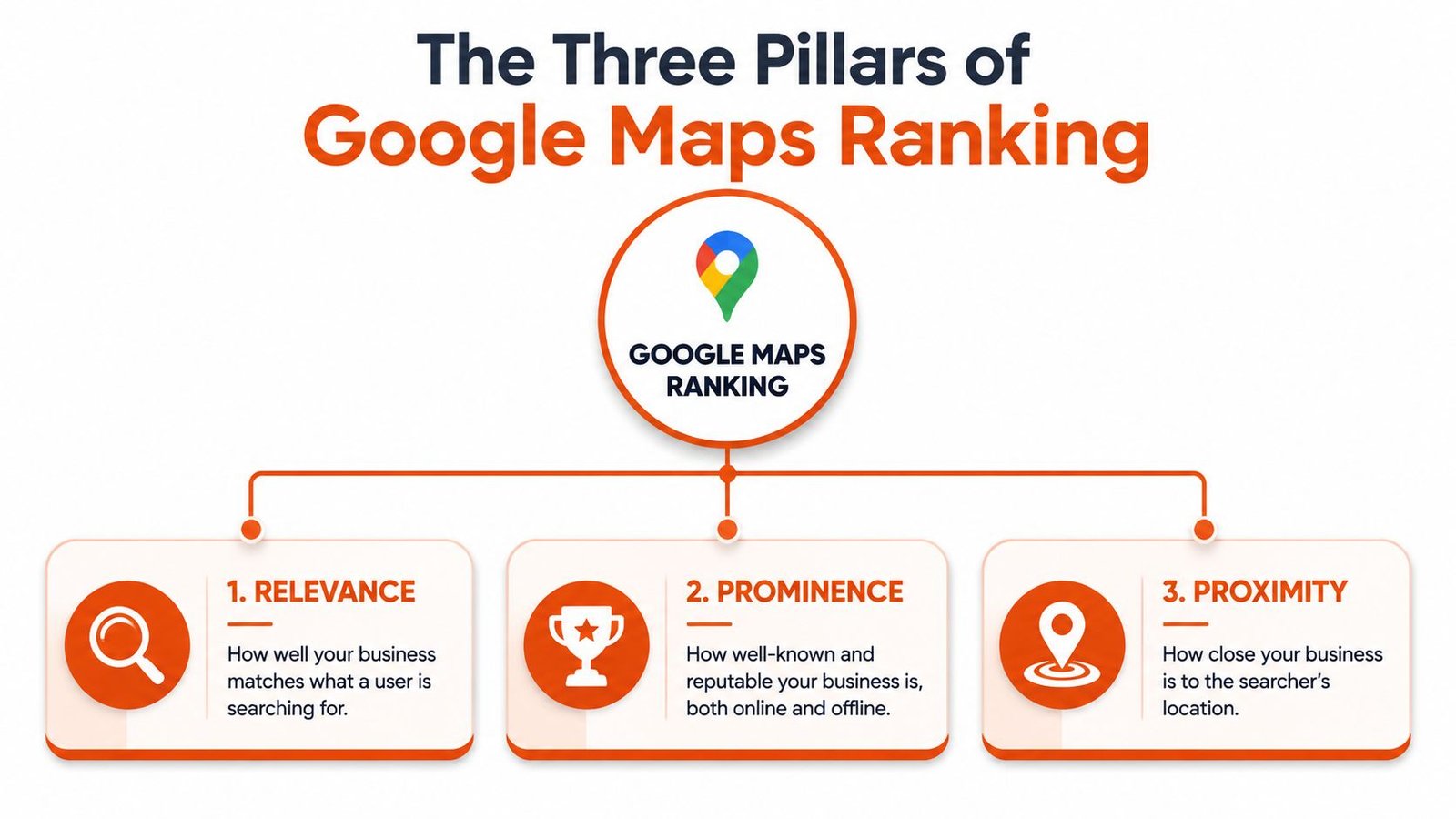
That’s the framework. But most businesses still misread it because they treat each pillar separately. Google doesn’t. It looks for a business that matches the search, serves the area, and appears trustworthy enough to recommend.
For a deeper trust and authority perspective, this guide on E-E-A-T in local SEO for Miami businesses is worth reviewing if you’re comparing agencies on strategy, not just deliverables.
Relevance decides whether you belong in the results
Relevance is about alignment. Does your profile clearly match what the searcher wants?
That starts with category selection, services, business details, and overall completeness. Google’s documentation also notes that businesses with complete and accurate information are more likely to appear in local results, and that recent reviews, raw job site photos, and consistent operating hours help confirm the business is active and legitimate.
If your listing is vague, outdated, or incomplete, Google has less confidence in showing it.
A practical example makes this obvious. A business that clearly presents itself as the specific service a user wants is easier for Google to rank than a business using broad labels and mixed signals.
Distance and prominence decide whether you beat nearby competitors
Distance is straightforward. Google considers proximity to the searcher. You can’t fake geography for long, and you shouldn’t try. Fake locations, virtual offices, or weak address signals usually create more problems than they solve.
Prominence is where the competition gets serious. It reflects how established and trusted your business appears online. That includes reviews, engagement, and wider brand signals.
According to Local Dominator’s summary of the local algorithm, Google’s Maps system is built on Relevance, Distance, and Prominence, and Prominence is driven primarily by review quantity, with a critical trust threshold at exactly 10 verified reviews that triggers a measurable ranking boost when moving from 9 to 10 reviews.
A business doesn’t need the flashiest brand to win on Maps. It needs cleaner signals than the competitors around it.
That matters because many business owners chase cosmetic changes first. New logo. New homepage banner. New tagline. None of that fixes a weak local search foundation.
If you understand these three pillars, you stop asking, “Why am I not ranking?” and start asking the right question. “Which signal is too weak for Google to trust me over the business next to me?”
That’s the question a competent agency should answer quickly.
Your Google Business Profile Is Your Digital Storefront
Your Google Business Profile is the core asset in local search. If it’s incomplete, inaccurate, or poorly structured, your Maps campaign starts weak and stays weak.
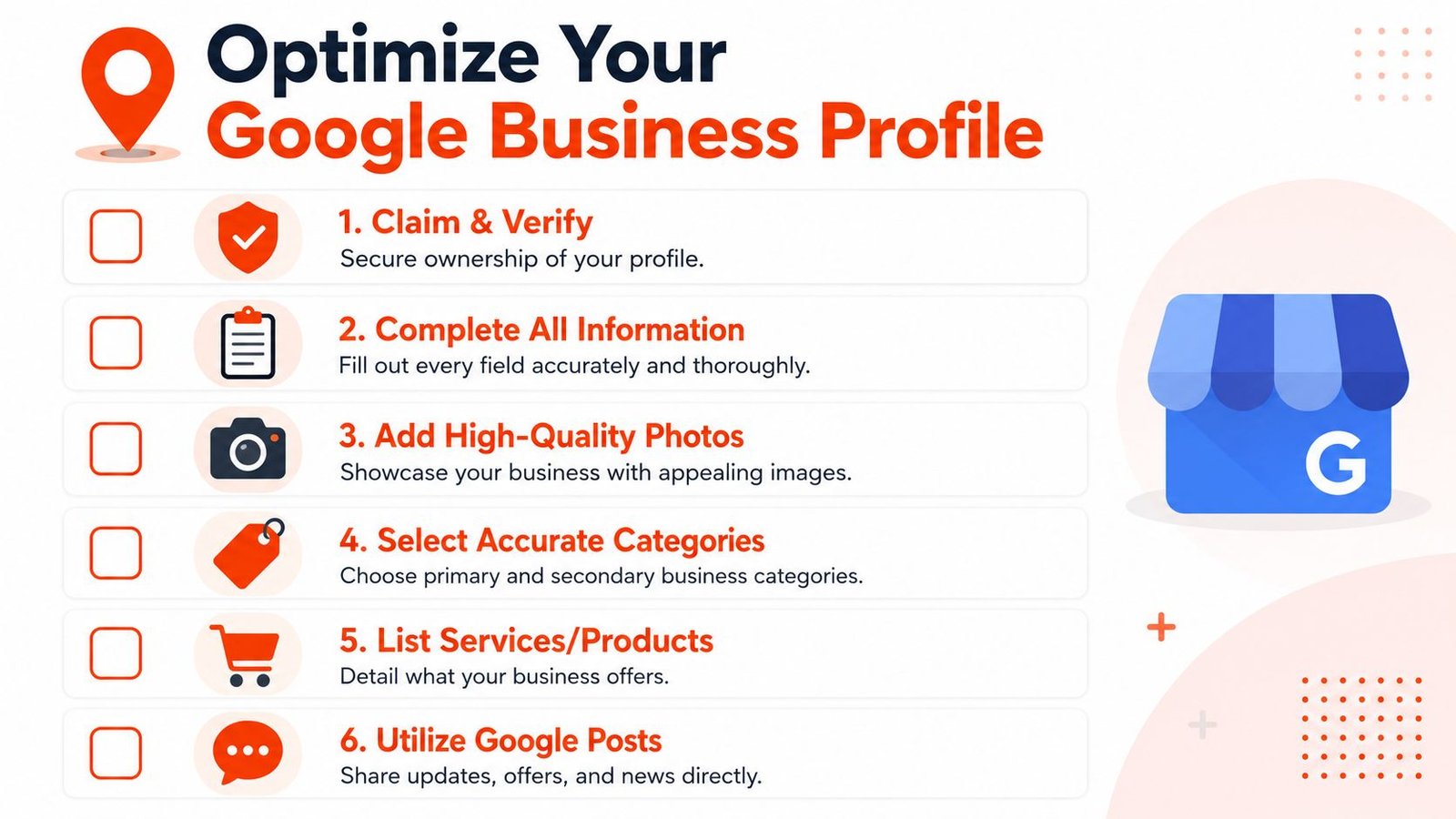
This matters even more because GBP signals account for 32% of the total local SEO ranking weight in 2026, making them the largest single factor group according to ClickRank’s local SEO ranking factors. If you’re asking where to focus first, the answer is your profile.
A strong example of niche profile optimization appears in this breakdown of Google Business Profile for restaurants. The same principle applies across service businesses, professional firms, and multi-location brands.
Your category choice does more work than most businesses realize
According to Whitespark’s 2026 data via Ahrefs, selecting the most specific primary category for your Google Business Profile is the #1 ranking factor for Google Maps. The same source states that businesses targeting 3 to 5 relevant categories, with a clear primary focus, maximize their visibility across multiple search intents without sacrificing relevance.
That means broad category choices cost you visibility.
If you’re an emergency plumber, don’t hide inside a generic category. If you’re a personal injury attorney, don’t make Google guess. Precision wins because Google uses your primary category as a core relevance signal before it evaluates everything else.
Bottom line: The wrong primary category can drag down every other optimization you make.
Many DIY efforts fail right here. Owners choose categories based on how they describe themselves internally, not how buyers search. Those aren’t always the same thing.
This short walkthrough is useful if you want to see how profile optimization looks in practice:
What a properly optimized profile should include
A high-performing profile isn’t built with one field. It’s built through consistency.
Use this as a standard:
- Claim and verify the profile so you control edits, features, and business information.
- Complete every field accurately including business name, address, phone, hours, service details, and business attributes.
- Choose one exact primary category that reflects the main service you want to rank for.
- Add relevant secondary categories only when they match additional services.
- Upload real photos regularly because current visuals help validate that the business is active.
- Use Google Posts intentionally to reinforce activity and direct attention to important offers or pages.
- Keep hours updated especially during holidays, seasonal changes, and special events.
- Avoid keyword stuffing in your business name or description because spam signals can hurt rankings.
A neglected profile sends the wrong message. To users, it looks sloppy. To Google, it looks unreliable.
That’s why professional management matters. Not because the individual tasks are impossible, but because they’re easy to do badly and expensive to ignore.
Building Unshakable Trust with Reviews and Citations
You can’t build local visibility on a shaky reputation layer. Google needs confirmation that your business is real, active, and trusted by actual customers. Buyers need the same thing.

Reviews shape both rankings and response rates
According to this local ranking discussion on YouTube, success rates for top-three ranking increase significantly when businesses maintain 5+ reviews with text, photos, and keywords, and reviews that mention services, locations, or experiences correlate with higher visibility.
That’s why lazy review collection underperforms. “Please leave us a review” isn’t a strategy. Timing, follow-up, and specificity matter.
The best review systems are simple:
- Ask right after delivery when the customer still remembers the service experience clearly.
- Send a direct review link so there’s no friction.
- Request detail, not scripts by encouraging mention of the service, area, or result in natural language.
- Respond to every review because inactive profiles look abandoned.
- Collect reviews continuously instead of in random bursts.
If you serve homeowners or local service buyers, these HomeProBadge’s tips for winning service jobs are helpful because they show how verified reviews influence trust before the phone even rings.
Citations either reinforce trust or create doubt
Citations are mentions of your Name, Address, and Phone, or NAP, across the web. Think directories, local listings, association pages, and other business references.
When those details are inconsistent, Google sees conflicting business data. That weakens trust.
A practical way to tighten that process is to build a formal workflow for customer feedback collection, then connect it to your citation cleanup and review response process so trust signals improve together instead of separately.
Here’s where businesses get into trouble:
| Problem | What it signals |
|---|---|
| Old phone number on directories | Unreliable business data |
| Slightly different business names | Brand inconsistency |
| Wrong suite or street formatting | Location ambiguity |
| Unclaimed listings | Weak ownership and low maintenance |
Reviews help Google trust your reputation. Citations help Google trust your identity.
Most companies ignore both until rankings drop or leads slow down. That’s backwards. Reviews and citations aren’t cleanup tasks. They’re part of the ranking system itself.
Connecting Your Map Listing to Your Website for Conversions
A Google Maps ranking without a strong website is incomplete. The listing gets attention. The website closes the gap between curiosity and action.
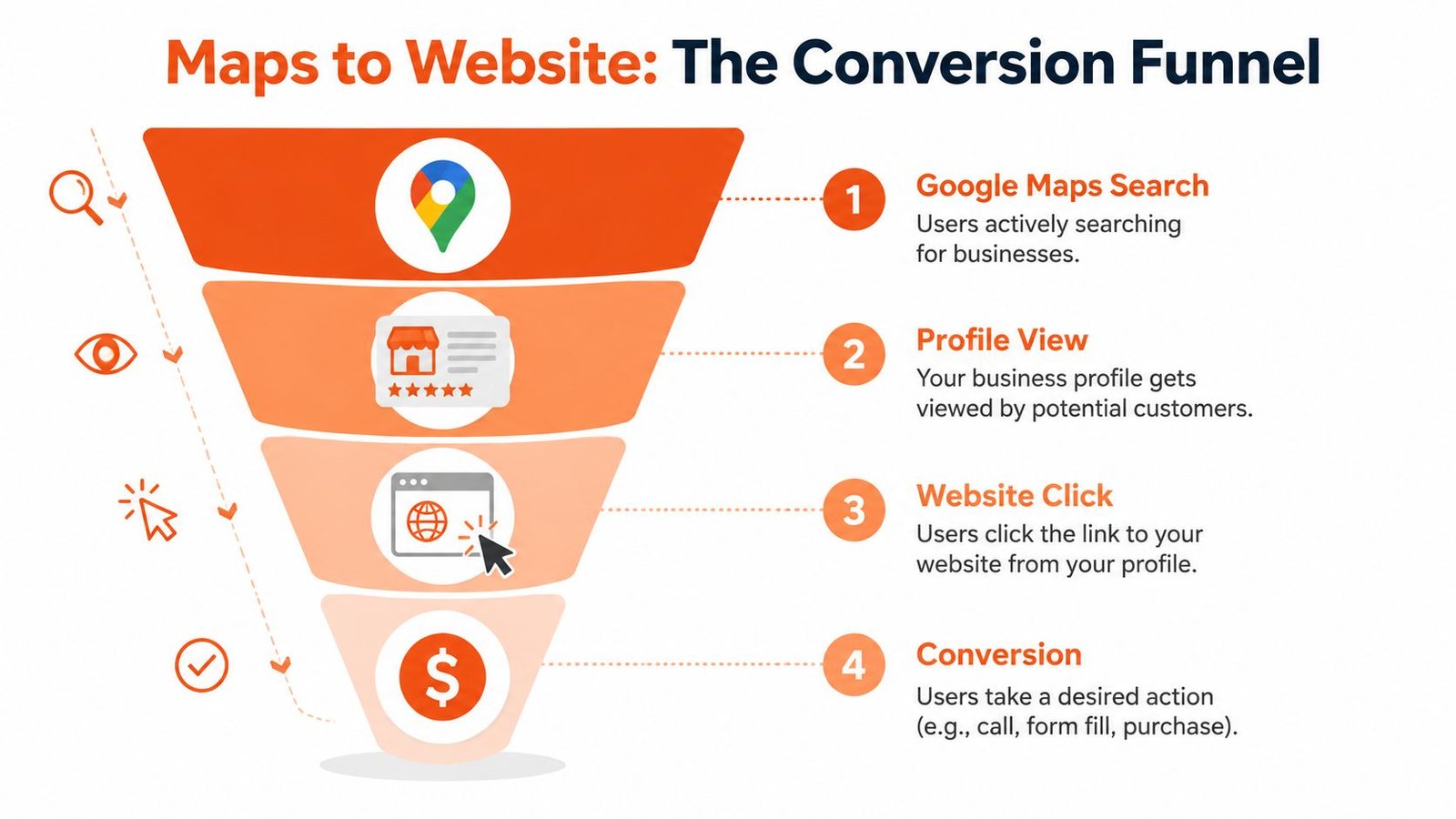
That’s where many businesses waste good visibility. They win the click from Maps, send the visitor to a weak page, and then wonder why calls don’t increase. If the page is generic, slow, vague, or not location-specific, the traffic leaks out.
Your website validates your Maps listing
Google doesn’t treat your profile and website as separate worlds. Your site helps verify your local relevance.
That includes clear service pages, consistent business information, localized content, and map integration. One of the most practical recommendations from the verified local SEO guidance is to embed your Google Business Profile on website pages and keep NAP consistent everywhere your business appears online.
A strong local site should do four things well:
- Match the service intent so the page reflects what the buyer searched.
- Match the geography so the page clearly supports the city or neighborhood you want to rank in.
- Support conversion with obvious calls, trust elements, and friction-free contact paths.
- Reinforce legitimacy through schema, embedded map elements, and accurate business details.
What local landing pages should actually do
According to this 2025 local SEO study discussion, landing pages with a higher “meaningful word count” correlate strongly with local pack rankings, and pages pairing location + service per individual page significantly boost visibility.
That’s the key nuance most businesses miss.
One generic “Services” page won’t do the job if you want to rank in multiple areas. A better structure looks like separate pages for each core service and service area. Not duplicate pages with city names swapped out. Real pages with distinct local relevance.
Use pages like these:
- Plumber in Miami
- Emergency plumber in North Miami
- Drain cleaning in Coral Gables
- AC repair in Aventura
Your website shouldn’t just describe your business. It should prove where you work and what you do best.
And those pages need more than keywords. They need evidence. Mention the service area naturally. Reference the actual service. Add FAQs, location context, and clear conversion paths. Include Local Schema where appropriate and keep your business information aligned with your profile.
If you’re serious about how to rank in Google Maps, your website can’t be an afterthought. It has to support both ranking and conversion, or you’ll pay for visibility with no return.
From Invisible to Inevitable Our Proven Local SEO Process
Most business owners can learn the basics of Google Maps optimization. That isn’t the hard part. The hard part is doing the work consistently, in the right order, and without making trust-damaging mistakes.
Why DIY usually stalls out
DIY local SEO often starts with enthusiasm and ends with neglect.
The owner updates a few fields, uploads some photos, asks for a handful of reviews, and then gets pulled back into operations. The profile stops changing. Citations stay messy. service pages never get built. Competitors keep moving.
The ranking system also reacts to behavior, not just setup. According to LocalHQ’s Google Maps ranking factors, behavioral signals including click-to-call rate, direction requests, and website clicks account for 8% of the total ranking weight, and businesses with high engagement, such as 20+ direction requests per week, tend to rank higher.
That means local SEO doesn’t stop at optimization. It extends into conversion performance, listing attractiveness, and user response.
If you want an outside tool to pressure-test location signals before making changes, a GEO Audit can be a useful reference point alongside manual review and rank tracking.
What a real local SEO system should include
A serious agency process should feel predictable, not mysterious. If you’re comparing providers, ask what happens in the first phase, what gets fixed, what gets built, how progress is tracked, and who is accountable.
A competent process usually includes a structured roadmap like this:
- Initial audit and benchmark
- Review profile setup, categories, service areas, reviews, citations, on-site local signals, and competitor positioning.
- Profile correction and optimization
- Fix errors, strengthen categories, improve completeness, update photos, services, and operating data.
- Citation cleanup
- Standardize NAP across relevant listings and remove conflicting versions where possible.
- Review acquisition system
- Build a repeatable process for asking, following up, and responding without sounding robotic.
- Localized website work
- Create or improve service-area pages, embed maps appropriately, and align on-page signals with the profile.
- Monthly management
- Monitor changes, protect listing accuracy, respond to shifts in visibility, and refine based on engagement patterns.
You should also expect deliverables that remove uncertainty:
- Clear onboarding steps
- Defined communication cadence
- Monthly reporting tied to leads and visibility
- Specific recommendations, not vague summaries
- A single point of contact
- A realistic timeline instead of empty promises
If you want a baseline to compare any provider against, use a detailed local SEO checklist and see who covers the full system.
Can you do some of this yourself? Yes.
Will you do it consistently enough, technically enough, and strategically enough while running a business? Usually not. That’s why hiring the right team isn’t an expense in the usual sense. It’s a way to turn a scattered, fragile effort into a repeatable lead generation system.
And that’s the key decision in front of you. Keep hoping your listing eventually rises on its own, or install a process that makes your business hard to ignore in the exact places buyers are already searching.
If you’re ready to stop losing local leads to stronger Maps competitors, book a strategy call with VIP TECH CONSULTING. They help Miami businesses turn Google Maps visibility, Local SEO, Google Ads, and conversion-focused websites into a predictable pipeline of calls and customers. If you want a quote, a real plan, and a faster path to ranking where buyers are searching, schedule a consultation now. Competitive local markets don’t stay open for long, and the cost of waiting is more missed revenue.