
Bilingual searches
Your customers may search in English or Spanish, from “plumber near me” to “dentista cerca de mí.” When both audiences matter, we build a strategy for both languages.
VIP Tech Consulting is a founder-led local SEO agency in North Miami. With roots in Miami since 2011 and a company founded in 2015, we help Miami businesses show up when nearby customers search on Google — in the Map Pack and organic results.
Local SEO works across both surfaces at once.
Illustrative interface.
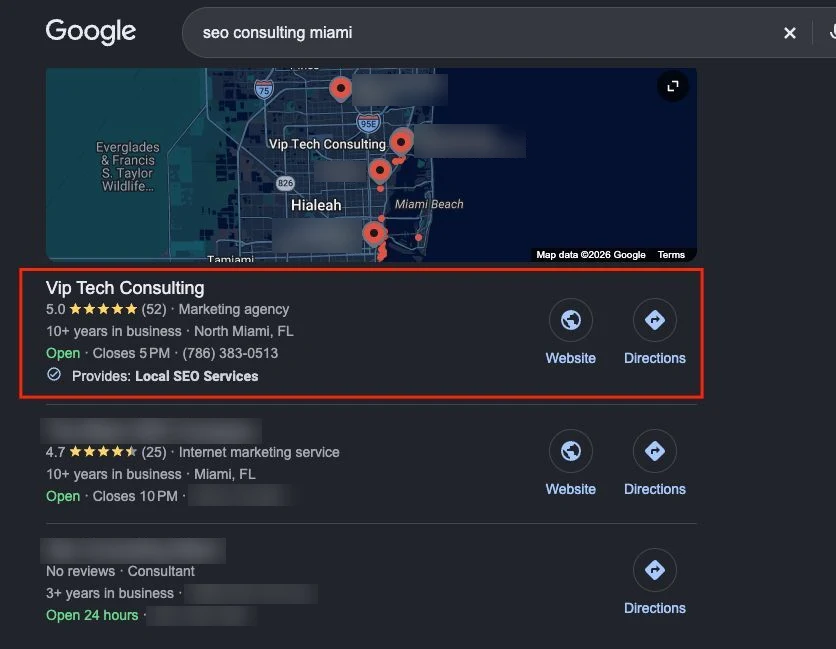
Plenty of agencies promise local rankings they can’t show. This is a real Google search for “seo consulting miami”: VIP Tech Consulting appears #1 in the Google Maps results, ahead of other Miami SEO firms. The local SEO process we use for our own business is the same one we apply to yours.
Screenshot of a Google search in Miami, October 2026. Local results vary by location, device and time, and past results don’t guarantee rankings for other businesses.
We make your business easier to find, easier to choose and harder to ignore.
A system to optimize your Google Business Profile, services and local presence so Google understands when to show your business to nearby customers.
A system for your real customers to leave reviews and for you to respond to all of them. Photos, services and frequently asked questions that build trust.
An automated follow-up system so you don’t lose a single lead. We incorporate a conversational agent that handles messages, follows up and ensures everyone who contacts you receives a response, even when you can’t reply right away.
We do not work with two direct competitors in the same area. When we work with you, we are not helping someone else compete for the same customers.
When someone in Brickell, Doral or Aventura searches for a nearby service, Google can show a local pack alongside organic results. Local SEO helps your business compete for those calls, direction requests and website visits.
Your customers may search in English or Spanish, from “plumber near me” to “dentista cerca de mí.” When both audiences matter, we build a strategy for both languages.
Maps visibility depends primarily on relevance, distance and prominence. A business in North Miami will not automatically rank in Coral Gables: your strategy must reflect the areas you actually serve.
Accurate listings, useful service pages and a consistent review process help people evaluate your business when they compare local options.
Clear, useful content and consistent business information also support how search systems understand your business. There is no special optimization or guaranteed placement in AI Overviews.
Our local SEO services connect your Google Business Profile, website and local presence. Every engagement starts with an audit of your market and the services most important to your business.
Categories, services, products where relevant, descriptions, photos, questions and answers, UTM tracking and weekly posts. We make your profile accurate, complete and useful to potential customers.
We identify and correct inconsistent business names, addresses and phone numbers across relevant listings, including BBB, Yelp, Clutch, Apple Maps, Bing Places and industry directories.
An SMS, email or QR-code process to invite genuine customers to leave an honest review, with response templates in English and Spanish. The process welcomes all feedback, without filtering by satisfaction.
Titles, content, internal links and structured data, plus useful, distinct pages for the cities or neighborhoods you genuinely serve. Need a faster site? See our North Miami web design service.
We develop opportunities for relevant links and mentions from Miami media, chambers of commerce, associations, sponsorships and business partners.
Separate, properly connected service pages for English- and Spanish-speaking customers, plus profile information and a review-response strategy appropriate to your audience.
We improve content clarity, structured data and the consistency of your business information so search systems can understand your services. Inclusion in AI answers is decided by each platform and is not guaranteed.
Geo-grid rank tracking, Google Search Console, GA4 and call tracking. Regular reports connect visibility with calls, direction requests and leads.
Looking for organic SEO beyond Maps? Explore our SEO services in Miami.
We review your Business Profile, citations, reviews, website and the top three Maps competitors for the selected searches. You receive a written report with priorities — free, with no commitment.
Business Profile optimization, NAP cleanup, structured data, tracking setup and fixes to your key service pages.
Service and neighborhood pages, bilingual content, Business Profile posts and photos.
An honest review process, relevant local links, industry citations and digital PR.
Regular reports with geo-grid rankings, call and lead tracking, plus a review call with Simón to decide the next priorities.
Some improvements make your business information clearer from the start. Other benefits develop as useful content, reputation and local authority build on one another.
An optimized Google Business Profile, corrected listings and contact information, and call and lead tracking in place. We also monitor early visibility changes for lower-competition searches and nearby neighborhoods.
Reviews, relevant local links and useful content build over time. We keep improving your presence for competitive searches and tracking the calls, direction requests and inquiries it generates.
Results depend on your category, competition and starting point. We do not guarantee a #1 position.
A different strategy for each business. Explore the work behind these partnerships.
Kosher steakhouse · North Miami Beach, FL
We built and maintain fuegobymana.com, manage the restaurant’s Google Business Profile and have run Google Ads.
Public reputation: 4.7★ from 498 diner reviews on OpenTable, plus 49 Tripadvisor reviews in the October 2026 reference snapshot.
Google Ads, 2018–2019: 1,072 clicks from 42,593 impressions (2.5% CTR), from account data. These are paid advertising results, not organic SEO results.
Modern Mexican kosher steakhouse · Cedarhurst, New York
Since the restaurant’s launch in New York, we designed and built ondasnyc.com, with our credit in the site footer.
A partnership focused on the business’s digital presence.
October 2026 reference snapshot: a 4.7★ Google rating from 158 reviews as reported by Forkstrike, and 4.6★ from 92 ratings on Restaurantji. The Jewish Link covered the opening.
A website partnership in another market; it is presented separately from evidence of local SEO performance in Miami.
Baby & children’s boutique · South Florida retail and e-commerce
We handle local SEO and a content-driven SEO program for NINI and LOLI, creating useful content on its website and promoting it on social media.
A partnership focused on the business’s digital presence.
A family-owned baby and children’s retailer with an online shop and stores across South Florida.
The program connects useful website content, local search visibility and social promotion to support discovery and sales opportunities in stores and online.
Kosher rooftop restaurant & bar · Hollywood, FL
Past client. VIP Tech Consulting handled the restaurant’s digital marketing and local search presence.
A partnership focused on the business’s digital presence.
Public reputation, October 2026 reference: 4.3★ from 850+ Google reviews, as reported by Foodeist and Postcard, and 3.6★ from about 76 Yelp reviews.
These figures describe the business’s public reputation; they are not a measure of results attributable to our past work.
Selected partnerships in South Florida and New York. Public review snapshots describe the businesses; they are not a measure of SEO lift or a claim that our work produced every review. Historical advertising figures are identified separately.
Start with a local SEO diagnosis, not a one-size-fits-all package. We review your business, Google Business Profile, competitors and Miami market before recommending a scope of work.
Categories, reviews, photos and gaps that may limit your visibility.
Who appears in your area, what they do well and where you have opportunities.
Clear next steps, scope and investment before you decide.
Free consultation · No obligation · Straight answers
Based at 11900 Biscayne Blvd in North Miami, we work with businesses across Miami-Dade and South Florida. We focus on the locations your business actually serves.
Local SEO is relevant when customers choose a business in their city, neighborhood or service area.
You work directly with Simón Chocrón on your local SEO strategy.
In Miami since 2011; VIP Tech Consulting was founded in 2015. We understand the neighborhoods and bilingual market.
A 5.0 Google rating from 52 reviews in the October 2026 reference snapshot. Read the feedback and evaluate our work.
A coordinated strategy for both audiences when they are relevant to your business.
Local SEO, organic SEO, web design and Google Ads can work together around your priorities.
Calls, leads and rankings in regular reports.
Got my website up and running so smoothly
Simon does fantastic work! He built our site from scratch and provided excellent support once we took control of it. Highly recommend.
Fast and reliable. Simon is a pleasure to work with and provides great support for our law firm.

It depends on what your business needs. Every engagement starts with a free strategy consultation: we review your business, Google Business Profile, competitors and market, then recommend the work that fits your priorities. You receive a clear plan and investment before committing. There are no long-term contracts.
Some improvements can appear early, especially after profile corrections and for lower-competition searches near your location. Competitive searches take longer, depending on your category, competition and starting point. We do not promise a fixed number of months; regular reports show progress so you can evaluate the results.
You need an eligible, verified Google Business Profile. Businesses that receive customers at an eligible location may show their address; businesses that visit customers can use a service-area setup and hide their address if they do not receive customers there. A virtual mailing address or mailbox does not establish eligibility. We help you choose the correct setup.
The Map Pack commonly shows a map with three business listings. Organic results are the website links elsewhere on the results page. Local SEO works on both: your Business Profile for Maps and your website for organic visibility.
Yes. When both audiences matter, we create coordinated English and Spanish pages and adapt profile information and review responses to the audience. Each language has its own properly connected page.
No. Google controls rankings, and local results vary by location, time and search. We commit to transparent work, clear regular reporting and a strategy grounded in your business and competitive market.
They can work together. Google Ads can provide paid visibility while campaigns are active; local SEO develops visibility without paying for each organic click. The right combination depends on your goals, competition and budget.
A review of your Business Profile, citations, reviews, website and the top three Maps competitors for the selected searches, with a prioritized action list you can use even if you do not hire us.
Get your free local SEO audit to understand what may be limiting your visibility in Miami and where to start.
VIP Tech Consulting · 11900 Biscayne Blvd, Suite 400, Office 454, North Miami, FL 33181 · (786) 383-0513