
A diner is standing on a sidewalk a few blocks from your restaurant, searching “best tacos near me” or “late dinner near me” on Google. They’re ready to spend. They want a place now. If your listing is incomplete, outdated, or buried, Google sends that diner somewhere else.
That’s the cost of a weak Google Business Profile for restaurants. You don’t just lose clicks. You lose reservations, walk-ins, phone calls, direct orders, and repeat business you never even knew you had a chance to win.
For restaurants, this profile is often the first interaction a customer has with your brand. It can account for up to 60% of total website traffic according to Go Fisherman’s restaurant GBP analysis. If that traffic is hitting bad hours, stale photos, or a broken menu path, you’re paying for your own invisibility.
If you already suspect your profile is underperforming, stop guessing. Start with a serious review of what’s broken. A practical place to begin is this local SEO checklist for service businesses and local brands, then compare it against what your restaurant is showing in Search and Maps today.
Table of Contents
- Your Restaurant Is Losing Customers You Never Knew You Had
- The Critical Mistakes That Make Your Profile Invisible
- The Anatomy of a Customer-Generating Restaurant Profile
- Turning Your Profile Into an Active Marketing Channel
- Why Expert Management Is the Only Logical Choice
- Stop Guessing and Start Dominating Local Search
Your Restaurant Is Losing Customers You Never Knew You Had
Most restaurant owners notice slow nights. What they don’t notice is how many ready-to-buy customers never make it to the website, never call, and never ask for a table because Google filtered them out before they had a chance.
That’s why a Google Business Profile for restaurants isn’t some side task for the host stand or a thing you update when someone remembers. It’s a revenue channel. If it’s neglected, it becomes a leak in the business.
A strong profile doesn’t just help people find you. It helps them choose you. Searchers compare photos, hours, menu access, reviews, service attributes, and how current the listing feels. Restaurants that ignore those details usually blame “competition” when the actual problem is poor local search execution.
The loss happens before the customer reaches your website
A lot of operators still treat Google as a digital phone book. That’s outdated thinking.
Your profile is where customers decide whether your place looks open, active, trustworthy, and worth the trip. If your menu is hard to access, your photos are weak, or your listing looks abandoned, they don’t investigate further. They tap the next option.
Practical rule: If a hungry customer has to work to understand your menu, hours, or ordering options, they won’t. They’ll pick the restaurant that makes the decision easy.
This matters even more if you’re trying to boost restaurant repeat visits. Repeat traffic doesn’t come only from great food. It comes from removing friction every time someone wants to find you, book, call, or reorder.
Silence in Google Maps is not neutral
An unmanaged profile doesn’t sit there harmlessly. It actively undercuts your visibility.
A customer searching at lunch sees a competitor with fresh dish photos, current hours, and clear ordering options. Your restaurant shows old holiday hours, a blurry cover image, and no clear menu experience. Google didn’t “hurt” you. You handed the advantage away.
If that sounds familiar, you’re already at the point where a proper audit makes sense. The restaurants that fix this early recover attention faster. The ones that wait usually keep losing business while assuming the problem is seasonal, economic, or random.
The Critical Mistakes That Make Your Profile Invisible
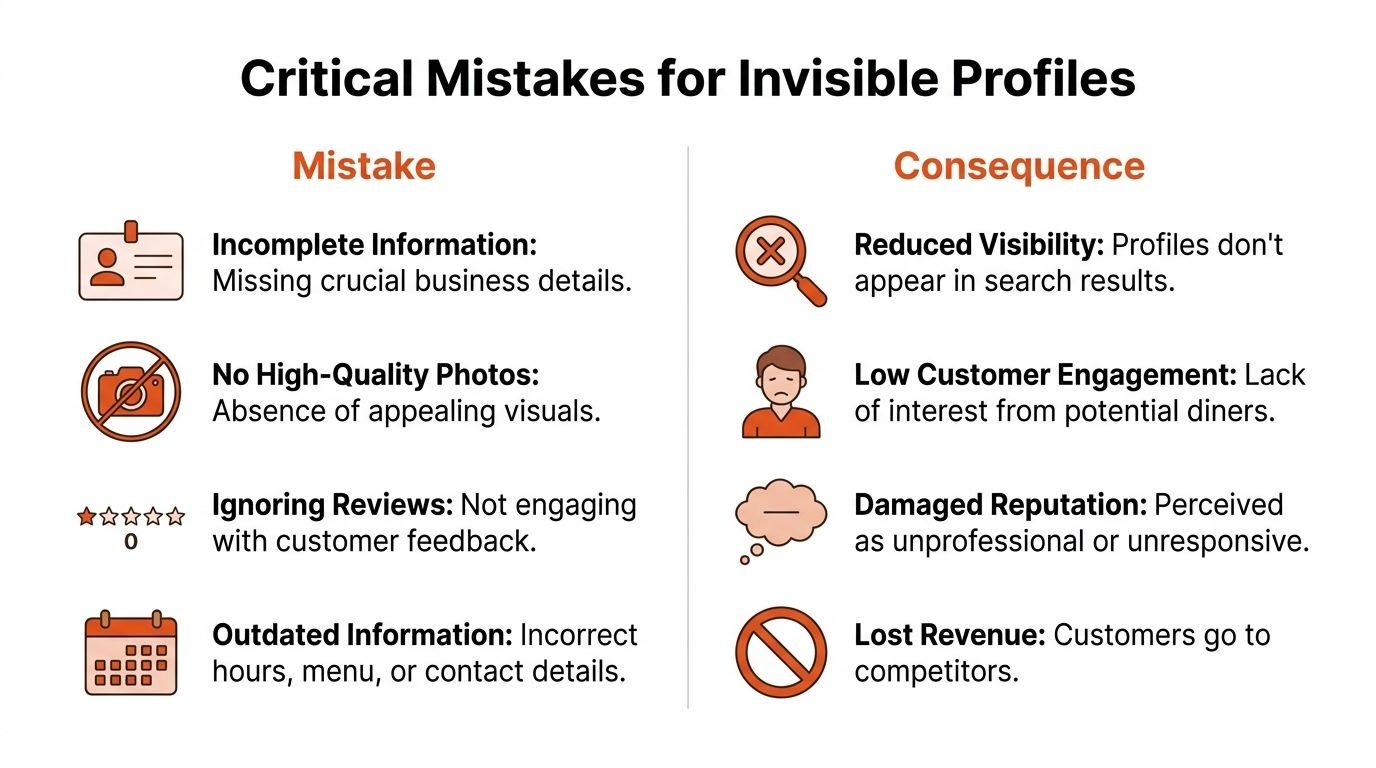
The biggest mistake restaurant owners make is thinking profile problems are minor. They’re not. They directly affect whether your business appears, gets clicked, and earns trust.
Google rewards completeness and consistency. According to Beyond Menu’s breakdown of Google Business Profile performance, fully complete profiles earn 7× more clicks and 70% more visits than incomplete profiles. That gap is massive in a category where purchase decisions happen fast.
Incomplete profiles lose the click before the customer ever calls
Restaurants often leave obvious fields half-finished. Missing service details, weak categories, no ordering link, no menu URL, old attributes, and thin photo galleries all send the same message: this business is not actively managed.
Here’s what that usually looks like in practice:
- Generic category selection: Choosing “Restaurant” when a more specific category would match actual search intent better.
- Thin profile content: No useful description of the dining experience, cuisine, or service model.
- Weak visual proof: A logo, one exterior photo, and nothing else.
- Broken conversion path: PDF menus, third-party dead ends, or no direct order path at all.
A restaurant can serve incredible food and still lose local search because the listing doesn’t communicate relevance clearly enough.
Bad maintenance tells Google your restaurant isn’t reliable
The second class of mistakes is operational neglect. In this situation, DIY management usually breaks down.
Hours don’t get updated for holidays. Seasonal items stay live long after they’re gone. Review responses pile up unanswered. The Q&A section gets ignored. Duplicate listings sit unresolved. NAP consistency drifts across your site, directories, and apps.
That kind of sloppiness hurts users first. Then it hurts rankings.
If you run a physical location, the profile also shapes expectations beyond SEO. Clean operations, accurate public information, and trust signals all reinforce each other. That’s true online and offline. For example, restaurants dealing with sanitation or facility issues should treat those as visibility issues too, which is why operational resources like pest control for GTA restaurants matter more than owners often admit.
A stale profile tells customers your dining room might be stale too.
If you’re serious about improving trust signals, your review and reputation workflow matters as much as your listing setup. A strong companion process starts with better customer feedback collection systems for local businesses, because restaurants can’t improve public perception if they’re not consistently collecting and acting on guest feedback.
The Anatomy of a Customer-Generating Restaurant Profile
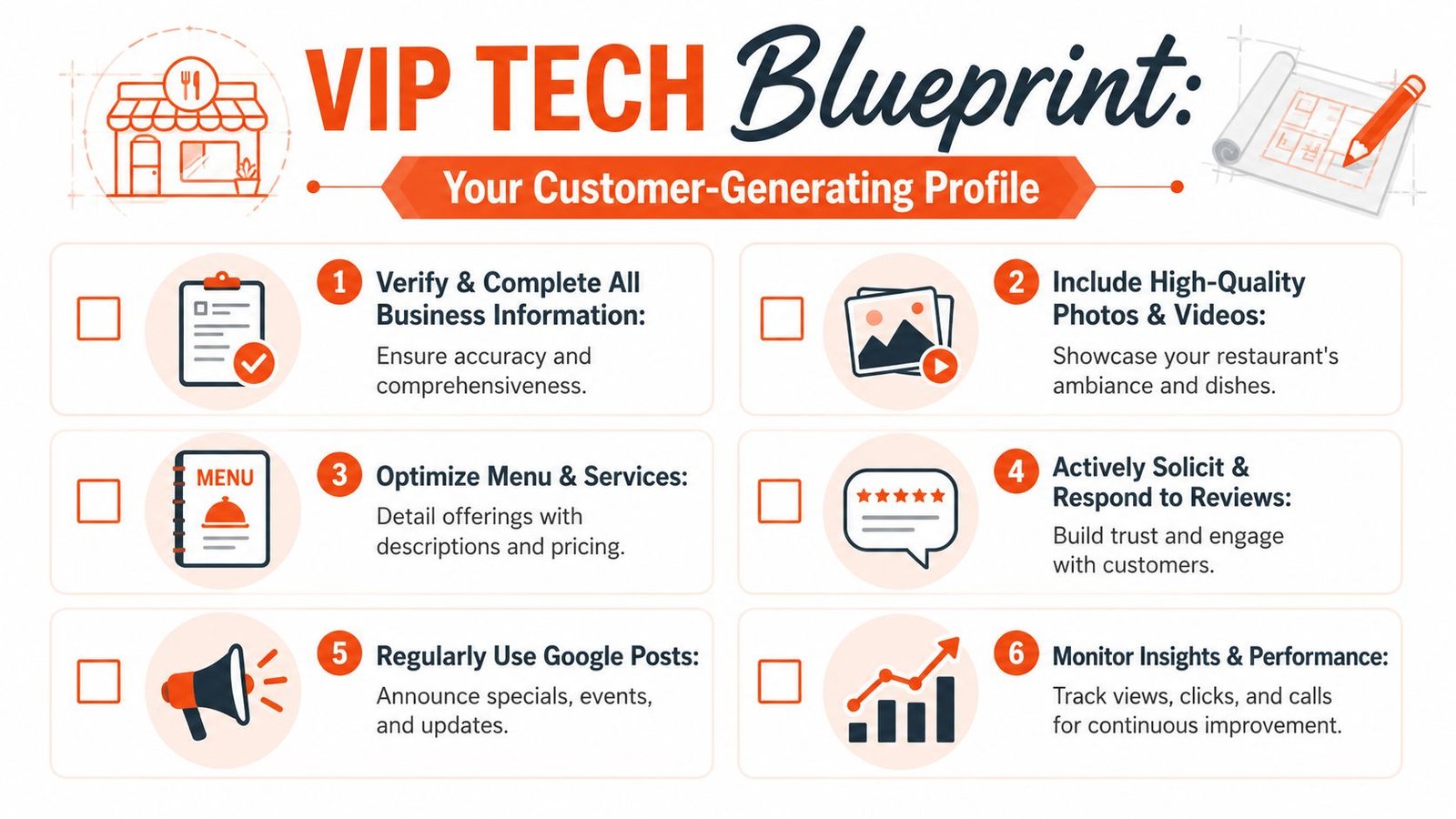
A high-performing Google Business Profile for restaurants follows a clear pattern. It’s complete, current, easy to use, and built to convert hungry searchers into diners, callers, and direct orders.
Generic advice frequently falls short. Owners get told to “fill out your profile” without being told what truly drives action. The difference between an average listing and a profitable one is not effort alone. It’s knowing which elements move customers.
Build the profile the way Google and diners actually use it
The foundation has to be exact.
Start with ownership and verification. Then complete every field with matching NAP details across your website and major listings. Choose the most precise primary category possible. A taqueria should say taqueria. A Neapolitan pizza restaurant should say that. Specificity improves relevance.
Then tighten the experience layer:
| Profile element | What it should do |
|---|---|
| Primary category | Match the main cuisine or concept precisely |
| Hours and special hours | Prevent customer frustration and “closed” signals |
| Attributes | Clarify dine-in, takeout, delivery, accessibility, and amenities |
| Website and order links | Send users to direct, crawlable pages |
| Photos | Prove food quality, ambiance, and legitimacy |
Restaurants also need one active profile per address. No duplicates. No naming chaos. No inconsistent phone numbers across platforms.
The best restaurant listings answer the customer’s decision questions before they ask them.
If your website experience is weak, the profile can only do so much. That’s why your menu pages and order paths need to connect to a site that’s built for conversion. This guide on the best website builders for restaurants is useful if your current setup still relies on clunky PDFs or slow mobile pages.
Menus and visuals drive action
Many restaurants often leave money on the table.
According to Restolabs’ restaurant Google Business Profile analysis, 90% of guides focus on adding menu items, yet 68% of restaurants fail to update them within 30 days, causing 42% of customer complaints. The same source reports that profiles with menu item photos and actual menu scans receive 3.2x more clicks, but only 12% of restaurants use this dual-upload approach.
That tells you two things. First, menu accuracy is not cosmetic. It affects trust. Second, the visual presentation of your menu influences whether people act.
A customer-generating profile should include:
- Structured menu entries: Clear sections, item names, descriptions, and pricing where possible.
- Current signature items: Not dishes you removed last season.
- Photo variety: Exterior, interior, team, plated dishes, drinks, and menu visuals.
- Decision support: Service-specific info for takeout, dine-in, and delivery.
Restaurants often obsess over social media while ignoring the one platform catching demand at the moment of intent. That’s backwards. When someone searches for food nearby, Google is closer to the sale.
Turning Your Profile Into an Active Marketing Channel
Most restaurant profiles die after setup. That’s where performance flattens out.
An effective listing isn’t static. It behaves like an active local marketing asset. It promotes specials, answers objections, manages reputation, and keeps sending freshness signals to Google and to customers who are comparing options in real time.
Near the top of the funnel, visual storytelling still matters. A current profile should reflect the dining experience customers can expect today, not six months ago.
Posts turn passive listings into active demand capture
Google Posts are underused because owners don’t see them as revenue tools. That’s a mistake.
Weekly specials, brunch promos, holiday menus, tasting events, chef features, and limited-time offers belong on the profile. Not buried only on Instagram. Searchers who find you in Google should see signs of life immediately.
According to Chowly’s restaurant SEO guide, weekly posts can increase profile engagement by 2.3x. That matters because engagement is often the difference between a listing that feels active and one that feels neglected.
Posts work best when they’re tied to a direct action:
- Seasonal offers: “Summer patio menu now live”
- Event-driven traffic: “Live jazz Friday”
- Operational updates: “Open for late-night service”
- Revenue intent: “Order direct for pickup”
This is also where paid traffic and local SEO should support each other. If you’re already investing in Google Ads for restaurants, your profile needs to be strong enough to convert branded and local search traffic you’ve already paid to generate.
Reviews and Q-and-A shape buying decisions fast
Review management is where many restaurants lose control of the story.
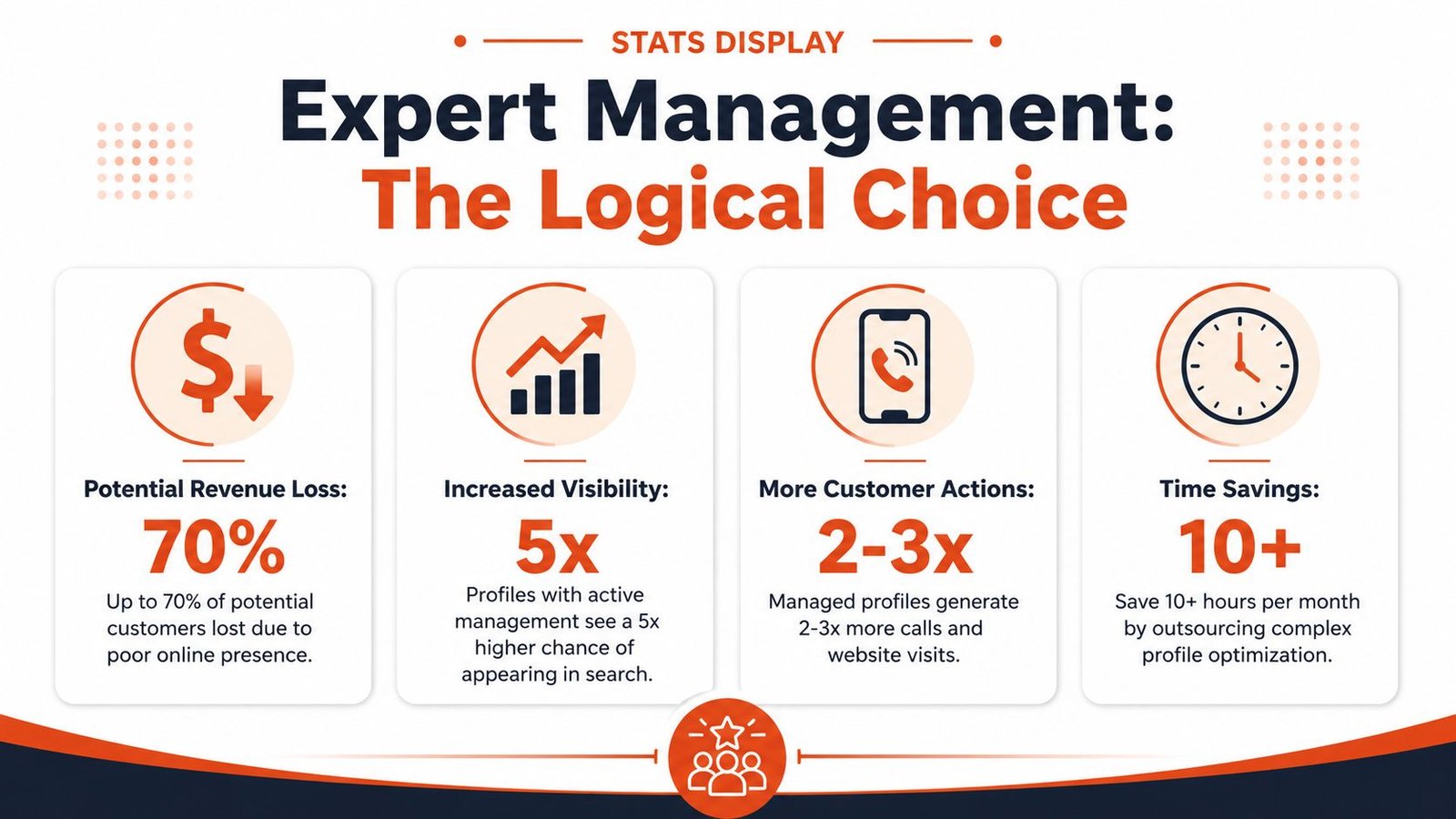
Chowly’s analysis also found that 68% of restaurants fail to reply to reviews within 48 hours, and that Google can reduce an inactive profile’s appearance in the Local 3-Pack by half when the profile shows inactivity on key engagement signals. If your team responds late, or not at all, you’re not just creating a service issue. You’re creating a visibility issue.
Responding to reviews isn’t customer service theater. It’s local search maintenance.
A good review workflow does three things:
- It asks satisfied diners for feedback while the experience is still fresh.
- It replies promptly with specifics, not copy-paste fluff.
- It surfaces patterns the operator should fix inside the business.
Q&A matters too. Customers ask about parking, reservations, gluten-free options, patio seating, delivery, and private events. If you don’t manage that section, random users do it for you, and those answers are often incomplete or wrong.
Video training helps teams understand how all these pieces fit together in real search behavior. This walkthrough is worth reviewing with anyone responsible for visibility and guest communications:
The owners who say “I’ll update it when I get time” rarely do. And when they finally look again, the profile has been sitting still while competitors kept publishing, replying, and attracting action.
Why Expert Management Is the Only Logical Choice
Restaurant owners usually ask three questions.
Is this worth paying for? Can my staff do it? How fast will it matter?
The first question is easy. If your profile influences whether customers call, visit, reserve, or order, then mismanaging it costs more than managing it. The second question is also easy. Yes, your staff can technically log in. That doesn’t mean they’ll manage categories, menu structure, review flow, photo cadence, duplicate suppression, and ongoing optimization correctly or consistently.
The do-it-yourself objection falls apart quickly
DIY works only when someone owns the process and understands local search mechanics. In most restaurants, that person doesn’t exist.
Managers are dealing with staffing, prep, guest issues, scheduling, vendors, and service. They are not auditing menu indexing, monitoring listing changes, or testing what happens after a category adjustment. That’s not a criticism. It’s reality.
A serious profile requires recurring work such as:
- Structured menu management: Adding and refining menu data inside the profile itself.
- Review operations: Tracking response times and improving public sentiment.
- Content updates: Posts, photos, service changes, and seasonal messaging.
- Performance analysis: Watching what changes produce more calls, clicks, and direction requests.
What professional management actually changes
The biggest lift usually comes from fixing what owners overlook.
According to David “Rev” Ciancio’s Google Business Profile playbook for restaurants, adding a structured menu through Google Business Profile’s native menu tool is a high-impact SEO action, and 78% of users who view a structured menu are more likely to complete an order or booking. Many restaurants still don’t implement this correctly.
That is exactly why expert management makes sense. Professionals don’t just “keep the listing updated.” They build the profile around buying behavior and local search visibility.
If you’re comparing providers, don’t choose based on who offers the cheapest monthly package. Choose the team that understands restaurant search intent, direct order paths, review systems, and local map visibility. A strong benchmark for that kind of work is a focused service built around restaurant SEO services, because your profile should be managed as part of a larger customer acquisition system, not as an isolated listing.
Stop Guessing and Start Dominating Local Search
Your Google Business Profile is either helping your restaurant win local demand or handing that demand to competitors. There isn’t much middle ground.
Customers don’t care how busy you are, how good the food is, or how strong your word-of-mouth has been if your profile makes your business look uncertain, outdated, or hard to choose. They’ll pick the place with the clearer menu, better proof, and easier path to action.
The restaurants that grow from local search usually do the simple things better and more consistently. They keep hours accurate. They manage reviews fast. They publish updates. They treat menu trust seriously. They understand that Google Maps is often the first dining room a customer sees.
If your broader retention strategy also needs work, practical ideas like these ways to keep customers coming back can support what a strong profile starts. Visibility gets the first visit. Better follow-up and experience help earn the second.
Waiting costs more than most owners think. Every day your profile is weak, your competitors get more chances to take the customer who should have found you first.
If you want a team that treats your Google Business Profile like the revenue asset it is, talk to VIP TECH CONSULTING. They help restaurants and local brands improve Maps visibility, tighten conversion paths, and turn local search into more calls, orders, and booked consultations. If your listing is underperforming, book a strategy session and get a clear plan before another busy shift goes to a competitor.