Digital marketing for education isn’t a branding nice-to-have anymore, it’s the difference between steady inquiries and an empty admissions calendar. Institutions spent over $2.4 billion on advertising in the first half of 2025 alone, and total higher-education digital media spend surpassed $2.77 billion in 2025, up from $2.55 billion in 2024. That shift is documented in the education marketing benchmark data, and it should change how you buy media, build pages, and measure enrollment.
If your programs don’t show up when families, students, or adult learners search, somebody else gets the call. The smarter move is a system that uses SEO to lower acquisition cost over time and Google Ads to fill the funnel while search equity catches up. If you want that kind of setup, book a strategy call before another admission cycle burns budget on traffic that never turns into inquiries.
Table of Contents
- Why Education Brands Cannot Afford to Be Invisible Online
- The Three Audiences That Decide Every Education Campaign
- Channel Strategy and Actual Cost-Per-Enquiry Numbers
- SEO and Local SEO That Actually Ranks Education Brands
- Google Ads and Meta Ads Built for Enrollment Inquiries
- KPIs, Attribution, and the CRM Handoff Most Schools Miss
- A 90-Day Implementation Roadmap With Sample Budgets
- Why Education Brands Hire a Specialized Agency Instead of Doing It In-House
Why Education Brands Cannot Afford to Be Invisible Online
Being invisible in search is expensive, and not in a vague brand-awareness sense. Education buyers are already comparing schools, programs, and training providers, so page-two visibility is a lost lead. Search and paid channels now take most of the budget attention in the market, and education brands that stay offline lose ground fast.
That’s why weak visibility costs more than traffic. It creates fewer inquiries, slower admissions response times, more dependence on last-minute discounting, and more pressure on the team to do more with less when the pipeline is already thin.
Practical rule: If your admissions team is still waiting for walk-ins, referrals, or random social posts to carry enrollment, your digital funnel is already underbuilt.
A serious digital marketing for education plan turns intent into contact. It should produce form fills, booked calls, and qualified conversations, not just impressions. SEO, Google Ads, local visibility, and nurture need to work as one system, because they all serve the same enrollment goal.
The sequence matters. SEO lowers acquisition cost over time, while Google Ads fills the funnel in the first 90 days and keeps demand moving while organic pages build authority. For schools that want more qualified search traffic, a focused plan for increasing organic traffic the right way gives the site a better shot at capturing the searches that already show intent.
The teams that win this quarter do not chase vanity traffic. They build a path from search to inquiry to admissions follow-up, then keep tightening that path until it produces booked consultations consistently.
The Three Audiences That Decide Every Education Campaign
Treating “students” as one audience is the fastest way to waste money. A certificate buyer on mobile, a parent comparing tuition and outcomes, and a corporate learner buying upskilling for a team need different messages, different proof, and different conversion paths. If your site and ads speak to all three with the same copy, nobody feels understood, and inquiry rates drop.
Prospective students
These buyers move fast, especially on mobile. Education sites see 62% of visits from mobile devices, average session duration is only 2 minutes 45 seconds, and bounce rate averages 55.4% based on the benchmark data. That means program pages need a clear promise, a clean path to inquiry, and no clutter that makes a student back out.
The page should answer one question immediately, “Why this program, why now?” If the answer is buried under generic brand copy, the visit is lost.
Parents and guardians
Parents want reassurance, not hype. They want outcomes, affordability, support, and a reason to trust the institution with a major decision. The right conversion asset here is usually a clear program guide, a comparison page, or a consultation call that answers practical concerns before the parent has to chase anyone for clarity. A practical framework for that kind of trust-building is outlined in this content strategy guide.
Corporate and adult learners
These buyers act more like procurement. They care about schedule flexibility, return on investment, and the speed of getting from interest to enrollment. Long-form pages, program-specific lead forms, and direct consultation booking tend to work better than broad brand content.
Trust is built when the page matches the buyer’s situation, not when the site uses the same message for everyone.
The practical move is to build separate tracks. Student pages should be mobile-first and intent-heavy. Parent-facing pages should carry proof and clarity. Corporate pages should speak to outcomes, delivery, and decision speed. Once you split the audience correctly, your ads, SEO, and follow-up sequence stop fighting each other.
Channel Strategy and Actual Cost-Per-Enquiry Numbers
A lot of education marketing advice sounds smart and still wastes money. The channel mix only works when each channel has a job in the enrollment sequence. Google Ads buys speed, SEO lowers acquisition cost over time, Meta Ads captures warm interest, and email converts prospects after they have already shown intent.
The clearest benchmark is simple. Average Google Ads CPC reached $6.23 in 2025 in the education search benchmark data. Paid search delivered 18 to 22% of qualified enquiries for UK universities at a £950 to 1,400 CPA, while organic search generated 28 to 32% of qualified enquiries at a lower £580 to 850 CPA in the education search benchmark data. That is why SEO becomes the efficiency engine once the campaign has momentum.
| Education Channel Economics at a Glance | Avg CPC | Typical CPA | Conversion Role |
|---|---|---|---|
| SEO | Not quoted in the benchmark set | Lower CPA once mature | Long-term demand capture |
| Google Ads | $6.23 | £950 to 1,400 | Fast enrollment demand capture |
| Organic Search | Not a CPC channel | £580 to 850 | Efficient qualified enquiries |
| Meta Lead Gen | Not quoted in the benchmark set | Not fixed in the benchmark set | Warm lead capture and retargeting |
| Email Nurture | Not a CPC channel | Not fixed in the benchmark set | Converts warm prospects |
Education sites also convert differently by channel. Meta lead-generation campaigns in education report a 10.05% conversion rate, and email to warm prospects can reach 7.7% conversion. For context on how local intent affects enquiry flow, see this local SEO explanation for service businesses. That means you should spend for speed in one place and squeeze more value out of prospects already in your CRM in another.
SEO is the long-term cost reducer. Google Ads is the short-term enquiry engine. Meta and email sit in the middle, where they push interested people back into the form-fill path instead of letting them disappear after the first visit. Treating all four channels as equal only drives up cost per enquiry.
If you want to structure this properly, start with Google Ads to create immediate enquiry volume, build SEO to reduce dependence on paid clicks, and use Meta plus email to retarget and nurture. Teams that use that sequence get cleaner reporting and better control over spend. The Nuwtonic Agentic SEO and GEO Platform can help teams keep search visibility and enquiry capture tied to the same pipeline goals.
SEO and Local SEO That Actually Ranks Education Brands
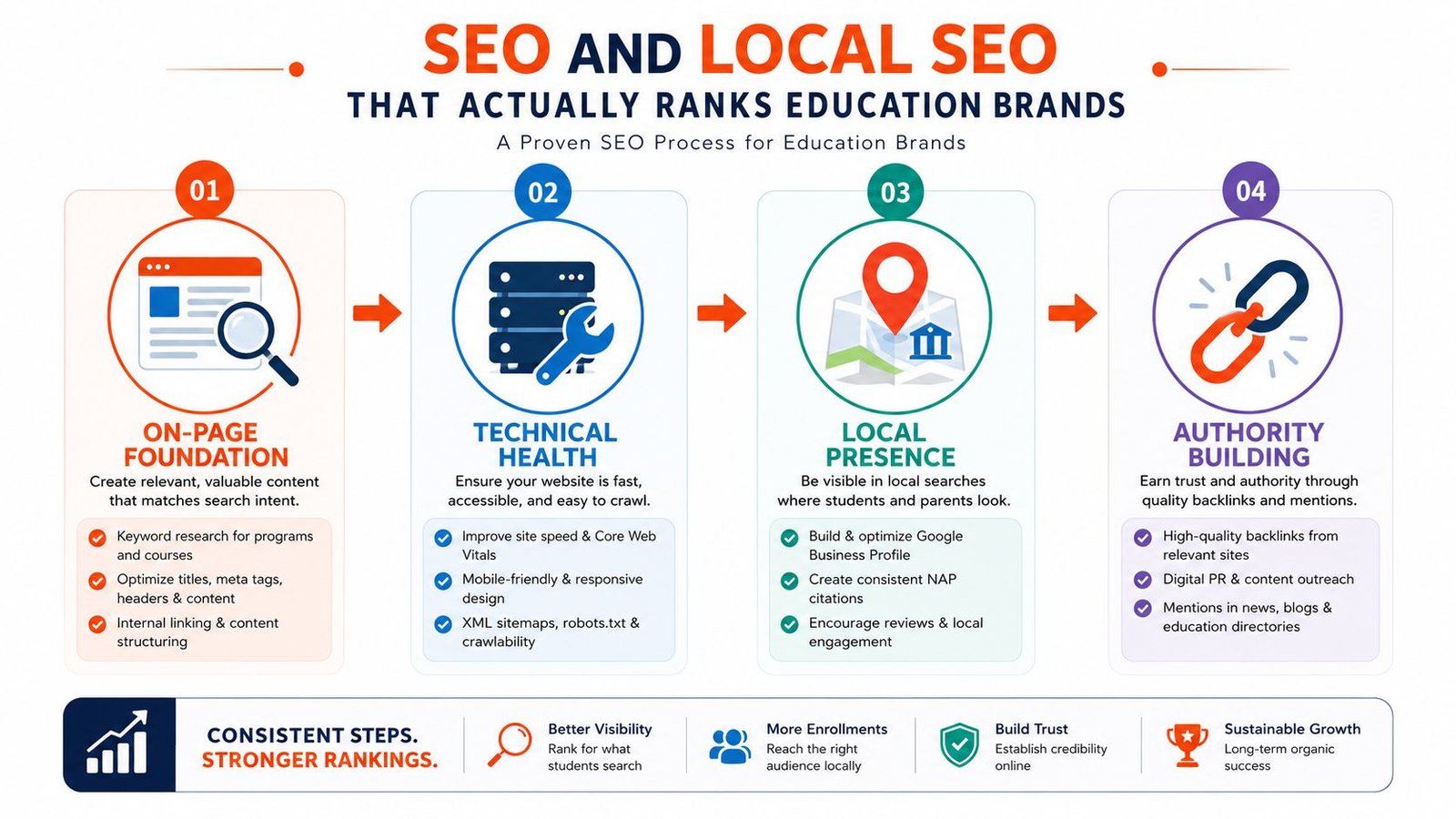
Education SEO works when the site is organized around intent, not departmental politics. Program pages should cluster around searches people use, like location-based program terms and specific course names. A page for “MBA near me” or a city-specific bootcamp page needs the same structure every time, clear offer, clear outcomes, clear inquiry path, and enough local relevance to matter.
Build around program intent
Program pages should not read like brochures. They should answer the exact search intent behind the query. That means tuition, entry requirements, schedule, location, delivery format, and a visible inquiry button. If someone searches a nearby city plus a program name, the page should make it obvious they’re in the right place.
Make local presence visible
Multi-campus schools need disciplined Google Business Profile management for each location, not one vague brand profile that tries to do everything. Reviews matter because local visibility depends on trust signals, not just keywords. Citation consistency and location-specific content help the right campus show up for the right search.
Build for AI search, not just classic rankings
Recent higher-ed guidance now emphasizes making core facts easy for AI systems to extract, especially around affordability, outcomes, and student life from the Encoura guidance. That changes how pages should be written. Clarity beats cleverness.
If you want an example of how broader local visibility strategy fits into a service business model, this local SEO explanation shows the logic well. For education brands, the same principle applies. Make the location, offer, and proof easy to read.
One useful resource for future-facing discovery is Nuwtonic Agentic SEO and GEO Platform, especially if your team is trying to understand how extractable content and search visibility can work together. The point isn’t to chase every trend, it’s to structure content so humans and AI systems can both understand it quickly.
Google Ads and Meta Ads Built for Enrollment Inquiries
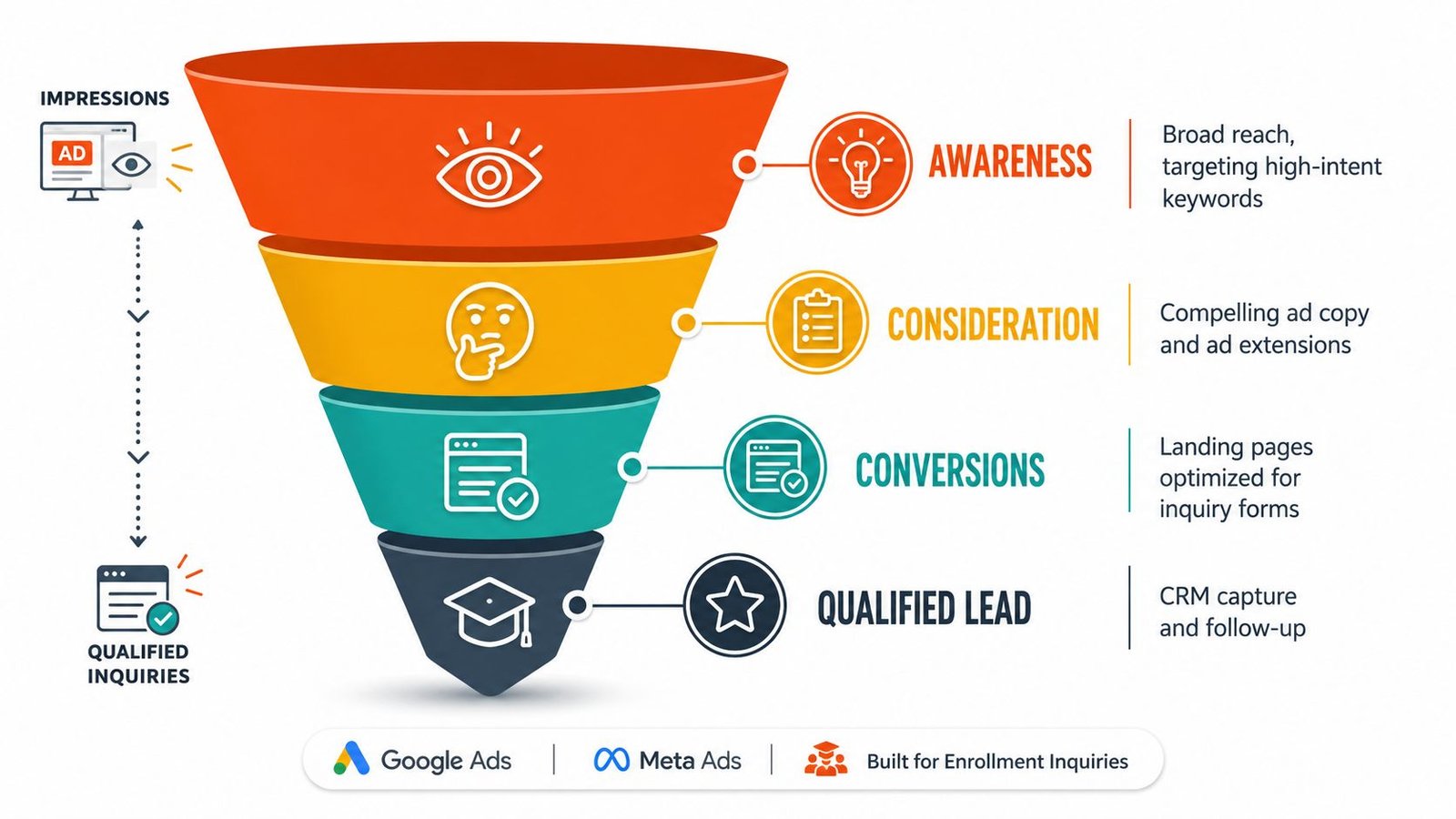
Paid media has to capture intent, not just curiosity. Build Google Ads around the programs, locations, and search terms that signal an inquiry is close, because one generic account usually burns budget on researchers, job seekers, and competitors.
Build search campaigns around intent tiers
Use exact and phrase match for high-intent searches, then load the account with negative keywords so irrelevant traffic never gets through. Separate campaigns for undergraduate, graduate, continuing education, and certificate programs keep reporting clean and show you where lead quality is strongest. If the landing page does not match the query, you pay for the click and lose the inquiry.
Program pages should also carry the message from SEO work. That sequencing matters because organic pages lower acquisition cost over time, while Google Ads fills the funnel in the first 90 days and gives you immediate inquiry volume while rankings catch up.
Make the landing page do the selling
The ad opens the door. The page closes the lead.
Short forms, one clear call to action, and visible trust elements beat polished visuals every time. Education buyers are not looking for creative awards. They want a fast path to admissions without wasting time, and they will fill out a form when the page makes that path obvious.
Meta works when the offer is simple and the form is short. Lead-gen campaigns on Facebook often perform well for warm audiences and retargeting, which is why this Facebook Ads lead generation guide is worth following if you want a practical setup. The same logic applies to education campaigns, use the platform to keep the funnel moving, then hand the best leads into admissions quickly.
Keep the account simple. Run one campaign for immediate intent, one for retargeting, and one for nurture. That structure makes budget decisions easier and keeps the team focused on which clicks produce conversations. A service like this CRM for tutoring businesses helps make that handoff cleaner when inquiries need to move from ad click to admissions follow-up without delay.
KPIs, Attribution, and the CRM Handoff Most Schools Miss
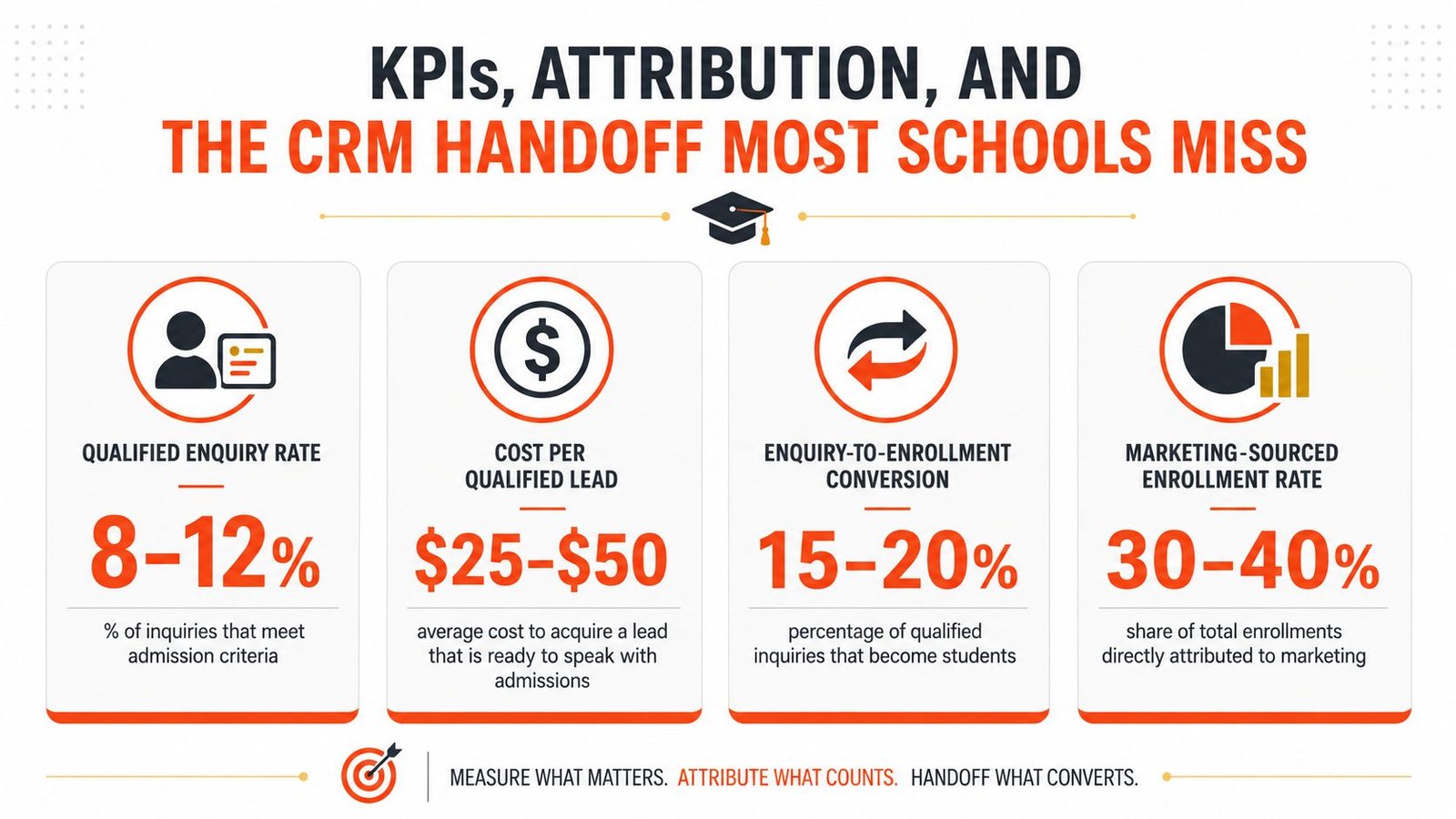
Too many education teams report activity instead of outcomes. Traffic, impressions, and follower counts don’t pay tuition. A clean dashboard should prioritize qualified enquiry rate, cost per qualified lead, enquiry-to-enrollment rate, and marketing-sourced enrollment rate because those are the numbers tied to real revenue, not surface-level momentum.
Track the lead all the way through admissions
If a form fill lands in a spreadsheet and nobody tags the source, the data is already weak. Call tracking, form tracking, and CRM stages need to work together so you can see which keyword, ad, or page produced a real enquiry. Once that’s in place, weekly budget decisions become rational instead of political.
Use a CRM that can hold admissions stages
The handoff matters because many inquiries die after the form is submitted. A purpose-built admissions workflow keeps follow-up fast, shows whether a lead is qualified, and helps the team prioritize the people most likely to enroll. For tutoring and student-style pipelines, this CRM for tutoring businesses is a useful example of how lead handling can stay organized after the first touch.
The benchmark framework you should use is simple. Qualified enquiry rate measures the share of leads that fit admission criteria. Cost per qualified lead tells you what it costs to bring in a real prospect. Enquiry-to-enrollment conversion shows whether admissions is closing the loop. Marketing-sourced enrollment rate proves whether marketing is producing students.
If you’re not tracking those, you’re guessing. And if you’re guessing, your budget will drift toward the channel that looks busiest, not the one that fills seats.
A strong setup for Google Ads conversion tracking closes that gap. It connects campaigns to outcomes, which is the only way to know whether your spend is buying interest or buying enrollment.
A 90-Day Implementation Roadmap With Sample Budgets
The first 30 days should be about foundation, not volume. Fix tracking, clean up landing pages, optimize Google Business Profiles, and tighten the offer on every program page. The next 30 days should launch paid search and retargeting so the admissions team starts seeing inquiry flow while SEO changes are indexed. By day 61 to 90, you should be optimizing based on real data, not assumptions.
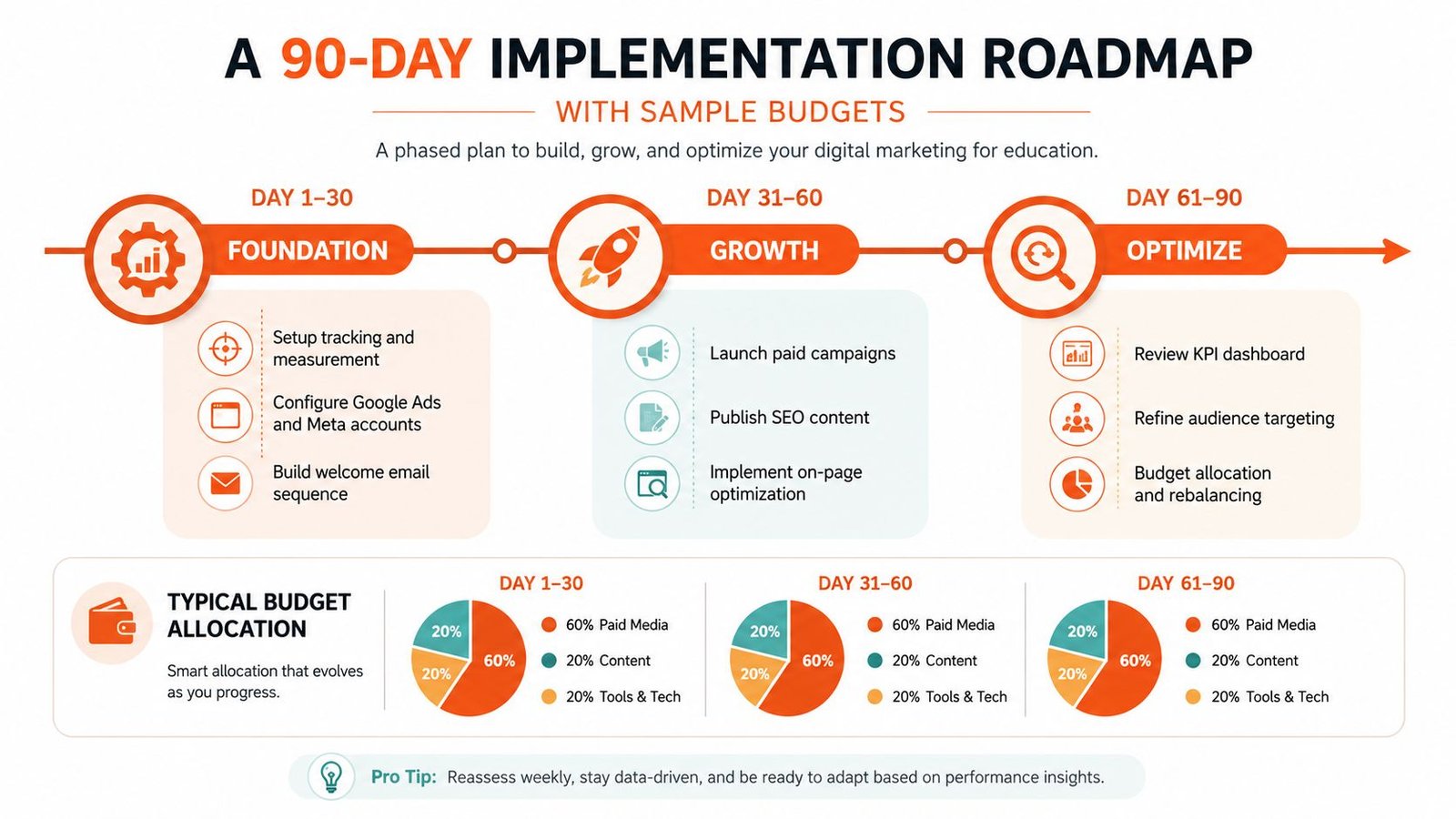
Days 1 to 30
Set up conversion tracking, review current site structure, and build the first version of the landing pages that will carry paid traffic. This is also when you define audiences and admissions stages in the CRM. Keep the budget focused on setup work and the minimum paid spend needed to validate conversions.
Days 31 to 60
Launch Google Ads by program and intent tier. Start testing ad copy, landing page headlines, and form friction. If you’re running Meta, use it for warm retargeting and lead capture rather than broad awareness. This is the period when inquiry quality starts telling you what’s working.
Days 61 to 90
Refine bids, trim waste, and shift budget toward the queries and audiences that produce qualified leads. Publish SEO content that supports the highest-value programs and reinforce pages that already bring in inquiries. By the end of this phase, the leadership team should be looking at a dashboard that connects spend to admissions activity, not just clicks.
A practical allocation often looks like this, 60% paid media, 20% content, 20% tools and tracking. That’s not a universal formula, but it’s a sensible way to keep the first quarter focused on pipeline creation instead of cosmetic marketing. It also makes it easier to explain the plan to a dean, director, or board member who wants to know when results start.
If you want a custom roadmap, ask for one before the next intake window opens. The best plans are built around the programs that matter most right now.
Why Education Brands Hire a Specialized Agency Instead of Doing It In-House
Most in-house teams don’t lack effort, they lack bandwidth and depth. SEO, Google Ads, Local SEO, and CRM setup all need senior execution at the same time, and schools rarely have that bench on day one. A specialized agency compresses the learning curve, launches faster, and avoids the common mistake of treating enrollment marketing like a side project.
A good partner should be able to show clear service scope, fast response times, and a reporting rhythm that ties spend to inquiries. You should also expect a practical launch plan, not a vague promise. If an agency can’t explain what happens in the first 30 days, keep looking.
The decision is usually simple. In-house gives you control, but it also gives you slower ramp-up and more training risk. A specialist gives you execution, focus, and a clearer path to booked consultations.
VIP TECH CONSULTING helps education brands build SEO, Local SEO, Google Ads, and Meta Ads systems that are designed to produce inquiries, calls, and booked consultations, not vanity traffic. If you want a focused enrollment plan for this quarter, visit VIP TECH CONSULTING and request a free strategy session before competitors claim the clicks your programs should be getting.