
If your phone isn’t ringing from Google, your competitors are taking jobs that should be yours.
That’s the reason business owners search how local SEO works for service businesses explained. You don’t want another vague marketing article. You want to know why one plumber, roofer, med spa, attorney, cleaning company, or HVAC contractor gets the call while another gets ignored.
Local SEO isn’t about vanity rankings. It’s about showing up when someone nearby needs help now, then making it easy for them to call, book, or request a quote. If you already know you need help and you’re comparing agencies, this is the point: the right local SEO setup creates visibility in Google Maps, strengthens your website’s local relevance, and turns search intent into leads.
If you want a faster picture of where your visibility is leaking, review this guide on how to increase organic traffic to your website. It pairs well with what local businesses need to fix first. And if you’re in a patient-driven service category, the LeadBlaze patient acquisition playbook is a useful example of how local demand turns into booked appointments when the funnel is built correctly.
Table of Contents
- Your Next Customer Is Searching Google Are You Invisible
- Your Google Business Profile Is Your Digital Front Door
- Why Consistent Business Info and Reviews Matter for Leads
- Turning Website Visitors Into Booked Appointments
- Our Proven Process for Dominating Local Search
- Common Questions About Investing In Local SEO
- Stop Losing Customers and Start Your Growth Plan Today
Your Next Customer Is Searching Google Are You Invisible
A homeowner searches for “emergency plumber near me.” A law firm owner searches for “IT support Miami.” A parent searches for “pediatric dentist near me.” In every case, Google shows a short list of businesses it trusts.
If you’re not in that list, you’re not part of the decision.
That’s why local SEO matters so much for service businesses. Salesgenie reports that 84% of consumers search online for local businesses daily. That’s not passive traffic. That’s active demand, happening every day, from people ready to compare providers and take action.
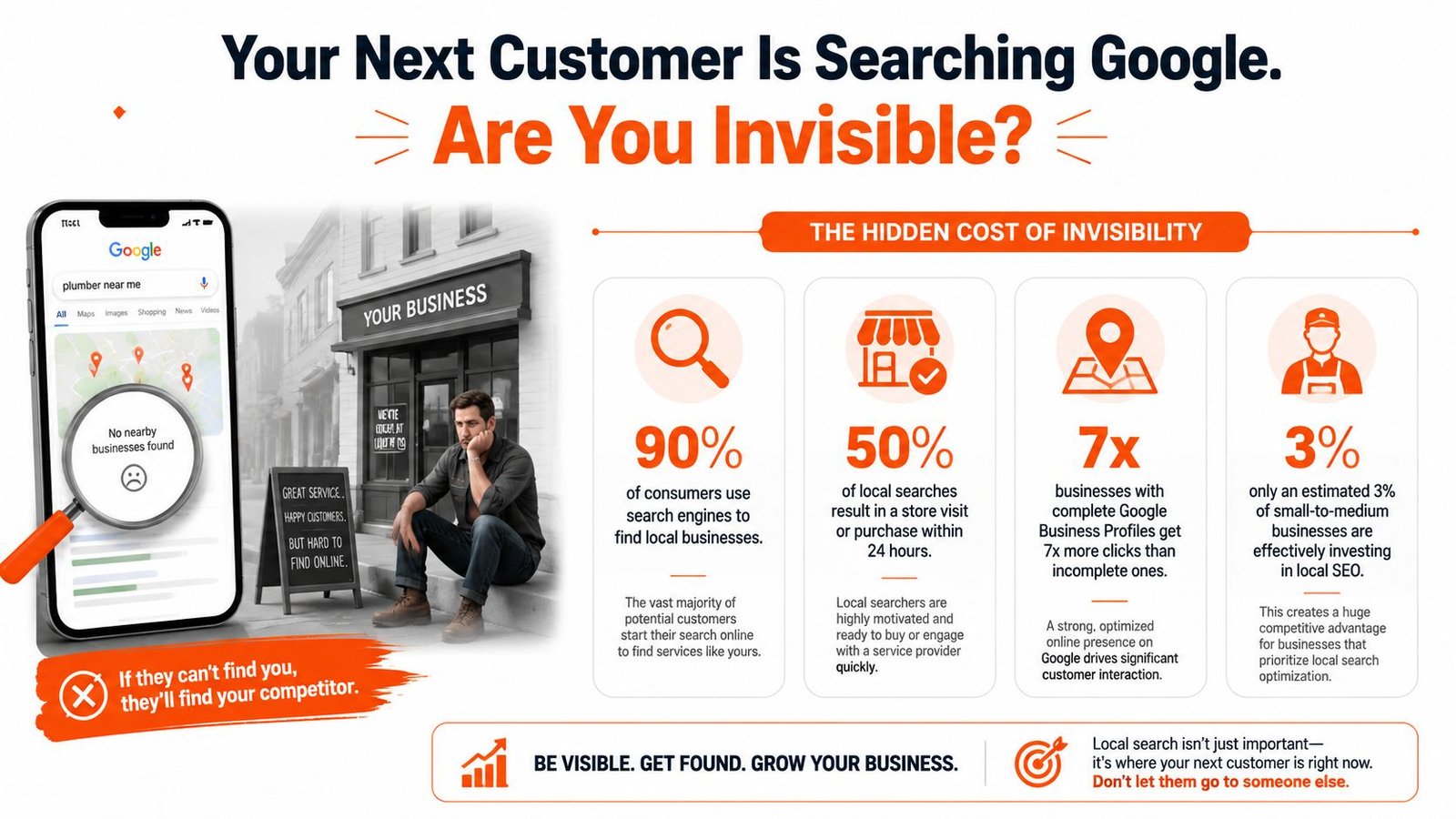
This is a lead problem, not a marketing theory problem
When a service business says, “We rely on referrals,” what that usually means is this: lead flow is inconsistent, and Google hasn’t been built into the sales pipeline.
Referrals help. They don’t replace search.
People still vet you online before they call. They check your Google Business Profile, your reviews, your service area, your hours, and your website. If any of that looks weak, outdated, or confusing, they move to the next company.
Practical rule: If a buyer has to work to figure out what you do, where you work, or how to contact you, you’ve already lost that lead.
Why invisible businesses stay invisible
Most service companies don’t have one giant problem. They have five smaller ones working together:
- Weak Google Business Profile: Missing services, poor categories, thin descriptions, old photos, or wrong hours
- No local service pages: One generic homepage trying to rank for every city and every service
- Messy business listings: Different phone numbers, old addresses, and duplicate directory profiles
- Low review velocity: Good customers aren’t being asked at the right moment
- No conversion path: Visitors land on the site, then stall instead of calling
That’s the urgency. Every day you delay, Google keeps sending leads to a competitor with clearer signals.
If you already know your business should rank in Google Maps and local search, don’t keep guessing. Contact an agency that handles local SEO for service businesses and get a real plan in place.
Your Google Business Profile Is Your Digital Front Door
Your Google Business Profile, or GBP, is the first thing many buyers see before they ever visit your website.
And it carries more weight than most business owners realize. According to Reboot Online’s local SEO statistics, a comprehensive Google Business Profile accounts for 32% of the total influence in Local Pack rankings. If you want calls from Google Maps, the work starts from this point.
A lot of businesses treat GBP like a setup form. Fill in the basics once, upload a logo, and move on. That’s amateur thinking. A high-performing profile is managed like a sales asset.
If you want a clearer view of what Google Maps visibility requires, review this breakdown of how to rank in Google Maps.
The mistakes that cost service businesses leads
Service businesses make the same GBP errors over and over:
- Wrong primary category: You tell Google the wrong thing about your business, so you show for the wrong searches or not at all.
- Incomplete services section: You offer multiple profitable services, but your profile barely mentions them.
- Bad service area setup: You serve specific neighborhoods or cities, but your profile doesn’t reflect them cleanly.
- Home address misuse: Service-area businesses often create avoidable risk by handling address visibility incorrectly.
- Stale business details: Holiday hours, photos, service descriptions, and Q&A content get ignored for months.
Those aren’t cosmetic issues. They weaken relevance and trust.
Service-area businesses need a tighter setup
If you run a business without a storefront, local SEO gets more nuanced. You still need visibility for “near me” and city-based searches, but you have to build that visibility with the right service-area signals.
That means your GBP should clearly support the services you sell, the areas you serve, and the questions people ask before they contact you. It also means your profile can’t live in isolation. It has to align with your website.
Your Google Business Profile should answer the buyer’s basic questions in seconds. What do you do, where do you work, when can I call, and why should I trust you?
What a serious GBP strategy includes
A proper local SEO service should handle GBP as an ongoing system, not a one-time task.
At minimum, that includes:
- Profile completion: Categories, business description, services, hours, contact details, and service areas
- Media management: Fresh photos that reflect real work and real trust signals
- Update discipline: Posts, offers, event or seasonal updates where relevant
- Q&A support: Answers written in natural language, not keyword spam
- Compliance checks: Especially important for service-area businesses trying to avoid listing issues
If an agency glosses over GBP and spends the whole pitch talking about blog posts and backlinks, they’re skipping the part that often drives the fastest local visibility gains.
Why Consistent Business Info and Reviews Matter for Leads
A homeowner finds you on Google at 7:10 p.m. They need service now. Your Google Business Profile shows one phone number, a directory shows another, and a review mentions an old location. That lead does not stop to investigate. They call the competitor whose information looks clean and current.
Local SEO has a trust problem before it has a ranking problem. Google compares your business details across the web to decide whether your company looks legitimate. Buyers do the same thing in seconds.
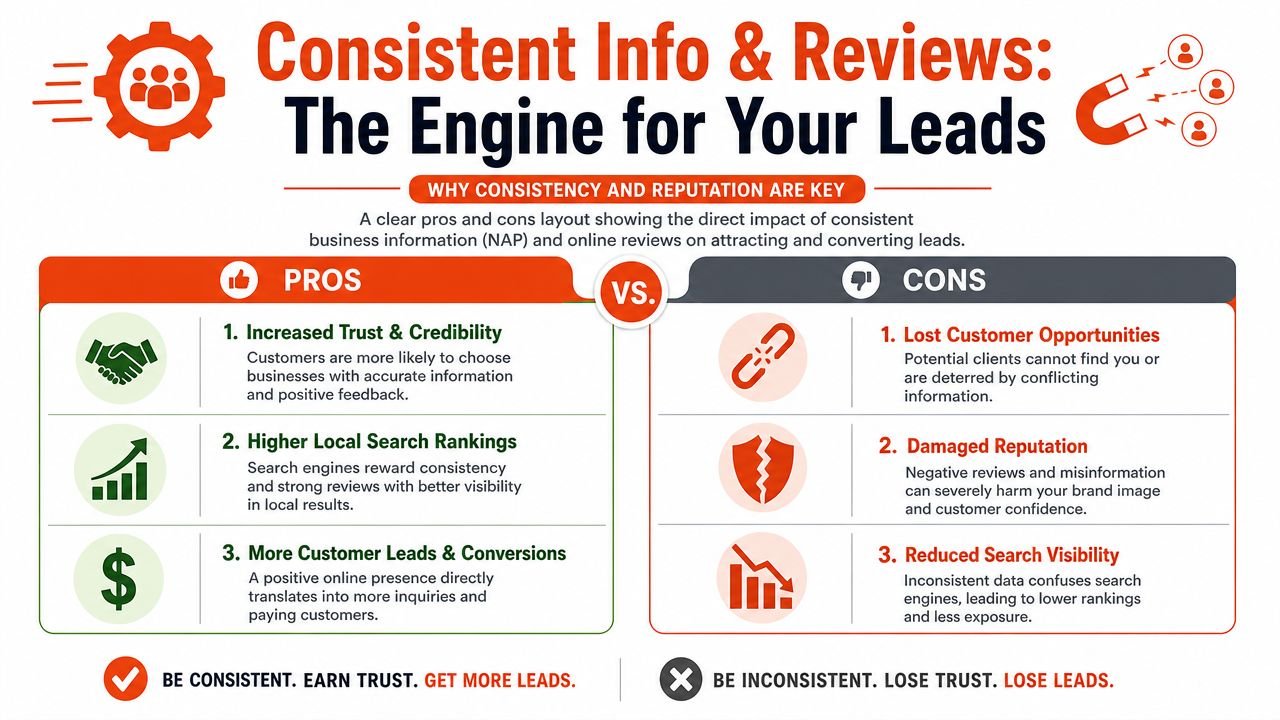
Bad data costs you calls
Inconsistent business info creates friction at the exact moment a prospect is ready to contact you. Wrong hours, an outdated phone number, duplicate listings, or mismatched service areas make your business look disorganized. That hurts click-through rate, hurts response rate, and costs booked jobs.
The fix is operational, not theoretical. You need one version of the truth for your business name, address, phone number, hours, and service area, then you need that information corrected everywhere it appears.
A serious cleanup usually includes:
- Citation correction: Fix wrong listings on major directories and remove duplicates
- Data source cleanup: Update the platforms that feed business data across the web
- Ongoing monitoring: Catch bad edits, suggested changes, and duplicate entries early
- Website alignment: Match your contact details and service area language across key pages
Moz explains in its local SEO learning center that accurate business information and strong review signals help search engines trust local businesses. Trust leads to visibility. Visibility only matters if it turns into calls.
If your reputation already has dents, this guide on responding to negative Google reviews the right way will help you protect conversion while the bigger local SEO issues get fixed.
Here’s a practical walkthrough on local ranking signals and reputation that’s worth watching:
Reviews shape the buying decision
Reviews do more than influence placement in local results. They decide who gets contacted.
A prospect comparing three plumbers, roofers, or HVAC companies is looking for the safest choice. They scan rating, review count, review recency, and the tone of recent feedback. Then they pick one or two businesses to contact. If your review profile looks stale, thin, or poorly managed, you lose before the phone rings.
BrightLocal’s Local Consumer Review Survey has repeatedly shown that consumers use reviews to evaluate local businesses and trust recent feedback more than old praise. That means review generation needs a process. Ask at the right moment, make it easy, and keep the flow steady.
Reviews are not a vanity metric. They are sales proof sitting inside your search results.
Ask any agency a blunt question. Who owns citation accuracy, who manages review requests, and who is accountable when lead volume stalls? If the answer sounds vague, keep looking.
Turning Website Visitors Into Booked Appointments
Getting found is only half the job.
If local SEO sends a qualified visitor to a weak website, you’ve paid for attention and wasted the opportunity. The site has to confirm relevance fast, remove friction, and push the visitor toward a call or form submission.
For service-area businesses, generic websites fail because they ask one page to do too much. One “Services” page won’t rank well for every city and won’t convert every intent level.
Generic pages don’t convert local intent
A person searching for “water heater repair Miami Beach” is not looking for a broad company overview. They want confirmation that you handle that problem in that place.
That’s why Straight North’s local SEO guidance says service-area businesses need dedicated service-area pages targeting specific neighborhoods and cities, with unique content that mentions local landmarks, cross streets, and local FAQs.
That structure matters because it does three jobs at once:
| Buyer need | What the page should show |
|---|---|
| Do you handle my issue | A clear service match with real problem-focused copy |
| Do you work in my area | City or neighborhood relevance, not vague region language |
| Can I trust you | Proof, reviews, FAQs, and visible contact options |
Your site has one job
A local landing page should move the visitor to action. That means:
- Clear service headline: Say exactly what you offer and where
- Fast proof: Reviews, trust markers, and relevant project examples
- Local detail: Neighborhood references, service-area language, and FAQs
- Simple conversion path: Tap-to-call, short forms, obvious booking buttons
- Schema support: LocalBusiness and areaServed markup that matches your profile
If your team misses calls after hours, there’s another conversion layer worth thinking about. This article on how to boost revenue with an AI receptionist is useful because local SEO doesn’t stop at the click. The handoff after the visitor lands matters too.
The best local SEO campaigns don’t just increase traffic. They reduce wasted clicks by sending the right searcher to the right page.
If you’re reviewing agencies, ask how they improve the page after the ranking happens. A serious provider should talk about conversion flow, not just keyword placement. In this context, website conversion improvements become part of the local SEO conversation.
Our Proven Process for Dominating Local Search
Local SEO works when you control the fundamentals instead of chasing hacks.
Google evaluates local visibility through proximity, relevance, and prominence, and Sitebulb notes that 80% of local searches convert within 24 hours. That means sloppy execution costs real leads quickly.
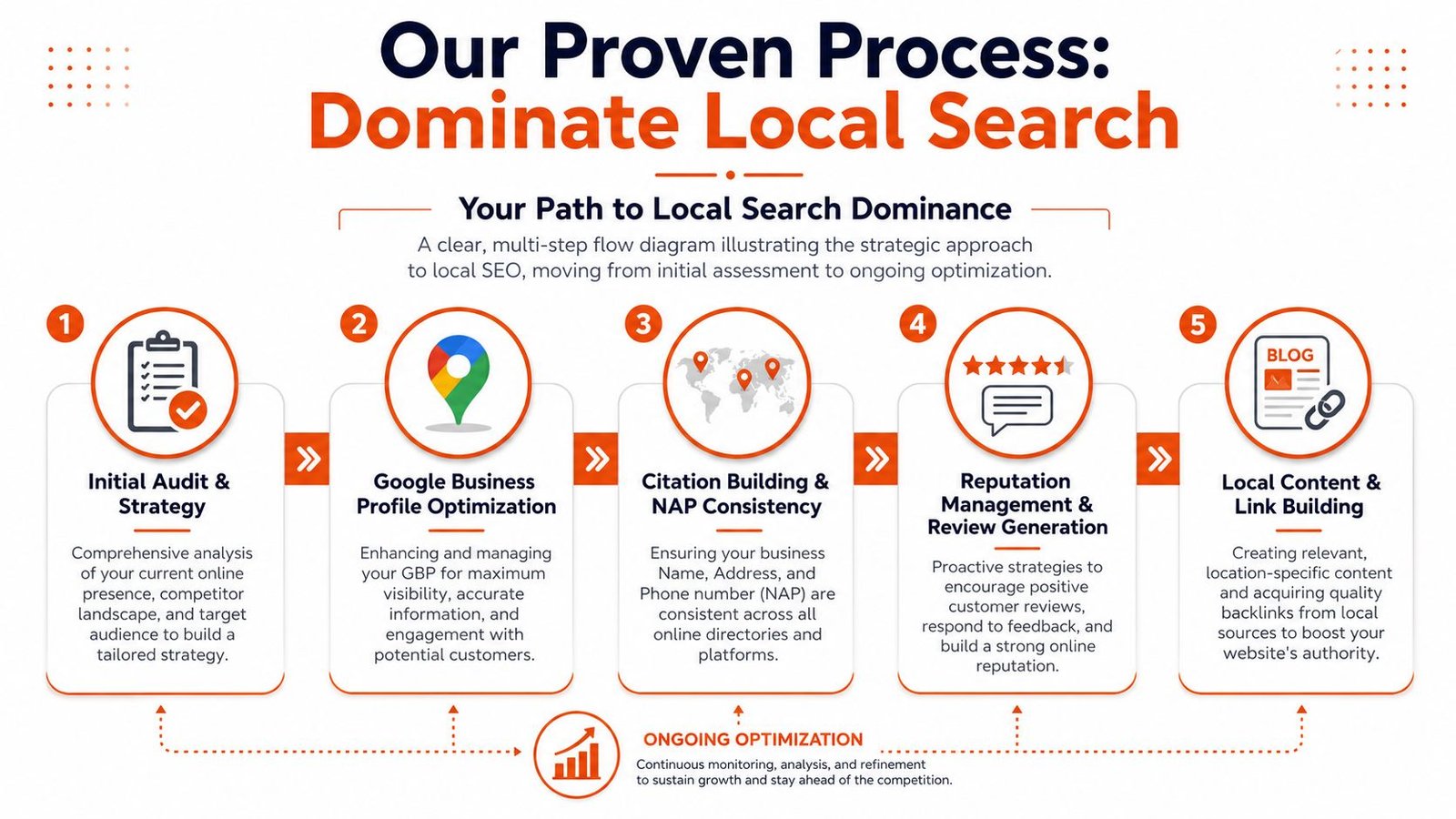
What you get from us
We run local SEO as a structured growth system. Not a pile of disconnected tasks.
Our process includes:
Local audit and market review
We assess your Google Business Profile, website, citation profile, competitors, reviews, and location targeting to find the leaks first.GBP and citation overhaul
We tighten business data, categories, service areas, and core profile elements so Google gets a consistent picture of your business.Local page strategy
We map services to cities and neighborhoods, then build the content structure needed to capture local intent.Reputation workflow
We help create a process for earning more strong reviews and managing responses without chaos.Reporting tied to lead flow
We care about calls, form fills, booked consultations, and qualified traffic. Rankings matter, but only if they produce business.
If you want a practical checklist before hiring anyone, use this local SEO checklist to compare what agencies promise against what they deliver.
Why this process works
The reason most local SEO campaigns underperform is simple. They focus on one layer only.
Some agencies live inside GBP. Some only write content. Some only chase links. That fragmented approach leaves gaps, and Google notices gaps.
A stronger model connects the full chain:
- Buyers find you in local search.
- They see accurate, trust-building business information.
- They land on a page built for the exact service and location.
- They contact you without friction.
For a city-specific example of how local competition shapes local SEO decisions, Surnex’s LA local SEO guide is a solid reference. The same principle applies in Miami, Fort Lauderdale, Orlando, or any dense service market. The businesses that win local search usually aren’t doing magic. They’re executing the basics better and more consistently.
If you want one option among several for implementation, VIP TECH CONSULTING provides local SEO services that include Google Business Profile optimization, website improvements, reputation management, and conversion-focused support for local businesses.
Common Questions About Investing In Local SEO
Business owners close to hiring usually ask the same three questions. Good. You should.
Is this worth it
Yes, if local search matters in your buying cycle.
If people search for your service with a city name, neighborhood, or “near me” intent, local SEO is part of your sales infrastructure. Ignoring it means paying the price in missed calls and lower-quality lead flow.
The wrong way to evaluate local SEO is, “How much does it cost?”
The right way is, “How many qualified calls am I losing because I’m not visible or credible enough when buyers search?”
Can you do it yourself
You can handle pieces of it yourself.
You can update your Google Business Profile, ask for reviews, clean a few listings, and publish some local pages. Many owners start there. The issue isn’t whether it’s possible. The issue is whether you want to spend your time learning platform rules, fixing mistakes, and waiting longer for traction.
A bad local SEO setup usually doesn’t fail loudly. It just underperforms month after month.
Hiring help makes sense when the cost of delay is higher than the fee for getting it done right.
How long does it take
You should expect stages, not instant domination.
Foundational fixes can improve clarity quickly. Stronger visibility, better coverage across service areas, and steadier lead flow take consistent work. That’s normal. Local SEO compounds when the profile, website, reviews, and business data all reinforce each other.
Here’s the standard I’d use when comparing providers:
- Clear deliverables: You should know what’s being fixed and built
- Clear communication: You should know what changed this month
- Clear measurement: You should know whether calls, leads, and visibility are improving
- Clear ownership: You should know who is accountable when progress stalls
If an agency can’t answer those points directly, they’re not ready to manage your growth.
Stop Losing Customers and Start Your Growth Plan Today
Local SEO isn’t optional for service businesses that want steady lead flow.
When your Google Business Profile is weak, your business data is inconsistent, your reviews are unmanaged, and your website has no local service pages, you make it easy for competitors to win. Not because they’re better. Because they’re easier to find and easier to trust.
A quick self-check
Run this five-minute audit on your business:
- Google Business Profile: Is it fully completed with accurate services, hours, categories, and current photos?
- Service areas: Are the cities and neighborhoods you target clearly supported across your profile and website?
- Business consistency: Is your name, address, and phone information aligned across major listings?
- Review process: Do you actively ask for reviews and respond to them consistently?
- Local pages: Do you have unique pages for your main services in your target locations?
- Schema markup: Does your website use LocalBusiness and areaServed in a way that aligns with your public business details?
- Conversion path: Can a visitor call or request a quote without hunting around the page?
If you answered “no” or “not sure” to several of those, that’s the gap. And that gap is costing you leads.
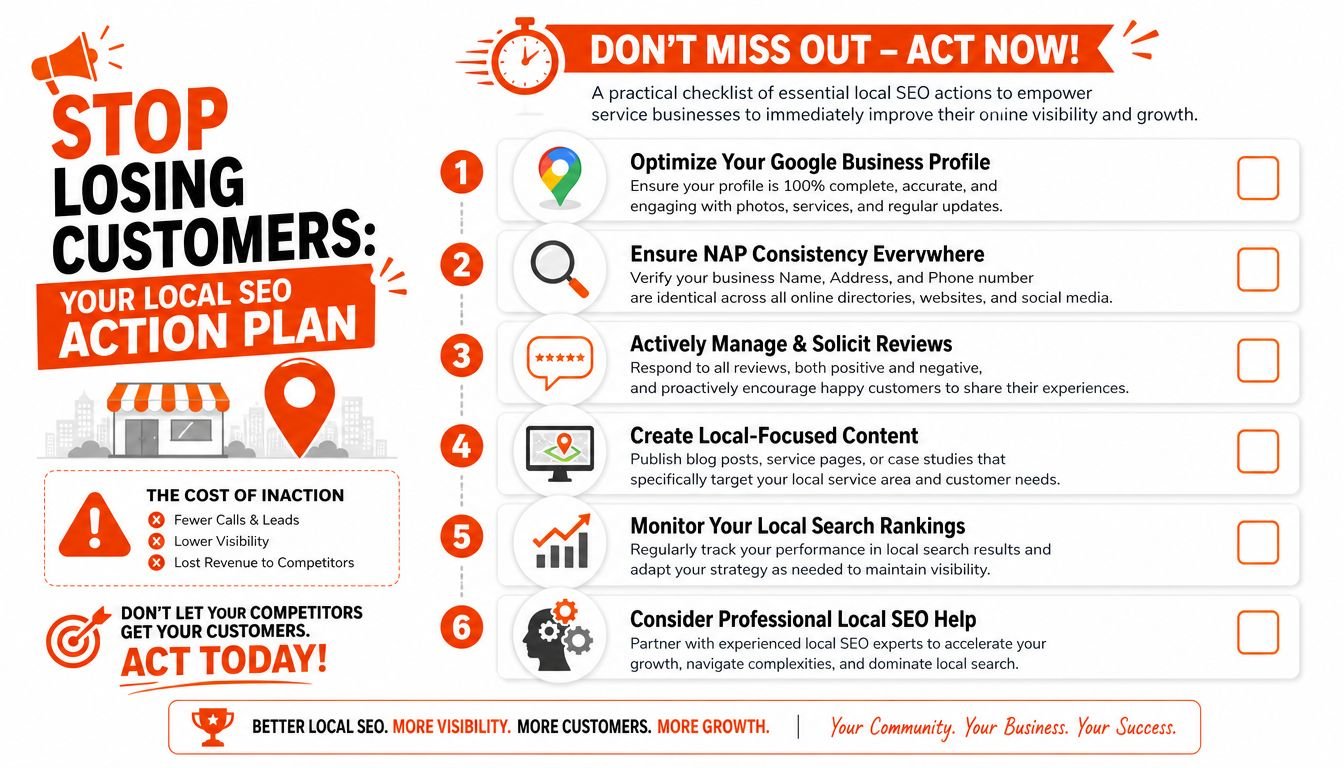
The market is competitive, and waiting doesn’t make local SEO easier. It just gives other businesses more time to lock in the visibility and trust you should own.
If you’re ready to turn Google visibility into more calls, quote requests, and booked consultations, contact VIP TECH CONSULTING for a strategy session. We’ll review your local presence, identify what’s blocking growth, and give you a practical action plan for ranking better and converting more of the traffic you already should be getting.