If you’re running Facebook ads for lead generation and your dashboard says “results” while your sales team says “junk,” the problem usually isn’t Facebook. It’s the system behind the campaign.
Most frustrated business owners see the same pattern. Clicks come in. Forms get filled. Cost per lead looks acceptable. Then the calls don’t turn into booked jobs, retained clients, or signed contracts. You paid for activity, not revenue.
That gap is where most campaigns fail. The businesses that win with Facebook don’t just launch ads. They build a lead flow that filters intent, matches the right message to the right audience, and follows up fast enough to turn interest into sales. If your current setup isn’t doing that, you’re not buying growth. You’re buying noise.
Table of Contents
- Why Your Facebook Ads Are Burning Cash Not Generating Leads
- The Blueprint for a Profitable Lead Generation Machine
- Targeting High-Intent Customers Not Just Window Shoppers
- Crafting Ad Creative and Offers That Convert
- Choosing Your Funnel Lead Ads vs Landing Pages
- From Lead to Customer Optimizing for Revenue
Why Your Facebook Ads Are Burning Cash Not Generating Leads
A lot of businesses arrive at Facebook ads after getting squeezed somewhere else. Google Ads got expensive. SEO is taking time. Referrals slowed down. So they launch a few campaigns, collect some leads, and expect momentum.
Instead, they get form submissions from people who never answer the phone, shoppers asking for the cheapest option, or inquiries from people outside the service area. The ad account shows movement, but the pipeline doesn’t.
The platform is not the problem
Facebook is still a serious direct-response channel. Recent benchmark data shows an average 2.59% CTR, $1.92 CPC, and 7.72% conversion rate for lead campaigns across industries in 2026, according to Sprout Social’s Facebook marketing benchmarks. That tells you the opportunity is real. It also tells you weak performance usually comes from weak campaign architecture.
The common mistakes are predictable:
- Cheap leads over qualified leads: Businesses optimize for the lowest CPL because it’s easy to see inside Ads Manager.
- Broad targeting: They go after vague interests instead of buyer signals.
- Weak offer positioning: “Contact us” and “free quote” don’t create urgency on their own.
- No filtering: Every click gets treated as equal, even when only a portion of inquiries fit the actual business.
- Slow follow-up: Sales gets the lead too late, or with too little context.
Practical rule: If your campaign produces leads that sales can’t close, your campaign isn’t profitable no matter how good the CPL looks.
This is also where compliance and setup errors waste money. If your ads, forms, disclaimers, or category settings aren’t aligned with Meta’s rules, delivery can get limited and quality drops with it. A solid Facebook advertising compliance guide helps prevent avoidable campaign friction before you spend another dollar.
What bad lead flow actually costs you
Poor lead generation doesn’t just waste ad spend. It burns staff time. Your office manager follows up on people who were never serious. Your salesperson chases bad-fit inquiries while good prospects hire a competitor who responded first.
That creates a false conclusion. Many owners decide “Facebook leads are low quality” when the actual issue is that the campaign was built to maximize submits, not sales opportunities.
A better system exists, and it doesn’t rely on luck. It relies on matching audience intent, message quality, form design, and follow-up speed. If your current lead flow feels inconsistent, that’s the point to get a second set of eyes on it. A short strategy conversation can usually expose the bottleneck fast.
The Blueprint for a Profitable Lead Generation Machine
Profitable Facebook ads for lead generation don’t come from one clever ad. They come from a coordinated system. When one part breaks, the rest of the campaign usually underperforms with it.
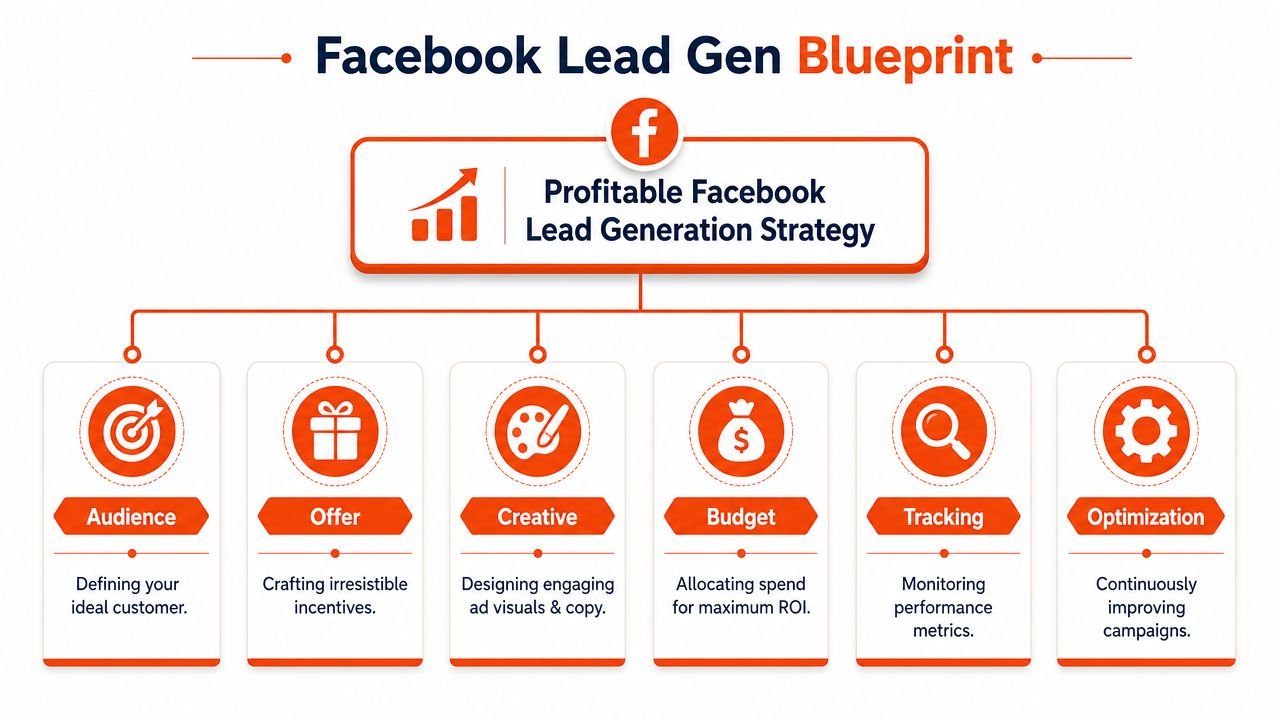
The six parts that have to work together
The businesses that generate steady inquiries from Meta usually get these six components right:
Audience
The campaign needs a clear idea of who should see the ad. Not everyone in your city is a prospect. The audience has to reflect your ideal customer, your geography, and your buying signals.
Offer
The offer gives people a reason to act now. For a local service business, that might be a consultation, inspection, estimate, or audit. The key is relevance. The offer has to solve the problem the prospect already feels.
Creative
The ad has to stop the scroll and pre-qualify the click. Good creative doesn’t just get attention. It helps the right person self-identify.
Budget
Budget isn’t just about how much you spend. It’s about where you place spend first, how you separate warm from cold audiences, and when you cut underperforming variations.
Tracking
If you can’t see what happens after the lead comes in, you’re managing blind. You need clean data between the ad platform, your website, and your CRM. If your measurement setup is shaky, start by fixing Google Analytics 4 implementation so decisions aren’t based on guesswork.
Optimization
Strong accounts improve because someone reviews search behavior, lead quality, creative fatigue, and follow-up performance on a regular basis. Ads don’t stay efficient by themselves.
A campaign is only as strong as the handoff between marketing and sales.
Why most small businesses never get this right alone
DIY management commonly unravels. Owners and in-house teams often focus on the visible parts, such as ad copy or audience size, while overlooking the operational elements that determine return.
A professional setup tends to ask different questions:
- What counts as a qualified lead?
- Which offer matches buyer urgency?
- Does this audience resemble current customers or random traffic?
- What happens in the first few minutes after submission?
- Can the business track booked calls, estimates, and closed deals back to the campaign?
That difference matters. Running ads is simple. Building a lead generation machine that produces usable demand is not.
Targeting High-Intent Customers Not Just Window Shoppers
Most bad Facebook lead campaigns start with lazy targeting. The account goes broad, the message stays generic, and the business ends up paying to reach people who were never close to buying.
For local service businesses, that gets expensive fast. A roofing company, law office, med spa, or home services brand doesn’t need attention from everyone. It needs attention from the right households, decision-makers, and recent visitors who already showed interest.

Broad targeting creates broad problems
When advertisers rely on broad interest stacks, they usually get what the algorithm can find most easily. That often means lower-friction form fills, not stronger business opportunities.
A smarter method is to work from buyer evidence instead of assumptions. Zapier’s lead ad guidance recommends a “work smarter, not broader” approach: build a lookalike from your highest-value customers, narrow it with relevant filters, and add one qualifying question so sales can prioritize intent, as explained in Zapier’s Facebook lead ad best practices.
That advice aligns with what strong agencies already do. They don’t ask Meta to find “more people.” They ask it to find more people who resemble buyers.
If you need help clarifying who that buyer is, Fypion Marketing’s customer profiling insights are worth reviewing. Clear targeting starts with a clear customer profile.
How to build an audience that acts like buyers
A high-intent structure usually includes layers, not one audience.
- Customer-based lookalikes: Start with your best customers, not your entire contact list. A bad seed list teaches the algorithm the wrong lesson.
- Warm retargeting pools: Website visitors, video viewers, and people who engaged with your page have already shown some level of interest.
- Geographic control: Local businesses need tight location settings. Nearby traffic with no buying ability isn’t useful.
- Business-specific filters: Industry, service need, homeowner status, or role relevance can all sharpen quality when used carefully.
For many service businesses, retargeting is where Facebook starts acting less like a discovery channel and more like a conversion channel. A structured retargeting strategy in digital marketing helps pull warm prospects back before they choose someone else.
A practical audience stack might look like this:
| Audience type | Best use | Main benefit |
|---|---|---|
| Customer lookalike | Cold prospecting | Finds people who resemble existing buyers |
| Website retargeting | Warm traffic | Re-engages users who already visited key pages |
| Engagement audience | Video or social interest | Captures people familiar with the brand |
| Narrow local layer | Service-area control | Reduces wasted spend outside real territory |
Later in the funnel, education matters too. This walkthrough breaks down the mechanics behind smarter audience builds and form choices:
The lead form should help sales not just marketing
Targeting doesn’t stop at the audience. The form itself should do some filtering. A simple multiple-choice question about timeline, budget range, or service type can help sales identify serious opportunities without making the process feel heavy.
Ask only what helps your team qualify and respond better. Extra fields that don’t affect sales decisions usually hurt more than they help.
This is the shift many accounts need. Stop optimizing for names in a spreadsheet. Start optimizing for inquiries your team wants to call.
If that sounds more complicated than what your current provider is doing, that’s because it is. Quality lead generation requires more than a boosted post and a broad audience.
Crafting Ad Creative and Offers That Convert
Even the best audience won’t save a weak offer. If your ad says the same thing every competitor says, the only people who respond are often the least committed buyers.
Generic copy attracts generic leads. That’s why “free quote,” “learn more,” and “contact us today” rarely produce the kind of pipeline a local business wants. They don’t create enough contrast. They don’t promise a clear next step. And they don’t help the buyer understand why your business is worth their attention right now.
The offer does the heavy lifting
Good offers frame a problem the prospect already wants solved. Strong ads usually work because the message connects pain, proof, and outcome in a tight sequence.
Recent practitioner guidance notes that the best lead generation offers now work across multiple angles, including pain-led, proof-led, and outcome-led messaging, while creative has shifted toward richer formats such as AI-assisted short-form video and video-first assets, according to Short Genius on lead gen ad creative.
That matters because local buyers don’t all respond to the same trigger.
A few examples:
- Pain-led: “Storm damage getting worse? Book a roof inspection before the next rain.”
- Proof-led: “See why local homeowners trust this team for fast AC replacements.”
- Outcome-led: “Get a cleaner, safer yard without giving up your weekends.”
Each angle attracts a slightly different buyer mindset. Good campaign management tests those angles instead of guessing.
What good creative looks like for local lead generation
For a Miami law firm, a weak ad says, “Need legal help? Contact us.”
A stronger ad says, “Injured in a car accident and not sure what to do next? Request a case review.”
For a local restaurant trying to generate private event inquiries, a weak ad says, “Book your event with us.”
A stronger one says, “Planning a birthday dinner or corporate event in Miami? Ask about private dining availability.”
For a med spa, a weak ad says, “We offer skin treatments.”
A stronger one says, “Not seeing results from at-home skincare? Request a personalized treatment plan.”
Creative checkpoint: The ad should make the right person feel understood and the wrong person feel unqualified.
This is also where copy and visual style have to match. If you’re selling a premium service, the creative can’t look rushed or generic. If you’re promoting an urgent service, the headline and image need to make that urgency clear without looking sensational.
A useful seasonal example is promotional timing. Reviewing how brands approach Black Friday Facebook ads can help illustrate how urgency, offer design, and creative framing work together when attention is crowded.
Why short-form video matters now
Static images still have a place. But many businesses get stronger engagement when they use short-form video to explain the offer quickly and show the authentic business behind the ad.
For local lead generation, video often works best when it includes:
- A visible problem: Show the issue the customer is dealing with.
- A credible solution: Put the team, process, or result on screen.
- A specific next step: Tell viewers exactly what to request.
The best creative doesn’t try to say everything. It gives the buyer enough clarity to take the next action confidently.
Choosing Your Funnel Lead Ads vs Landing Pages
This is one of the most important strategic choices in Facebook ads for lead generation. Do you keep the form inside Facebook, or do you send people to a landing page on your website?
Both can work. Both can fail. The right choice depends on your sales process, your offer, your audience temperature, and how much qualification you need before the lead reaches your team.
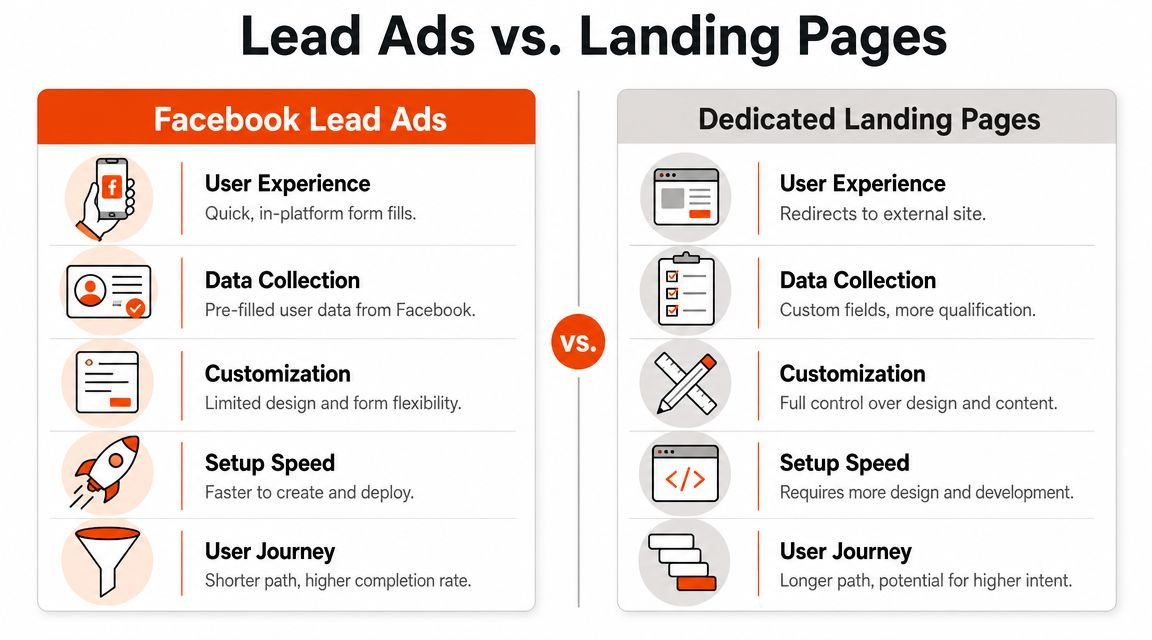
When Facebook Lead Ads make sense
Facebook Lead Ads reduce friction. The user stays in-platform, sees a native form, and can submit quickly. For businesses trying to capture interest from mobile users, that convenience matters.
Cognism cites a study covering 3,000+ campaigns and $9.5 million in ad spend where Facebook lead ads reached a 12.5% conversion rate, outperforming landing-page approaches in that dataset, as discussed in Cognism’s review of Facebook lead generation.
That doesn’t mean native forms are always better. It means reduced friction can create a real advantage, especially when the audience is semi-warm and the offer is easy to understand.
When a landing page is the better move
A landing page gives you more control. You can add testimonials, explain the process, show service areas, handle objections, and pre-qualify harder before the person fills out a form.
For high-ticket services, complex services, or businesses with stronger websites, a dedicated page often produces fewer but more informed inquiries.
This becomes even more important when your business depends on trust. A local legal service, medical practice, or premium contractor may need more than a short native form to convert the right prospect.
A practical comparison
Toptal notes that the choice between form types is a trade-off between more volume and higher intent. It also notes that Facebook lead forms can include up to 15 questions, though shorter forms with predictive fields are generally the smarter choice, as covered in Toptal’s guide to Facebook Lead Ads.
| Factor | Facebook Lead Ads | Landing Pages |
|---|---|---|
| User path | Shorter and faster | Longer and more controlled |
| Friction | Lower | Higher |
| Qualification | Limited but useful | Stronger and more customizable |
| Brand storytelling | Limited | Full control |
| Setup speed | Faster | More involved |
| Best fit | Simple offers, mobile users, warm audiences | High-trust services, complex offers, deeper qualification |
The smartest approach isn’t ideological. It’s operational.
- Use Lead Ads when speed and convenience matter most.
- Use landing pages when trust-building and qualification matter more.
- Test both when the business has enough lead volume to compare downstream sales quality.
If you’re unsure which path fits your business, the distinction between a campaign page and a broader site experience becomes important. This guide on landing page vs website strategy helps frame that decision properly.
From Lead to Customer Optimizing for Revenue
Most lead generation advice stops at the submit button. That’s exactly why so many campaigns disappoint business owners.
The lead isn’t the win. The sale is the win. If your follow-up process is slow, generic, or disconnected from the ad promise, even a good campaign can look bad on paper because the business failed after capture.
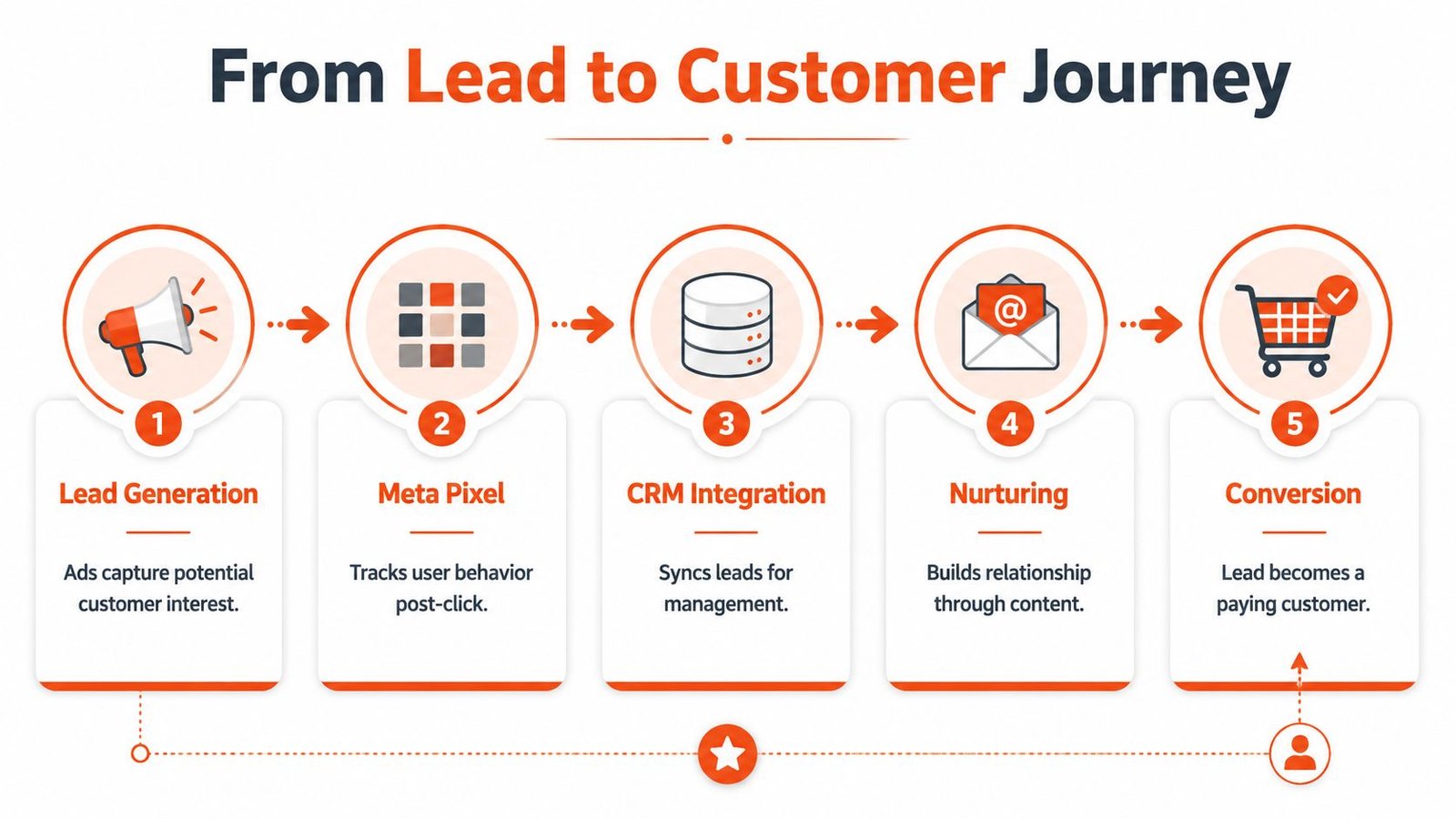
Most lead problems happen after the form submit
Independent guidance on Facebook lead ads points out a problem many advertisers ignore: the platform often optimizes for form fills, not sales-ready quality. Strong systems need CRM integration, faster personalized follow-up, and downstream conversion tracking, as explained by Stape’s analysis of Facebook Lead Ads.
That matches what happens in real accounts. The campaign sends a lead. Then one of three things happens:
- No immediate response: The lead cools off.
- Generic response: The prospect doesn’t feel understood.
- No closed-loop tracking: Marketing never learns which leads became revenue.
When that happens, the business keeps feeding budget into the same machine and hoping for a different outcome.
What a revenue-focused setup includes
A serious Facebook lead generation system should include a few essential elements:
- CRM integration: Leads should route directly into the system your team uses, not sit in Ads Manager waiting to be exported.
- Fast follow-up: The first response should happen while intent is still high.
- Personalized handoff: Sales should know which ad, service, and qualifier triggered the lead.
- Tracking infrastructure: Meta Pixel and Conversions API support better visibility and more reliable event handling.
- Regular optimization: Teams need to compare lead quality, not just front-end ad metrics.
The business that responds with context and speed usually has the advantage, even when competitors spend more.
What to expect if you want this done properly
If you’re hiring a provider for Facebook ads, don’t just ask what they’ll run. Ask what they’ll measure.
Ask questions like:
- How do you define a qualified lead?
- How will leads enter our CRM?
- Who sees follow-up data and sales outcomes?
- How do you test form quality against close rate?
- How do you decide between native forms and landing pages?
Those questions separate campaign managers from growth partners.
If your current lead flow is inconsistent, now is the right time to fix it. Every week spent tolerating bad leads means more wasted ad budget, more missed calls, and more deals going to competitors with better systems.
If you want an agency that treats Facebook ads for lead generation as a revenue system instead of a vanity metric exercise, VIP TECH CONSULTING is built for that job. The team helps local and service-based businesses tighten targeting, improve lead quality, connect campaigns to CRM follow-up, and turn ad spend into booked consultations and real customers. If your current campaigns are producing noise instead of pipeline, book a consultation and get a clear plan before another month of budget disappears.