
You open your Google Business Profile, see a fresh 1-star review, and your stomach drops. You’re not just thinking about the unhappy customer. You’re thinking about the next prospect who searches “SEO agency near me,” “local SEO services in Miami,” or your exact service plus your city and sees that review before they ever call.
That reaction is justified. A bad review can cost you trust fast. But panic creates the worst responses. Smart businesses treat responding to negative Google reviews as part of lead generation, not just customer service. The public reply is often a true sales asset because future buyers read it while deciding whether to contact you or your competitor.
If your reviews are sitting unanswered, or your team is replying emotionally, fix that now. A structured response system protects rankings, preserves trust, and helps convert people who are already comparing providers. If you want to tighten the process behind review collection before the next issue hits, start with a better customer feedback collection workflow.
Table of Contents
- That 1-Star Review Is a Sales Opportunity in Disguise
- The Hidden Costs of Unanswered Negative Reviews
- Our 4-Step Method for Responding to Negative Reviews
- Editable Response Templates for Common Scenarios
- Escalation How to Handle Fake Reviews and Legal Threats
- Why a Professional Reputation System Beats DIY Every Time
That 1-Star Review Is a Sales Opportunity in Disguise
A one-star review feels personal, especially when you know your team worked hard, the complaint is incomplete, or the customer left out half the story. Still, the emotional hit isn’t the main problem. The core problem is public interpretation.

The review isn’t talking only to the reviewer
That review now sits in front of every future buyer checking whether your business looks reliable. According to ReviewTrackers’ guide to responding to reviews, 94% of consumers admit that a single bad review has convinced them to avoid a business. Your response is your only chance to counteract that statistic for thousands of future readers.
That changes the assignment. You are not writing to win an argument with one upset customer. You are writing for the next prospect who is already comparing options, already nervous about making the wrong choice, and looking for proof that you handle problems like a professional.
Practical rule: Your public reply is sales copy with accountability attached.
What buyers actually see
Prospects don’t expect perfection. They expect composure. They want to see whether you listen, whether you stay respectful under pressure, and whether you offer a real path to fix the issue.
A weak reply creates more damage than the original complaint. So does silence.
Here’s what businesses get wrong when they react instead of respond:
- They defend themselves publicly: That makes the business look thin-skinned.
- They write a novel: Long explanations read like excuses.
- They get vague: “Please contact us” without context sounds robotic.
- They do nothing: That leaves the complaint uncontested in the mind of the buyer.
A strong reply does the opposite. It shows control. It shows standards. It signals that if something goes wrong, your business won’t disappear.
A negative review is often the first time a prospect sees your customer service in action.
That’s why responding to negative Google reviews belongs inside your broader lead-generation system. The same local prospect who finds you in Google Maps, clicks your profile, and scans your reviews is making a purchase decision in real time. Your response can push that person away or move them closer to calling.
The Hidden Costs of Unanswered Negative Reviews
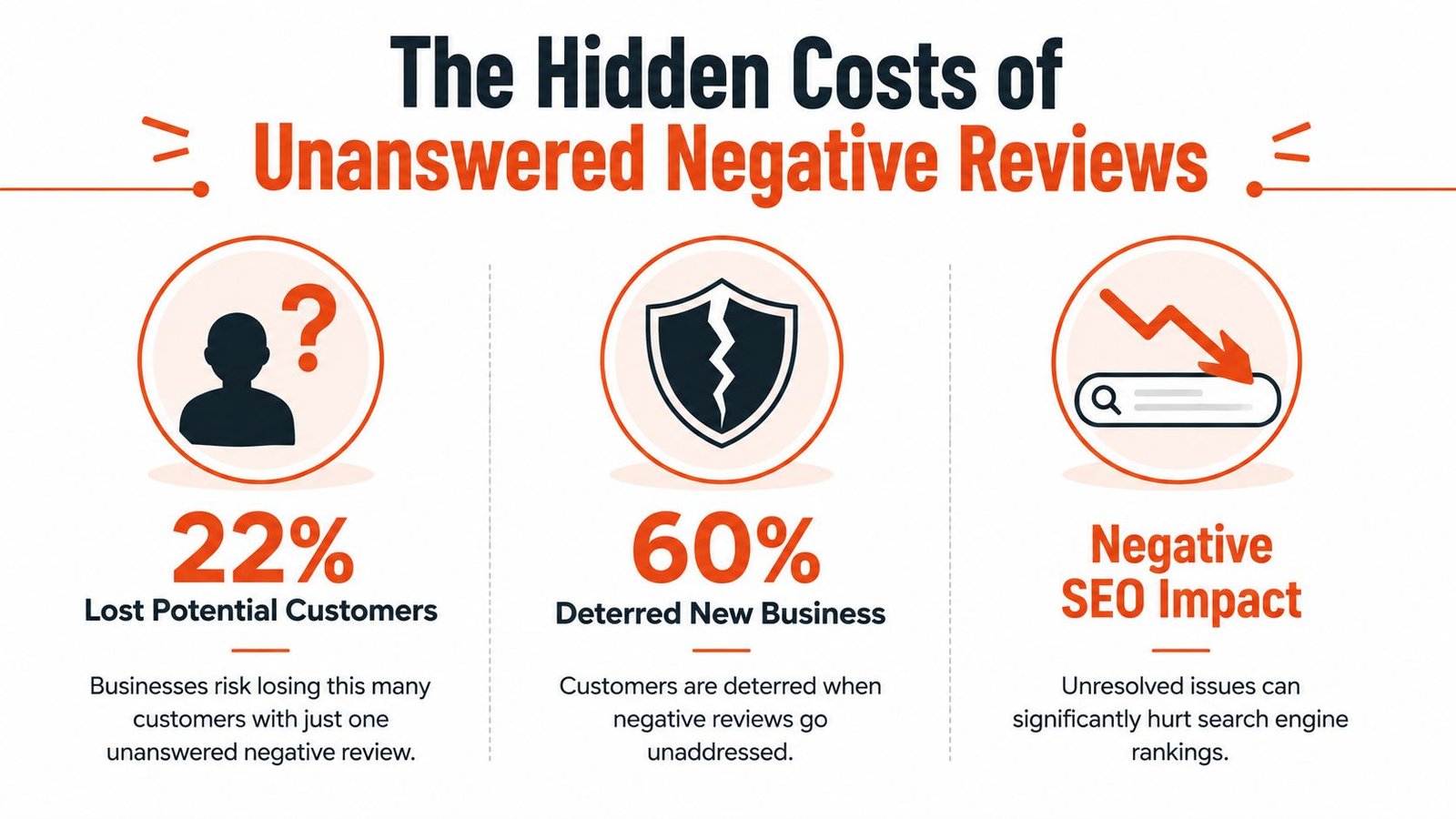
Ignoring a negative review doesn’t freeze the situation. It lets the complaint define your brand without resistance.
Ignoring reviews weakens trust first
The most immediate loss is trust. According to BrightLocal’s 2026 survey coverage, 88% of consumers are more likely to use a business that responds to all its reviews. If you’re not replying, you’re actively alienating nearly 9 out of 10 potential customers.
That matters even more in crowded local markets like Miami, where a buyer can switch to another provider in seconds. They search, compare star ratings, skim the worst reviews, and judge how management behaves. If your competitor answers every complaint calmly and you leave yours hanging, you’ve handed them the easier close.
Here’s the business reality:
| Situation | What a prospect assumes |
|---|---|
| Negative review with no reply | “They don’t pay attention.” |
| Defensive reply | “They’re difficult to deal with.” |
| Calm reply with next steps | “They handle problems well.” |
That third outcome wins calls.
Reputation and local visibility work together
Many owners separate review responses from local SEO and lead generation. That’s a mistake. Your Google Business Profile is part storefront, part trust page, part conversion page. When a prospect searches for a service plus “near me,” reviews shape whether that click becomes a lead.
An unanswered complaint also hurts your positioning against businesses that treat reputation as an operating discipline. A Miami restaurant, med spa, law office, or home service company doesn’t lose leads only because a review was negative. It loses leads because the profile tells buyers that management isn’t present.
That’s why review response shouldn’t sit in a forgotten inbox. It should live inside an active reputation management process for small businesses, tied to local visibility, conversion intent, and follow-up.
Use this standard:
- Monitor daily: Waiting until the end of the week is too slow.
- Respond with intent: The reply should reassure future customers, not vent frustration.
- Spot patterns: If multiple reviews mention the same issue, fix operations, not just wording.
- Protect your pipeline: Every review page view is a pre-sales moment.
If you want more calls from Google, you can’t treat reviews as side noise. They’re part of how buyers qualify you before they ever fill out a form.
Our 4-Step Method for Responding to Negative Reviews
Generic templates aren’t enough. The right response needs structure, timing, and restraint.
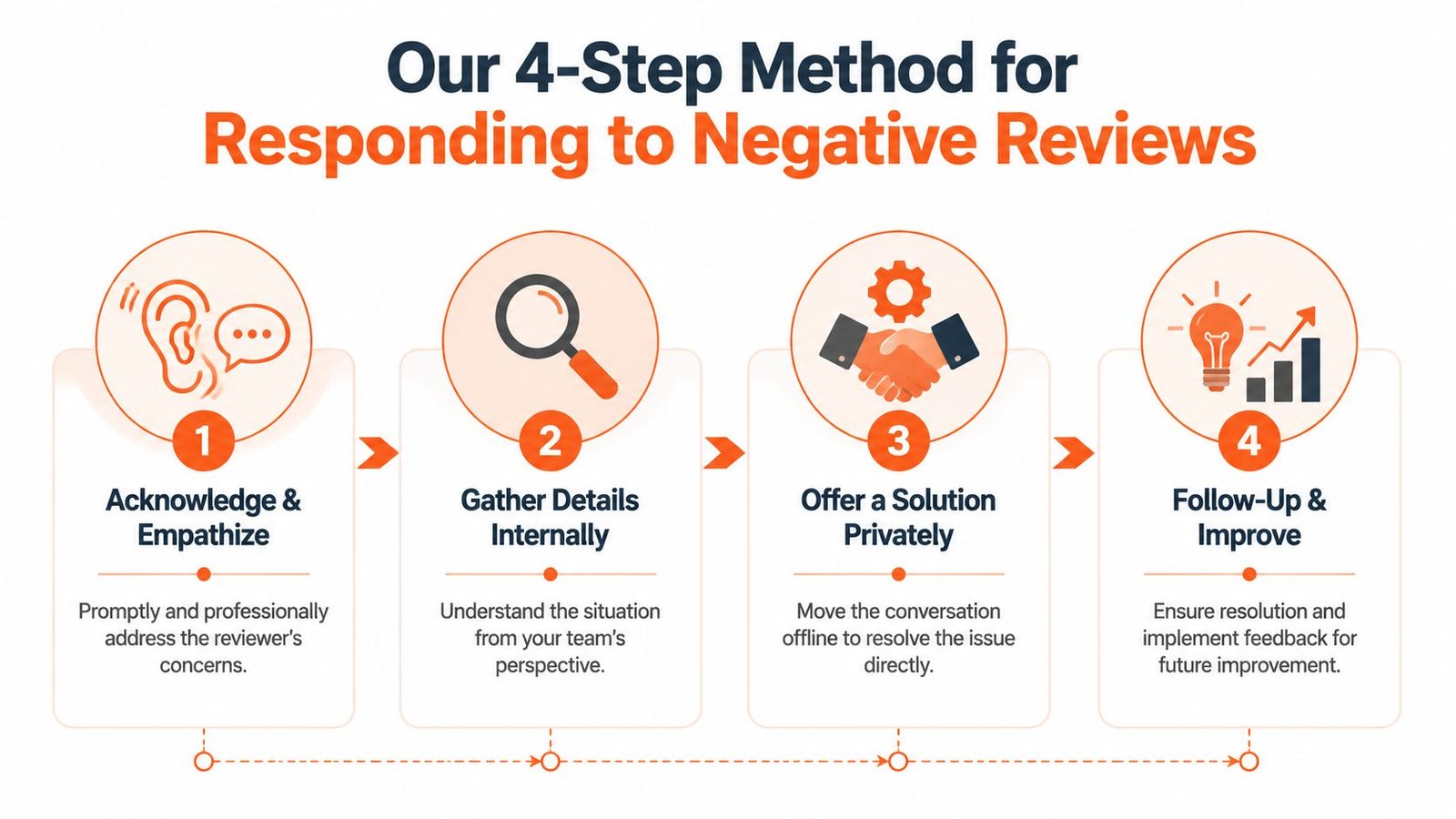
Step 1 Acknowledge and empathize fast
Speed matters. The optimal benchmark is within 24 to 48 hours, and that window is critical for problem resolution and for the 97% of consumers who read responses, as noted in this review response benchmark summary.
Use the reviewer’s name. Keep the response to one paragraph. Stay calm.
Good opening lines do three things fast:
- Acknowledge the experience: Show that you read the review.
- Express empathy: You don’t need to surrender your position to sound human.
- Avoid blame: Public argument makes you look worse than the complaint.
A simple structure works:
“Hi [Name], thank you for sharing this feedback. I’m sorry to hear about your experience, and I understand why that would be frustrating. We’d like the opportunity to look into this and make it right.”
That’s enough to lower the temperature.
A lot of the same principles apply outside Google as well. If your brand also deals with public feedback on video platforms, this roundup of advice for YouTube creators on comments is useful because it reinforces the same discipline. Respond for the audience, not your ego.
Step 2 Investigate before you overexplain
Never assume the reviewer is wrong. Never assume your employee is wrong either. Check the order, appointment, timeline, and internal notes before you add details.
Most DIY replies often face a critical failure point. Owners feel pressure to answer immediately, so they overexplain facts they haven’t confirmed. Then they either contradict themselves later or expose internal issues in public.
The best public response is brief. The real work happens behind the scenes.
Review response examples can help your team spot the difference between a polished reply and a risky one. A gallery of online reputation management examples is useful for training because it shows how tone and wording affect public perception.
Step 3 Offer a private path to resolution
Now give the reviewer a direct route offline. Don’t try to resolve the full dispute in public. Offer a contact method and make it easy for the person to continue the conversation privately.
Use one or two specific next steps:
- Phone option: Good for service disputes or urgent friction.
- Email option: Better when details need documentation.
- Named contact: Stronger than “contact our office.”
This short training video explains the mindset clearly before your team starts replying at scale:
Step 4 Follow up and turn the lesson into process
Once the issue is handled privately, don’t stop there. Review what failed. Was it communication, speed, fulfillment, staff behavior, scheduling, or expectation setting?
Then change the process. A negative review should improve your operation, your scripts, or your handoff points.
Use this internal checklist:
- Log the issue category: Delay, product defect, billing, attitude, misunderstanding.
- Share the pattern with the right team: Don’t leave review insights trapped in marketing.
- Update the response library: Tighten future replies so they’re consistent.
- Close the loop privately: Ask whether the issue has been resolved to the customer’s satisfaction.
That’s how responding to negative Google reviews turns into a business system instead of a recurring fire drill.
Editable Response Templates for Common Scenarios
Templates save time, but only if your team understands why each line is there. The goal of any public reply is to acknowledge the complaint, show professionalism, and move the discussion into a private channel. As explained in this guide on handling Google reviews, the primary strategic goal of any public response is to move the conversation offline through phone or email.
If your team needs stronger phrasing discipline, this library of customer service script examples from CallZent is worth reviewing. It’s useful for sharpening tone before your staff starts answering public complaints.
Service was too slow
Use this when the complaint focuses on wait time, delayed service, or slow communication.
Hi [Name], thank you for your feedback. I’m sorry your experience felt slower than it should have, and I understand how frustrating that is. Please contact [Name/Department] at [phone/email] so we can review what happened and work on a proper resolution with you.
Why it works:
- It validates the delay: You’re not pretending speed didn’t matter.
- It avoids excuses: No public lecture about staffing or busy hours.
- It redirects fast: The conversation moves offline where details belong.
Product didn’t work
Use this for defects, faulty items, broken expectations, or missing functionality.
Hi [Name], thank you for bringing this to our attention. I’m sorry the product didn’t meet expectations. Please reach out to [phone/email] with your order details so we can look into the issue and help with the next step.
What to avoid:
- Don’t imply misuse publicly
- Don’t debate technical details in the review thread
- Don’t promise a remedy you haven’t approved internally
Rude staff member
Staff complaints require discipline because owners often feel protective. Stay neutral in public.
Hi [Name], thank you for sharing this experience. I’m sorry to hear you felt disrespected during your interaction with our team. Please contact [manager name] at [phone/email] so we can review this directly and address it properly.
Use this template carefully. If you publicly defend the employee before investigating, you make the business look dismissive. If you publicly condemn the employee before confirming facts, you create internal damage and legal risk.
Keep the public reply respectful, short, and noncommittal on disputed details.
Wrong business or fake review
This one needs precision. You want to challenge the review without sounding combative.
Hi [Name], thank you for your feedback. We take reviews seriously, but we haven’t been able to match this experience to a customer record. Please contact [phone/email] with more details so we can investigate further.
That wording does three things:
- Signals doubt without accusation
- Shows willingness to investigate
- Reassures future readers that you’re not ignoring the issue
If your reviews already feel messy or inconsistent, get them audited before the next complaint forces a rushed reply. A review response process is much easier to fix before a reputation problem starts costing leads.
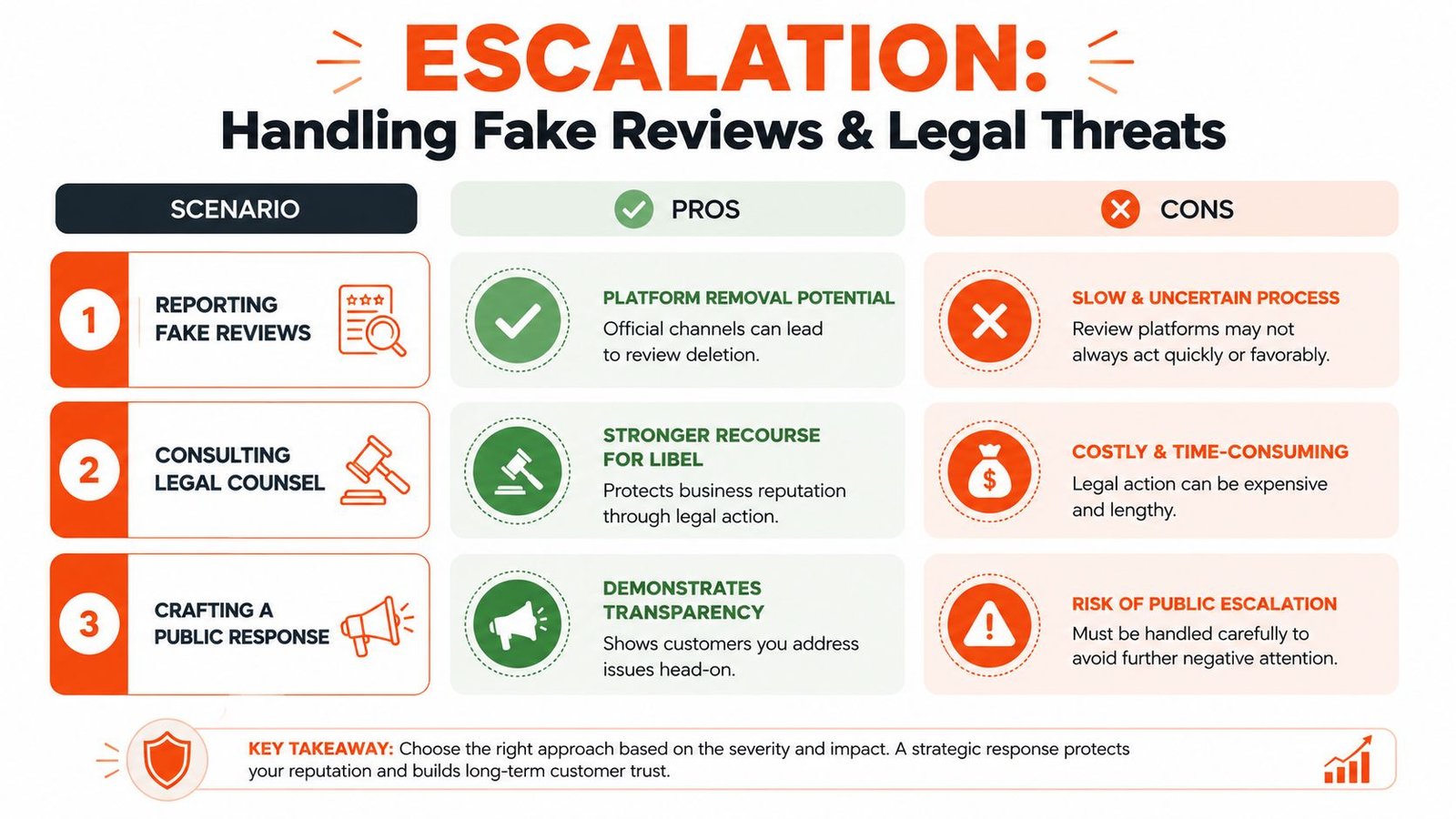
Escalation How to Handle Fake Reviews and Legal Threats
Some reviews need more than a polished reply. Fake reviews, competitor attacks, and legal threats require restraint and sequence.
When to flag first and when to reply
If a review appears to violate platform policy, flag it first. Then wait. According to Widewail’s review response guidance, when a review is flagged for a policy violation, you should wait approximately 3 business days for Google to act. If it remains live, you must respond publicly to manage the narrative for future customers.
That timing matters. If you respond too quickly to a review that may be removed, you may give it extra visibility. If you wait too long after it stays up, the complaint sits there unanswered and shapes perception.
Use this sequence:
- Capture evidence internally: Screenshot the review and note why it may violate policy.
- Flag through Google: Use the proper reporting route.
- Pause briefly: Give the platform time to review.
- Respond if it stays live: Keep the reply short, factual, and non-defensive.
For hospitality operators, this issue gets especially ugly because fake or exaggerated reviews can hit reservations fast. A tighter reputation management approach for restaurants is often necessary because review velocity and public visibility move quickly in that category.
What separates strategic management from amateur cleanup
Amateurs treat escalation like a fight. Professionals treat it like risk control.
If a reviewer threatens legal action, don’t answer emotionally. Don’t post internal records. Don’t try to “set the record straight” with a giant paragraph. A public thread is not the place to litigate the facts.
Instead:
- Acknowledge receipt carefully: Confirm you take concerns seriously.
- Move offline immediately: Offer a direct point of contact.
- Coordinate internally: Bring in management, operations, or legal counsel if needed.
- Protect the audience view: The public reply should show order, not panic.
A fake review or legal threat doesn’t just test your wording. It tests your system. Businesses with no escalation process usually bounce between silence and overreaction. Both damage trust.
The businesses that handle these situations well don’t look louder. They look controlled.
Why a Professional Reputation System Beats DIY Every Time
DIY sounds cheaper until the first bad week. Then the owner is answering reviews between appointments, a front desk employee is improvising replies, and nobody is tracking patterns that affect lead flow.
DIY breaks under real business pressure
Most businesses don’t fail at responding because they don’t care. They fail because they don’t have a system.
A DIY approach usually creates the same problems:
- Emotional replies: Owners answer from frustration instead of strategy.
- Missed monitoring: Reviews sit too long before anyone notices.
- Inconsistent tone: One reply sounds polished, the next sounds irritated.
- No connection to lead generation: The business answers complaints but never uses responses to improve conversion trust.
- No reporting loop: Feedback never reaches operations, sales, or marketing.
If you’re still deciding whether to keep this in-house or hand it off, read a practical framework on how to choose a digital marketing agency. The right partner won’t treat review response as a side task. They’ll tie it to local visibility, conversion behavior, and lead quality.
There are also platforms that help centralize activity. An AI-powered tool for business reviews can support review management workflows. That said, software doesn’t replace judgment. It speeds up monitoring and drafting. It doesn’t decide when to escalate, how to protect brand positioning, or how to align responses with your broader SEO and lead-generation goals.
What a real reputation system includes
A proper setup is more than templates and notifications. It should give you consistency, oversight, and direct business value.
What that system should include:
- Daily monitoring: New reviews are seen fast, not days later.
- Response rules: Clear standards for tone, timing, and escalation.
- Template library with customization: Enough structure to stay efficient, enough flexibility to sound human.
- Offline resolution process: Named contacts, tracked outcomes, and internal accountability.
- Pattern reporting: Recurring complaints get flagged and fixed.
- Integration with Local SEO: Review quality and response quality support your profile’s conversion power.
- Communication cadence: You know who handles what, when, and how updates are shared.
That’s why responding to negative Google reviews shouldn’t sit with whoever happens to be available. It’s reputation management, local SEO support, and conversion optimization rolled into one workflow.
If you want more calls, stronger Google Maps performance, and fewer lost leads from preventable trust issues, build a system or hire one.
If your business is losing leads because reviews are unmanaged, inconsistent, or handled too slowly, VIP TECH CONSULTING is the logical next step. The team helps Miami-area businesses and growth-focused local brands turn reputation management into a real acquisition channel by connecting review response with Local SEO, Google Business Profile optimization, paid search visibility, and conversion strategy. If you’re ready to stop guessing and start using your public reviews to win more calls, request a consultation through VIP TECH CONSULTING now.