
Your phones are ringing less. Form fills are thinner than they should be. You’re paying for SEO, Google Ads, or both, but too many prospects disappear right before they contact you.
That usually isn’t a traffic problem. It’s a trust problem.
A Miami homeowner searches for a service, taps the map pack, compares two listings, and chooses the business that looks safer. Better reviews. Better responses. Fewer unanswered complaints. Decision made in seconds. Your ad may have done its job. Your Google Business Profile may have shown up. But your reputation closed the sale for someone else.
That’s why reputation management for small business has to be treated like lead generation, not cleanup. If your public feedback weakens trust, every dollar you put into Local SEO, Google Ads, and Meta Ads has to work harder to produce the same call. If you want a direct plan for fixing that gap, review these online reputation management examples and then request a consultation.
Table of Contents
- Why Negative Reviews Cost You More Than Just Customers
- Building Your Reputation Command Center
- How to Generate Reviews That Win You Business
- Our Proven Reputation Management Process
- Answering Your Toughest Reputation Questions
- Turn Your Reputation into Your Strongest Asset
Why Negative Reviews Cost You More Than Just Customers
A prospect doesn’t need to call you to reject you. They only need to see enough friction to keep scrolling.
For local businesses in Miami, that friction usually shows up in plain view. A weak star rating. A recent complaint with no response. An outdated listing. A competitor who looks more active, more trusted, and easier to buy from.

The lost lead happens before you ever hear from them
This problem is bigger than most owners realize because the buyer behavior is already established. 97% of consumers read online reviews before selecting a local business, according to this small business reputation management guide. If your reviews look weak, inconsistent, or neglected, the market doesn’t give you a second chance.
That means reputation affects far more than brand image. It determines whether your traffic becomes inquiries.
Practical rule: If a prospect sees your listing before they speak to you, your reputation is already part of your sales process.
I see this mistake often with service businesses that invest in visibility first and trust second. They launch Google Ads, improve rankings, or expand local landing pages, but they leave a damaged review profile untouched. The campaign produces impressions and clicks. Then conversion stalls because the buyer checks reviews before calling.
Bad reputation makes paid and organic marketing less efficient
The financial trade-off becomes obvious.
If you spend on Google Ads and your listing looks unstable, you pay to send people into hesitation. If you invest in Local SEO and rank in map results, but your competitor appears more trustworthy, your visibility helps them more than it helps you. Reputation is the layer that determines whether attention turns into calls.
A poor review profile also creates internal pressure. Teams start assuming the website needs a redesign, the ad copy needs a rewrite, or the lead quality is bad. Sometimes those things matter. But often the actual issue is simpler. Prospects don’t trust what they see after the click.
Here’s the practical takeaway. If your reviews are dragging, reputation management for small business isn’t optional support work. It’s conversion infrastructure. Fixing it can improve the output of every traffic channel you already use.
If you’re comparing agencies right now, ask a direct question: how will they protect conversion after they generate the click?
Building Your Reputation Command Center
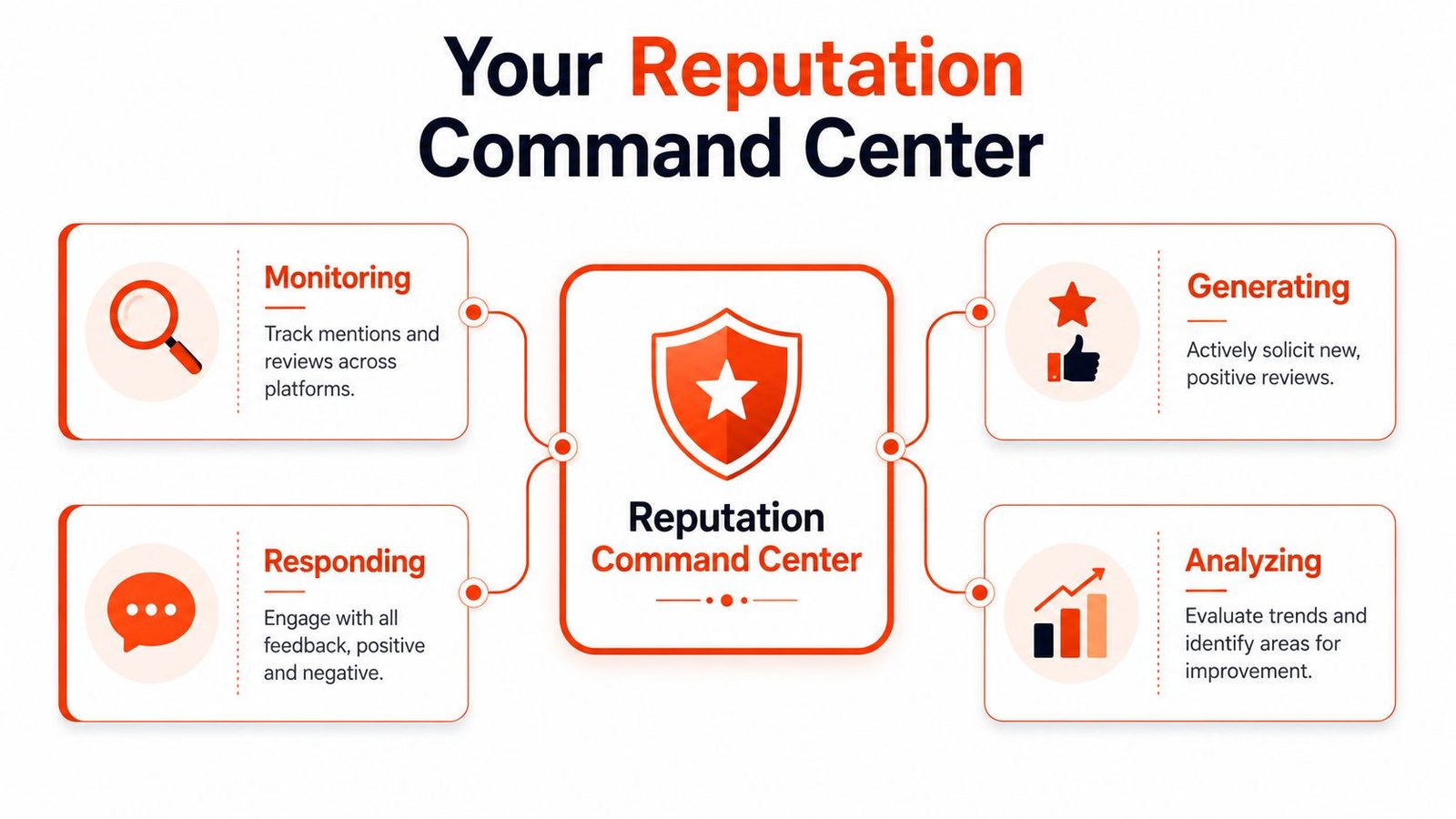
Strong reputation management isn’t reactive. It runs like an operating system.
Businesses that handle this well don’t wait for a bad review to force action. They build a simple command center that makes monitoring, responding, and correction part of weekly operations.
Start with the assets prospects actually see
The first asset is your Google Business Profile. For most local searches, that profile is your front desk, sales sheet, and first impression at the same time. It needs accurate categories, business description, services, hours, photos, and review activity that shows the business is active and accountable.
The second asset is your listings ecosystem. If your name, address, and phone number vary across platforms, you create doubt for both search engines and customers.
Maintaining strict NAP consistency across at least 15 major online directories is identified as a ranking threshold in this local SEO analysis. That matters because inconsistency weakens local trust signals right where high-intent prospects are checking you.
Fix the trust signals Google and customers compare
A command center should answer four questions every week:
Where are reviews coming in
Google Business Profile, Yelp, Facebook, and niche industry platforms need one monitoring workflow, not scattered manual checks.What do prospects see first
Search your brand, service names, and branded variations in an incognito browser. That shows the real first-page experience, not the version influenced by your own browsing history.Are your business details uniform
Address changes, duplicate listings, tracking numbers, and inconsistent suite formatting can create confusion fast.Is your response process documented
If staff members improvise review replies, tone and speed become inconsistent.
Search results don’t just reflect your business. They reflect how disciplined your business is online.
What a professional setup includes
This is the baseline setup I’d expect before any serious push with Local SEO or paid ads:
| Area | What needs to be in place | Why it matters |
|---|---|---|
| Google Business Profile | Complete services, categories, photos, hours, and active review management | Supports local visibility and conversion |
| Directory listings | Consistent NAP across key platforms | Reduces trust friction |
| Review monitoring | One dashboard or routine for every major platform | Prevents missed complaints |
| Response workflow | Templates, escalation rules, and ownership | Shortens reaction time |
| Feedback capture | A repeatable ask process after successful jobs | Keeps fresh reviews coming |
If you want a cleaner system for gathering and routing feedback after service completion, a dedicated customer feedback collection process makes that far easier than chasing reviews manually.
This is the part many owners skip because it doesn’t feel urgent. But when the foundation is loose, every later campaign has to compensate for it.
How to Generate Reviews That Win You Business
Most businesses don’t have a review problem. They have a review system problem.
They ask inconsistently. They ask the wrong customers. They ask too late. Or they ask once, then disappear for three months. That creates an online profile that looks stale even when customer experience is solid.
Review velocity beats random bursts
Many DIY efforts falter because owners focus on total review count and ignore review velocity, which is the steady pace of new reviews over time.
That distinction matters. According to this industry write-up on small business reputation recovery, businesses recovering from negative review spikes saw 68% faster sentiment improvement when they achieved a minimum of 3 to 5 new positive reviews per week. The lesson is practical. A slow drip of fresh feedback often does more for recovery than a one-time push.
For lead generation, that means consistency beats intensity.
A buyer looking at your listing today wants proof that customers trust you now. Fresh reviews provide that proof. Old reviews, even good ones, don’t carry the same reassurance.
Ask at the right moment and remove friction
The best time to request a review is right after the customer experiences a clear win. A completed repair. A successful consultation. A delivered order. A resolved support issue. Not weeks later when the emotional value has faded.
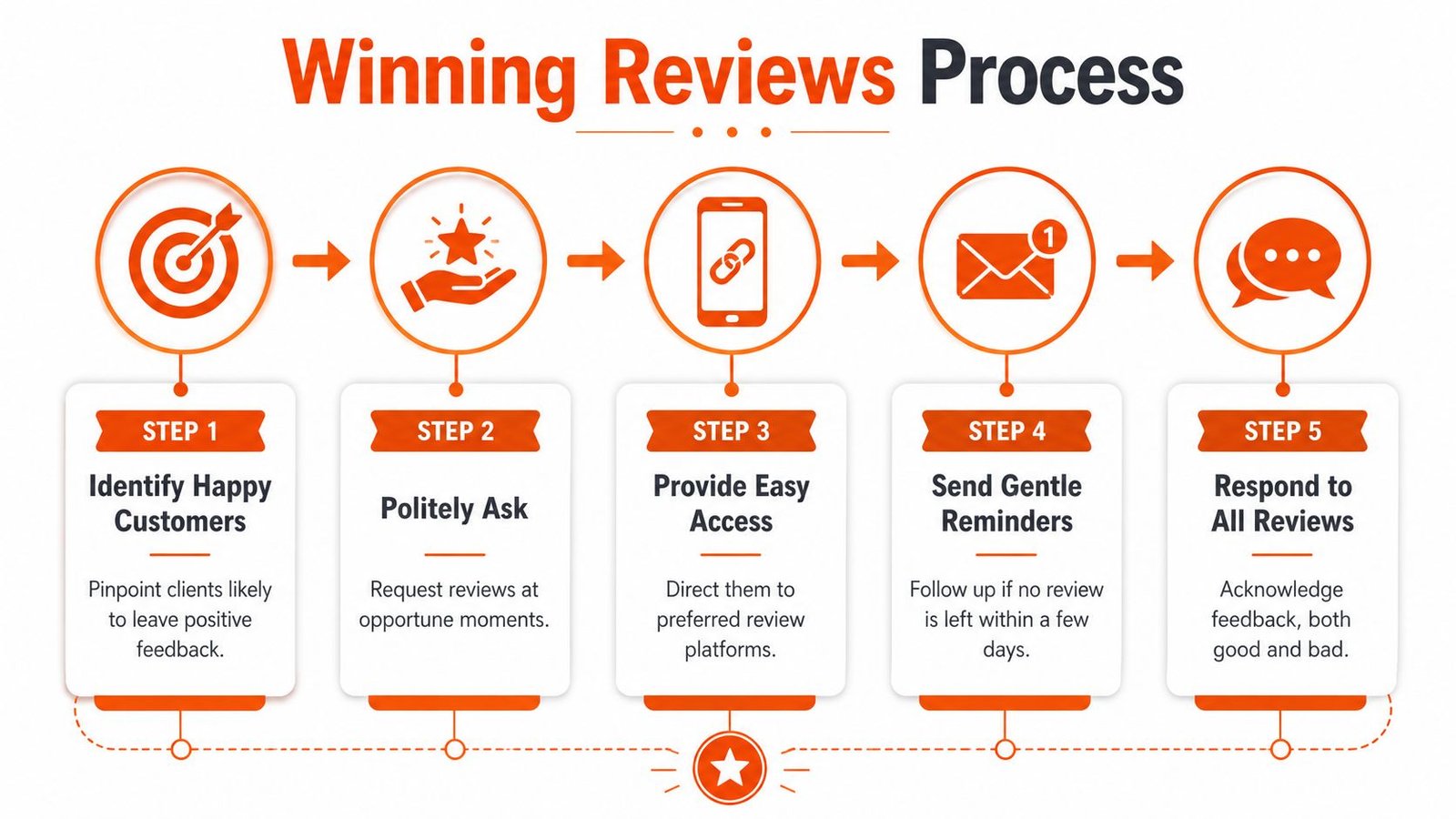
A review-generation workflow usually works best when it includes:
- A trigger point after a completed service or successful delivery
- A short SMS or email with one direct review link
- A reminder if the customer doesn’t respond
- Internal routing so unhappy customers can raise concerns privately before posting publicly
This is also where technology helps. CRM automations, booking systems, and email tools can prompt requests without making your staff remember every time.
For businesses that need stronger map visibility, combining review generation with Local SEO services for small businesses usually creates a more reliable path to calls than treating them as separate projects.
Later in the workflow, it helps to review practical guidance on monitoring and responding to reviews, especially if your team is trying to standardize tone across platforms.
Response quality changes conversion quality
A good response does more than satisfy the person who wrote the review. It reassures everyone else reading it.
That’s why response quality matters almost as much as review quantity. Positive reviews should get a real acknowledgment, not a copied “thank you.” Negative reviews need calm language, ownership where appropriate, and a fast move toward offline resolution.
A useful benchmark video on how businesses handle this process is below.
Three response habits consistently work better than most owners expect:
Be specific
Refer to the service or issue directly so the reply feels human.Stay brief in public
Public review threads aren’t the place for arguments or detailed defense.Move resolution offline
Give the customer a clear path to continue the conversation privately.
Fast, respectful responses tell future buyers that your business won’t disappear when something goes wrong.
That’s the core difference between reviews that sit there and reviews that actively help you win business.
Our Proven Reputation Management Process
If you’re hiring help, you shouldn’t have to guess what happens after you sign.
A real reputation service needs a visible process, named deliverables, and clear ownership. Otherwise you’re paying for vague “brand protection” while your team still handles the hard parts.
What happens first
The first phase is an audit. Not a generic scan. A working review of how your business appears across search, maps, review platforms, and directory listings.
That audit should identify missing listings, duplicate profiles, reputation gaps, weak review responses, and breakdowns between your marketing channels and your public trust signals. For example, if your Google Ads are driving traffic but the landing experience and public reviews tell conflicting stories, that has to be fixed early.
This kind of service category keeps growing because the commercial value is obvious. The online reputation management market was valued at USD 7.75 billion in 2026 and projected to reach USD 14.01 billion by 2031, according to these reputation management statistics. Businesses don’t invest there out of vanity. They invest because trust affects revenue.
What’s included every month
A strong monthly process should include more than review replies.
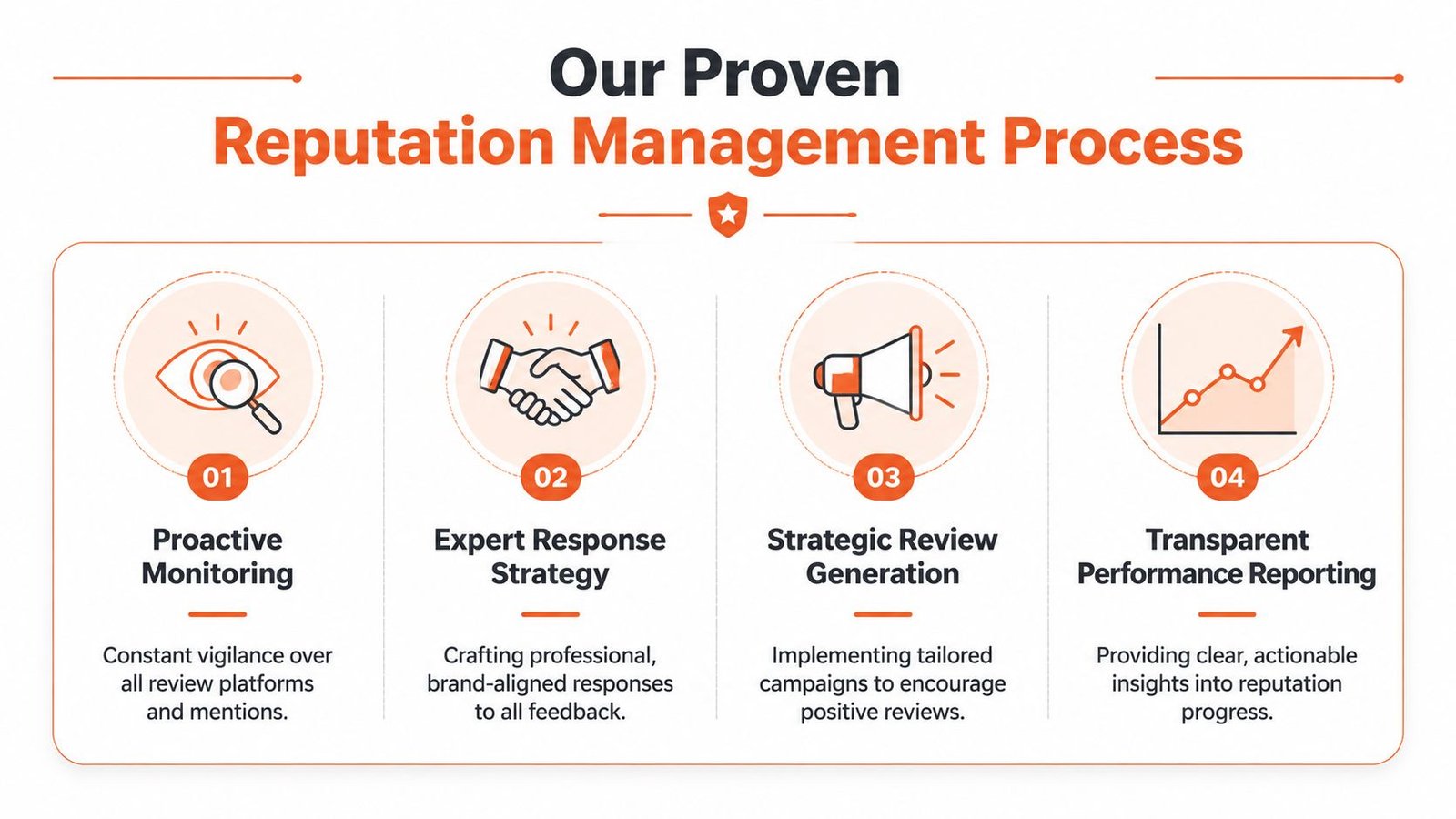
Here’s what clients should expect from a structured engagement:
Initial reputation audit
Review platform presence, listing consistency, branded search results, and priority risks.Strategic response playbook creation
Response frameworks for praise, service complaints, billing disputes, delays, and unfair or suspicious feedback.Proactive review generation campaign setup
Email and SMS workflows tied to completed jobs, milestones, or customer success points.Monthly performance reporting
Clear reporting on star trends, incoming review pace, sentiment patterns, and unresolved issues.Crisis monitoring
Fast escalation when a complaint starts spreading or a pattern suggests coordinated negative activity.
One practical example is a service line built around sectors with heavy review pressure, such as reputation management for restaurants, where reservations, walk-ins, and map visibility are tightly linked.
The one provider mention worth making here is VIP TECH CONSULTING, a Miami-based agency that offers reputation management alongside Local SEO, Google Ads, and web support. That integrated structure matters because it lets one team connect review strategy with lead generation channels instead of treating them as separate problems.
Why this matters if you’re running SEO or Google Ads
Reputation work becomes far more valuable when it’s aligned with acquisition.
If your SEO team improves rankings but doesn’t address review friction, organic traffic underperforms. If your PPC team improves click volume but negative feedback sits unanswered, cost per lead gets harder to control. The same is true for Meta Ads when prospects search your brand after seeing an ad.
The right agency doesn’t just get you seen. It protects the moment when visibility turns into trust.
This is why good reputation management for small business should sit inside the same conversation as Local SEO, map pack visibility, branded search, and paid media performance.
If an agency can’t explain that connection clearly, they’re only solving part of the problem.
Answering Your Toughest Reputation Questions
Business owners usually ask the same questions before they commit. Fair questions. Reputation work touches sales, staffing, customer service, and marketing all at once.
Is this worth paying for
Yes, if lost trust is reducing the return on your existing lead generation.
If your business depends on local discovery, reviews influence whether prospects call, book, or keep comparing. That means reputation management is often cheaper than letting weak conversion rates drag down your SEO and ad spend month after month.
A good way to judge value is simple. Are you losing inquiries at the exact point where buyers verify your credibility? If the answer is yes, the issue is no longer cosmetic.
Can you handle it in house
Sometimes. Usually not well for long.
The challenge isn’t writing one thoughtful reply. The challenge is doing it consistently across platforms, with the right tone, at the right speed, while also asking for fresh reviews and fixing listing issues. Most in-house teams already have enough on their plate.
There’s also a skill component. A study found that 39% of customers leaving negative feedback do so primarily because they want the company to apologize, according to this Wharton Online article on small business reputation management. That means defensive or robotic replies often make the situation worse.
How long does it take and what if there’s a crisis
You can usually improve process quickly. You can’t force public trust on demand.
Some fixes are immediate. Claiming listings, correcting NAP details, tightening response workflows, and creating automated review requests can happen fast. Reputation recovery itself depends on your starting point, how often reviews come in, and whether the underlying customer experience supports better feedback.
If you get hit with a sudden review bomb or a fast-moving complaint, use this checklist first:
Pause emotional replies
Don’t let staff argue publicly.Document everything
Capture screenshots, dates, usernames, and platform details.Verify pattern and legitimacy
Separate real service complaints from suspicious activity.Post one calm public response
Acknowledge the issue and direct resolution to a private channel.Fix the root cause if it’s real
Reputation management can’t cover up operational failure.Increase monitoring frequency
During a live issue, silence creates more damage than a measured response.
That’s also why many businesses outsource this work before a crisis hits, not after.
Turn Your Reputation into Your Strongest Asset
The businesses that win local searches consistently don’t treat reputation like a side task. They treat it like sales enablement.
A strong review profile helps your Google Business Profile convert map views into calls. It helps branded searches feel safer. It improves the performance of traffic you generate from SEO, Google Ads, and Meta Ads because prospects find proof that your business is active, credible, and responsive.
The numbers that actually matter
You don’t need a bloated report full of vanity metrics. You need a short set of indicators tied to lead flow:
- Average star rating because buyers use it as a shortcut for trust
- Review velocity because fresh feedback carries more decision-making power
- Sentiment patterns because repeated complaints point to conversion risk
- Response coverage and speed because public silence hurts credibility
- Listing accuracy because local trust breaks when core details don’t match
A practical support area that often gets overlooked is email deliverability. If you’re sending follow-up requests for reviews, guides on boosting sender reputation are useful because weak email trust can interfere with customer communication before the review ask is even seen.
What happens when reputation supports lead generation
When your reputation system is healthy, every other channel gets cleaner.
SEO traffic is more likely to convert. Google Ads clicks face less hesitation. Referral traffic lands on a business that looks credible. Your team spends less time overcoming distrust on the phone because more buyers arrive pre-sold.
If you want a sharper way to evaluate where those local trust signals are helping or hurting, use a practical local SEO checklist and review your visibility, listings, and reputation together.
Miami is competitive. While you’re comparing providers, another business is collecting fresh reviews, responding faster, and winning the calls that should have been yours. The right move isn’t just to protect your name. It’s to turn reputation management for small business into a growth channel that supports every lead source you already depend on.
If you want a clear action plan instead of more guesswork, book a strategy session with VIP TECH CONSULTING. You’ll get a practical review of your current reputation gaps, how they affect SEO and paid lead generation, and what to fix first so more search traffic turns into calls, inquiries, and booked consultations.