
A busy Friday service can feel strong inside the dining room, but your online presence could be undermining you.
A guest searches your restaurant on Google, sees an unanswered complaint, an outdated hour listing, and a recent review calling service slow. They never click your menu. They never book a table. They move to the place down the street.
That’s why reputation management for restaurants isn’t a side task. It’s a sales system. If you want more reservations, more calls, stronger Google Maps visibility, and fewer lost diners, you need a process that turns feedback into trust and trust into revenue.
If you already suspect your reputation is costing you business, don’t wait for another slow week to confirm it. Start with a proper audit of your Google Business Profile for restaurants and fix the leaks before they get more expensive.
Table of Contents
- How Online Reviews Quietly Control Your Restaurant’s Revenue
- The Professional System That Turns Reviews Into Reservations
- Building Your 5-Star Reputation Proactively
- Why a DIY Approach Costs More Than It Saves
- What a Results-Driven Management Service Includes
- Stop Losing Customers and Book Your Strategy Call
How Online Reviews Quietly Control Your Restaurant’s Revenue
A single review can hurt you long before anyone tastes the food.
Most restaurant owners still think reputation problems begin after a bad visit. They don’t. They begin in search results, inside Google Maps, on Yelp, and on the review summary a diner scans while deciding where to go tonight.
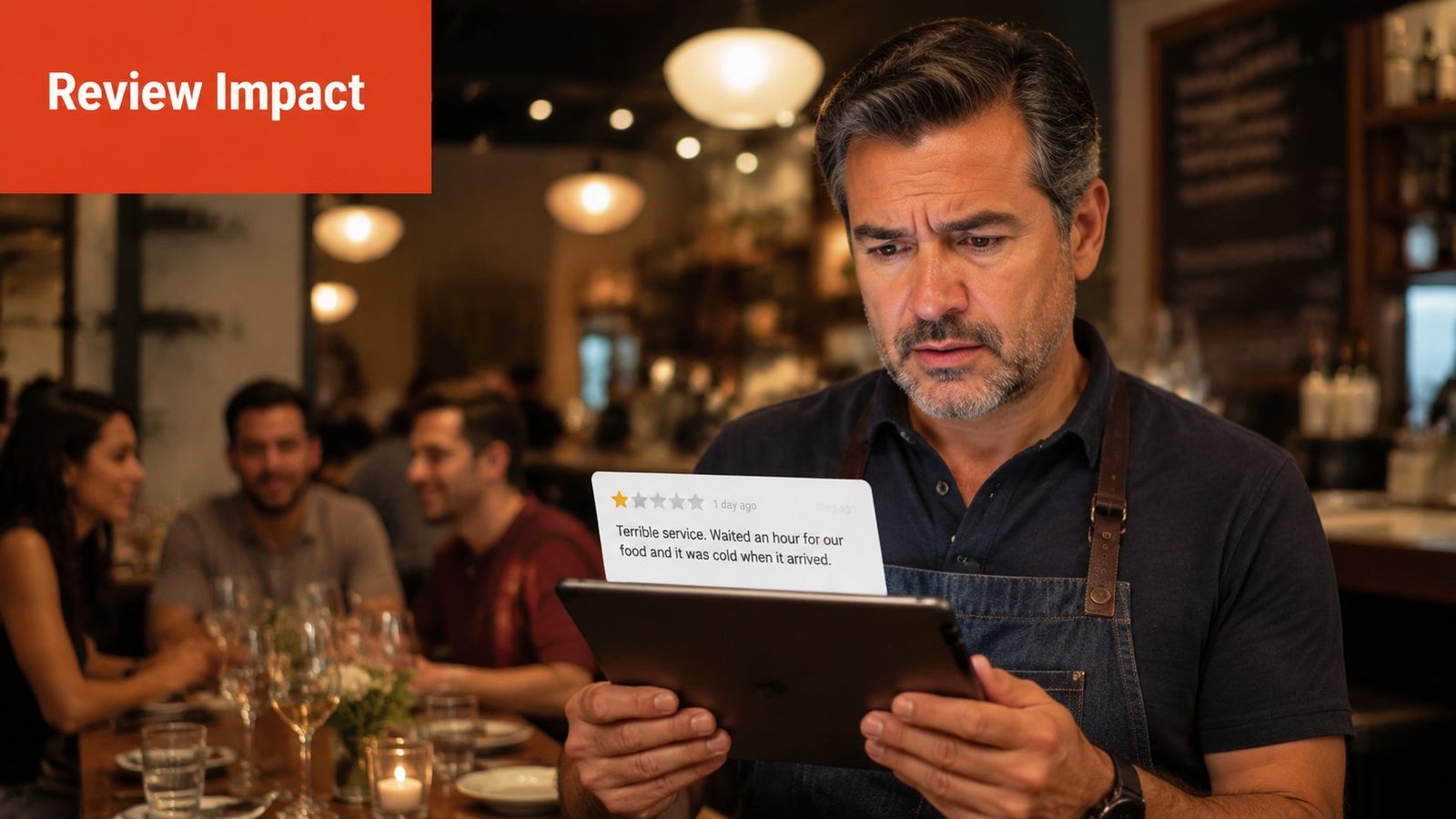
One bad impression now hits before the first visit
The buying decision often happens before your host greets anyone. According to Vip Tech Consulting, most diners research reviews, ratings, and local search results before choosing where to eat, making online reputation management a key factor in restaurant growth.
92% of food consumers read online reviews before deciding where to eat, and a Harvard Business School cited finding reports that a 1-star increase in a restaurant’s Yelp rating can raise revenue by 5% to 9%.That should change how you think about reviews.
They are not comments sitting on the internet. They are part of your funnel. A weak rating, stale responses, or repeated complaints about speed, noise, or accuracy can block the reservation before a customer ever sees your menu.
Practical rule: If your reputation is unmanaged, your marketing is paying to send diners into a trust problem.
This matters even more in competitive cities and food-heavy neighborhoods. Diners compare options fast. If your profile looks neglected and the restaurant next to you looks current, responsive, and consistent, they win the click.
If you’re watching new openings and changing diner expectations in active markets, Food Escapes’ restaurant insights are a useful reminder of how quickly competition evolves when customers have plenty of fresh choices.
What owners get wrong about ratings
Owners often fixate on one number. That’s too shallow.
A profile can look “fine” at a glance and still underperform because the recent reviews are weak, the complaints repeat the same issue, or the negative comments are sitting unanswered near the top. Diners don’t read your average score like an accountant. They read the story your reviews tell.
That story usually answers a few blunt questions:
- Is the experience consistent
- Does the staff care
- Will my order be right
- Will I regret choosing this place over the competitor nearby
Here’s the hard truth. If your restaurant has service issues online and no visible recovery process, prospects assume the same carelessness happens in the dining room.
That’s why the owners who win treat reputation management for restaurants as revenue protection. Not vanity. Not housekeeping. Revenue protection.
If you’ve noticed strong food, decent traffic, and weaker-than-expected reservations, your reputation may be the leak. You don’t need more guessing. You need a health check and a fix.
The Professional System That Turns Reviews Into Reservations
Replying when you remember is not a system.
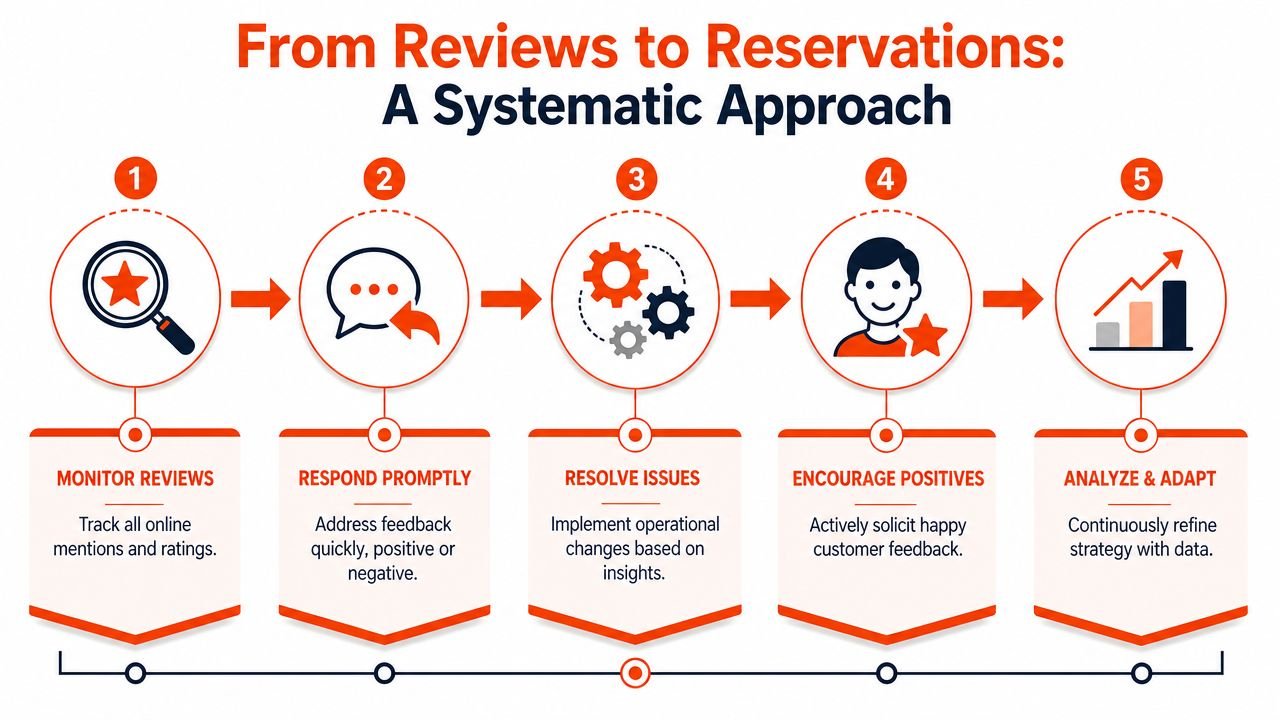
A professional setup turns reviews into bookings because it handles three jobs at once. It catches issues early, protects trust in public, and feeds recurring complaints back into operations so the same problem stops repeating.
What a real workflow looks like
At Vip Tech Consulting, we recommend a structured reputation management process that includes ongoing review monitoring, categorizing customer feedback by severity, assigning accountability for each issue, and delivering timely responses to protect and strengthen your online reputation.
. The same guidance warns that customers expect empathetic, specific responses rather than automated text.That’s the difference between amateur damage control and a real management process.
A proper workflow usually includes:
Continuous monitoring across platforms
Google, Yelp, TripAdvisor, social mentions, and owned channels all need to be watched. If you only check one platform, you’re operating blind.Triage by seriousness
A complaint about slow service is not handled the same way as an allegation involving billing, food safety, harassment, or repeated order errors.One owner per issue
Shared responsibility usually means no responsibility. Someone has to own the response, the follow-up, and the internal handoff.Fast public response
Not robotic. Not defensive. Clear, human, and tied to the specific issue.Closed-loop follow-up
The best systems don’t just answer reviews. They resolve causes.
You can improve response handling by putting a structured customer feedback collection process behind the scenes so issues are caught before they spread publicly.
Why speed without judgment still fails
Many restaurants make the same mistake. They respond quickly, but the response says almost nothing.
“Thanks for your feedback” is not recovery. “We’re sorry you feel that way” usually makes the brand look worse. Generic replies signal that nobody read the review and nobody fixed the problem.
A weak reply doesn’t neutralize a negative review. It confirms it.
Good responses do three things:
| Response element | What the guest needs to see | Why it matters |
|---|---|---|
| Acknowledgment | You understood the actual complaint | It lowers public friction |
| Specificity | You addressed the issue, not a template | It builds credibility |
| Resolution path | You offered a next step or explained the fix | It shows accountability |
Restaurants that treat this as an operational discipline usually protect far more than brand image. They protect conversion.
If your team is too busy to watch every platform, too inconsistent in replies, or too close to the problem to respond calmly, that’s exactly when professional help pays for itself. The goal isn’t to answer reviews. The goal is to remove friction between search and reservation.
Building Your 5-Star Reputation Proactively
Most restaurants stay stuck in defense mode. They wait for reviews, react to complaints, and hope more positive feedback shows up on its own.
That’s backward.
A better system creates steady review momentum, filters feedback intelligently, and uses what guests say to improve service in the areas that keep hurting conversion.
Set up a feedback path that does the sorting for you
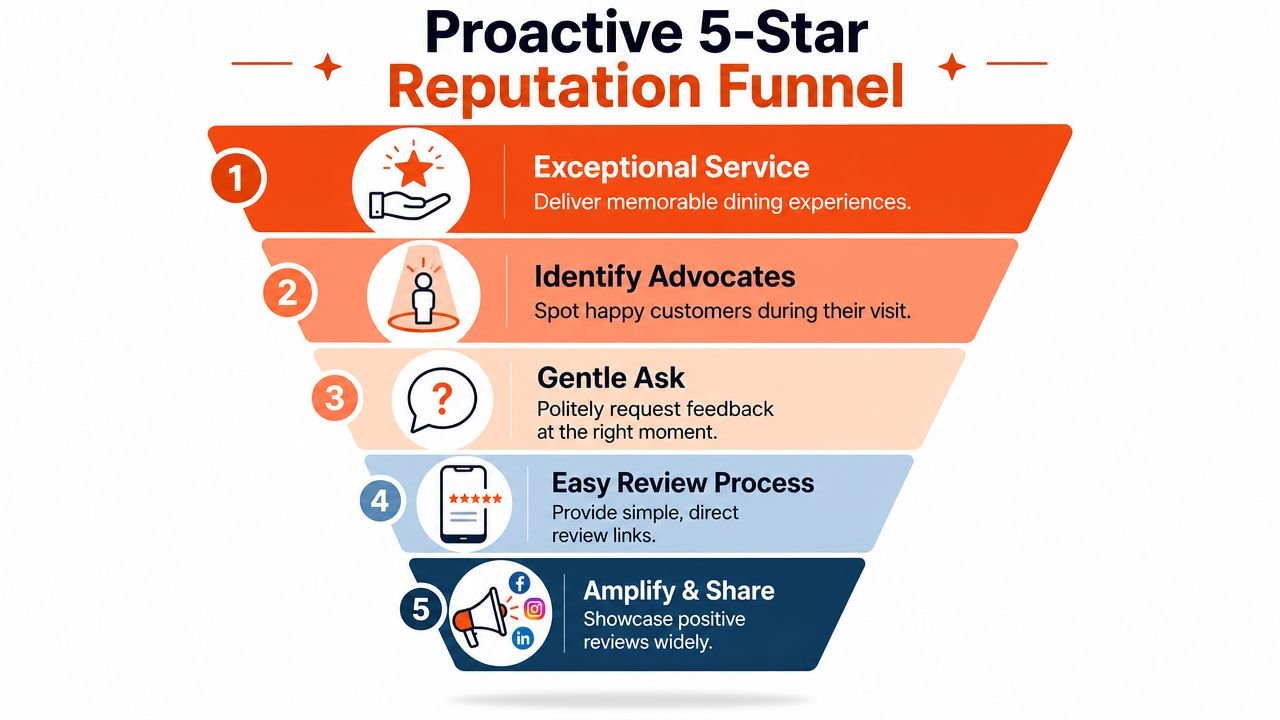
According to Jotform’s restaurant reputation management guidance, a stronger system combines review generation, sentiment analysis, and operational benchmarking. After each meal or delivery, guests should move through a low-friction feedback path such as QR-code surveys, then be segmented into promoters and detractors before satisfied customers are asked for public reviews.
That model works because it removes guesswork.
Instead of asking everyone for a public review and hoping for the best, you build a simple path:
After dine-in or delivery
Give guests an easy feedback prompt through a receipt QR code, text, or follow-up email.For happy guests
Ask for a public review while the experience is fresh.For unhappy guests
Route them to a private form or direct contact path so staff can recover the issue.For recurring complaints
Push them into operations, not just marketing.
That’s how review generation becomes a growth system rather than a gamble.
If your restaurant also depends on takeout and delivery experience, details outside the dining room matter too. Packaging affects perception, temperature, presentation, and brand recall. This breakdown of effective food packaging strategies for businesses is worth reviewing if off-premise orders are part of your reputation challenge.
A well-built reputation funnel should also improve your local search performance over time because recent, relevant, positive feedback gives searchers more confidence. If you want to see how that plays out in practice, these online reputation management examples show the kind of systems businesses use to move from random reviews to structured growth.
Here’s a useful walkthrough on the same principle:
Use reviews as an operating dashboard
Restaurants waste a lot of value when they treat reviews as public relations only.
Reviews tell you where money is leaking. If guests keep mentioning long waits on certain shifts, cold delivery, inattentive staff, wrong orders, or confusing pickup instructions, those are not reputation issues alone. They are operating issues with visible sales consequences.
Owner mindset: Don’t chase stars without fixing the behavior that causes low-star experiences.
What should you track?
- Complaint categories such as wait time, food quality, order accuracy, cleanliness, and staff interaction
- Response latency so reviews don’t sit unanswered
- Repeat issue frequency by shift, location, or order type
- Patterns by channel because delivery complaints often differ from dine-in complaints
When restaurants do this well, reputation management for restaurants stops being a defensive task and becomes one of the cleanest feedback loops in the business.
Why a DIY Approach Costs More Than It Saves
Most owners who say they’ll handle reputation in-house mean well. They also underestimate the workload, the consistency required, and the strategic judgment needed to do it properly.
The result is predictable. Monitoring happens sporadically. Responses bunch up when someone has time. Complaints get answered emotionally or too vaguely. The same service problems keep showing up because nobody turns the feedback into a fix.
The work is larger than most owners think
DIY usually sounds cheap because it hides the labor.
Someone has to monitor Google, Yelp, TripAdvisor, social mentions, and listing changes. Someone has to decide which complaints need immediate escalation. Someone has to respond in the restaurant’s voice without sounding canned. Someone has to review patterns and bring them back to managers or staff.
That “someone” is usually the owner, the GM, or a stretched marketing assistant.
Here’s what typically breaks in a DIY setup:
- Consistency slips because operations come first during busy service.
- Tone gets sloppy when a frustrated manager replies too fast.
- Important patterns get missed because nobody is reviewing themes across time.
- Listings drift out of sync and customers show up to the wrong hours, wrong menu, or wrong expectations.
If you’re still deciding whether to outsource this or keep patching it together internally, the broader decision framework in this guide on how to choose a digital marketing agency can help you evaluate fit, accountability, and real service standards.
The real cost is missed opportunity
The biggest cost of DIY isn’t the replies you send. It’s the reservations you never earn.
When your team handles reputation casually, you lose speed, visibility, and trust at the same time. Reviews sit unanswered. Happy guests aren’t prompted at the right moment. Complaint trends stay trapped inside platforms instead of improving training or operations.
That creates a slow bleed.
Your best people stay focused on service and growth. They should not be switching between floor problems, vendor issues, staffing gaps, and review triage every day. That fragmentation hurts execution everywhere.
Professional support is not about outsourcing a nuisance. It’s about removing a bottleneck that quietly suppresses demand.
If your restaurant depends on local search, map visibility, repeat business, and fast customer trust, DIY often becomes the expensive option disguised as the cheap one.
What a Results-Driven Management Service Includes
Most providers sell reputation work like a bundle of chores. Monitor reviews. Reply to comments. Send a report. That’s not enough.
A results-driven service should protect visibility, improve conversion, and surface the operational issues hurting guest experience. If it doesn’t do those three things, you’re paying for activity, not progress.
The baseline deliverables you should expect
Any serious service should include clear deliverables, clear ownership, and clear communication.
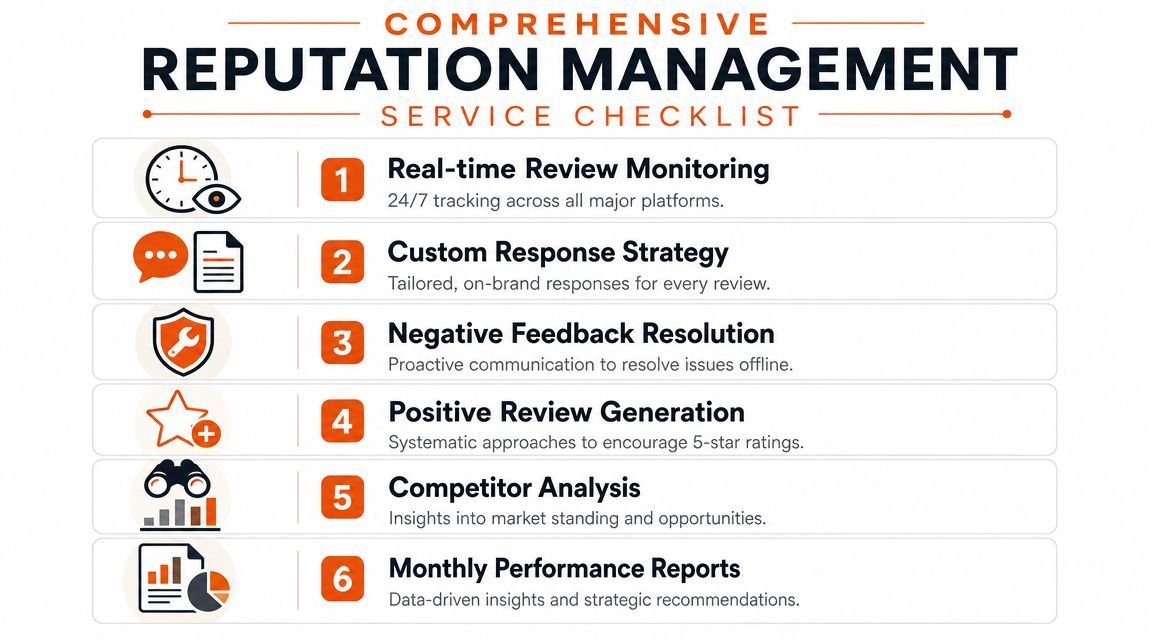
Look for the following:
Platform coverage
Monitoring across Google, Yelp, TripAdvisor, and relevant social channels, plus checks on profile accuracy, hours, menu links, and contact details.Response management
Review replies that sound human, match your brand voice, and address the actual issue instead of dropping the same template into every thread.Escalation handling
A process for routing serious complaints, repeat failures, or sensitive issues to the right person quickly.Review generation support
Systems that help satisfied guests leave public feedback through QR codes, follow-ups, or friction-free prompts.Reporting that matters
Not vanity screenshots. You need insights on complaint themes, response performance, and where operational fixes are needed.Regular strategy communication
Someone should tell you what changed, what needs attention, and what to do next.
A restaurant-specific provider should also understand local visibility. Reviews affect discovery, and discovery affects revenue. That’s why reputation work should support broader search performance, especially if you’re trying to win in competitive map results with restaurant SEO services.
The strategic layer most providers miss
Here’s where weaker vendors fail. They assume a decent average rating means the account is healthy.
It doesn’t.
At Vip Tech Consulting, we believe that effective reputation management is not about chasing more five-star reviews—it’s about uncovering operational insights. By categorizing reviews by business function, analyzing trends across locations, and identifying recurring customer concerns, businesses can address root causes and strengthen their brand reputation over time.
That matters because a profile can be underperforming even when the average score looks acceptable.
A strong service should investigate questions like these:
| Signal | What it may mean | What a good provider does |
|---|---|---|
| Weak review recency | Guests aren’t seeing fresh proof of quality | Builds a consistent review capture system |
| Repeated complaint themes | Operations are causing avoidable trust loss | Flags patterns for management and training |
| Location-level variation | One unit is pulling down brand perception | Separates issues by location and ownership |
| Good score, weak conversion | The profile story still creates hesitation | Audits sentiment, response quality, and visible objections |
That’s the level of thinking you want. Not “you got three new reviews this week.” You need someone asking why a restaurant with a good rating still isn’t converting searchers into diners.
Stop Losing Customers and Book Your Strategy Call
If your restaurant is in a market like Miami, you don’t have the luxury of a weak online reputation.
Diners compare options quickly. They read reviews before they book. They notice whether owners respond. They notice whether complaints repeat. They notice whether your profile looks current and trustworthy or neglected and risky.
What happens when you keep waiting
Every week you delay, one of two things is happening.
Either prospects are choosing a competitor with a cleaner online profile, or your own guests are leaving feedback that never gets turned into a recovery or operational fix. In both cases, you lose business you should have won.
This is why reputation management for restaurants belongs in the revenue conversation. It affects search visibility, click decisions, booking confidence, and guest trust before service even begins.
The next step should be simple
You don’t need another generic checklist.
You need a clear view of where your restaurant is leaking trust, where review patterns are hurting conversion, and what should be fixed first across profiles, responses, and local search presence. That’s what a strategy call should do.
If you’re serious about more reservations, better Google Maps performance, and a stronger brand story online, act now while the market is still deciding who to trust.
If you want a practical next step, book a strategy session with VIP TECH CONSULTING. Their team helps restaurants strengthen local visibility, improve Google Business Profile performance, and build reputation systems that support real growth. If your reviews, listings, or local search presence are costing you customers, this is the right time to fix it.