
If you’re an insurance agent and your phone isn’t ringing from Google, your competitors are taking the calls that should be coming to you.
A prospect gets rear-ended, closes on a house, buys a second car for their teenager, or realizes their current policy is overpriced. They don’t start with a postcard or a billboard. They search. If you aren’t visible in Maps, in local organic results, and on a credible Google Business Profile, you’re invisible at the exact moment intent is highest.
That is why local SEO for insurance agents matters so much. This isn’t a branding exercise. It’s a lead generation system. Done right, it drives qualified calls, quote requests, and booked consultations from people already looking for coverage nearby. Done poorly, it turns your website into a brochure nobody sees.
If you already know you need help and you’re comparing agencies right now, that’s a good instinct. The gap between an average local SEO setup and one that consistently produces leads is huge. If you want to know where you’re leaking visibility, start with a practical local SEO checklist for service businesses.
Table of Contents
- Why Your Competitors Are Getting Calls That Should Be Yours
- Building a Foundation That Actually Generates Leads
- Mastering Your Google Business Profile for Maximum Visibility
- Creating Content and Pages That Google and Clients Love
- Choosing a Partner vs Going It Alone
- Stop Losing Leads and Start Owning Your Local Market
Why Your Competitors Are Getting Calls That Should Be Yours
A prospect gets hit with a rate increase at 8:15 a.m. By 8:17, they search “auto insurance agent near me.” A homebuyer searches for homeowners coverage before closing. A business owner looks up general liability the day a lease is signed. Those searches are not casual browsing. They are lead opportunities with a short decision window.
71% of insurance clients use a search engine to find agents, which makes local search one of the clearest paths to qualified calls and signed policies. If your agency is missing from local results, those buyers do not pause and wait for you. They call the agent who showed up.
Search intent now decides who gets the first conversation
Interruption marketing can keep your name in circulation. It rarely captures someone who needs a quote now.
Local SEO does. A person searching with a city name, “near me,” or a specific coverage term has already moved past awareness. They are comparing options and looking for the safest choice. Google Maps often becomes the shortlist.
That is where agencies lose business before the phone rings.
Practical rule: If a prospect sees three nearby agencies in Maps and your profile is missing, incomplete, or weaker than the others, you are out before your sales process has a chance to work.
Missed calls usually come from weak visibility, not weak service
Insurance agents tend to blame lead volume. The bigger problem is usually lead capture.
You can be the better advisor and still lose. If a competitor has stronger reviews, cleaner local signals, and a clearer presence in search, Google gives them the visibility and the prospect gives them the call. This is why generic SEO advice falls short. Rankings alone are not the goal. You need local visibility that turns into measurable business outcomes.
Here is what that loss looks like day to day:
| Prospect action | What they see | Business outcome |
|---|---|---|
| Searches “insurance agent near me” | Competing agencies dominate Maps and local results | Competitor gets the first call |
| Compares local options | Better reviews, categories, and service details stand out | Your agency gets filtered out |
| Visits your website | Weak local relevance or unclear next step | Prospect leaves without contacting you |
That pattern erodes revenue. One missed call turns into a missed quote. A missed quote turns into a missed policy. Repeat that across dozens of local searches each month and the cost is no longer small.
If you want a fast read on where your agency is leaking those opportunities, use this local SEO checklist for service businesses. It helps you spot whether the issue is rankings, trust, conversion friction, or all three.
Building a Foundation That Actually Generates Leads
Local rankings don’t hold if the foundation is sloppy. You can publish content, ask for reviews, and even run ads, but if your site is slow, confusing on mobile, or inconsistent across directories, your lead flow will stay unstable.
Your site has to work on a phone first
Insurance shopping happens on mobile. Not partially. Not eventually. Right now.
20% of consumers complete insurance quotes via mobile devices, which means your site has to be built for fast, clean phone-based conversion, not just desktop browsing, based on EZLynx insurance SEO findings. If a page loads slowly, buttons are hard to tap, or the quote request form is clunky, people leave.
That is why mobile-first execution isn’t technical trivia. It’s direct revenue protection.
A strong insurance site should do these basics well:
- Load fast: Slow service pages kill urgency and waste paid and organic traffic.
- Make calls obvious: Phone numbers should be tap-to-call and visible without digging.
- Keep forms short: Ask for what you need to start the conversation, not every detail upfront.
- Guide one next step: Every page should push toward a call, a quote request, or a consultation.
Slow websites don’t lose “traffic.” They lose buyers who were ready to talk.
If your current website wasn’t built for lead generation, fix that before you spend another dollar pushing people to it. This guide on how to build a lead generation website is a useful benchmark for what your site should be doing.
NAP consistency is a trust signal, not admin work
Name, address, and phone consistency sounds boring. It isn’t.
Google uses consistency across your website, Google Business Profile, and local directories to validate that your agency is legitimate and established in the market you claim to serve. If your suite number appears one way on your site, another way on a directory, and your phone number changes format across platforms, you’re creating doubt where you need trust.
That matters even more for insurance, where buyers make decisions based on credibility.
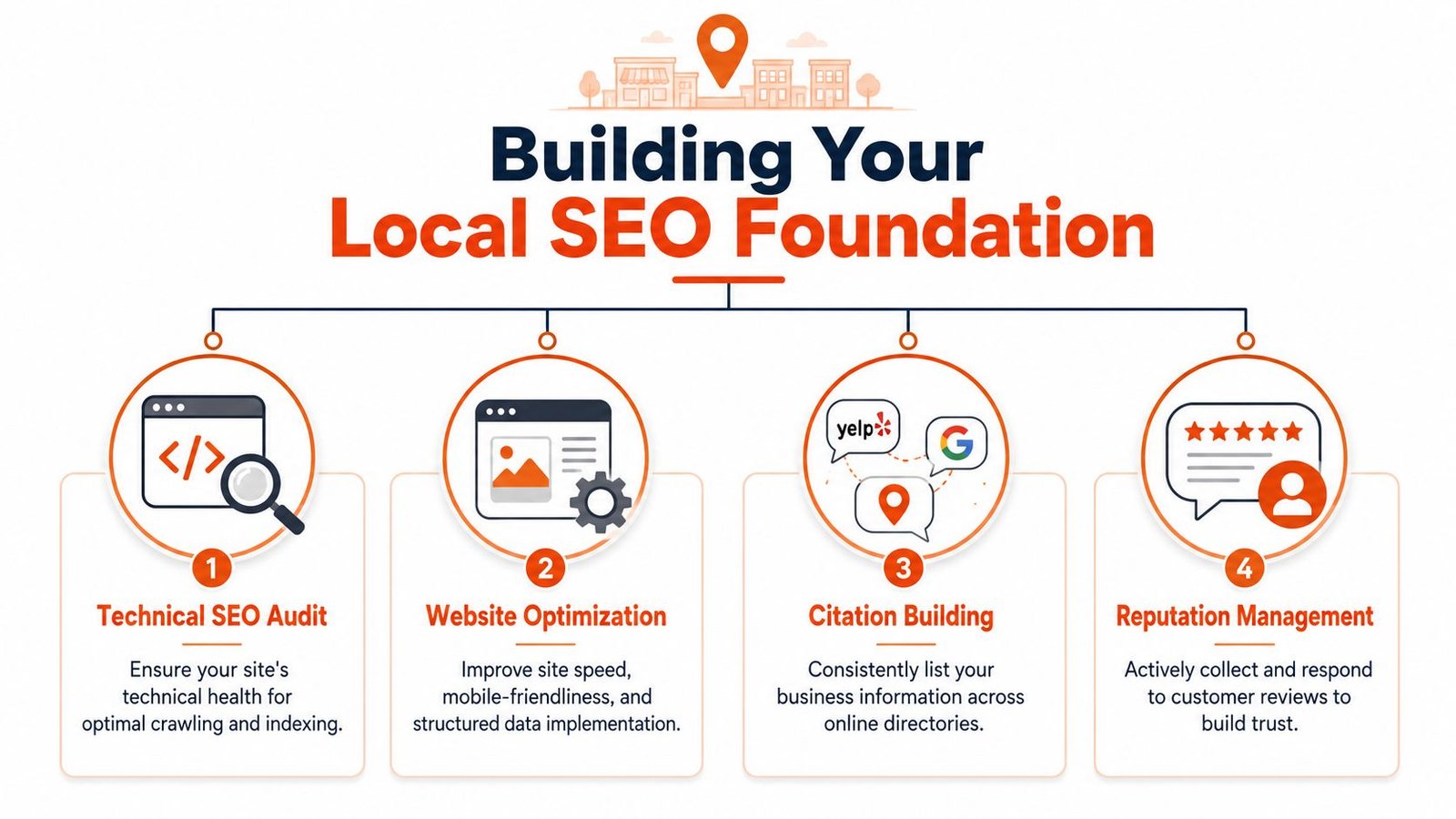
What a serious local SEO foundation includes
This is the work most agents never see, but it decides whether the visible stuff performs.
Technical SEO audit
Broken links, crawl issues, duplicate pages, weak title tags, and indexing problems drag down everything built on top of them.Website optimization
Mobile responsiveness, internal linking, location relevance, schema support, and page speed all shape how well your site can rank and convert.Citation cleanup
Your agency details need to match across the web. Inconsistency weakens local trust signals.Reputation workflows
Reviews don’t happen by accident. You need a process for asking, following up, and responding.
A lot of agencies skip this foundation because it isn’t flashy. That’s exactly why their results stay erratic. Good local SEO feels simple on the surface because the hard work underneath has already been handled.
Mastering Your Google Business Profile for Maximum Visibility
If your Google Business Profile is weak, your local SEO is weak. That’s the truth.
For most insurance agents, the GBP is the asset that determines whether they show up in the Map Pack when someone searches nearby. It is often the first thing a prospect sees, compares, and clicks before they ever visit a website.
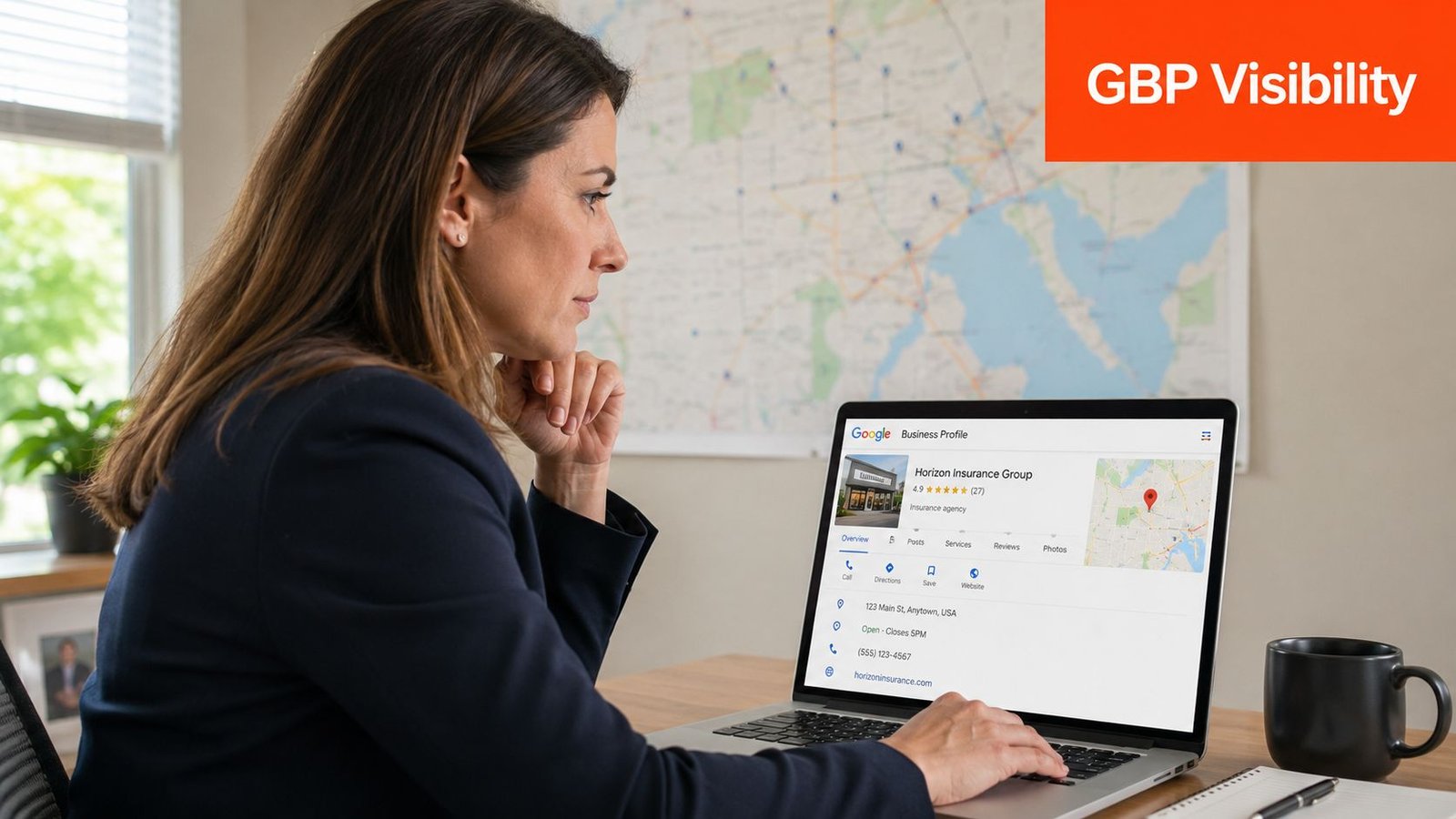
Your GBP is your front page on Google
A neglected profile sends the wrong message. Missing categories, vague descriptions, outdated hours, and no recent activity make your agency look inactive.
A strong profile should include:
- Accurate primary and secondary categories: Tell Google exactly what kind of insurance business you are.
- A clear business description: Mention lines of coverage and service areas naturally.
- Relevant photos: Real office, team, branding, and local presence matter.
- Q&A coverage: Pre-answer common questions so prospects get clarity fast.
- Messaging enabled: If someone wants to ask a quick question, don’t force friction.
The review threshold that changes visibility
This is one of the clearest benchmarks in local SEO for insurance agents.
According to this Google Business Profile review benchmark video, achieving exactly 10 verified Google Business Profile reviews correlates with a 40 to 50% increase in map pack visibility and conversion rates compared to profiles with fewer reviews. That gives you a real target, not vague advice to “get more reviews.”
If you’re below that threshold, getting there should be urgent.
Reviews are not reputation decoration. They are ranking signals and conversion assets at the same time.
Here’s the practical approach:
- Ask immediately after a positive interaction: Renewal save, claim help, policy bundle, or smooth onboarding.
- Make it easy: Send a direct review link with a short, polite request.
- Coach for relevance without scripting: Encourage clients to mention the type of service they received and the local area naturally.
- Respond to every review: Google sees activity. Prospects see professionalism.
For agencies that need a process around this, customer feedback collection workflows can tighten review requests and response management.
What to optimize inside the profile
Most agencies fill out the basics once and stop. That leaves a lot of visibility on the table.
Use your profile like an active sales asset:
| GBP element | What to do | Why it matters |
|---|---|---|
| Services | Add specific insurance offerings | Increases relevance for service-based searches |
| Business description | Write for local intent, not corporate language | Helps users and Google understand fit |
| Posts | Share updates, community content, or helpful tips | Shows profile activity |
| Q&A | Seed common buyer questions | Reduces hesitation before contact |
| Messaging | Turn it on and monitor it | Captures leads that won’t call first |
Watch this quick overview if you want a visual breakdown of how profiles influence local visibility:
A polished GBP won’t fix a broken local strategy by itself. But without it, the rest of your local strategy struggles to gain traction.
Creating Content and Pages That Google and Clients Love
Most insurance websites are too broad, too generic, and too city-focused. They say “serving Miami” or “serving South Florida” and call that local optimization. That isn’t enough.
To win local intent, your content has to prove that you understand the neighborhoods, roads, risk patterns, and service areas your prospects live in.

Generic city pages won’t win local intent
One of the most useful findings in this space is also one of the most ignored. Agents who include street names and neighborhood landmarks in blogging content attract 30% more local intent traffic than generic city-only keywords, and those micro-local searches drive 60%+ of mobile insurance queries, based on this local insurance SEO article on hyper-local keywords.
That means “auto insurance Miami” is only part of the opportunity.
You also need content and page copy that reflects how people really search:
- Neighborhoods: Brickell, Wynwood, Kendall, Coral Gables
- Landmarks: near a known shopping center, corridor, or major road
- Service context: homeowners near flood-prone areas, condo coverage in dense urban pockets, commercial coverage in retail zones
A page that only targets a city name sounds generic. A page that reflects a real local area sounds trustworthy.
What insurance content should actually look like
This isn’t about publishing random blog posts. It’s about building pages that align with buying intent.
A practical content structure looks like this:
- Core service pages: Auto insurance, homeowners insurance, renters insurance, life insurance, business insurance
- Location pages: One page per city, suburb, or service area worth targeting
- Hyper-local articles: Specific questions tied to neighborhoods, local conditions, and real client concerns
- FAQ content: Short answers to high-intent questions that reduce friction before a call
Examples of useful content topics:
| Content type | Example |
|---|---|
| Service page | Homeowners insurance for condo owners in Brickell |
| Location page | Auto insurance in North Miami |
| Blog article | Do I need flood coverage near Biscayne Bay |
| FAQ page | What documents do I need for a commercial insurance quote |
Performance matters here too. If your local pages are bloated, they won’t convert well even if they rank. For a solid technical primer, this PageSpeed Plus article on site speed is worth reading.
Authority beats volume
Google doesn’t need fifty weak posts from your agency. It needs clear signals that you serve a place, understand the coverage needs there, and publish trustworthy content around that expertise.
That is where topical authority and credibility matter. If you’re building local landing pages and service content, tie them together with strong internal linking, clear authorship, and real-world local context. This is the same trust framework behind E-E-A-T in local SEO for Miami businesses.
This is also where many agencies fail insurance clients. They produce generic location pages at scale, but none of them sound like they were written by someone who understands the market. Thin content doesn’t build trust. It just fills a sitemap.
Choosing a Partner vs Going It Alone
By the time most insurance agents look for help, they’ve already tried bits and pieces themselves. They updated the website. Asked for a few reviews. Posted some blogs. Maybe hired a cheap freelancer. Then nothing moved.
That frustration makes sense. 84% of consumers search online for local businesses every single day, and 39% estimate that at least 41% of their total searches are focused on local businesses, according to these local search behavior statistics. If local search is that active, weak execution gets exposed fast.
DIY sounds cheaper until it stalls
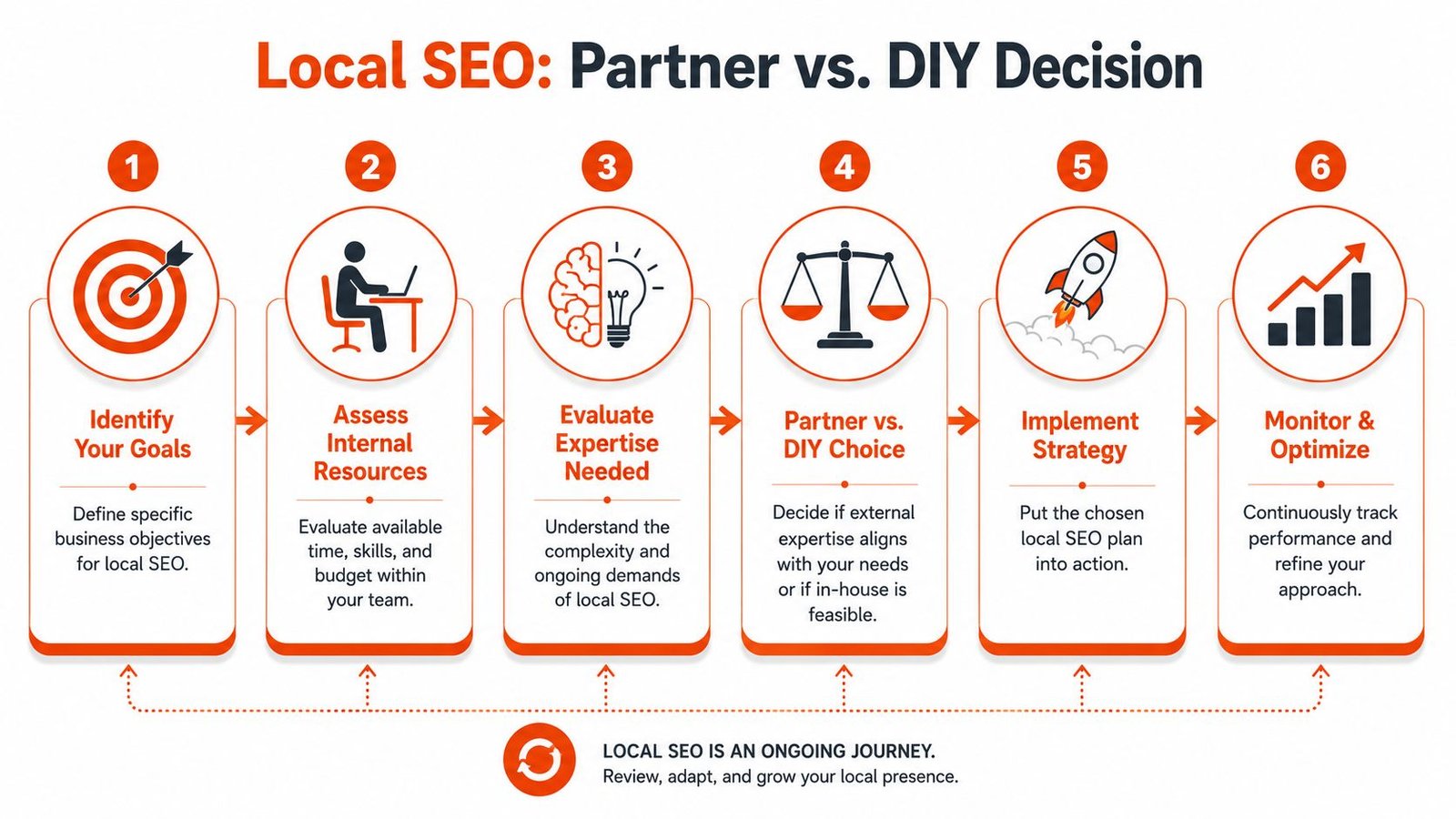
Doing it yourself can work if you have time, technical ability, copywriting skill, review systems, and patience. Most agency owners don’t have all of that. They have policies to sell, renewals to manage, and a team to run.
The true cost of DIY isn’t just money. It’s delay, inconsistency, and missed opportunities while someone else captures the local demand.
A weak DIY path usually looks like this:
- You fix one issue at a time: No strategy ties the pieces together.
- You stop after the basics: GBP gets updated once, then goes stale.
- You publish content without intent: Traffic might come, but leads don’t.
- You can’t diagnose drops: Rankings shift and nobody knows why.
What a professional service should include
If you’re comparing providers, don’t ask who “does SEO.” Ask what their process entails and how they connect activity to lead generation.
A serious local SEO service should include:
- Technical auditing and fixes: Crawl issues, indexing problems, mobile UX, on-page gaps
- Google Business Profile management: Optimization, review process support, updates, Q&A, monitoring
- Location and service page strategy: Pages built for local intent, not filler
- Content planning: Topics based on buying signals and local relevance
- Citation work: NAP consistency and cleanup across important directories
- Reporting: Rankings are useful, but calls, form submissions, and lead quality matter more
- Communication cadence: Clear updates, fast response times, and a defined next-step plan
One option in this category is VIP TECH CONSULTING’s guide on how to choose a digital marketing agency, which outlines the criteria business owners can use when comparing SEO and lead generation partners.
Common objections from smart agency owners
These objections are fair. They just need honest answers.
“Is this worth it?”
If local search is already where buyers are looking, then visibility in that channel isn’t optional. The question isn’t whether local SEO matters. The question is whether your current setup is converting search demand into calls.
“Can I do this myself?”
You can do parts of it. Most agents can update a profile, request reviews, or edit a page. The hard part is building a coordinated system and maintaining it consistently enough to gain traction.
“How long does it take?”
Local SEO is not instant like paid ads, but it compounds. The right setup starts improving visibility and trust over time. The wrong setup wastes months.
Good agencies don’t sell mystery. They show you the work, the priorities, and what happens next.
If you’re hiring someone, hire for process clarity, local search competence, and lead generation thinking. Not jargon.
Stop Losing Leads and Start Owning Your Local Market
Insurance is one of the clearest local intent categories on Google. People search when they need help, and they usually contact one of the businesses they can find quickly and trust immediately.
That means every weak point in your local presence has a direct cost. An incomplete Google Business Profile. Slow mobile pages. Thin service content. No review system. Generic city targeting. Those aren’t minor issues. They are the reasons another agent gets the call.
What happens when you delay
Waiting doesn’t keep things neutral. It gives competing agencies more time to strengthen their reviews, content, and Maps visibility while your agency stays flat.
If you’re serious about getting more qualified calls, your plan should be simple:
- Fix the technical foundation
- Turn your GBP into a lead asset
- Build local pages that match real buying intent
- Publish hyper-local content that reflects your service area
- Track inquiries, calls, and booked consultations, not vanity metrics
Your contact flow matters too. If your form is attracting junk submissions, clean that up so real leads don’t get buried. These Static Forms tips for spam prevention are useful if your website has become noisy or unreliable.
The right next move
You do not need another generic marketing package. You need a local search system that turns nearby demand into conversations with people ready to discuss coverage.
That is the whole point of local SEO for insurance agents. More visibility only matters if it leads to calls. More traffic only matters if it leads to quotes. More rankings only matter if they help you write more business.
The market is competitive, and high-intent searchers won’t wait for you to catch up later. If you’re already comparing providers, you’re probably closer to making the right decision than you think.
If you want a practical plan instead of vague advice, book a strategy session with VIP TECH CONSULTING. We’ll review your local visibility, identify where leads are slipping away, and show you what needs to be fixed first so your agency can generate more qualified calls from Google.