
Your dining room isn’t empty because people stopped using Facebook or Instagram. It’s empty because your ads are showing the wrong message to the wrong people in the wrong moment.
That’s the hard truth behind most Facebook Ads for Restaurants campaigns. Owners boost a post, see some likes, maybe a few comments, and then wonder why tables are still open on a Friday night. Attention without action doesn’t pay payroll, food costs, or rent.
If you’re tired of guessing, stop treating Meta like a place to “post content” and start treating it like a customer acquisition channel. If you need a sharper local marketing foundation alongside paid social, study these restaurant marketing strategies in Miami and then fix your ad system with the framework below.
Table of Contents
- Why Your Restaurant Is Empty While Your Competitor Is Full
- The Unspoken Rule of Restaurant Ads That Convert
- Your Three Essential Audiences for Precision Targeting
- Campaign Setup That Prevents Wasted Ad Spend
- Why Smart Restaurants in Miami Choose VIP Tech Consulting
- Your Playbook for Launching and Optimizing Your Campaign
Why Your Restaurant Is Empty While Your Competitor Is Full
It’s a slow weeknight. Your kitchen is ready. Your staff is standing by. A competitor a few blocks away is packed, and you know your food is better.
Better food doesn’t automatically win. Better timing does.
Most restaurant decisions happen fast
Meta itself notes that 84% of consumers decide where to eat less than one hour before a meal in its restaurant industry guidance from Facebook Business. That single reality changes everything about how restaurants should advertise.
If diners are making the decision that close to mealtime, your campaign can’t rely on vague brand exposure. It has to show up in the local feed at the exact moment someone is ready to choose.
Practical rule: Restaurant ads should be built for immediate action, not passive awareness.
Most owners get burned when they run broad campaigns, boost a nice-looking post, or recycle a generic “come dine with us” message. That approach might produce activity inside Ads Manager, but it rarely produces a reliable stream of reservations or online orders.
Boosted posts feel productive but usually fail
A boosted post is easy. That’s why so many restaurants use it. Easy isn’t the same as profitable.
Here’s what usually goes wrong:
- The targeting is too broad. You end up paying to show ads to people who are too far away or not ready to visit.
- The message is too soft. “Check out our menu” isn’t a reason to act tonight.
- The campaign goal is sloppy. Meta will gladly spend your money unless you give it a tight structure.
- The owner measures the wrong thing. Likes, reach, and comments can look healthy while sales stay flat.
The result is familiar. The card gets charged, the posts get some engagement, and nothing changes in the dining room.
A good restaurant campaign works more like direct response marketing. It uses urgency, local intent, a clear call to action, and a real conversion path. That means reservation pages, menu clicks that lead somewhere useful, and retargeting for people who showed interest but didn’t book.
If your current setup feels random, it probably is. And random advertising is expensive.
The Unspoken Rule of Restaurant Ads That Convert
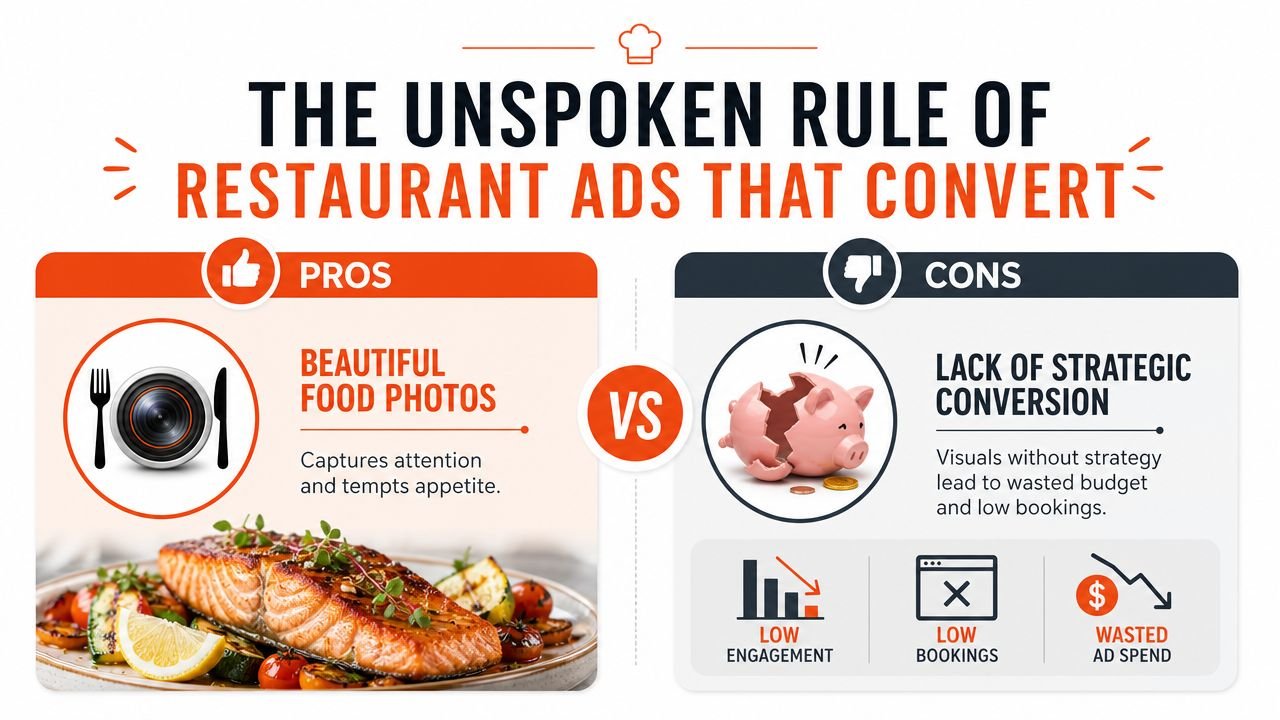
Most restaurant ads fail for one reason. They ask for attention before they earn action.
A polished food photo helps. It can stop the scroll. But a plate of pasta by itself doesn’t answer the question in the customer’s mind, which is simple: “Why should I choose this place tonight instead of the other five options near me?”
Pretty creative is not a strategy
Restaurant owner communities keep saying the same thing. “Brand awareness ads aren’t moving the needle” without a tangible offer like a free drink with purchase or a free appetizer with reservation. The same discussion also cites that 70% of businesses report over 3x ROI on Facebook Ads precisely when engagement is driven by specific offers, as discussed in this restaurant owner thread.
That matches what serious operators already know. Generic awareness is weak when people have dozens of dining options and very little time to decide.
If your ad says:
- “Try our new menu”
- “Authentic flavors”
- “Best restaurant in town”
you’re relying on the customer to do all the work. They have to care, compare, decide, and act.
That’s too much friction.
If your ad says:
- Free appetizer with reservation
- Free drink with dinner tonight
- Limited-time dinner special for local guests
you’ve created a reason to act now.
For restaurants trying to turn more visits into sales, this same friction shows up on the website. If your landing page is weak, even a strong ad won’t convert. That’s why conversion work matters as much as ad setup, and these website conversion improvements often decide whether traffic becomes bookings.
What a real offer does
A good offer doesn’t cheapen your brand. It lowers hesitation.
Restaurants don’t need more “visibility.” They need a compelling excuse for a local customer to choose them now.
The best offers share a few traits:
- Low friction: Easy to understand in one glance
- Immediate value: Useful tonight, not someday
- Simple redemption: Reservation, order, or walk-in instruction is clear
- Brand fit: The offer supports your positioning instead of undermining it
Use offers that fit your operation. A casual concept can push a direct incentive. A premium concept can use a reservation-based perk instead of a discount.
The mistake is thinking beauty alone sells. It doesn’t. Beauty gets attention. Offers get movement.
Your Three Essential Audiences for Precision Targeting
If you’re targeting “everyone in Miami,” you’re wasting money.
Restaurants are local businesses with local buying windows. That means your audience strategy needs to behave like a map, not a megaphone.
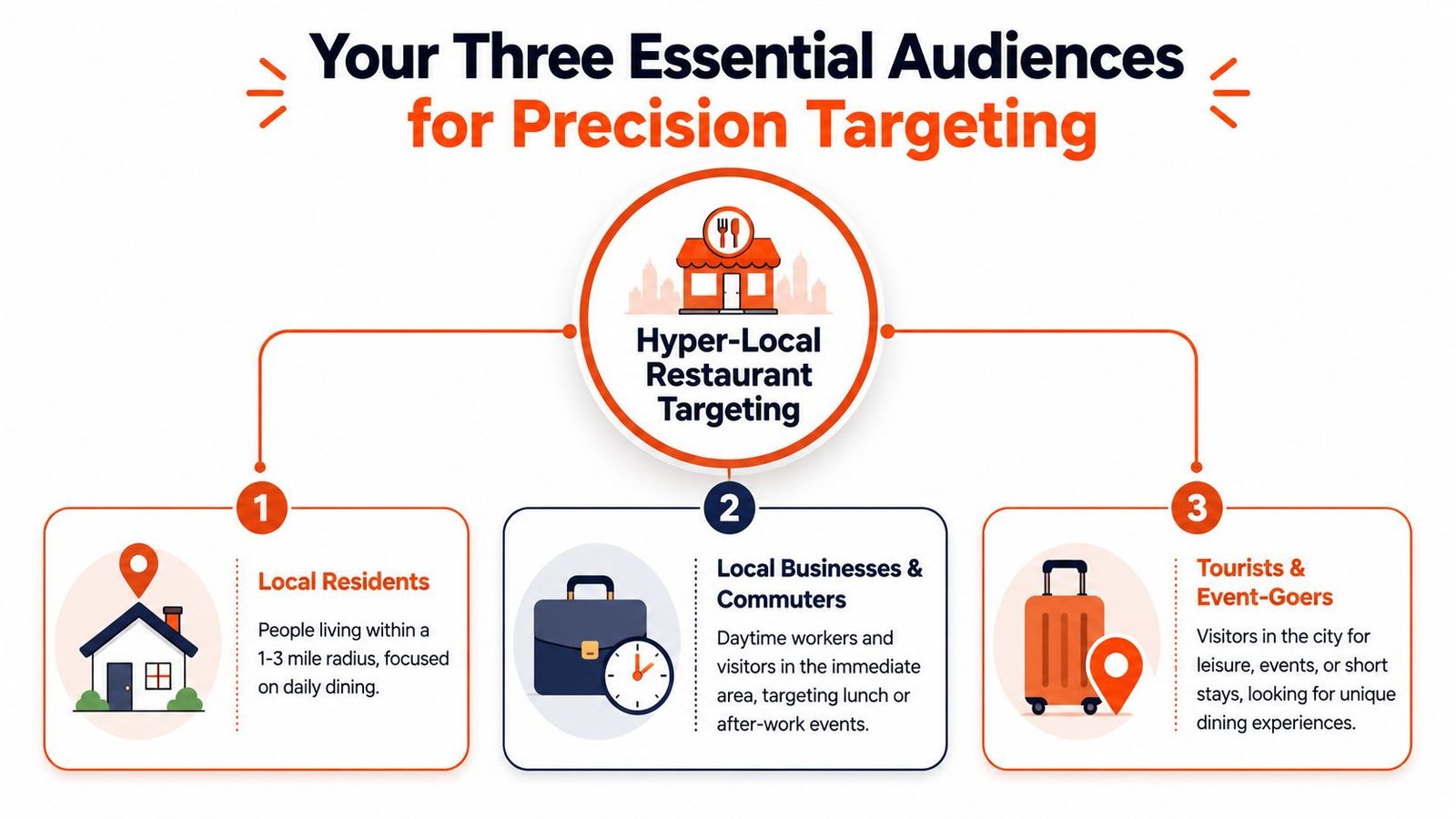
A strong Meta setup for restaurants uses broad targeting with creative-led segmentation, anchored by a tight 1 to 3 mile geo-radius, as described in this restaurant targeting breakdown from 39 Celsius.
Audience one is the money zone
Start with the people most likely to visit without overthinking it.
Geo-targeted local
This is your core audience. Build around the restaurant location and keep the radius tight. The point isn’t to reach more people. The point is to reach the people who can realistically decide and arrive.
Niche interest diner
This audience layers relevant dining interests with location. It helps when your concept has a clear identity, such as brunch, steak, sushi, cocktails, family dining, or date-night appeal.
That local-first approach is exactly why so many businesses need dedicated Facebook ads for local business support instead of generic campaign management.
A short explainer is useful here before you build anything more advanced.
Audience two and three expand reach without losing intent
The third audience is where a lot of restaurants leave money on the table.
Similar customers
Upload your existing customer list and build a matching audience. This gives Meta a much stronger signal than random interest targeting because it starts from real people who already buy from you.
There’s also a fourth practical layer for many accounts, even if it isn’t the first place to start.
Re-engage website visitors who viewed your site recently but didn’t book. They already know you. They need a nudge, not an introduction.
How to use the audience stack correctly
Don’t cram every audience into one ad set and hope Meta sorts it out.
Use a cleaner structure:
| Audience | Purpose | Best use |
|---|---|---|
| Geo-targeted local | Capture nearby intent | Daily campaigns, dinner pushes |
| Niche interest diner | Add relevance | Cuisine-specific or event ads |
| Similar customers | Find new people like regulars | Prospecting with proven buyer signals |
Your creative should do the filtering. Tight local targeting gets you close. The image, offer, headline, and call to action decide who clicks.
That’s the right way to let Meta do some of the work without giving it total control.
Campaign Setup That Prevents Wasted Ad Spend
Meta’s defaults are built for volume. Your restaurant needs control.
That’s why campaign setup matters so much. One wrong setting can send budget into placements that produce cheap clicks and weak intent. The account looks busy, but the campaign underdelivers where it counts.
Start with the ad before the settings
Most restaurants build ads backwards. They obsess over audience tweaks while running weak creative.
You need strong ad assets first:
- Short food videos: Kitchen prep, plating, drinks being poured, staff energy
- Authentic photos: Real food, real tables, real atmosphere
- Direct headlines: Offer plus outcome
- Clear calls to action: Reserve now, order today, claim tonight’s offer
A basic restaurant copy formula works well:
- Hook: Call out the local diner or moment
- Offer: Give a concrete reason to act
- Proof of experience: Mention the atmosphere, specialty, or signature dish
- Action: Send them to the booking or ordering page
Example structure:
- Dinner plans tonight?
- Reserve now and enjoy a free appetizer with your table.
- Fresh cocktails, signature dishes, and a dining room built for date night.
- Tap to book.
If you want a broader look at automation ideas for follow-up and campaign support, this Splash Access automation guide is a useful companion resource.
The settings that actually protect your budget
Most of the waste happens here.
The recommended setup for restaurant campaigns is clear in this Get Bento guide to restaurant Facebook ads. Use the Auction buying type, choose Traffic as the objective, and run manual traffic campaigns. Most importantly, manually restrict placements to Facebook and Instagram Feed and Stories only, removing Audience Network and other automatic placements.
That matters because restaurants don’t need the cheapest traffic. They need the most actionable traffic.
Use this checklist when launching:
Buying type
Choose Auction. It gives you tighter control over spend and delivery.
Objective
Use Traffic when you want users moving to menu, reservation, or ordering pages.
Placements
Manually select Facebook Feed, Instagram Feed, Facebook Stories, and Instagram Stories. Remove everything else that doesn’t match local dining intent.
Audience controls
Keep the radius local. Don’t let the platform drift too far from your service area.
Creative testing
Build multiple ad variations. Test different visuals, offers, and hooks. Don’t fall in love with one ad just because the owner likes it.
Cheap clicks from weak placements are one of the fastest ways to drain a restaurant ad budget.
Tracking matters too. If your analytics are messy, you won’t know whether the issue is the ad, the audience, or the landing page. Make sure your attribution and event setup are clean before scaling. This GA4 setup guide is a practical reference if your reporting is still unclear.
Why Smart Restaurants in Miami Choose Vip Tech Consulting
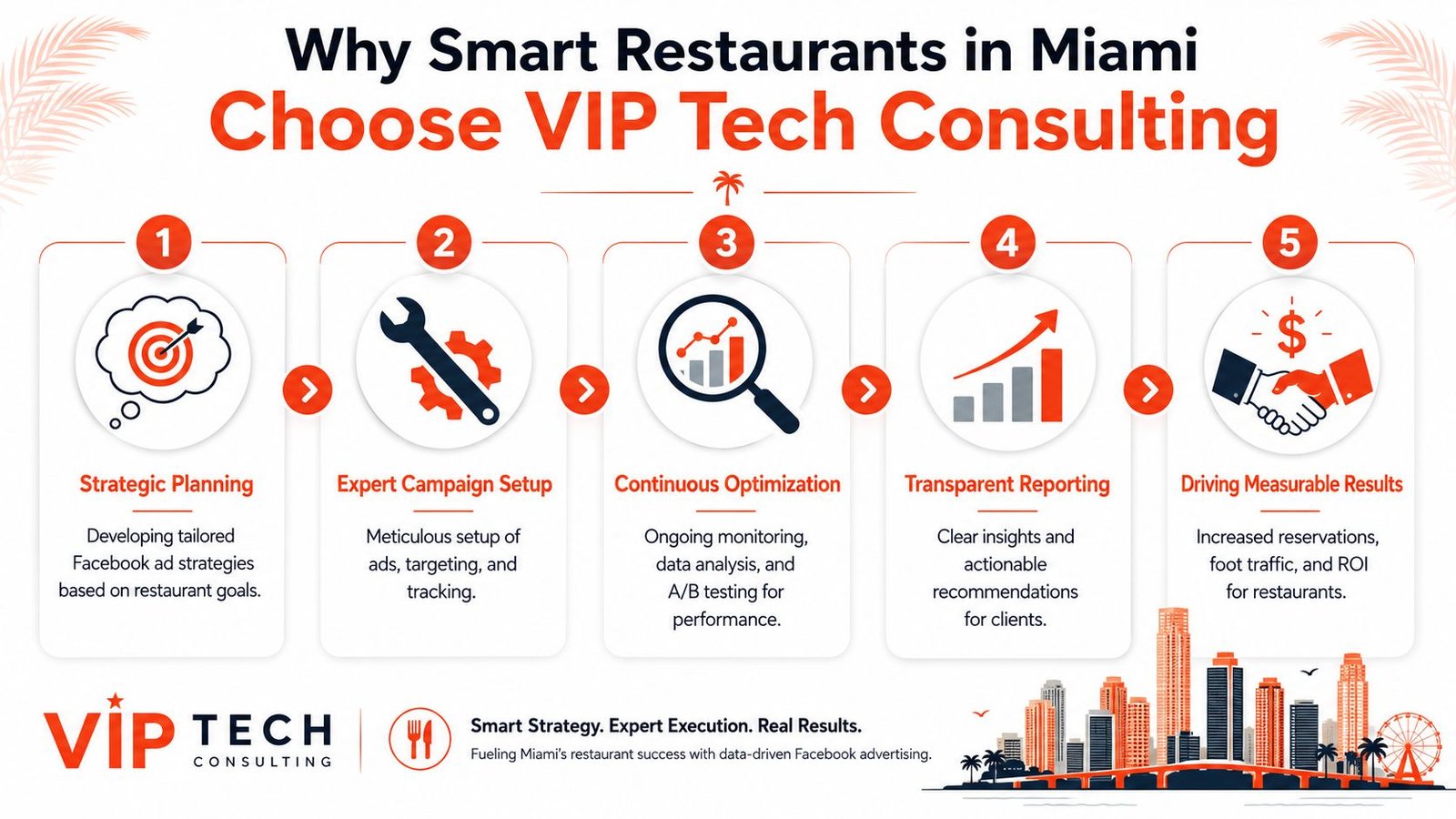
A restaurant owner doesn’t need another vendor who “runs ads.” They need a team that understands local demand, conversion paths, creative testing, and what counts as a real result.
That’s especially true in Miami, where competition is constant and diners have options every few blocks.
Benchmarks matter when money is tight
A serious agency should benchmark performance against real industry numbers, not vague promises.
For restaurant campaigns, LocaliQ reports an average CPC of $0.72 and CTR of 1.67%, with conversion costs for online orders or reservations typically ranging from $8.65 to $20.92, according to these restaurant Facebook ad benchmarks.
Those numbers matter because they create a reality check. If your campaign is far outside that range, something is wrong with the targeting, the offer, the creative, the landing page, or all four.
A good partner doesn’t hide behind impressions and reach. They track business outcomes and explain what’s changing week by week. For a broader primer on platform mechanics, this Facebook and Instagram ad guide is worth reviewing, but execution is where most restaurants win or lose.
What a serious restaurant ad service should include
If you’re hiring help, don’t settle for “we’ll manage your ads” and a monthly screenshot.
A proper service should include:
Account audit
Review of current campaigns, offer quality, targeting, placements, and conversion paths.
Strategy build
Audience plan, offer selection, creative direction, and landing page recommendations.
Campaign setup
Manual campaign build, controlled placements, proper structure, and tracking alignment.
Creative testing
Multiple ad concepts built around distinct hooks, visuals, and offers.
Ongoing optimization
Budget shifts, underperformer cuts, retargeting adjustments, and audience refinement.
Clear reporting
Focus on metrics tied to reservations, orders, landing page quality, and return.
Communication
Straight answers, fast response times, and no hiding behind jargon.
Can you do this yourself? Yes, technically.
Should you, if you’re already running a restaurant full-time? Usually not. Owners who try to manage campaigns between vendor calls, staffing issues, and inventory rarely maintain the testing discipline required to keep ad performance stable.
That’s why experienced help is often cheaper than continued trial and error.
Your Playbook for Launching and Optimizing Your Campaign
Launch day isn’t the finish line. It’s the starting point.
Most restaurant campaigns don’t fail because the first version was terrible. They fail because nobody managed the account with discipline after it went live.
The weekly review that keeps campaigns profitable
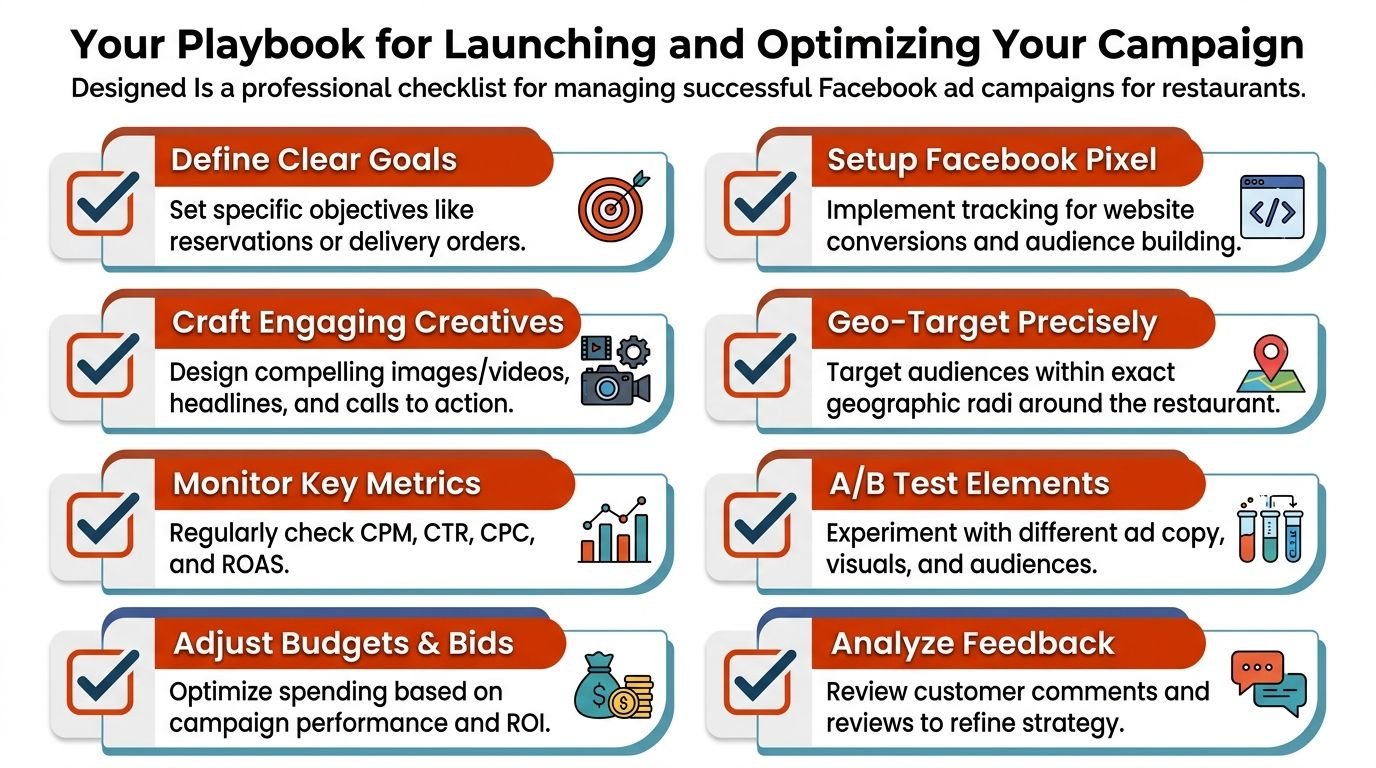
A useful weekly review should answer simple business questions.
Check these first:
Are people clicking through to a relevant page
Send traffic to the menu, reservation page, or offer landing page. Never dump paid clicks onto a vague homepage if a tighter page exists.
Which creative is pulling attention
Pause weak visuals. Keep testing strong ones. Restaurant performance often shifts based on the food shot, the first line, and the offer framing.
Is the offer still strong
A stale promotion loses power. Refresh the angle before blaming the platform.
Are local comments giving you useful feedback
Customers will often tell you what matters. Price sensitivity, parking concerns, confusion about the offer, or enthusiasm about a specific dish all help shape the next round of ads.
For additional reading on broader social media marketing for restaurants, it helps to compare paid promotion with your organic content so the full channel works together.
What to change when performance slips
Don’t make random edits. Diagnose before touching the account.
Use this response pattern:
If clicks are weak
Change the headline, visual, or offer. The ad isn’t compelling enough.
If clicks are strong but bookings are weak
Fix the landing page, reservation flow, or page-message match.
If spend rises without useful action
Tighten placement control, review targeting, and cut dead creative faster.
If good campaigns stall
Introduce fresh creative before fatigue drags performance down.
The best restaurant operators treat ad management like menu engineering. You keep what sells, cut what doesn’t, and keep testing. That’s the same mindset behind effective Facebook ads for lead generation in any local market.
Good campaigns aren’t static. They improve because someone is watching the numbers and making smart adjustments every week.
If your current Meta ads feel expensive, inconsistent, or impossible to trust, the issue usually isn’t Facebook itself. It’s strategy, setup, and follow-through.
If you want a clear plan instead of more wasted ad spend, book a strategy session with VIP TECH CONSULTING. We help restaurants and local businesses turn Facebook and Instagram ads into real reservations, calls, and revenue. If your market is competitive, waiting costs more than fixing the campaign now.