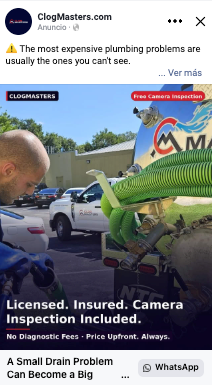
You launch a Facebook campaign on Monday, spend for two weeks, get a few likes, one low-quality message, and zero booked jobs. That is the standard outcome when a local business runs Meta ads with broad targeting, weak local intent, and no system for measuring which neighborhoods produce revenue.
Facebook Ads for local business work when you treat them like a local acquisition channel, not a boosted post machine. That means tighter geography, stronger offers, cleaner tracking, and a setup built around lead quality instead of cheap clicks. If you serve a defined area, your targeting should reflect that with the same precision used in Google Ads location targeting for service areas.
The gap between campaigns that waste budget and campaigns that produce calls usually comes down to structure. Smart local advertisers do not blanket a city and hope Meta figures it out. They use radius stacking to control reach by proximity, then compare lead quality by zone. They also connect Meta traffic with Google Business Profile signals, because booked jobs come from local trust, not ad clicks alone.
If your ads feel expensive, inconsistent, or impossible to judge, stop changing creative at random. Fix the targeting, fix the tracking, and fix the handoff from ad to lead. That is how local service businesses turn Facebook from a frustrating expense into a predictable source of calls and form submissions.
Table of Contents
- Why Your Facebook Ads Are Failing to Attract Local Customers
- The Blueprint for Precision Geo-Targeting
- Crafting Audiences and Ads That Convert Neighbors into Leads
- Measuring Real-World Results and Proving ROI
- Your Optimization Playbook for Scaling Leads
- Take Control of Your Local Lead Generation Today
Why Your Facebook Ads Are Failing to Attract Local Customers
You launch a campaign for your plumbing, med spa, roofing, or legal service. Meta shows healthy reach, a decent number of clicks, and a few form fills. Then you check the leads. Wrong ZIP codes. Price shoppers. People outside your service area. People who were never going to buy.
That failure usually starts with relevance. Your ads are reaching people, but not the right local people at the right level of intent.
A bakery does not need clicks from someone 45 miles away. A personal injury lawyer does not need impressions in counties they never serve. A med spa does not need a boosted post drifting across a giant radius because the platform found cheap attention. Cheap attention is not local demand.
The pattern is consistent:
- You boost a post: Fast to launch, weak for lead generation.
- You target one oversized area: Meta spends into the edges, where lead quality drops first.
- You write generic ads: No neighborhood names, no service-area cues, no proof you know the market.
- You send traffic to a weak page: The click happens, then trust collapses.
The broad-radius mistake is especially expensive for service businesses. Local demand is uneven. High-value neighborhoods, commute corridors, and nearby towns do not perform the same way. If you lump all of them into one audience, Meta optimizes for volume, not lead quality. That is why radius stacking matters. Separate tight service zones, control spend by area, and stop letting one cheap pocket drain your budget.
Creative is the next failure point. Local buyers scroll past ads that sound like they were copied from a national template. Good local ads mention the area, reflect the service problem, and give people a reason to act now. If your message still feels flat, study stronger Facebook ad creatives and compare them against what you are running now.
Practical rule: If your ad could run unchanged in five different cities, it is too generic to win consistently in one.
There is another mistake that hurts lead quality. Business owners treat Meta like a closed system. It is not. Your Facebook ad gets the click. Your site and your Google Business Profile help close the lead. If your ad promises one thing, your page says another, and your GBP shows weak reviews or outdated service areas, local prospects hesitate. The click was real. The trust was not.
What owners usually notice before they ask for help:
| Symptom | What it usually means |
|---|---|
| High reach, no leads | Your targeting is broad and your offer is weak |
| Clicks, no calls | Your landing page is losing trust and urgency |
| Leads come in, but they are poor quality | Your geography, message, and service area do not line up |
| Results fade after a few days | The campaign structure never had enough control to begin with |
If this sounds familiar, stop boosting posts and calling it a strategy. Local campaigns need tighter geography, stronger local signals, and a page built to convert high-intent traffic. Start by fixing the click-to-lead handoff with a focused website conversion rate strategy.
The Blueprint for Precision Geo-Targeting
Precision geo-targeting is where local Facebook campaigns stop acting like broad awareness buys and start behaving like real lead generation systems.

A lot of agencies still treat location targeting as a checkbox. Pick a city, drop a radius, launch. That works poorly for most service businesses because local demand isn’t evenly distributed. People cluster by neighborhood, commuting patterns, income bands, and service need. If you ignore that, Meta spends your budget wherever it can, not where you win.
Pick the right campaign goal first
The objective matters because it changes how Meta looks for users.
For local campaigns, the decision is usually straightforward:
- Store traffic style campaigns: Best for businesses that need physical visits, like restaurants, gyms, salons, and retail.
- Lead generation campaigns: Best for service companies such as HVAC, law firms, med spas, roofers, and consultants.
- Brand awareness campaigns: Useful when you’re entering a market or supporting another channel, but weak as a standalone lead strategy.
For service businesses, leads usually beat awareness because the goal isn’t “being seen.” It’s getting a call, form fill, or booked appointment from someone in your actual service area.
There’s another practical guardrail many local advertisers ignore. For local campaigns targeting a specific area, the most effective starting point is often a broad cold audience with a minimum size of 25,000 people, using only gender and location filters so Meta can find converters more efficiently, based on this practitioner recommendation on YouTube.
That doesn’t mean “go broad everywhere.” It means stay broad enough inside the right geography.
Why radius stacking beats one big circle
At this point, most local service businesses either waste money or get serious.
One large radius sounds efficient. It isn’t. A single circle often covers areas you don’t want, misses profitable pockets you do want, and forces Meta to optimize across zones with very different buyer intent. A plumber, mobile detailer, or criminal defense firm rarely serves one perfect circle around an office.
A better structure is radius stacking. You build multiple smaller radii around high-value zones instead of relying on one oversized radius.
Examples of where this works:
- An HVAC company: One radius around dense homeowner neighborhoods, another around older housing stock with replacement demand.
- A law firm: Separate targeting around court-heavy urban zones and affluent suburban areas where higher-value cases come from.
- A mobile service brand: Multiple pockets based on travel efficiency and job value, not office location.
As noted earlier, nuanced strategies like radius stacking are critical for service businesses because generic local ads often convert worse than campaigns built around layered service zones. That difference is exactly why cookie-cutter targeting underperforms.
One big radius is simple to launch and expensive to keep.
If you’re evaluating agencies, ask how they handle overlapping service areas, exclusions, and neighborhood-level performance. If they don’t have a real answer, they don’t have a local strategy.
For businesses that also rely on search traffic, location targeting shouldn’t live in a silo. Your paid social geography should align with your search campaigns, your Google Business Profile visibility, and your service footprint. That’s why it’s smart to review how Google Ads location targeting should support the same local map you’re using on Meta.
Crafting Audiences and Ads That Convert Neighbors into Leads
Great local targeting gets your ads in front of the right map. It doesn’t guarantee the right people or the right message. That’s where most campaigns stall.

A local business doesn’t need “more impressions.” It needs the right audience mix and creative that feels specific to a real area, real problem, and real buying moment.
Build audiences that give Meta room to work
Too many advertisers overbuild audiences. They stack interests, narrow behaviors, add exclusions, then wonder why delivery gets weird and lead quality drops.
Start simpler.
- Cold audiences: Use location and basic demographic controls first. Let the geography do most of the filtering.
- Retargeting audiences: Build segments from site visitors, video viewers, and lead form openers who didn’t convert.
- Lookalike audiences: Use customer lists or qualified lead lists to help Meta find similar prospects.
Backlinko reports that 54% of surveyed marketers say Facebook ads are “very effective” for sales generation, 29% say it delivers the biggest ROI compared to any other social platform, and 67.55% of advertisers say video drives significantly more ad clicks than other formats in its Facebook ads statistics roundup. That matters locally because the right format often determines whether a prospect ignores your ad or stops scrolling.
If you want stronger examples for ad structure and messaging angles, this guide to Facebook ad creatives is worth reviewing. It’s useful because it focuses on hooks and creative patterns you can adapt to local offers instead of recycling bland templates.
Write ads that sound local, not generic
Generic local ads usually look like this: “Trusted service. Great prices. Contact us today.”
That copy is invisible.
Local creative should sound like it belongs in the market you’re targeting. Mention the service area naturally. Refer to local pain points. Use visuals that feel familiar. If you’re running video, keep it grounded in the neighborhood and the offer.
Here are the patterns that consistently make sense:
- Area-specific offer: “North Miami AC service appointments available this week.”
- Problem-first angle: “Water damage getting worse after every storm? Book an inspection.”
- Trust-based proof: Use review language, before-and-after footage, or a short customer testimonial from a nearby client.
- Fast-response framing: Good for urgent services where speed matters more than branding.
A strong local video can do a lot of heavy lifting. This is one reason video keeps outperforming static creative in so many accounts.
Use this checklist before launching:
- Headline fit: Does the headline mention the service and place naturally?
- Visual relevance: Would a local buyer recognize the setting, scenario, or problem?
- Offer clarity: Is there a reason to act now?
- Click destination: Does the landing page match the promise in the ad?
- Follow-up path: Are you ready to respond fast once the lead comes in?
Good local ads don’t try to impress everyone. They make the right person feel like the message is for them.
If you want Facebook campaigns that produce qualified inquiries instead of random form fills, this is the standard. And if you’d rather build a channel around actual bookings, not vanity metrics, explore a tighter Facebook ads for lead generation approach before increasing spend.
Measuring Real-World Results and Proving ROI
Your phone rings more after the campaign starts, but the calendar is still half-empty. That usually means one of two things. You are buying cheap attention instead of qualified local demand, or you have no tracking between the ad click and the sale.

Local business owners get burned here all the time. The agency sends a report full of reach, clicks, and form fills. You ask whether those leads came from people inside your service area, whether they booked, and whether they turned into revenue. Nobody gives a straight answer because the campaign was never built to prove that.
Track booked jobs and closed revenue
A local Facebook campaign earns its keep only when it produces revenue you can trace. Start with the numbers that matter in the real world:
- Qualified leads by service area
- Booked appointments
- Show rate
- Closed jobs
- Revenue by campaign
- Cost per booked job, not just cost per lead
That filter makes problems obvious fast.
| If you see this | What it usually means |
|---|---|
| Plenty of leads, weak booking rate | The offer is attracting low-intent prospects or your follow-up is slow |
| Good booking rate, poor close rate | Sales handling or pricing is the issue |
| High spend, vague results | Tracking is broken |
| Leads clustered outside your best service zones | Geo-targeting is too loose and radius stacking needs work |
| Facebook looks good, Google Business Profile gets the real calls | You are undercounting assisted conversions |
Local service businesses miss that last point constantly. A prospect sees your Facebook ad, checks your reviews, then searches your business name and calls from your Google Business Profile. If you only credit Facebook for instant form fills, you will understate ROI and shut off campaigns that were doing useful work. That is why we measure Meta as part of a local intent path, not as an isolated channel.
If you want a broader framework for the numbers worth watching inside the ad account, Koast’s complete metrics guide is a solid reference.
Build a tracking setup that matches how local buyers actually convert
Browser-only tracking is not enough. It misses phone calls, delayed bookings, and offline sales conversations. For a plumber, roofer, med spa, dentist, or HVAC company, those are not edge cases. That is the sales process.
Use a measurement stack encompassing the full path:
- Meta Pixel for page views, lead events, and key on-site actions
- Conversions API to recover cleaner event data when browsers block or lose it
- Offline conversion imports for booked estimates, completed appointments, and closed deals
- CRM attribution so you can tie revenue back to campaigns and ad sets
- Google Business Profile tracking to catch branded searches, direction requests, and calls influenced by paid social
Advanced local strategy is reflected in careful analysis. If you are running radius stacking, compare lead quality by zone, not just campaign totals. The 3 to 5 mile ring around your office may produce cheaper leads, while the 10 to 15 mile ring may produce higher-ticket jobs. Those are different economics. Treating them as one blended audience hides the truth and leads to bad budget decisions.
Budget for signal, not wishful thinking
Underfunded local campaigns rarely fail because Facebook is broken. They fail because the account never gets enough conversion data to learn.
Set budgets based on your real cost per qualified lead and the number of conversion signals Meta needs each week. If one radius stack only produces a couple of leads, combine it with a stronger adjacent zone or widen the offer. If one area drives booked jobs consistently, fund that area first and stop spreading budget evenly across weak territory.
A small daily budget can still work for local service businesses. It has to be matched to tight geography, a clear offer, and a realistic volume target. Otherwise you are forcing Meta to optimize on scraps.
The campaign is profitable when booked jobs and closed revenue justify the spend. Everything else is noise.
If your reporting is messy, fix the foundation first with a proper Google Analytics 4 setup for lead tracking and attribution. That makes it much easier to line up paid traffic, website actions, Google Business Profile activity, and actual lead flow in one system.
Your Optimization Playbook for Scaling Leads
Launching the campaign is the easy part. Keeping it efficient is the work.

DIY campaigns typically encounter difficulties. Owners get an ad live, see a few leads, then performance drifts. They don’t know whether the problem is the creative, the audience, the budget, the landing page, or the follow-up speed. So they make random edits and reset the learning process.
Use CTR as a fast diagnostic
One of the fastest ways to judge whether a lead generation campaign has a front-end problem is click-through rate.
Facebook’s average CTR for lead generation campaigns is 2.59%, according to Sprout Social’s Facebook stats for marketers. If your local campaign is falling well below that line, don’t blame the platform first. Fix the ad.
Low CTR usually points to one of these issues:
- The creative is weak: The image or video isn’t stopping the scroll.
- The copy is generic: Nothing in the message feels local or urgent.
- The audience is off: You’re attracting people who don’t care right now.
- The offer is soft: There’s no clear reason to click today.
A lean testing rhythm works better than constant overhauls. Change one major variable at a time.
| Test area | What to compare |
|---|---|
| Creative | Video vs static image |
| Message | Problem-first vs offer-first |
| Offer | Free estimate vs limited-time promotion |
| Audience | Cold local audience vs retargeting segment |
If you want a useful outside reference on how to keep winners moving without wrecking performance, this piece on scaling Meta ad winners gives a practical view of what to adjust and what to leave alone.
Connect Meta ads with Google Business Profile signals
This is the overlooked move most local advertisers miss.
A lot of “near me” intent starts on Google Maps and Google Business Profile, not in Facebook. That doesn’t make Meta weak. It changes its job. Meta often works best as the channel that reinforces trust, retargets interest, and brings people back after they’ve already seen you elsewhere.
That means your Facebook ads should borrow proof from your local presence:
- Use review language from your Google Business Profile in ad copy when it fits naturally.
- Match service-area language across GBP, landing pages, and ads.
- Retarget people who visited from branded or local search and didn’t convert.
- Sync follow-up fast so lead forms don’t sit unanswered.
Local paid social gets stronger when it amplifies trust you’ve already built in search.
This is also where retargeting earns its keep. The first click rarely closes the sale, especially for higher-consideration services. If you’re not following up with visitors, form openers, and engaged viewers, you’re leaving money on the table. A clean retargeting strategy usually does more for local efficiency than launching yet another cold campaign.
Take Control of Your Local Lead Generation Today
Successful Facebook Ads for local business don’t come from one clever ad or one boosted post that got lucky. They come from a complete system. Tight geography. Smart audience construction. local-first creative. Accurate tracking. Ruthless optimization. Fast follow-up.
That’s why fragmented tactics keep disappointing owners who are already spending money. The platform isn’t the issue in most cases. The setup is.
If you’re in a competitive market like Miami, waiting has a real cost. While you’re debating whether to keep tinkering with your campaigns, another business is taking the click, answering the call, and closing the customer first. Local markets don’t give slow advertisers extra time to catch up.
A professional local campaign should remove uncertainty, not create more of it. You should know what you’re targeting, what you’re offering, how leads are tracked, what gets tested, and how performance is judged. If an agency can’t explain that clearly, keep looking.
After seeing the full picture, smart business owners usually decide:
- They stop boosting posts
- They narrow their geography
- They fix tracking before scaling
- They align Meta with Google Business Profile and landing pages
- They get expert help before wasting another month of budget
If you’re comparing providers right now, use a simple standard. Choose the team that can build a measurable lead generation system, not just launch ads inside Meta Ads Manager.
If you’re ready to stop guessing and start turning local traffic into real leads, book a strategy session with VIP TECH CONSULTING. Based in North Miami, the team helps local businesses build conversion-focused campaigns across Meta, Google Ads, SEO, and Local SEO so every click has a clear path to revenue. If your market is getting more competitive and your current ads aren’t producing consistent calls or booked consultations, now’s the time to fix it.