


If your business isn’t showing up when someone searches seo services near me, you’re not losing “traffic.” You’re losing calls, quote requests, booked appointments, and ready-to-buy customers to competitors who are easier to find.
That hurts more in Miami because people don’t browse forever. They search, compare a few listings, and act. If your Google Business Profile is weak, your reviews look neglected, your service pages are vague, or your local signals are inconsistent, Google gives that visibility to someone else.
You don’t need another article explaining what SEO is. You need a clear way to judge which provider can make your business visible where buyers make decisions. If you already know you need help, this guide will help you avoid wasting money on weak SEO and choose a partner that drives real leads.
Table of Contents
- Why Your Competitors Are Getting Calls That Should Be Yours
- What Winning SEO Services Actually Include
- How to Evaluate and Choose a Local SEO Partner
- Critical Red Flags That Signal a Bad SEO Investment
- Our Blueprint From Local Invisibility to Market Leader
- Your Next Step to Getting More Local Customers
Why Your Competitors Are Getting Calls That Should Be Yours
Your competitors aren’t necessarily better than you. They’re just easier to find at the exact moment a customer is ready to act.
That matters because local search behavior is already settled. 99% of people have used the internet to find information about a local business in the past year, and 76% of consumers who search for something “near me” visit a related business within a day, according to BrightLocal’s local SEO statistics. If you aren’t visible when that search happens, you don’t get a second chance.

The problem isn’t demand
Most business owners blame the wrong thing. They assume the market is slow, leads are drying up, or referrals are down.
Often, the actual issue is simpler. Buyers are searching on Google and Google Maps, and your business isn’t earning enough visibility or trust to get picked.
In Miami, that gap gets expensive fast. A service business can be excellent offline and still lose online because its local presence looks incomplete, outdated, or generic.
Practical rule: If your business profile doesn’t answer the searcher’s first questions right away, Google has no reason to favor you and customers have no reason to call you.
A weak local presence usually looks like this:
- Thin profile details with missing services, categories, or photos
- Confusing local signals because your business name, address, or phone information doesn’t match across listings
- Generic service pages that say you serve “South Florida” but don’t show clear local relevance
- Passive review management where reviews go unanswered and recent activity is missing
What invisibility really costs
The real loss isn’t rankings. It’s missed intent.
When someone searches for a service near them, they’re often close to a decision. They want a provider they can trust now. If your competitor appears first with stronger reviews, better photos, clearer services, and a more complete profile, that customer doesn’t “keep researching.” They call.
That’s why businesses that are serious about growth stop treating local SEO like a side task. They treat it like revenue infrastructure.
If that’s where you are right now, start with a Miami local SEO strategy built for visibility and leads. Waiting doesn’t protect your budget. It hands market share to whoever is already showing up.
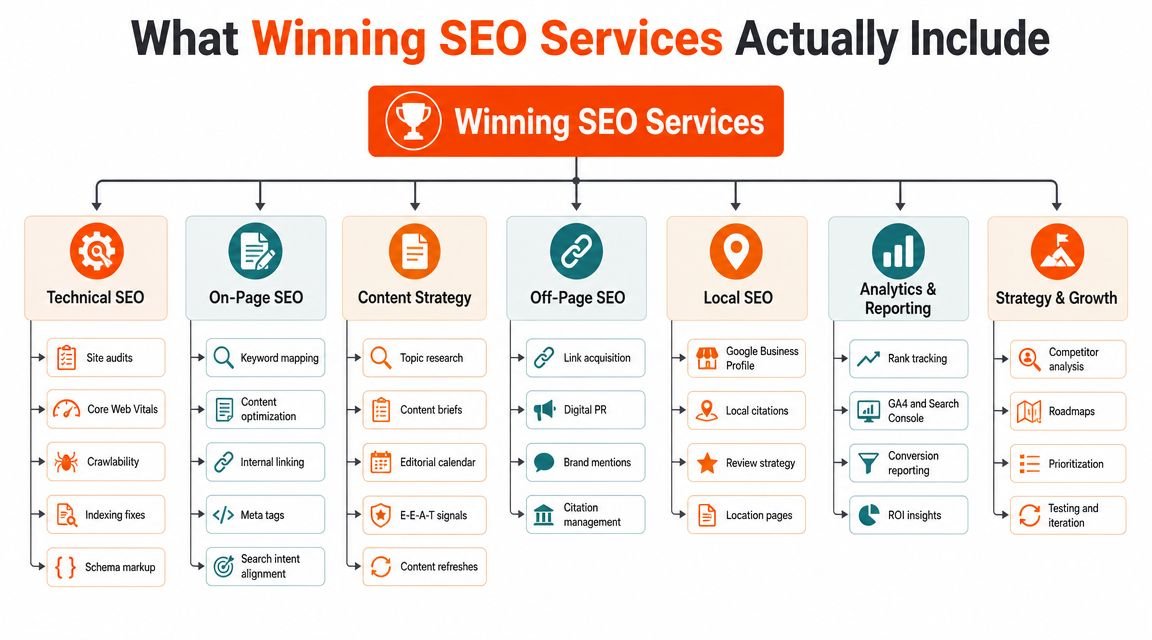
What Winning SEO Services Actually Include
A real local SEO campaign isn’t a blog post package and a monthly ranking report. It’s a coordinated system built to win visibility in Google Maps, strengthen trust, and turn searchers into calls.
The biggest mistake I see is business owners buying “SEO” that focuses almost entirely on the website while ignoring the asset customers interact with first. For local intent, that’s often your business profile.
Your Google Business Profile is the front line
For seo services near me and similar local queries, the map pack is where buyers choose. The Google local map pack gets 42% of all clicks for local searches, according to SOCi’s local SEO statistics roundup. If you’re not competitive there, you’re missing the highest-intent visibility on the page.
A strong provider starts with your Google Business Profile and treats it like a conversion asset, not a formality. That means:
- Category precision so Google understands exactly what you do
- Service completeness with clear descriptions tied to buyer intent
- Photo quality that makes the business feel active and credible
- Review strategy that improves trust and shows responsiveness
- Competitive analysis of nearby profiles that already dominate your market
Your website still matters. But in local search, a neglected profile can kill performance before a visitor ever reaches your site.
The core pieces that make local SEO work
Professional local SEO has several moving parts. If an agency doesn’t handle these, you’re not buying a complete service.
| Component | What it should do |
|---|---|
| Google Business Profile optimization | Improve relevance, trust, and action rate inside Google Maps and local results |
| NAP consistency | Keep your business name, address, and phone aligned across directories and citations |
| Localized service pages | Show Google and users exactly where you work and what problems you solve |
| Technical SEO | Make your site fast, crawlable, mobile-friendly, and easy to use |
| Review management | Strengthen prominence and help buyers trust you quickly |
| Local authority building | Support prominence through citations, links, and location signals |
Here’s what a serious campaign usually includes in practice:
- A full profile rebuild instead of minor edits
- Location-focused content that answers real buyer questions, not keyword-stuffed fluff
- Directory cleanup so search engines stop receiving mixed business data
- On-page updates to titles, headings, internal links, schema, FAQs, and service-area relevance
- Ongoing monitoring of which queries trigger map visibility and which pages support conversions
If you want this done correctly, look for local SEO marketing services built around maps, content, and conversion tracking. Cheap SEO usually strips out the work that moves local rankings.
How to Evaluate and Choose a Local SEO Partner
Hiring an SEO agency feels risky because most business owners have already heard the same recycled promises. More traffic. Better rankings. More visibility. That language is too vague to trust.
A good agency shouldn’t want blind trust. They should want scrutiny.
Google states that local results are based on relevance, distance, and prominence, and SharpNet Solutions highlights that a crucial question is how an agency plans to improve prominence through reviews, citations, and local links. That’s the hiring lens you should use.
Questions that expose weak agencies fast
Ask these in the first conversation.
What will you improve first in my local presence?
If the answer is generic, move on. They should mention your Google Business Profile, citation consistency, service pages, reviews, and local competitors.How do you decide what matters most in my market?
Miami is not a low-competition environment. The agency should have a process for reviewing local pack competitors, categories, review patterns, and on-page signals.How do you define success?
“More traffic” isn’t enough. A serious partner talks about qualified leads, calls, booked consultations, and profile actions.What will you show me every month?
You need clear reporting on work completed, visibility changes, business profile engagement, and lead-focused outcomes.
A strong SEO partner doesn’t hide behind jargon. They explain what they’ll do, why it matters, and how you’ll know whether it’s working.
What a serious partner should measure
If an agency only reports keyword movement, they’re giving you an incomplete picture.
The right partner should connect search visibility to business outcomes. That means tracking actions that happen on the site and inside your Google Business Profile. For companies that rely on forms, appointment requests, and follow-up emails, operational details matter too. If your sales team depends on outreach sequences or automated responses, an Email Deliverability Service can also protect lead flow after the SEO work starts generating inquiries.
A useful evaluation checklist looks like this:
| What to ask | What a good answer sounds like |
|---|---|
| How do you track leads? | They mention calls, form submissions, booked appointments, and GBP actions |
| How do you prioritize local SEO tasks? | They explain audits, competitive gaps, and business-specific opportunities |
| How do you report results? | They provide clear deliverables and business-focused metrics |
| How do you handle reviews and citations? | They have an actual process, not a vague recommendation |
| How do you improve prominence? | They talk about reviews, citations, local links, and stronger local content |
What to ask about execution
Unreliable providers typically falter at this stage.
Ask who performs the work. Ask how often they update your profile. Ask whether they write city and service pages from scratch or use templates. Ask how they handle duplicate listings, category selection, review response support, and service-area alignment.
Then ask a harder question: how do they adapt if rankings improve but calls don’t?
That answer matters because SEO isn’t just about being found. It’s about being chosen. Sometimes the issue is weak messaging, poor profile presentation, bad calls to action, or a site that doesn’t convert.
If you want a benchmark for what that evaluation process should look like, review this guide on how to choose a digital marketing agency without getting stuck with vague promises.
The right agency won’t rush you past these questions. They’ll answer them directly because their process can handle inspection.
Critical Red Flags That Signal a Bad SEO Investment
Bad SEO rarely fails in an obvious way. It usually sounds polished in the sales call, sends a few reports, and steadily wastes months while your competitors keep taking leads.
That’s why you need to spot the warning signs before you sign anything.
Bad promises are easy to spot
If an agency guarantees the number one spot on Google, walk away. No one controls Google’s rankings, and serious providers know better than to sell certainty where there isn’t any.

Other red flags show up in the offer itself:
- Suspiciously cheap packages that promise everything but don’t explain deliverables
- One-size-fits-all plans with no discussion of your market, competitors, or service area
- Keyword obsession without any mention of calls, forms, appointments, or map visibility
- No discussion of reviews or citations even though local SEO depends on local trust signals
If they can’t explain the work in plain English, they either don’t have a process or they don’t want you to see how thin it is.
Weak reporting hides weak work
A useless report is one of the most common symptoms of weak SEO.
If all you get is ranking screenshots and traffic charts, you still don’t know whether the campaign is helping the business. You should be able to see what changed, why it changed, and what happens next.
Look for reporting that includes:
- Completed actions so you know the agency is doing work
- Profile and local visibility insights rather than website-only data
- Lead-focused outcomes tied to your business goals
- Next-step recommendations based on performance, not generic filler
If you want to see the difference between surface-level reporting and meaningful analysis, review this site review example that shows what transparent digital evaluation should look like.
Cheap SEO often costs more than doing nothing because it burns time, creates confusion, and delays the work that should’ve been done correctly from the start.
Our Blueprint From Local Invisibility to Market Leader
A business doesn’t become dominant in local search because someone “did SEO.” It happens when the right work gets done in the right order, with clear accountability and conversion tracking from the start.
The modern local search environment demands that approach. With over 60% of local searches ending without a website click, a modern SEO strategy must optimize for and track zero-click conversions like calls from the Google Business Profile, direction requests, and direct messages, as noted by Connectica’s guidance on local SEO mistakes. If your agency only reports website traffic, they’re missing how local buyers convert.
Phase one and phase two
The first phase is diagnosis and direction.
That means a full audit of your Google Business Profile, local rankings, site structure, service pages, reviews, citation consistency, and top local competitors. You need to know what is suppressing visibility before you start publishing content or chasing links.
The second phase is foundational optimization. Most of the immediate cleanup occurs in this phase.
- Google Business Profile overhaul with categories, services, photos, business details, and conversion-focused improvements
- Citation cleanup and consistency work to reduce conflicting local signals
- Service and location page refinement so your website supports local intent
- Technical fixes that improve crawlability, mobile performance, and user experience
The fastest way to waste an SEO budget is to skip fundamentals and jump straight into content or backlinks.
Phase three and phase four
Once the foundation is strong, the work shifts to authority and growth.
That includes review strategy, local authority building, stronger internal linking, expanded localized content, and continuous testing around what drives actual inquiry volume. This is also where prominence becomes a competitive advantage instead of just a theory.
The final phase is reporting and refinement. That reporting should focus on business outcomes:
| KPI | Why it matters |
|---|---|
| Calls from Google Business Profile | Buyers often convert before visiting the website |
| Form submissions | Strong indicator of qualified local interest |
| Direction requests and messages | Useful signal for zero-click local intent |
| Local pack visibility | Shows whether your business is entering the decision set |
| Landing page engagement | Helps identify whether traffic supports lead generation |
For local businesses trying to build trust in a crowded market, authority also matters beyond rankings. This is why many serious campaigns are shaped by principles like E-E-A-T in local SEO and authority building for Miami businesses.
A proper blueprint removes guesswork. You know what is being done, what is being measured, and how the campaign connects to revenue.
Your Next Step to Getting More Local Customers
By now, the pattern should be obvious. Businesses don’t lose local searches because nobody is looking. They lose because a better-optimized competitor shows up first, looks more credible, and makes it easier to take action.
When you’re looking for seo services near me, you’re probably past the awareness stage. You’re comparing providers and trying not to make an expensive mistake.
Straight answers to the last objections
Is local SEO worth it for a small business?
Yes, if local search matters to how customers find you. For service businesses, professional firms, restaurants, clinics, and contractors, it usually does. If your buyers search Google before calling, local SEO isn’t optional.
Can you do it yourself?
You can handle parts of it yourself. Most owners don’t sustain it well because local SEO isn’t one task. It’s profile optimization, reviews, site updates, citations, tracking, competitive analysis, and ongoing refinement. DIY usually stalls after the easy fixes.
How long does it take?
It depends on your starting point, your competition, and how much cleanup is needed. Some improvements show up early, especially after profile and citation fixes. Stronger market position takes consistent work.
What to do now
Don’t hire the first agency that says the right buzzwords. Use the questions in this guide. Push for specifics. Ask how they’ll improve prominence, how they’ll track calls and inquiries, and what they’ll do in the first month.
Then make a decision quickly.
Every week you stay buried, another customer picks a competitor who looks easier to trust. In Miami, that compounds fast because the market doesn’t wait for you to “eventually” fix your visibility.
If you’re serious about getting more calls, better leads, and stronger local visibility, the next step is simple. Talk to a team that can review your current presence, identify the fastest wins, and give you a clear roadmap instead of recycled SEO talk.
If you’re ready to stop being invisible and start turning local searches into real customers, book a strategy session with VIP TECH CONSULTING. You’ll get a direct look at what’s holding your business back, what should be fixed first, and how to build a local SEO plan that drives calls, consultations, and qualified leads.