
If your practice isn’t showing up when someone searches for a dentist near me, you’re losing patients to offices that may not be better than you. They’re just easier to find.
That’s the uncomfortable truth behind seo for dentists. Clinical skill matters once a patient gets in the chair. Search visibility decides whether they ever call in the first place. For most practices, the core problem isn’t demand. It’s discoverability, trust, and follow-through.
A modern dental SEO strategy has to do more than push rankings up. It has to turn Google searches into calls, appointment requests, and booked treatment plans. That means local intent, service page depth, Google Business Profile optimization, review generation, structured data, and clear measurement tied to actual patient acquisition.
If you already know you need help and you’re comparing agencies or deciding whether to keep this in-house, that’s the right moment to look at what actually drives growth.
Table of Contents
- Why Great Dentists Are Invisible Online
- The Blueprint for Attracting High-Value Patients
- How to Dominate Google Maps and Local Search
- Building Unshakeable Trust with Content and Reviews
- Advanced SEO to Outrank Your Toughest Competitors
- Measuring What Matters From Clicks to Patients
- Your Path to a Full Patient Schedule
Why Great Dentists Are Invisible Online
A dentist can have a clean office, strong chairside manner, excellent clinical outcomes, and still have gaps in the schedule. That happens every day. The reason usually isn’t quality of care. It’s weak local visibility.

Patients don’t discover practices the way they used to. 71% of patients research potential dentists before booking an appointment, and 75% never scroll beyond the first page of search results, which makes page-two visibility close to invisible for local practices, according to dental marketing statistics published here.
That creates a costly pattern. A practice invests in equipment, staff, and patient experience, but broad local searches like “dentist in Miami,” “Invisalign near me,” or “emergency dentist” send attention to competitors with stronger SEO foundations.
What invisibility looks like in real life
A few signs show up repeatedly:
- The website exists but doesn’t rank. It looks fine, but service pages are thin, generic, or missing.
- The practice depends too heavily on referrals. Referrals help, but they rarely create a predictable acquisition system.
- Google Maps visibility is inconsistent. Some weeks the practice appears. Other weeks it disappears behind competitors and directory sites.
- Staff says the phone feels quiet. Usually that’s a search problem before it’s a front-desk problem.
Practical rule: If patients can’t find you when they’re actively searching, your competitors are collecting the calls that should have been yours.
This is why seo for dentists can’t be treated like a side project delegated between patients or squeezed into a monthly checklist. It’s tied directly to revenue.
If you want a fast way to spot the gaps, start with a visibility review like this guide on how to increase organic traffic to a website. It helps clarify whether the issue is rankings, weak page targeting, poor local signals, or all three.
The Blueprint for Attracting High-Value Patients
The practices that win organic search usually don’t target “more traffic” as the goal. They target the right searches. That’s a major difference.
Broad traffic brings curiosity. High-value traffic brings appointment intent.
Start with search intent, not broad traffic
Effective keyword strategy for dental SEO breaks into three groups. Geo-modified searches, service-specific searches, and informational searches. Practices that create dedicated pages for each core service rank 60% faster than practices with a single services list, based on this dental local SEO breakdown.
A workable structure looks like this:
| Search type | Example | Why it matters |
|---|---|---|
| Geo-modified | dentist in Miami | Captures local discovery |
| Service-specific | Invisalign cost | Pulls in treatment-focused demand |
| Informational | why do my gums bleed | Builds trust earlier in the journey |
The mistake I see most often is a practice trying to rank one homepage for everything. That usually fails. Google needs clear service relevance, and patients need a page that speaks directly to what they want.
Build pages that can rank and convert
Every important service should have its own page. Not a paragraph on a generic services page. A full page.
That includes high-intent services such as:
- Emergency dentistry. These searches often come from patients ready to act now.
- Dental implants. This is usually a higher-value treatment that needs education and trust signals.
- Invisalign or orthodontics. Patients compare options and cost, so page clarity matters.
- Cosmetic dentistry. Before-and-after proof and consultation pathways matter more than generic copy.
A strong service page should include the basics people skip:
- A focused title and H1 built around one service and one local angle
- Patient-first copy that explains who the treatment is for, how it works, and what to expect
- FAQ blocks written in plain language
- Clear calls to action for booking or calling
- Internal links to related procedures and financing or contact pages
A service page should answer the patient’s first five questions before they ever need to call.
That matters even more now because AI-generated search summaries favor direct answers, structured headings, and concise explanations. Long pages still work, but only if they’re organized for extraction, scanning, and trust.
Accessibility also deserves attention here. Dental websites serve a broad patient base, and better accessibility improves usability for everyone. If you want a practical outside perspective, this piece on digital accessibility in healthcare is worth reviewing.
Once the page structure is right, the website becomes a lead-generation asset instead of a brochure. This is also why practices benefit from studying what a real lead generation website needs to do beyond just looking polished.
How to Dominate Google Maps and Local Search
For most dental practices, the map pack drives the fastest path from search to phone call. A patient searching on mobile doesn’t always want to read your blog. They want a trusted local option, a clear service match, and a number to tap.
That makes your Google Business Profile one of the most important assets in the entire marketing stack.
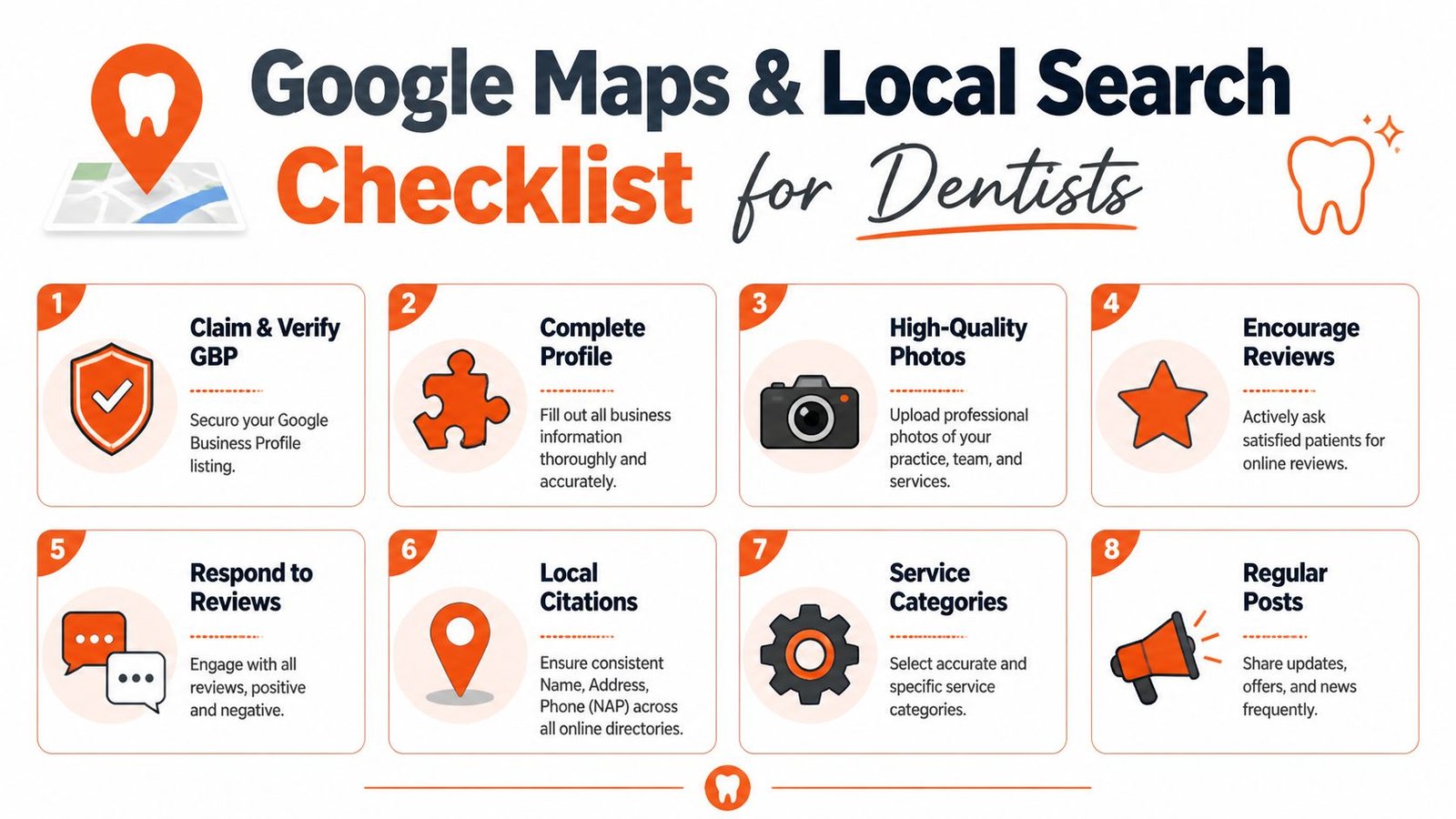
Your Google Business Profile is your real homepage
78% of local mobile searches result in an offline visit within 24 hours, and a fully optimized Google Business Profile is the primary driver for capturing that local intent, as noted in the verified data above.
That’s why an incomplete profile costs more than most practices realize. Missing categories, weak descriptions, outdated hours, poor photos, and inconsistent service details create friction right when the patient is closest to booking.
A strong profile includes:
- Accurate core details. Name, address, phone, hours, and website must match the rest of the web.
- Correct categories. “Dentist” alone is rarely enough if you also provide cosmetic, pediatric, or emergency services.
- Real office photography. Exterior, reception, operatories, team photos, and signage all improve trust.
- Service menu coverage. Important procedures need to appear clearly, not just in website copy.
- Active profile management. Posts, Q&A, review responses, and updates show the listing is maintained.
If you want an additional outside reference, LPagery’s local SEO guide outlines many of the practical local ranking inputs that practices often overlook.
Local authority comes from consistency
Google Business Profile optimization works best when the rest of your local footprint backs it up. That means citation consistency across directories like Yelp, Healthgrades, Apple Maps, Bing Places, and core local business listings.
Here’s where practices often slip:
- They use one phone number on the website and another in a directory.
- They abbreviate the address in one place and spell it out elsewhere.
- They forget to update holiday hours or suite numbers.
- They ignore duplicate listings.
Each inconsistency weakens confidence in the business data.
A local SEO campaign that performs usually includes regular checks on citations, review activity, neighborhood relevance, service-page alignment, and map-pack visibility. If you want a benchmark for that work, this local SEO checklist is a solid reference point.
If your team doesn’t have time to manage that every week, that’s exactly why practices hand it off. Google Maps performance rarely improves from one-time setup alone. It improves from disciplined maintenance.
Building Unshakeable Trust with Content and Reviews
Visibility gets you considered. Trust gets you chosen.
That’s especially true in dentistry, where patients often feel anxious, compare multiple providers, and look for reassurance before they commit.

81% of patients trust online reviews as much as personal recommendations, and review quantity, quality, and recency are major local ranking inputs in Google’s system, according to the verified data above.
Content has one job, reduce hesitation
A good dental page doesn’t just describe a treatment. It lowers uncertainty.
Patients usually want answers to practical questions:
- Will this procedure hurt?
- How long does it take?
- Am I a good candidate?
- What happens at the first appointment?
- Why should I trust this office?
That’s why the highest-performing service pages tend to include:
- Dentist bios and credentials that show who provides the care
- Before-and-after images where appropriate
- Office photos that reduce first-visit anxiety
- Treatment FAQs in short, direct language
- Clear next steps for consultations, insurance questions, or urgent care
The way articles are presented has shifted here because AI search results increasingly pull concise, quotable answers from pages with clear Q&A formatting. A long page filled with vague marketing language is easy to ignore. A page with direct answers, proof, and local relevance is easier to surface.
For practices working on authority signals, this guide to E-E-A-T in local SEO is useful because it connects credibility elements to real local business performance.
Reviews influence rankings and patient choice
Review management shouldn’t be treated as a front-desk afterthought. It’s part of SEO, conversion, and reputation.
The offices that generate reviews consistently usually have a simple system:
- Ask at the right moment. Right after a positive visit or successful treatment outcome.
- Make it easy. Use a direct review link by text or email.
- Respond to every review. Thank satisfied patients and address concerns professionally.
- Watch recency. A profile with fresh feedback feels more trustworthy than one with stale praise.
Patients don’t read reviews like marketers do. They scan for patterns. Friendly staff. Clean office. Clear communication. Good outcomes. Easy scheduling.
Later in the funnel, video can help reinforce that trust. A simple explainer or educational asset often answers objections that keep patients from booking.
Practices that combine review acquisition with stronger service-page content usually convert more of the visibility they already have. That’s the important point. SEO for dentists isn’t just about getting found. It’s about being the obvious choice once found.
Advanced SEO to Outrank Your Toughest Competitors
A lot of practices assume they can stop at titles, keywords, and a few blog posts. In a low-competition market, that may hold for a while. In a real city, it usually won’t.
The practices that keep climbing are the ones doing technical SEO, structured data, local authority work, and AI-ready content formatting consistently.
Basic optimization won’t hold in a competitive market
Backlinks still matter, but random directory links won’t move the needle much. The stronger signals usually come from local relevance and professional credibility.
That often means earning links and mentions from:
- Local community organizations
- Health-related publications
- Professional associations
- Local news or event coverage
- Partner businesses and referral networks
Not every practice needs an aggressive link-building campaign. But every serious practice needs authority signals beyond its own website.
Schema markup is another separator. Implementing DentistOffice and MedicalProcedure schema can improve local search impressions by 15 to 25 percent, according to this schema guidance for dental practices. That matters because it helps Google understand your services, location, hours, and business details more clearly.
A solid schema setup for a dental website usually includes:
| Schema type | Best use |
|---|---|
| DentistOffice | Homepage and contact page |
| MedicalProcedure | Individual treatment pages |
| FAQPage | Service page question blocks |
| LocalBusiness | Reinforces local entity data |
| AggregateRating | Supports review visibility where appropriate |
Clean schema implementation helps search engines interpret what your practice does. Sloppy implementation creates errors and missed opportunities.
AI search changed what pages need to do
The search environment has shifted. AI summaries answer simple questions directly in results, which means dental pages need to be easier for search systems to interpret and quote.
That has changed page strategy in a few important ways:
- Front-load the answer. Don’t bury the main explanation halfway down the page.
- Use question-based subheadings. They align better with patient search behavior.
- Write concise answers first, then expand. This improves readability for both users and AI systems.
- Support claims with proof. Office images, staff bios, and treatment process clarity help establish trustworthiness.
If you’re exploring how automation and AI-assisted workflows fit into search strategy more broadly, AI SEO for small businesses offers useful context.
The DIY objection usually fades here. Not because these tactics are impossible to learn, but because a busy practice owner rarely has the time to manage schema validation, technical audits, content restructuring, citation cleanup, and authority building without something important slipping.
Measuring What Matters From Clicks to Patients
Most dental SEO reporting is too shallow. It focuses on rankings, impressions, or traffic without connecting those metrics to booked appointments.
That’s not enough. A practice can’t make smart budget decisions from vanity metrics alone.
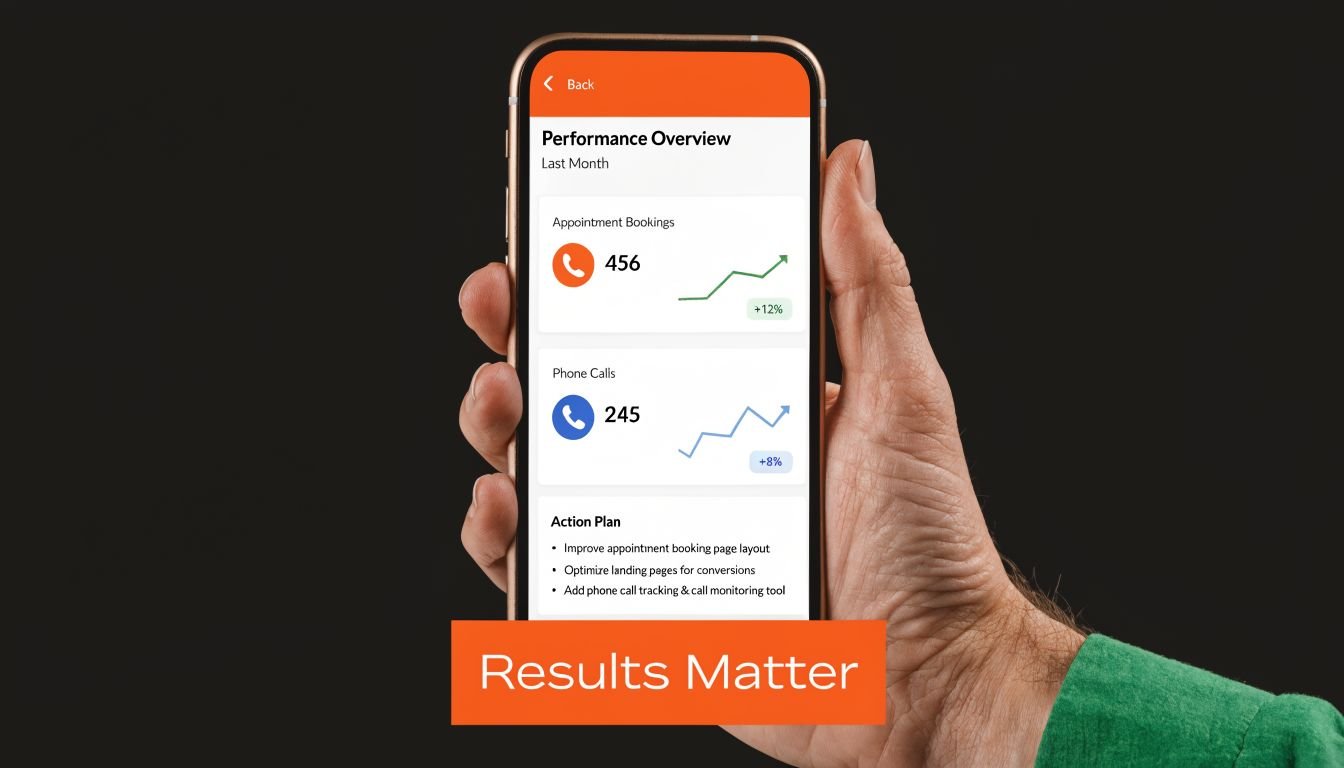
Stop reporting vanity metrics in isolation
The question isn’t “Did rankings improve?”
It’s “Did SEO generate qualified calls, consultation requests, and new patients?”
That means tying local SEO work to:
- Phone call tracking
- Form submissions
- Appointment request completions
- Google Business Profile interactions
- Landing page conversion paths
- New patient source data inside your CRM or practice workflow
There’s another reason this matters. AI search is changing click behavior. Search visibility may rise while clicks become more selective. That makes conversion quality more important than raw traffic totals.
What a practice should actually track
A practical reporting model for dentists should answer five questions every month:
- Which service pages generated inquiries?
- Which local searches drove calls or direction requests?
- Which neighborhoods or locations produced patient demand?
- Where are calls being missed or forms dropping off?
- How does organic lead quality compare with paid search?
That last point is important. SEO and Google Ads shouldn’t compete inside the practice. They should work together. Paid search can cover immediate high-intent terms while organic SEO builds durable visibility and lowers dependency on ad spend over time.
A clean analytics setup is the foundation. If your measurement is messy, every decision after that gets weaker. This guide on how to set up Google Analytics 4 is a useful starting point for getting event tracking and conversion reporting in order.
The best dental SEO campaigns don’t just show more traffic. They show which channels produced patients, which pages assisted conversions, and where revenue opportunities were lost.
Once reporting is tied to patient acquisition, SEO becomes much easier to evaluate. It stops feeling like a vague marketing expense and starts behaving like a growth system.
Your Path to a Full Patient Schedule
The practices that win with seo for dentists aren’t guessing. They’re building a system.
That system includes the right service-page structure, a fully developed local presence, trust-focused content, active review generation, technical SEO, schema markup, and reporting tied to actual patient intake. It also requires ongoing work. Rankings shift. Competitors react. Google changes the way results are displayed. Patient behavior evolves.
A dentist can try to manage that internally, but there’s a trade-off. Every hour spent chasing citations, rewriting metadata, fixing page structure, reviewing analytics, or updating Google Business Profile content is an hour not spent on patient care, operations, or growth decisions.
That’s why the best SEO partner for a dental practice doesn’t just “do SEO.” They build a search acquisition engine that supports predictable bookings and clearer ROI.
If your practice is competing in a dense local market, delay is expensive. The patients searching today will choose someone. The question is whether they’ll find and trust your office before they book with another one.
If you want a direct path forward, book a free strategy session with VIP TECH CONSULTING. They help local businesses build conversion-focused SEO, stronger Google Maps visibility, and measurable lead generation systems that turn search demand into calls, consultations, and consistent growth.