
If you're paying for Google Ads or Meta Ads and the clicks keep coming while the calls don't, you don't have an ad problem. You have a system problem.
That distinction matters. Plenty of Miami business owners assume the platform isn't working, or that they just need a few better keywords, a lower bid, or a new ad headline. That's usually wrong. The actual leak happens after the click, where weak landing pages, bad tracking, loose targeting, and unclear offers steadily drain budget every day.
This is why smart buyers don't look for someone to "run ads." They look for PPC advertising management services that turn paid traffic into booked jobs, qualified leads, and real revenue.
If that's what you need, keep reading. If you want a fast diagnosis of what's broken, start with your website's weak points and improve website conversion rates before more budget gets wasted.
Table of Contents
- Stop Burning Your Budget on Clicks That Don't Convert
- The Difference Between Buying Ads and Building a Lead Machine
- What Our PPC Advertising Management Services Include
- Why a Local Miami Agency Delivers Better PPC Results
- PPC Results We've Delivered for Florida Businesses
- Answering Your Most Pressing Questions
- Book Your Free PPC Strategy Session Today
Stop Burning Your Budget on Clicks That Don't Convert
You're not alone if your ad account looks active but your pipeline doesn't. The budget spends. The dashboard shows clicks. Maybe impressions are up. But the phone is quiet, form submissions are weak, and your sales team keeps asking where the good leads are.
That's not a traffic issue. It's what happens when someone treats PPC like a switch instead of a system.
A lot of businesses get stuck in one of two bad scenarios. They either try to manage campaigns in-house without enough time or experience, or they hire a low-cost provider who follows a checklist and calls it strategy. In both cases, the result is the same. Broad targeting, weak intent matching, generic landing pages, and reporting that talks about clicks instead of customers.
Your competitors aren't waiting
PPC isn't some niche tactic anymore. Industry estimates put worldwide PPC spending at $218.3 billion in 2026, while another roundup projects $306 billion for paid search/PPC in 2026 with 11% year-over-year growth and $350 billion by 2028. Definitions vary, but the point is obvious. This is a massive, fast-growing channel, and serious competitors are already using it to capture demand in real time, according to this PPC market roundup from DesignRush.
If your campaigns aren't converting, you're not just wasting money. You're training the market to choose someone else.
Practical rule: If your ads generate clicks but not qualified actions, stop tweaking bids first. Fix targeting, offer clarity, landing page experience, and tracking.
What wasted spend usually looks like
Here are the patterns that show up again and again:
- Loose keyword targeting that matches searches from people who were never going to buy
- Ads with weak intent alignment that promise one thing and land visitors on a page about something else
- No clear conversion path for calls, forms, bookings, or purchases
- Bad tracking that makes poor leads look like wins
- No post-click strategy so the campaign gets judged on cost per click instead of cost per customer
This is why many businesses feel like PPC is unpredictable. It isn't. Their management is.
If you want a serious answer, get a real diagnosis before another month of spend disappears. A strategy session should show you where the leaks are, what to fix first, and whether your current setup can produce profit.
The Difference Between Buying Ads and Building a Lead Machine
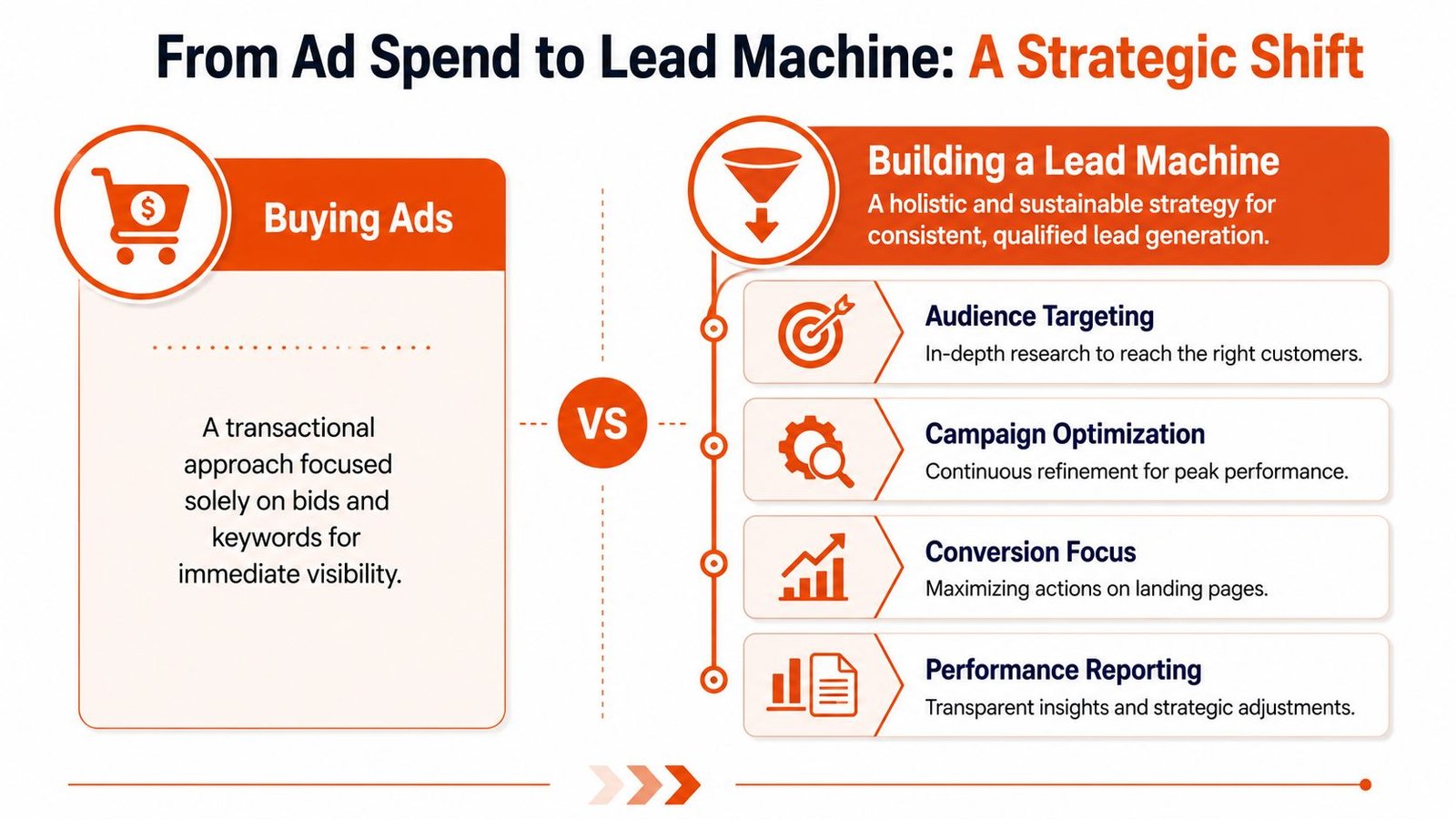
Buying ads is easy. Building a lead machine takes discipline.
Most providers can open Google Ads, choose keywords, write a few headlines, and launch a campaign. That's not hard. What's hard is turning paid traffic into a reliable stream of calls, form fills, booked consultations, and sales while keeping waste under control.
Most campaigns fail before the first click
The technical center of paid search is Quality Score. Google uses relevance signals like ad relevance, expected click-through rate, and landing page experience to influence ad rank and effective cost per click. That means the advertiser with the highest bid doesn't automatically win. Better relevance can earn stronger positions at lower cost, as explained in Bruce Clay's overview of how PPC and Quality Score work.
That single point separates amateurs from professionals.
If your campaign structure is sloppy, your ad groups are too broad, your search terms aren't filtered with negative keywords, and your landing page doesn't match search intent, you force the platform to work against you. Then you overpay for traffic and wonder why ROI is weak.
A better approach starts with the website itself. If the page can't convert the visitor, the media buy won't save it. That's why serious advertisers build a lead generation website before they scale ad spend.
What a lead machine actually includes
A real lead generation system has connected parts. If one breaks, the whole campaign suffers.
Business goal alignment
The campaign needs one clear job. Generate calls. Book consultations. Drive quote requests. Sell a product. If the objective is fuzzy, the account becomes a mess fast.Tight audience and keyword control
Good management narrows intent. It doesn't chase every search variation just because volume exists.Offer and message match
A searcher looking for urgent service needs a different message than someone comparing providers. Good ads reflect that difference.
A useful visual summary of that shift is below.
Landing page conversion design
The visitor should know what you do, why they should trust you, and what action to take within seconds.Tracking that reaches revenue
Clicks and impressions are not outcomes. Good management tracks calls, forms, qualified leads, and downstream sales signals whenever possible.
Good PPC management doesn't ask, "How do we get more clicks?" It asks, "Which clicks turn into profitable customers, and how do we get more of those?"
If you're comparing agencies, this is the standard to use. Anyone who only talks about keywords, bids, and monthly reports is selling campaign activity, not growth.
What Our PPC Advertising Management Services Include
Most businesses don't need another vague promise. They need to know what they're getting, how the work is done, and how that work ties back to leads and revenue.
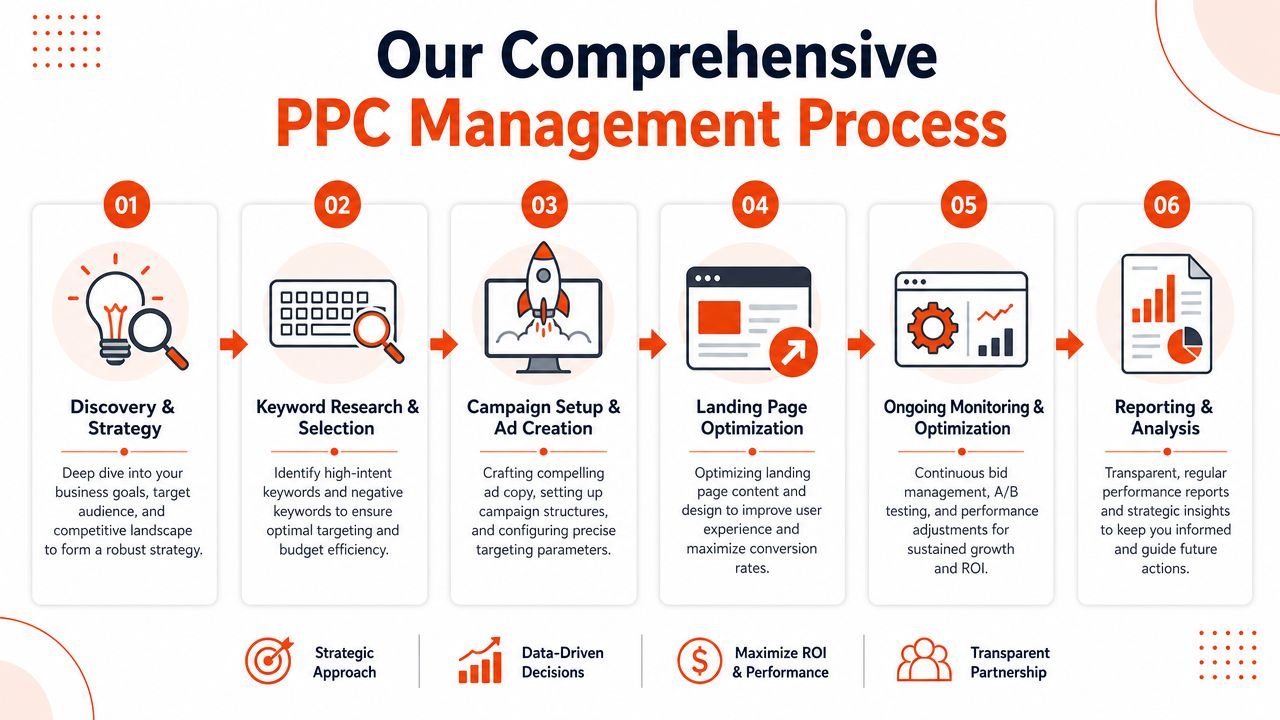
A proper scope for PPC advertising management services should be visible from day one. If a provider can't explain the moving parts, they're probably not managing many of them.
What you should expect before launch
Before a campaign goes live, the groundwork should be heavy. That includes:
Account and offer audit
Review existing Google Ads or Meta Ads accounts, current landing pages, call handling, forms, and the actual offer being promoted.Keyword and intent mapping
Separate high-intent searches from research traffic. Build negative keyword lists early. Keep campaign structure tight.Competitive review
Look at who already dominates the search results and where weak competitors leave openings.Tracking setup
Form fills, phone calls, appointment requests, and other meaningful actions should be measured correctly before scaling starts.Landing page planning
Ads should not point to generic service pages if the campaign needs focused conversion behavior. In many cases, the page needs its own copy, layout, CTA, trust elements, and mobile-first structure.
Many agencies cut corners in their approach. They launch first and fix later. That's backwards.
If you're evaluating providers, your benchmark should be simple. Their Google Ads process should include strategy, structure, conversion planning, and post-click improvements, not just campaign setup. For a direct example of that service category, review professional Google Ads services.
What should happen every month after launch
Launch is the starting line, not the service.
A competent team keeps adjusting what matters:
| Focus area | What strong management does |
|---|---|
| Search terms | Cuts irrelevant traffic and expands on real buyer intent |
| Ads | Tests messaging, offers, and calls to action |
| Landing pages | Improves conversion flow, trust, and clarity |
| Budgets and bids | Shifts spend toward what produces qualified leads |
| Reporting | Connects campaign activity to business outcomes |
Industry guidance often defines PPC management as strategy, keyword selection, ad creation, bid management, landing page development, and performance tracking. The bigger gap is what happens after setup. Many guides stop before explaining landing page optimization, call tracking, and revenue attribution, even though those are the pieces that show whether ads are improving business outcomes, as noted in ForeFront Web's discussion of PPC management services.
If your report doesn't tell you which campaigns generated qualified calls, booked appointments, or real sales opportunities, the report is incomplete.
That's the standard. Anything less is maintenance, not management.
Why a Local Miami Agency Delivers Better PPC Results
National agencies love generic playbooks. Miami businesses pay for the consequences.
A local market changes everything about paid acquisition. Search behavior in Brickell isn't the same as Aventura. A restaurant in Wynwood doesn't need the same audience strategy as a law firm in Coral Gables. Seasonal patterns, bilingual search behavior, neighborhood intent, commuting habits, and service radius all shape performance.
Local context changes campaign performance
A strong Miami PPC strategy gets specific fast.
- Neighborhood targeting matters because the same service can attract very different customers across North Miami, Downtown, Doral, Kendall, and Miami Beach.
- Offer framing matters because local buyers respond to urgency, convenience, trust, and proximity in different ways depending on the category.
- Search terms matter because local service campaigns often hinge on "near me," city modifiers, and mobile-first behavior with immediate call intent.
That level of precision is hard to get from a remote provider who treats South Florida like a pin on a map.
For service businesses especially, location settings can make or break results. If you're trying to control radius, zip-level reach, or city-specific intent, you need a provider who understands Google Ads location targeting for local campaigns.
Automation helps, but it can't replace judgment
Platforms keep pushing automation. That's fine. Automation is useful for execution. It is not strategy.
A smart local agency uses automation where it saves time and improves efficiency, then applies human judgment where machines still fail:
- Choosing the right offers
- Judging lead quality
- Spotting wasted spend hidden inside automated campaign types
- Aligning ads with real sales conversations
- Adjusting landing pages for local trust signals
Many businesses get burned when they assume automated bidding and auto-generated recommendations mean the account is managed. It isn't. Someone still has to decide what a good lead looks like, what traffic should be excluded, and whether the campaign is producing incremental growth or just more low-value clicks.
For Miami businesses, local context plus post-click discipline usually beats generic automation-first management every time.
PPC Results We've Delivered for Florida Businesses
Most agencies talk in theory. Business owners want evidence that the strategy works in practice.
The examples below matter because they reflect what businesses care about. Not vanity metrics. Not abstract reach. Calls, reservations, booked consultations, and qualified inquiries.
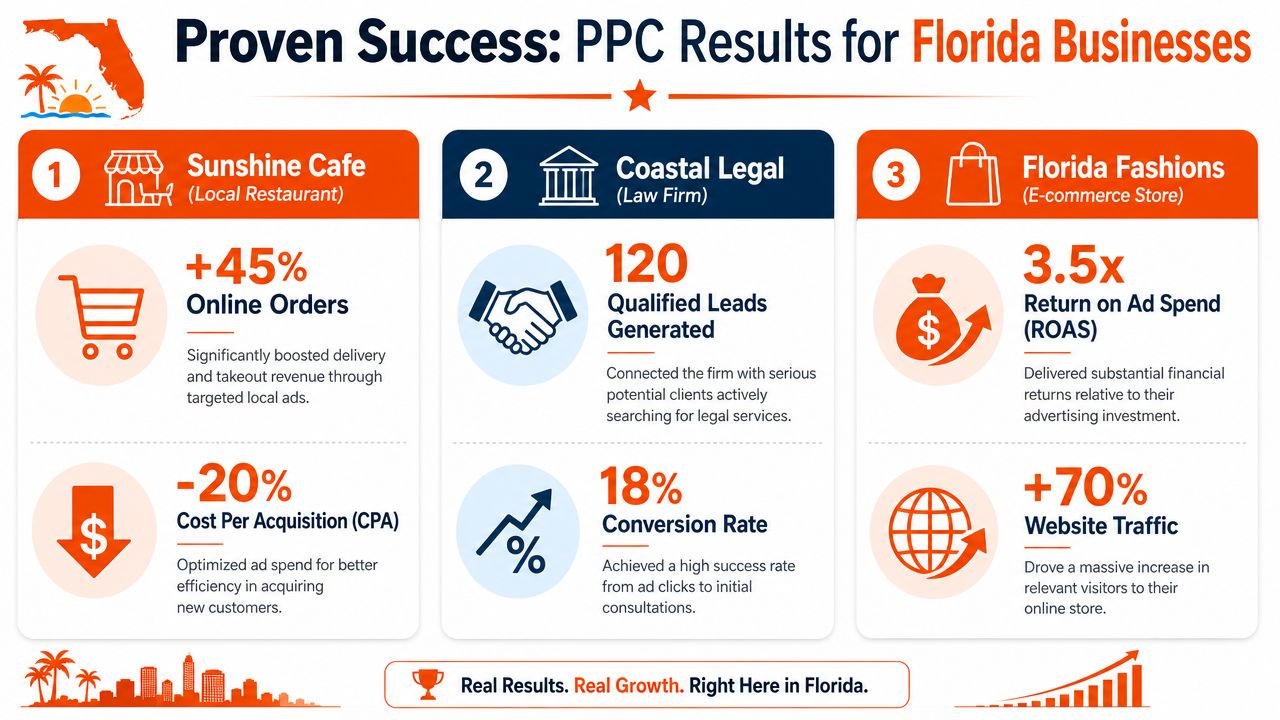
Restaurant leads and reservations
A South Florida restaurant usually doesn't need more random traffic. It needs more diners, more online orders, and stronger reservation flow during the hours that matter most.
The winning setup is usually straightforward in concept but strict in execution. Geo-targeted campaigns, sharp audience exclusions, mobile-first creative, and landing experiences built around immediate action. The ad has one job. Drive the booking or the order without friction.
When restaurants struggle with paid ads, the usual problem isn't ad reach. It's sending paid traffic to cluttered pages with too many choices and no strong call to action.
Professional services and qualified inquiries
Law firms, consultants, and other professional service businesses make a different mistake. They often generate inquiries, but too many are low quality.
That problem starts when campaigns go broad and the landing page tries to speak to everyone. A better system narrows by service line, location, and buyer intent. The page then filters visitors with sharper copy, better trust signals, and a conversion path that attracts serious prospects instead of casual researchers.
The best professional service campaigns don't maximize lead volume. They improve lead quality first.
Local service calls from high-intent search traffic
For HVAC, plumbing, electrical, restoration, and similar local services, speed and intent matter more than volume. Someone searching for help now doesn't want a long sales pitch. They want clarity, trust, and a fast way to call.
The strongest campaigns for these businesses usually combine:
- High-intent keyword segmentation around urgent service needs
- Negative keyword controls to block DIY, job seekers, and irrelevant searches
- Call-first landing pages with strong mobile usability
- Geographic filters based on service area and profitability
- Tracking tied to actual calls and lead quality
That's what good PPC advertising management services should produce. Not more dashboard activity. More business from the right searches.
Answering Your Most Pressing Questions
Businesses shopping for PPC help usually ask the same three questions. Good. They should.
The wrong agency gets defensive here. The right one gives direct answers.

Is professional management worth the cost
Yes, if you're already spending money on ads and don't have a system that protects that spend.
Current benchmarks show PPC management commonly costs $1,001 to $3,000 per month, and 21.2% of marketers spend in that range on external support. The same survey roundup also notes that 33% of small businesses spend $100 to $5,000 per month on paid advertising. That's the important context. When a business is already committing budget to paid traffic, management isn't a luxury. It's how you avoid wasting the budget in the first place, based on this PPC cost benchmark summary from Reboot Online.
If you're comparing agencies, focus less on the fee and more on what the fee protects. Bad management burns ad spend. Good management cuts waste, improves lead quality, and gives you a clearer path to profit. Before signing with anyone, review how to choose a Google Ads management agency.
Can you do this yourself
You can. You probably shouldn't.
If you're a business owner, your time is better spent on sales, operations, hiring, and customer experience. PPC platforms change constantly. Tracking breaks. Search terms drift. landing pages underperform. Automation makes weak decisions look efficient.
DIY usually costs more than it saves because the mistakes don't announce themselves. They just keep charging your card.
How long does it take to see results
You can usually spot early signals quickly. That doesn't mean the campaign is mature.
Real improvement takes testing, traffic, and enough clean data to make better decisions. Serious managers don't promise instant perfection because they know that profitable accounts are built through iteration. The first wins often come from fixing obvious waste. The bigger gains come from tightening targeting, improving conversion paths, and learning which leads turn into revenue.
A trustworthy provider won't promise magic in week one. They'll show you what gets fixed first, what gets tested next, and how performance will be judged.
That's the answer most business owners need. Honest timelines. Clear priorities. No fluff.
Book Your Free PPC Strategy Session Today
You have two options.
Keep funding campaigns that generate activity without enough revenue behind it. Or fix the system and turn paid traffic into a consistent lead source your business can rely on.
The market won't slow down while you think about it. Competitors are already buying visibility, refining offers, and improving their conversion paths. If your account is unmanaged, loosely managed, or pointed at the wrong pages, you're giving them room to win.
A real strategy session should do three things:
- Identify waste in your current Google Ads or Meta Ads setup
- Show the biggest conversion bottlenecks on the landing page and follow-up path
- Map out a practical plan for better leads, better tracking, and stronger ROI
This doesn't need to be complicated. You need a clear diagnosis, a serious plan, and a team that understands local lead generation in Miami.
If you're ready to stop guessing and start fixing what affects performance, book the conversation now.
Book a free strategy session with VIP TECH CONSULTING if you're ready to turn ad spend into qualified leads, better calls, and measurable growth for your Miami business.