
If you’re paying for Google Ads, investing in Local SEO, or trying to rank for “near me” searches, your website has one job. It has to turn attention into action.
Most business owners don’t have a traffic problem. They have a conversion problem. The average website converts about 2.35% of visitors, which means more than 95 out of every 100 visitors leave without buying or contacting you, while high-performing sites can reach 5% or higher according to this conversion benchmark overview.
That gap is where leads disappear, calls get missed, and ad spend gets wasted. The push to improve website conversion rates often stems from this issue, which you’re probably already feeling. Traffic is coming in, but inquiries don’t match the budget, effort, or expectations. That’s fixable, but not with random tweaks.
If you want to see what a real diagnosis looks like, review this website performance review example.
Table of Contents
- Your Website Is Leaking Money Here Is How to Fix It
- Find the Leaks First Your CRO Audit Playbook
- Fix the Foundation Technical & UX Dealbreakers
- Turn Clicks into Clients with High-Impact Landing Pages
- Prove It or Lose It A/B Testing and Personalization
- Why Our Agency Approach Delivers More Leads
- Frequently Asked Questions About Conversion Optimization
Your Website Is Leaking Money Here Is How to Fix It
Every paid click costs money. Every organic visit from a local search took time, content, SEO work, and patience to earn. When those visitors land on your site and leave without calling, booking, or filling out a form, you didn’t just miss a lead. You paid to create an opportunity for a competitor.
That’s why most conversion advice falls flat. Changing a button color or rewriting one headline won’t rescue a broken system. If your Google Ads promise one thing, your landing page says another, and your site makes people work to find the next step, the problem isn’t cosmetic. The problem is structural.
Practical rule: More traffic won’t save a page that confuses buyers.
Business owners often assume poor lead flow means they need more SEO, higher ad budgets, or a full redesign. Sometimes they do. Often they don’t. Independent guidance has pointed out that copy and image changes alone can improve conversion rates without a full rebuild, which is why testing should come before expensive reinvention. That’s one reason smart operators stop guessing and start diagnosing.
Here’s the hard truth. If you’re asking how to improve website conversion rates, you’re already late to the problem. People are visiting your site today. They’re deciding whether to trust you today. They’re contacting someone today.
What usually causes the leak
A failing website usually suffers from a few predictable breakdowns:
- Traffic mismatch: Your SEO or paid traffic lands on pages that don’t match search intent.
- Weak direction: Visitors don’t see one clear next step.
- Too many exits: Menus, sidebars, and distractions pull people away from conversion.
- Low trust: The page asks for action before it earns confidence.
- No measurement: You can’t fix what you aren’t tracking.
The fix is a conversion system. SEO brings in the right visitors. Ads target ready-to-buy intent. Landing pages continue the message. Analytics show where friction happens. Testing improves results over time.
That is how to improve website conversion rates in a way that compounds.
Find the Leaks First Your CRO Audit Playbook
Before changing headlines, layouts, or offers, you need evidence. A real conversion rate optimization process starts with instrumentation, not opinion. If you can’t see where people abandon the path, you can’t make the right fix.
Stop guessing and instrument the funnel
A structured CRO workflow begins with proper instrumentation. You need to track conversion rate, checkout abandonment, and time on page, then use heatmaps and session recordings to locate friction points, as explained in this CRO workflow guide.
If that setup isn’t in place, you’re flying blind.
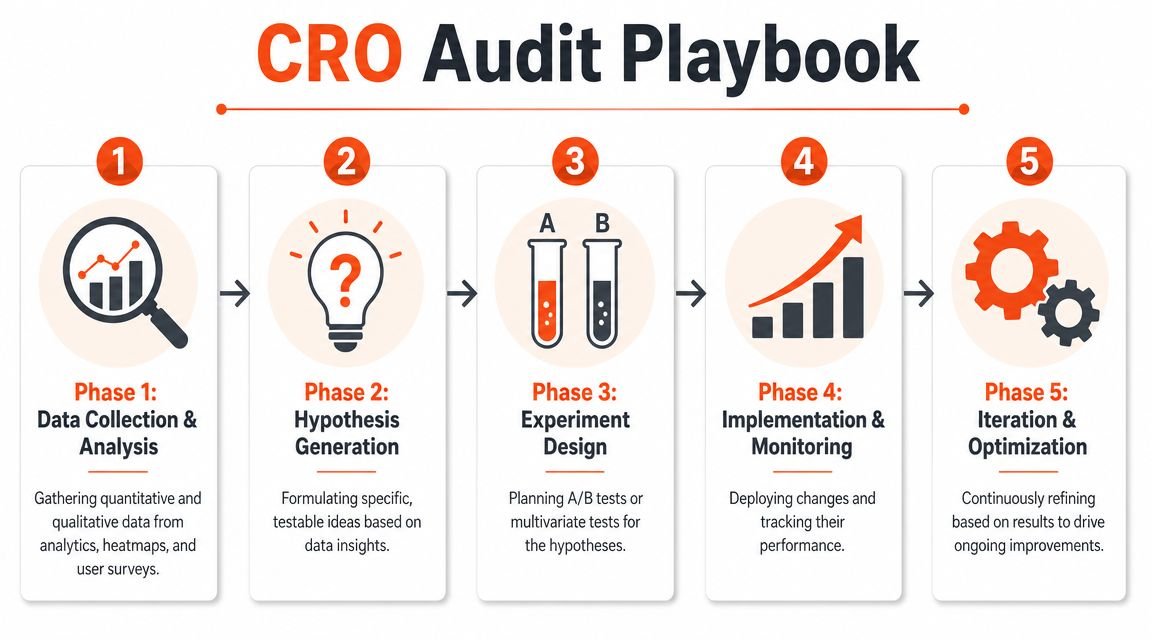
A proper audit starts by mapping the funnel. For a lead generation site, that usually means:
- Landing page visit
- Scroll or engagement
- CTA click
- Form start
- Form submission or call click
For e-commerce, the path shifts toward product view, cart, checkout start, and purchase completion. The principle stays the same. Identify the exact step where users disappear.
If you’re unsure whether your setup is reliable, start with this guide to setting up Google Analytics 4 correctly.
What a serious audit actually looks at
Most business owners look at bounce rate and stop there. That’s not enough. Bounce rate tells you that someone left. It doesn’t tell you why.
A serious audit looks at behavior in layers:
| Audit layer | What it shows | Why it matters |
|---|---|---|
| Analytics events | Funnel drop-off points | Shows where leads are lost |
| Heatmaps | Click and scroll behavior | Reveals ignored CTAs and distraction points |
| Session recordings | Real user actions | Exposes hesitation, confusion, and dead clicks |
| Form analysis | Field-level friction | Shows where users quit before submitting |
| Source segmentation | Differences by channel | Separates SEO, Ads, mobile, and local traffic behavior |
When the data is clean, the page tells you what’s broken.
DIY efforts typically fall short. Owners jump straight to solutions before they isolate the problem. They shorten a form when the issue is weak trust. They redesign a page when the issue is slow mobile interaction. They blame ad traffic when the issue is page mismatch.
What gets prioritized first
The best fixes usually aren’t the flashiest ones. They’re the changes most likely to remove friction fast.
Typical high-priority items include:
- Form simplification when lead forms ask for information too early
- CTA placement when the action step is buried or diluted
- Mobile cleanup when local traffic struggles on smaller screens
- Checkout or inquiry flow reduction when too many steps create drop-off
- Message alignment when ad copy and landing page copy don’t match
You don’t need guesses. You need a ranked list of problems, supported by evidence, with a clear path to implementation.
Fix the Foundation Technical & UX Dealbreakers
A prospect in Miami finds your business on their phone, taps through, and waits. The page loads slowly, the buttons are cramped, the menu takes over the screen, and the contact form asks for too much. They’re gone.
That wasn’t a branding issue. It was a conversion failure.
Mobile friction kills local intent
Site performance and mobile experience are core constraints on conversion. Guidance on landing page optimization consistently recommends prioritizing page speed, mobile-friendliness, and removing unnecessary distractions so users get the shortest possible path to action, as outlined in this technical CRO guide.
For local businesses, this matters even more. A person searching for a lawyer, contractor, med spa, restaurant, or repair company isn’t browsing casually. They’re trying to decide quickly. If your site makes that hard on mobile, you lose them before your sales process even starts.
Recent guidance on mobile friction also emphasizes practical issues beyond speed alone. Responsive layouts, simplified mobile navigation, better tap targets, and testing on real devices matter because many losses happen through awkward interactions, not just slow load times.
Use tools like those covered in this resource on website speed optimization tools to catch the issues users feel before they complain.
Clean up forms and remove escape routes
Many websites sabotage their own lead generation by asking for too much too soon.
If you’re a local service company and the user only needs to request a call, don’t make them complete a mini application. If you’re running Google Ads to a specific offer, don’t send people into a full website navigation maze.
The highest-friction elements are usually obvious once you look for them:
- Oversized menus: They pull visitors away from the conversion path.
- Sidebars and extra links: They create competing decisions.
- Bloated forms: Each extra field gives users another reason to quit.
- Unclear progress: Users won’t continue if they don’t know what comes next.
- Weak mobile controls: Small buttons and poor spacing kill completion.
A conversion page should feel easy to use on a phone with one thumb.
This is why foundational fixes come first. There’s no point pushing harder on SEO, Local SEO, or PPC if the destination page is technically working against you. Better traffic sent to a weak experience just wastes money faster.
What to fix before you redesign
A lot of businesses reach for a redesign because it feels decisive. That’s often the expensive way to avoid real diagnosis.
Start here instead:
- Check speed and stability
- Test the full path on mobile
- Trim forms to essential fields
- Remove navigation clutter from conversion pages
- Make the CTA obvious without searching
These aren’t cosmetic improvements. They’re the baseline requirements for any site that expects to generate leads consistently.
Turn Clicks into Clients with High-Impact Landing Pages
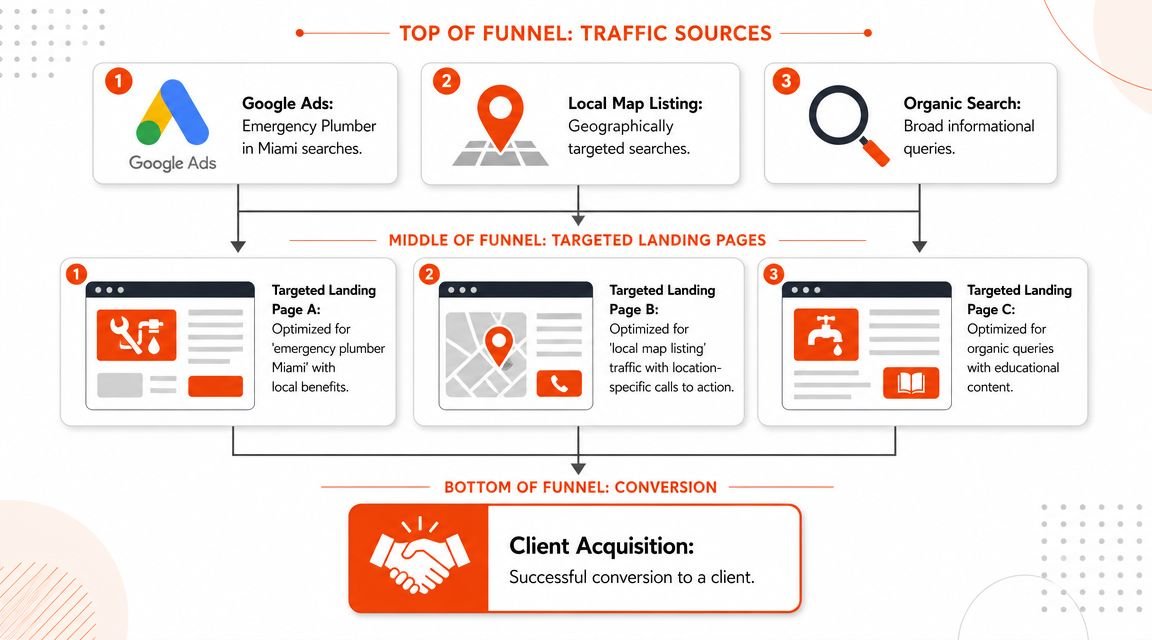
A person clicks a Google Ad for “emergency plumber in Miami.” They expect urgency, local relevance, trust, and one obvious next step. Instead, they land on a generic homepage with six services, a slider, a menu full of distractions, and copy that could apply to any business in any city.
That click was wasted.
Why the homepage keeps failing
The homepage isn’t built for every traffic source. It shouldn’t be.
Someone from a Google Ads campaign has different intent than someone discovering you through branded search, a Google Business Profile, or a broader organic result. A strong conversion strategy sends each audience to a page built for that intent.
That page should continue the conversation started in the ad or search result. Same problem. Same promise. Same location context. Same next step.
For stores and product-focused brands, many of the same lessons show up in strong eCommerce product page conversion strategies. The principle stays consistent across lead gen and e-commerce. Focus the page, remove friction, and support the buying decision where it happens.
A dedicated lead generation website does this far better than a general-purpose site.
What a conversion page needs to do
Landing page structure has an outsized impact. Pages with fewer than 10 elements can achieve about 2x higher conversion rates, customer reviews can increase conversions by up to 270%, and personalized CTAs can convert 202% better than generic ones, according to this landing page statistics roundup.
That tells you what matters. Simplicity. Trust. Relevance.
Here’s what a high-impact landing page should include:
- A headline that matches intent: If the ad says “Miami emergency plumber,” the page should say it too.
- A clear promise: Explain what problem you solve and why someone should contact you now.
- Visible trust signals: Reviews, testimonials, and credibility cues belong near action points.
- One primary CTA: Call now, request a quote, book a consultation. Pick one.
- No unnecessary navigation: A landing page is not a directory.
This breakdown shows the difference visually and strategically.
A before and after reality
Before optimization, the click lands on a generic page. The visitor scans, hesitates, and leaves.
After optimization, the visitor sees a headline that mirrors their search, local proof that the company serves their area, a short form or click-to-call button, and supporting trust where hesitation usually appears. The path is cleaner, the decision is easier, and the lead is more likely to happen.
That’s how to improve website conversion rates without pretending every visitor wants the same page.
Prove It or Lose It A/B Testing and Personalization
A prospect clicks your ad, reaches the page, hesitates, and leaves. Your team says the headline is fine. The designer wants a cleaner layout. Sales blames lead quality. None of that matters until the page is tested under real traffic.
A/B testing settles the argument. Google explains the core method in its A/B testing guide for Google Optimize users. You create a controlled variation, split traffic, measure one conversion goal, and keep the version that produces more leads. That is how serious CRO work gets done.
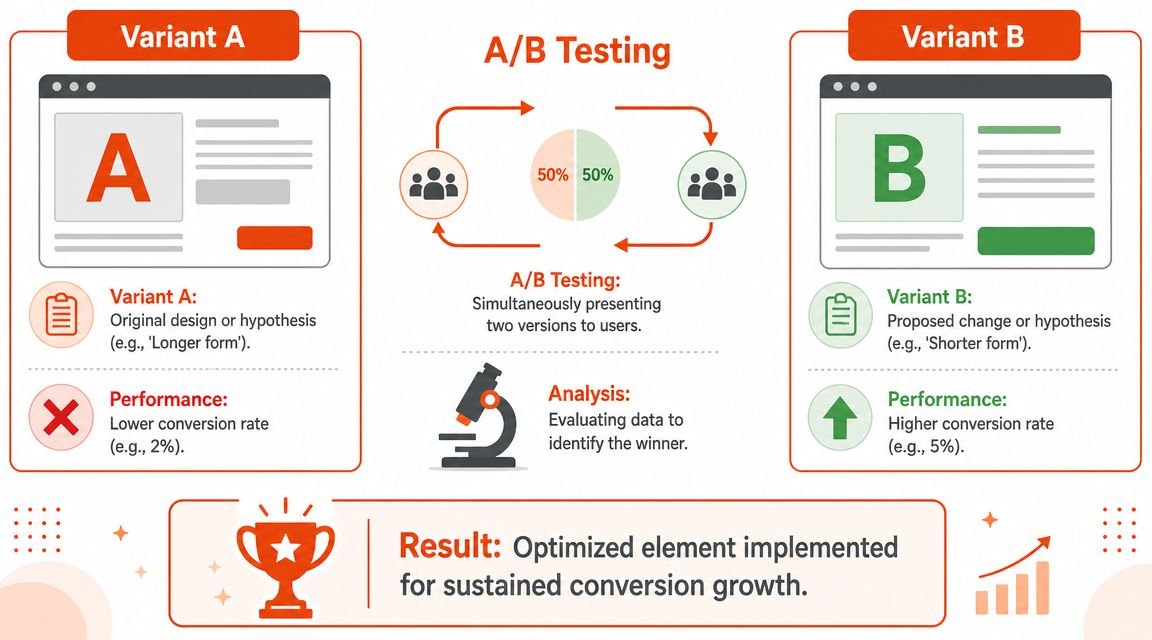
The mistake companies make is treating testing like a side project. Someone changes a button color, watches results for three days, then declares a winner. That is not optimization. That is random editing with a dashboard open.
A testing program needs control and sequence:
- One meaningful hypothesis per test: Change a single decision point, such as the headline, CTA, form length, or proof near the form.
- One primary conversion goal: Use booked calls, qualified form fills, or demo requests. Pick the action that affects revenue.
- Enough traffic and time: Early calls create false winners and bad rollouts.
- A recorded baseline: You need a starting conversion rate, traffic source mix, and lead quality benchmark before changing anything.
- Post-test implementation: A winning variant only matters if it gets deployed across the right pages and campaigns.
What should you test first? Start where hesitation happens.
If visitors bounce fast, test the headline and opening message. If they scroll but do not act, test the CTA, trust placement, or form friction. If paid traffic converts poorly while branded or referral traffic performs better, test message match between keyword, ad, and page. That is the work of turning visitors into customers. It is not one trick. It is a managed system.
Personalization matters too, but only after the basics are under control. A first-time visitor from local search needs direct proof, local relevance, and a low-friction next step. A return visitor from a follow-up campaign needs stronger offer framing and a shorter path to contact. That is why we pair page testing with channel strategy, including retargeting campaigns in digital marketing for warm traffic that did not convert on the first visit.
This is also where DIY CRO usually breaks down. Business owners can run isolated tests. They usually cannot connect search intent, ad traffic, landing page behavior, CRM outcomes, and lead quality into one decision-making process. Our agency does. We test with full-funnel context, keep weak ideas from wasting budget, and turn CRO into an operating process that improves lead volume and sales efficiency over time.
Without that process, every website change is still a guess. Guesses cost money.
Why Our Agency Approach Delivers More Leads
Most businesses don’t fail because they lack effort. They fail because their marketing is fragmented.
The SEO provider chases rankings. The PPC freelancer drives clicks. The website developer focuses on pages. Nobody owns the full journey from search to conversion. That split is exactly why performance stalls.
Disconnected vendors create disconnected results
A conversion problem rarely belongs to one channel.
If Google Ads traffic doesn’t convert, the issue might be keyword intent, landing page mismatch, mobile friction, offer clarity, tracking gaps, or weak trust on the page. If local SEO traffic lands but doesn’t call, the problem may be page structure, CTA placement, or relevance to the original search.
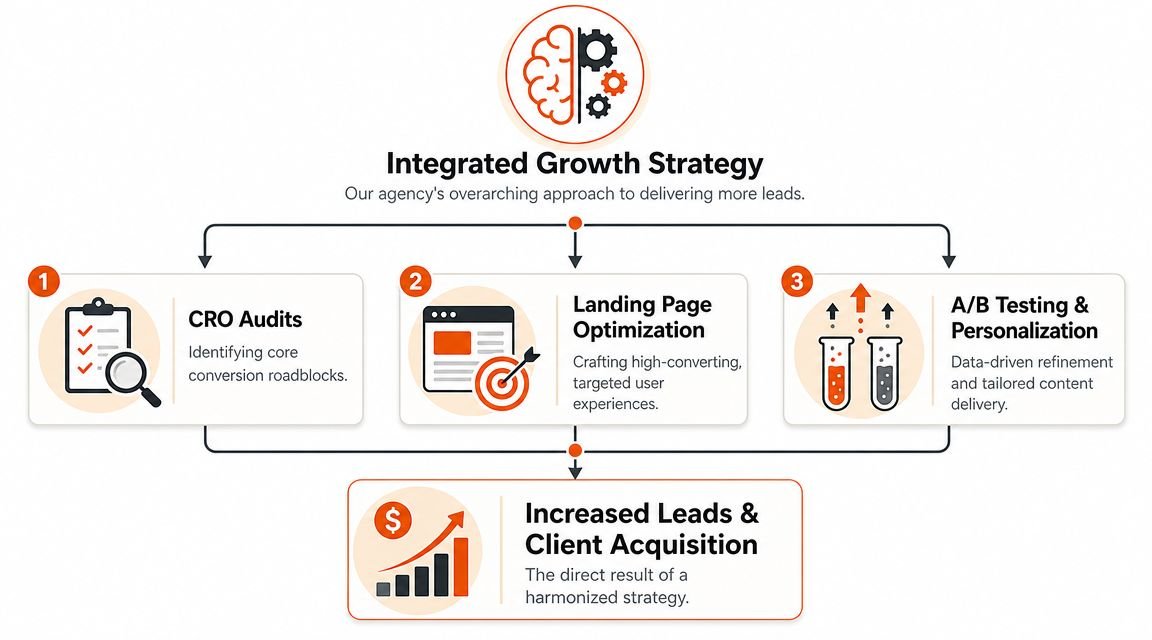
An integrated approach fixes this because the channels inform each other. The same system that improves landing page conversion also improves paid traffic efficiency and helps organic traffic produce more leads.
What a proper engagement should include
If you’re comparing agencies, don’t settle for broad promises. Ask what gets tracked, what gets fixed, how changes are prioritized, and how results are reviewed.
A serious engagement should include:
Complete audit and diagnosis
Funnel review, conversion tracking validation, page-level friction analysis, and traffic source alignment.Technical and UX corrections
Mobile issues, speed constraints, form friction, CTA visibility, and landing page cleanup.Dedicated landing page strategy
Pages built around service intent, local relevance, and ad-to-page message match.Ongoing testing
A/B testing for headlines, forms, offers, and trust placement, with measured rollouts.Channel coordination
SEO, Local SEO, Google Ads, and Meta Ads managed as one growth system instead of separate tasks.Clear communication
Reporting that explains what changed, why it changed, and what should happen next.
The objection most owners get wrong
“Can I do this myself?” is the wrong question.
The question is whether you have the time, tools, tracking accuracy, testing discipline, copy skill, landing page strategy, and channel coordination to do it well while running the business. Most don’t. That’s not a weakness. It’s reality.
The other objection is cost. Cost matters. But so does waste. If you’re already paying for traffic, every month you delay fixing conversion issues is another month of buying clicks that don’t turn into revenue.
A weak system keeps taking your budget. A strong system helps every marketing dollar work harder.
Frequently Asked Questions About Conversion Optimization
Is this worth it if I already run SEO or Google Ads
Yes. In fact, it’s more urgent.
SEO and Google Ads bring visitors in. Conversion optimization makes those visitors count. If you already pay for traffic or invest in search visibility, then every missed action is a known inefficiency. You’re already spending. CRO helps you get more from what you’re already doing.
Can I handle CRO myself
You can handle pieces of it. Most businesses do. They change copy, test a form, or install analytics.
What usually breaks down is consistency. Tracking isn’t fully configured, tests aren’t controlled, landing pages aren’t aligned with traffic intent, and no one reviews enough behavioral data to spot patterns. If you want a useful outside perspective on the broader process of turning visitors into customers, that resource is a solid companion read. But execution is where most internal efforts stall.
How long does it take to see progress
That depends on what’s broken and how much traffic the site gets.
Some fixes show up quickly. A cleaner form, a stronger CTA, or a better mobile experience can improve performance fast. A/B testing takes longer because you need enough data to validate a winner. The important point is this. A measured process beats random changes every time.
What if I think I need a redesign
Maybe. But don’t assume that first.
Independent guidance has noted that copy and image changes alone can improve conversion rates without a full redesign. If the structure is usable and the core offer is sound, a disciplined CRO process often produces gains before a rebuild becomes necessary.
What should I ask before hiring an agency
Ask direct questions:
- How do you track conversions and funnel drop-off?
- Do you review session behavior, not just dashboard metrics?
- Will you build dedicated landing pages for campaigns?
- How do you decide what to test first?
- Who owns implementation across SEO, Ads, and on-page conversion work?
If the answers are vague, keep looking.
If your website gets traffic but doesn’t produce enough calls, leads, or sales, it’s already costing you money. VIP TECH CONSULTING helps businesses fix the full system behind conversion problems, from SEO and Google Ads to landing pages, speed, tracking, and ongoing optimization. If you’re ready to stop leaking leads and start turning more visitors into customers, book a strategy session now.