
If your phone isn't ringing and your contact form is collecting dust, your problem usually isn't demand. It's visibility, targeting, and conversion.
That's why local business marketing services shouldn't be sold to you as a random bundle of SEO tasks, ad clicks, and monthly reports. They should function as one thing: a customer acquisition system that turns local search intent into calls, booked appointments, walk-ins, and sales.
Most agencies get this wrong. They talk about impressions, content calendars, and “brand awareness” while you're trying to figure out why a competitor across town keeps showing up first on Google and taking customers that should've found you. If you're evaluating providers right now, you don't need more activity. You need a system that can be measured, improved, and tied to revenue.
Table of Contents
- Are Your Competitors Stealing Your Customers on Google
- The Core Components of a Local Lead Generation System
- Our Proven Process for Predictable Growth
- What to Expect What's Included and Typical Pricing
- How We Measure Success KPIs That Matter
- Your Vendor Selection Checklist
- Miami Case Studies and Your Next Step
Are Your Competitors Stealing Your Customers on Google
A prospect in Miami searches for the exact service you offer. They're ready to call. They're comparing options. Your competitor appears in the map pack, has better reviews, a tighter Google Business Profile, and a page built for that service and location. They get the call. You get nothing.
That isn't a one-off event. It happens every day.
80% of U.S. consumers search online for local businesses weekly, 32% search daily, and nearly half of Google searches are local in intent, according to BrightLocal's local SEO statistics. If your business isn't visible for “near me” or service plus city searches, you're not losing abstract traffic. You're losing buyers.
Why this keeps happening
Many local businesses still rely on referrals, an outdated website, a neglected Google Business Profile, or broad ad campaigns with weak targeting. That creates a gap between demand and discovery.
Your competitors fill that gap by doing the basics better:
- They show up locally: Their business listings are accurate, complete, and active.
- They target buying intent: Their pages match what people search for.
- They remove friction: Their phone number, hours, offer, and proof are easy to find.
- They build trust fast: Reviews, location relevance, and strong ad copy make the decision easier.
Practical rule: If a customer can't find you in the moment they need you, your marketing isn't underperforming. It's failing at the most important step.
This is why “waiting to see what happens” is expensive. Local visibility compounds. So does invisibility.
If you already suspect your rankings, ads, or Google Business Profile are leaking leads, stop guessing and request a free local SEO audit in Miami. You need to know where you're losing demand before you spend another dollar.
The Core Components of a Local Lead Generation System
A real local acquisition system has to do four jobs in sequence. Get found. Get trusted. Get the click. Get the call.
Anything less is fragmented marketing.
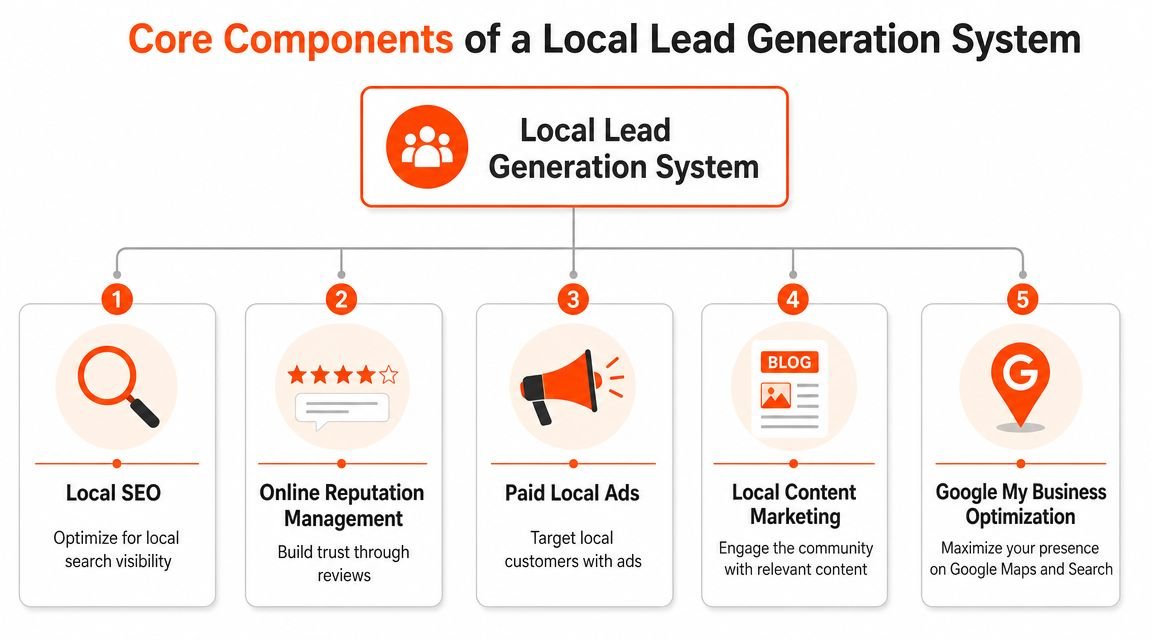
Visibility comes first
Local search and paid media work best when they're built around immediate intent. A widely cited service-business benchmark says 88% of searches for local services result in a call or visit within 24 hours, as summarized by SLT Creative's service business marketing statistics. That's why speed and relevance matter more than vanity reach.
Here are the core pillars.
Local SEO and Google Business Profile dominance
This is your demand capture layer.
When someone searches for a service in your city, Google decides which businesses are relevant, nearby, credible, and worth showing. Local SEO shapes that decision through service pages, location pages, internal linking, structured business details, category relevance, review signals, and map visibility.
A neglected profile or thin local page doesn't just hurt rankings. It lowers trust before a prospect even clicks.
Hyper-targeted paid ads
SEO builds durable visibility. Google Ads and Meta Ads give you immediate control over demand.
Used correctly, paid campaigns let you target by geography, service intent, demographics, and audience behavior. Used badly, they burn money on broad keywords, weak copy, and landing pages that don't convert.
The right paid strategy doesn't “boost awareness.” It puts your offer in front of local buyers who are already close to action.
Trust and conversion finish the job
A click doesn't mean much if the user hesitates after landing on your site.
That's where reputation management and conversion-focused assets come in.
- Reputation management: Reviews, responses, and visible local proof reduce buyer hesitation.
- Landing page clarity: Every service page should answer what you do, where you do it, and how to contact you.
- Mobile-first conversion paths: Tap-to-call buttons, short forms, trust cues, and clear offers matter because local buyers often decide fast.
- Message match: The ad, listing, and landing page should feel like one continuous experience.
A lot of businesses don't have a lead problem. They have a follow-through problem between search impression and phone call.
A local campaign only works when every piece supports the next one. That's also why website performance can't be treated separately from lead generation. If you want a site that supports rankings and converts traffic into inquiries, review what makes a lead generation website actually produce business outcomes.
Our Proven Process for Predictable Growth
Most local campaigns fail because they start with tactics. Good campaigns start with diagnosis.
A predictable system has to answer basic business questions before a single optimization is made. Which services matter most. Which locations matter most. Which competitors are taking visibility. Where leads are dropping off. Which channels are creating real opportunities instead of noise.
We start by finding what is broken
Our process begins with a deep audit and competitive review.
That includes your Google Business Profile, local rankings, search presence, landing pages, existing ad account structure, conversion paths, and review profile. We also look at who keeps outranking you in your target market and why they're winning.
Then we build a roadmap around commercial intent, not random tasks. That means prioritizing the service pages, local queries, and ad groups most likely to produce calls and form submissions.
This is the point where many businesses realize they've been paying for disconnected activity. Blog posts with no local intent. ad campaigns with no conversion tracking. SEO reports full of ranking movement for terms that don't bring customers.
Then we build accountability into the campaign
Once the priorities are clear, implementation gets aggressive.
That usually includes on-page local SEO fixes, Google Business Profile improvements, location-specific content, search campaign restructuring, ad copy testing, landing page revisions, call tracking setup, and CRM or GA4 alignment. One option businesses often evaluate for this kind of work is VIP TECH CONSULTING's Google Ads campaign management services, alongside other providers that can handle paid search, local SEO, and conversion tracking in one workflow.
What matters is not who posts the most updates. It's who can connect strategy to execution without losing momentum.
A serious process also includes regular optimization. Search terms shift. Competitors react. Offer positioning needs testing. Landing pages need refinement. If your agency “sets it and forgets it,” you're paying for drift.
Good local marketing feels disciplined. Every change has a reason, every report answers a business question, and every month should produce clearer decision-making.
What to Expect What's Included and Typical Pricing
You shouldn't have to decode an agency proposal to understand what you're buying. If the scope is vague, the accountability will be vague too.
The SBA's guidance is clear that effective local marketing works best as a portfolio approach, combining tactics such as listing management, nearby social targeting, directories, referrals, and event-based promotion instead of relying on one channel alone, as outlined by the U.S. Small Business Administration's local marketing strategies. That matters because a real service package isn't an upsell. It's the minimum structure required to compete.
What a serious local marketing program includes
Here's a practical view of what should be included.
| Service Area | Core Deliverables |
|---|---|
| Local SEO | Service page optimization, location page strategy, internal linking, on-page improvements, map pack targeting |
| Google Business Profile | Category refinement, business description updates, service optimization, photo strategy, posting guidance, Q&A and profile completion |
| Google Ads | Campaign build or rebuild, keyword targeting, ad copy testing, conversion tracking, search term review, bid adjustments |
| Meta Ads | Local audience targeting, creative testing, lead form or landing page campaigns, retargeting setup |
| Reputation management | Review request process, review response guidance, local trust signal improvements |
| Reporting and analysis | Monthly reporting, call and lead review, ranking snapshots, campaign recommendations |
You should also expect:
- Clear communication cadence: Regular check-ins, not silence followed by a PDF.
- Defined deliverables: What gets done monthly should be easy to verify.
- Conversion focus: Calls, forms, bookings, and qualified leads should stay central.
- Channel coordination: SEO, ads, and landing pages should support each other.
How pricing usually works
Most local business marketing services are priced as a monthly retainer because rankings, ads, and conversion optimization need ongoing work. Some providers also offer project-based work for audits, setup, landing page creation, or account rebuilds.
What you should pay attention to isn't the cheapest quote. It's whether the scope matches your goals. A low retainer that excludes tracking, page updates, ad management, and local optimization usually becomes expensive fast because it doesn't move the numbers that matter.
If you want clarity on scope before you commit, get a personalized estimate instead of comparing generic packages. Get a custom quote based on your market, service mix, and lead goals.
How We Measure Success KPIs That Matter
Most agencies report what's easy to show. Impressions. Reach. Clicks. Maybe rankings without context.
Business owners need a different scoreboard.
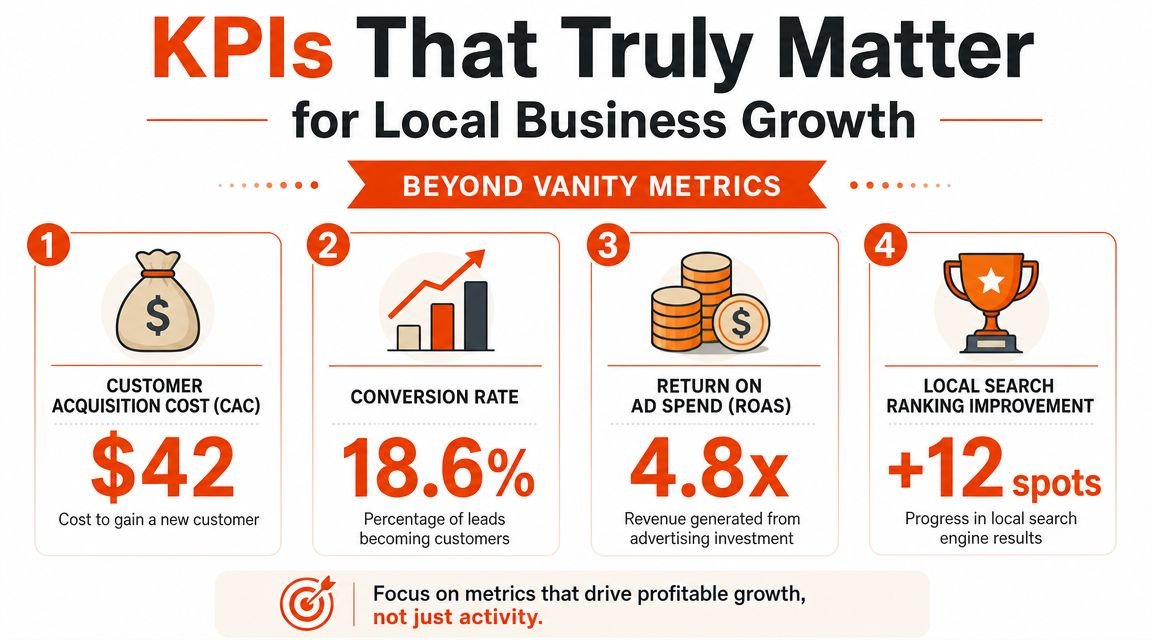
The numbers that deserve your attention
The most useful local KPIs are location-qualified intent signals. Rio SEO's guidance emphasizes tracking Google Business Profile direction requests, phone calls, website clicks, and local search impressions, then segmenting them by radius and channel to see whether visibility is driving actual customer action, not just traffic, as explained in Rio SEO's local marketing metrics guide.
That's the standard.
For a local service business, the most important questions are straightforward:
- Are qualified phone calls increasing
- Are contact form submissions improving
- Are direction requests rising from the right areas
- Are high-intent service pages producing leads
- Are ads generating inquiries at an acceptable acquisition cost
How we connect marketing to revenue
Instrumentation, therefore, matters.
Call tracking tells you which campaigns drive phone leads. GA4 tracks forms, calls, and key page actions. CRM tagging helps you separate booked opportunities from junk leads. Radius-based analysis tells you whether nearby searches convert differently from people farther away.
If your current reporting stops at traffic charts, you're missing the part that informs budget decisions. A practical next step is making sure your analytics are configured to track real business actions, not just page views. This GA4 setup guide for meaningful conversion tracking is a good benchmark for what should already be in place.
Traffic without conversion data is just motion. You can't optimize spend if you can't see what produced the lead.
Your Vendor Selection Checklist
Choosing an agency badly can cost you more than doing nothing. At least doing nothing doesn't come with invoices and vague explanations.
A weak provider usually sounds polished in the sales call and fuzzy in the details. That's why you need a checklist.
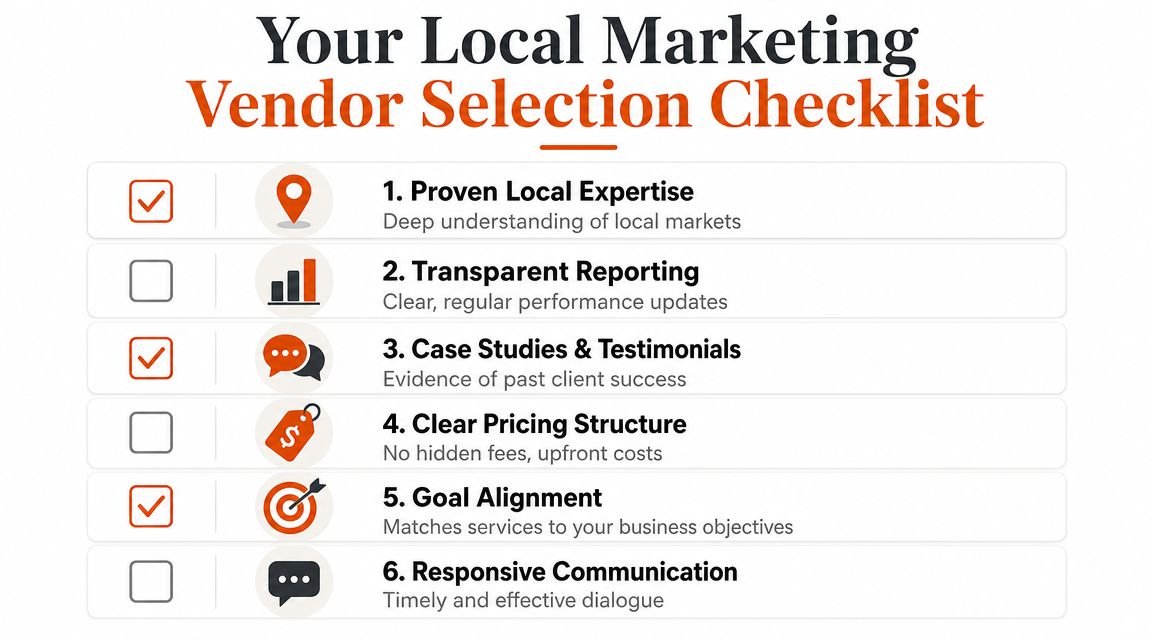
Questions that expose weak agencies fast
Ask these before signing anything:
- How do you track leads, not just traffic: If they can't explain calls, forms, attribution, and reporting clearly, walk away.
- What will you optimize first: Serious teams can identify likely bottlenecks quickly.
- How often will strategy be reviewed: Monthly reporting without strategic interpretation isn't enough.
- What happens if leads go up but close rates don't: Good agencies understand that marketing and sales friction can both affect outcomes.
- Who does the work: You need to know whether execution is in-house, outsourced, or split.
- How do you handle local intent across SEO and ads: If they treat channels separately, expect disconnected results.
This resource on how to choose a digital marketing agency is useful if you want a sharper framework for comparing proposals.
A short video can also help you spot common mistakes before you hire:
Can you do this yourself
You can handle parts of it yourself. Many owners do.
You can update your Google Business Profile, ask for reviews, respond to leads faster, and improve some basic website messaging. But if you're in a competitive market, DIY usually stalls when you need coordinated execution across SEO, Google Ads, Meta Ads, landing pages, tracking, and ongoing optimization.
The better question isn't “can I do it myself?” It's “should I be the one debugging campaign structure, tracking issues, and map pack visibility while also running the business?”
Hire for the pieces that require technical precision and constant attention. Keep ownership of the offer, the sales process, and the customer experience.
Miami Case Studies and Your Next Step
Local business owners in Miami usually don't need another theory session. They need proof that the right system can fix weak lead flow, poor visibility, and wasted ad spend.

Here's what that often looks like in practice.
A Coral Gables law firm comes in with a familiar problem. Their website exists, but key service pages don't align with high-intent local searches. Their Google Business Profile is under-optimized. Their paid campaigns send traffic to generic pages. The result is predictable: weak lead quality, inconsistent calls, and no confidence in where budget should go. The fix isn't one tactic. It's rebuilding the local acquisition path from search query to consultation request.
A Wynwood restaurant faces a different issue. People know the brand locally, but online discovery is messy. Search visibility is uneven, map engagement underperforms, and paid social pushes attention without enough conversion intent. In that case, the priority becomes location relevance, review strength, local content alignment, and ad creative tied to specific actions such as reservations, calls, or menu views.
A home service company in Miami-Dade often sees another pattern. They're spending on ads, but the campaign is too broad, the landing experience is weak on mobile, and there's no clean tracking between search terms, calls, and booked jobs. Once geo-targeting, message match, and conversion tracking improve, the business finally sees which neighborhoods, services, and campaigns are worth scaling.
What these examples show
The common thread is simple. Businesses don't need more marketing pieces. They need a tighter system.
That system should do four things well:
- Capture intent: Show up when local buyers are ready to act.
- Build trust quickly: Reviews, relevance, and clear offers reduce hesitation.
- Convert efficiently: The site, ad, and profile should make contacting you easy.
- Report clearly: You should know what drove the lead and what needs fixing.
If your current provider can't explain your acquisition system in those terms, you're paying for disconnected work.
Miami is too competitive for passive marketing. Every week you delay, another business gets the calls, consultations, and customers your campaign should be capturing.
If you want a direct assessment of where your local lead generation is breaking down, book a strategy session with VIP TECH CONSULTING. We'll review your visibility, ads, conversion path, and tracking so you can make a clear decision about what to fix next.