
If your Miami business is getting traffic but not getting calls, form fills, or booked consultations, your website isn't doing its job. It's not a branding asset. It's a failed sales tool.
That matters even more if you're paying for SEO, Local SEO, Google Ads, or Meta Ads. Every click you buy or earn lands on the same place. If that place is slow, vague, cluttered, or hard to trust, your campaigns underperform before your sales team even has a chance.
Lead generation website design isn't about making a prettier homepage. It's about building the conversion engine behind your rankings, your ad spend, and your local visibility. If you already know you need help, the right move is to fix the website and the acquisition strategy together, not in pieces.
If you want a second set of eyes on why your site isn't converting, stop guessing and book a strategy conversation now.
Table of Contents
- Your Website Is Leaking Money Every Day
- Stop Designing Pages Start Engineering Journeys
- Building the Conversion Machine Layouts Copy and CTAs
- Why Visitors Trust You and Google Ranks You
- Turning Interest Into Action with Smart Forms
- The Logical Next Step for Your Miami Business
Your Website Is Leaking Money Every Day
A lot of Miami business owners have the same complaint. The site looks fine, the agency says traffic is coming in, but the phone isn't ringing enough and the leads that do show up are inconsistent.
That's a website problem, not just a traffic problem.
According to 2024 B2B website conversion benchmark data, the median user conversion rate is 2.5%. Put plainly, roughly 97.5% of visitors don't convert on a given visit. If your site is average, many visitors depart. If your site is below average, your SEO and PPC investment bleeds out even faster.
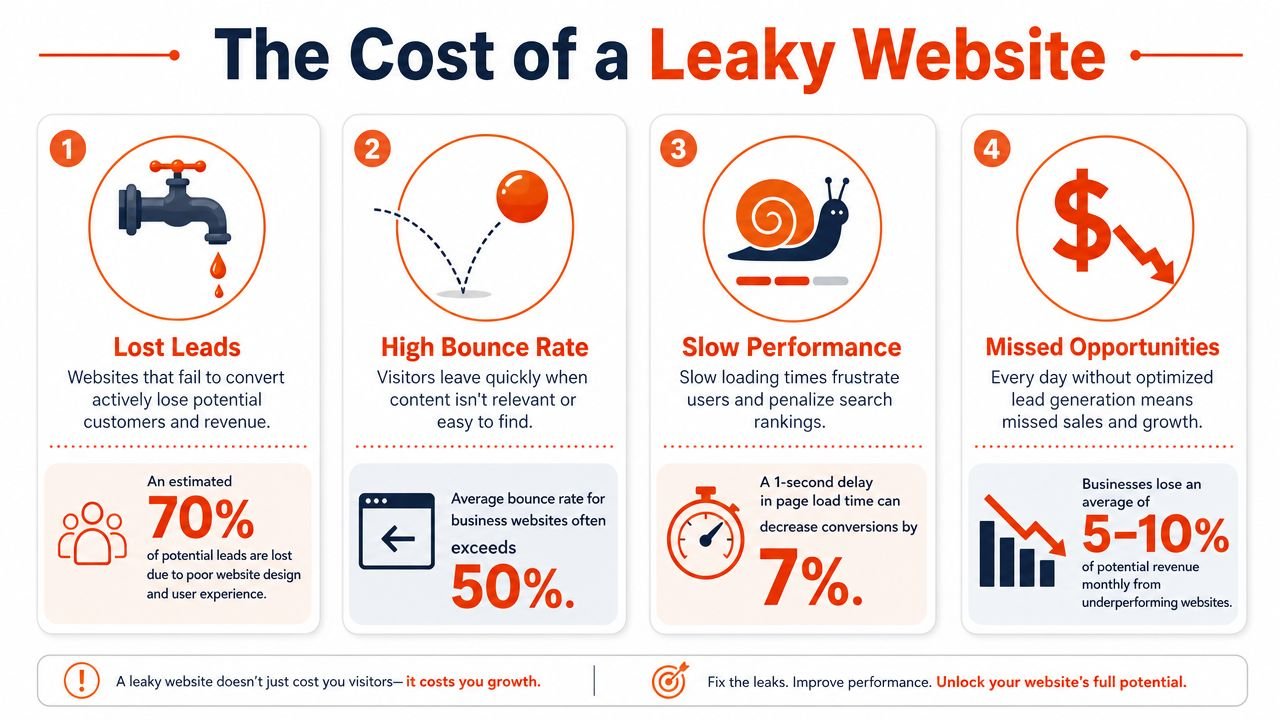
Traffic without action is wasted spend
If you're running Google Ads for a local service, every click has intent behind it. Somebody searched because they need something. But when they land on a page that buries the offer, loads slowly, or asks them to work too hard, they leave.
That same leak hurts organic traffic too. You can rank in Miami. You can show up for “near me” searches. You can even get map visibility. None of that fixes a weak conversion path.
Here's the practical test:
- Can a visitor tell what you do immediately
- Can they see why they should trust you
- Can they take action without hunting for the next step
- Can they do all of that on mobile
If the answer is no, your website is turning marketing into waste.
Practical rule: Don't judge your website by how it looks in a boardroom. Judge it by whether a busy prospect can act on it in seconds.
What this looks like in a Miami business
A law firm gets local search traffic but sends everyone to a generic homepage. A med spa runs Meta Ads to a page with three different offers. A contractor buys high-intent Google Ads clicks and then asks visitors to fill out a long, confusing form on mobile.
Those aren't design preferences. Those are conversion failures.
Before you redesign anything, fix the basics that block action first. Start with performance. A slow site makes every other improvement weaker. If that's already an issue on your site, review these website loading speed improvements for lead generation pages.
If your website isn't producing leads now, waiting won't solve it. Miami is competitive, and your competitors don't need a better logo to beat you. They just need a clearer path to conversion.
Stop Designing Pages Start Engineering Journeys
Most websites are built like brochures. They talk about the company, list services, add a contact page, and hope people figure out the rest.
That approach fails because visitors don't all arrive with the same intent. Someone who clicks a Google Ads ad for “emergency AC repair Miami” needs a different page experience than someone who finds your business through a blog post or a map listing.
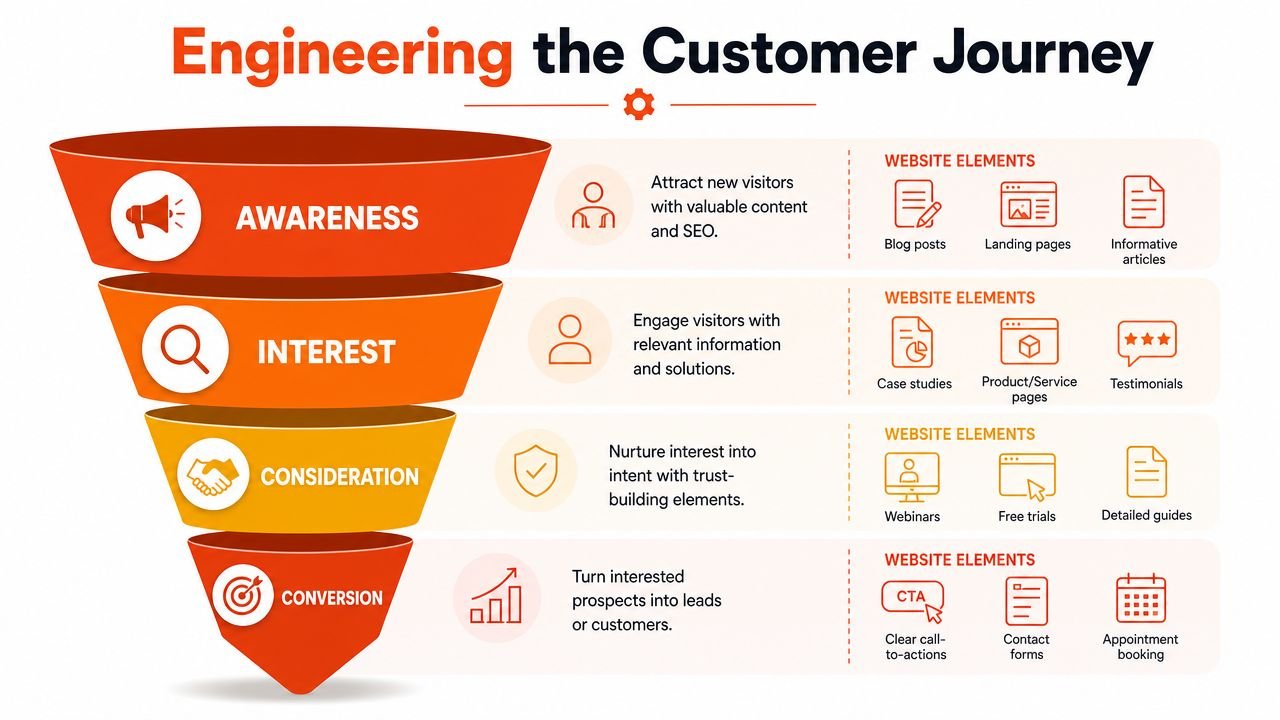
A brochure site loses intent
A brochure site treats every visitor the same. That's lazy strategy.
Strong lead generation website design maps pages to intent. A top-of-funnel visitor may need education. A middle-of-funnel visitor may need service detail and credibility. A bottom-of-funnel visitor may need one thing only, a fast way to call, request a quote, or book.
Expert guidance from New Breed on lead generation website essentials recommends at least one conversion point per funnel stage, including a bottom-of-funnel CTA in the main navigation for visitors ready to act immediately.
That matters for local SEO and PPC because not every click lands on your homepage. Many of your service pages are entry pages. Many of your ad landing pages should be built for one audience, one problem, and one next step.
What a real conversion journey looks like
Take a Miami service business that offers multiple services in multiple neighborhoods. The wrong move is sending all traffic to one broad page and calling that “web design.”
The right move is to build a journey like this:
| Visitor source | What they need first | Best page type | Best next action |
|---|---|---|---|
| Local SEO search | Local relevance and trust | City or service page | Call or request quote |
| Google Ads click | Message match and urgency | Dedicated landing page | Book consultation |
| Meta Ads click | Clear problem-solution framing | Focused campaign page | Claim offer or submit form |
| Research-driven traffic | Education and credibility | Content or service explainer | Download guide or contact |
That's how you stop wasting traffic.
A page should match the reason the visitor clicked in the first place. If the click promised one thing and the page delivers something broader, conversion drops.
For businesses reviewing their current site structure, it helps to get outside feedback before rebuilding. This guide on website design feedback and conversion issues is a useful gut check.
A serious agency doesn't just design pages. It engineers decision paths. That's the difference between a site that gets compliments and a site that feeds your pipeline.
Building the Conversion Machine Layouts Copy and CTAs
The highest-value part of a page is the part people see first. If the top of the page is weak, the rest often doesn't matter.
Too many businesses waste that space on vague branding lines, oversized sliders, or generic welcome copy. That kills momentum fast, especially for local search and PPC visitors who clicked because they wanted a direct answer.
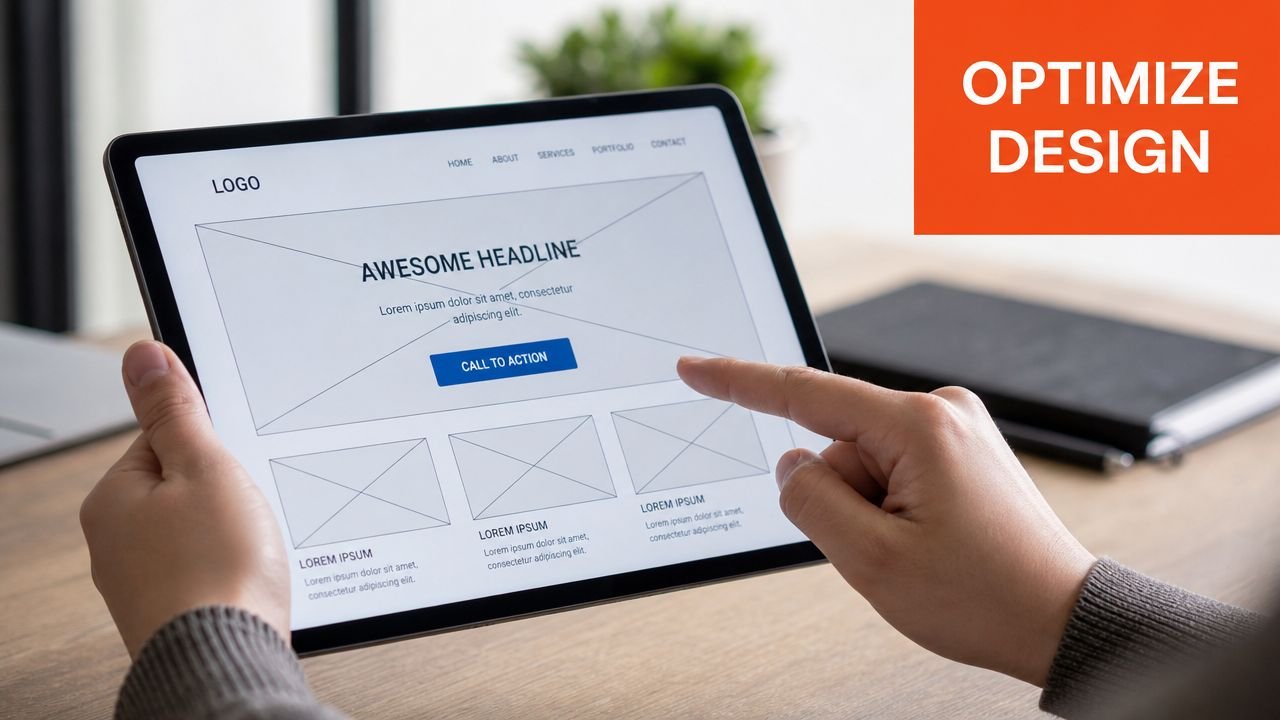
What the top of the page must do immediately
A conversion-focused page should tell the visitor four things near the top:
- What you do
- Who it's for
- Why you're credible
- What to do next
That's why the one offer, one action principle matters. Unbounce's landing page guidance for lead generation recommends keeping the page focused on a single offer and a single desired action, without competing CTAs or cluttered navigation.
Here's the difference in real terms.
| Weak version | Stronger version |
|---|---|
| “Welcome to our website” | “Miami PPC Management for Local Businesses That Need More Qualified Leads” |
| “Learn More” | “Request Your Campaign Review” |
| “We provide innovative solutions” | “Get SEO and Google Ads built to drive calls, quote requests, and booked appointments” |
The stronger version wins because it removes guesswork.
Strong CTAs beat clever CTAs
Don't ask visitors to decode your button copy. If you want a consultation, say that. If you want a quote request, say that. If the page is built for calls, make the call action obvious.
Use CTA language that matches buyer intent:
- For urgent services use direct action like “Call Now” or “Request Service”
- For considered purchases use “Book a Consultation” or “Request a Proposal”
- For local SEO pages use “Get a Free Local Visibility Review” if that is the appropriate next step
- For ad landing pages match the promise in the ad, not a generic site-wide CTA
A lot of business owners obsess over colors and layout tweaks while ignoring the core issue. The copy is soft, the offer is buried, and the CTA asks for too much commitment too early.
For a deeper look at message match on paid traffic, Keywordme's guide to PPC landing pages is worth reviewing.
This walkthrough also shows the mechanics behind stronger page structure and CTA decisions:
Why paid traffic fails on weak landing pages
Google Ads and Meta Ads don't fail only because of targeting. They fail because the landing page doesn't close the gap between click and action.
If the ad says one thing and the page says five things, you create friction. If the page forces users to scroll too far to find the form, you create friction. If the page sends them into a full website menu maze, you create friction.
Keep each campaign page narrow, specific, and aligned to one buyer problem.
If you're already driving traffic and want to improve results before spending more, start with these website conversion rate improvements for service pages and landing pages.
One page. One promise. One CTA. That's not simplistic. It's disciplined.
Why Visitors Trust You and Google Ranks You
Businesses often separate SEO from conversion. Google rankings are one project. trust is another. The website sits in the middle and gets treated like a container.
That's a mistake.
Search visibility and conversion performance reinforce each other because they both depend on usability, clarity, and credibility. If your site is hard to use on mobile, slow to load, and light on trust signals, you create two problems at once. You weaken user confidence and make your acquisition efforts less effective.
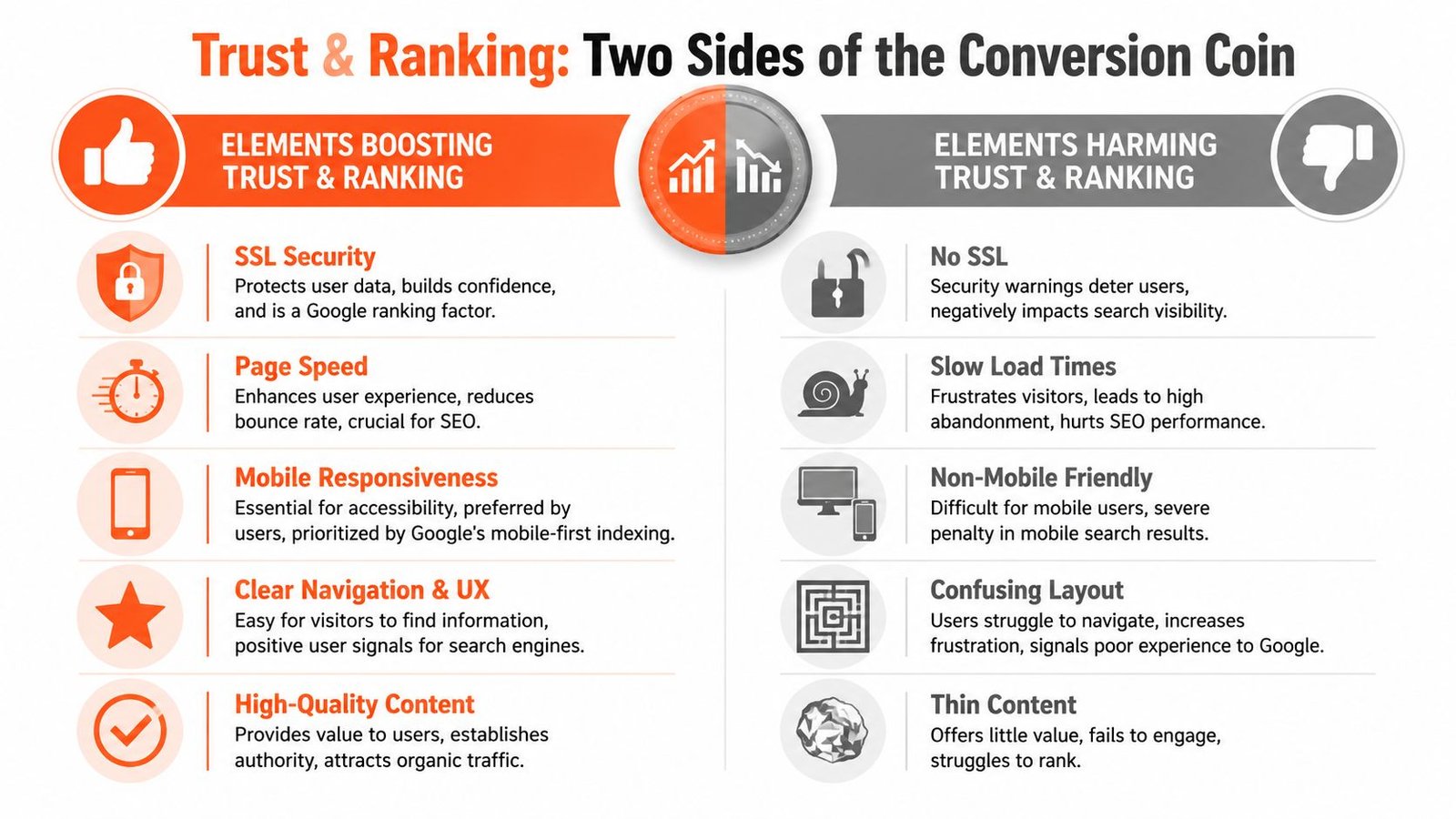
Speed and mobile usability are trust signals
A benchmark cited by Ironpaper's web design statistics roundup found that 62% of companies reported increased sales after designing their websites for mobile platforms.
That's not a design trend. It's a business signal.
For Miami SMBs, mobile matters because local searches often happen in motion. People are comparing providers, checking reviews, and deciding quickly. If your mobile layout hides the CTA, squeezes the text, or makes the form painful, visitors don't “come back later.” They choose someone else.
Here's a simple breakdown:
- Fast pages reduce hesitation
- Mobile-friendly layouts reduce friction
- Clear navigation lowers confusion
- Reliable page structure supports both SEO and paid traffic quality
Proof belongs near the decision point
Trust signals only help when people see them.
A testimonial buried on a separate page won't do much. The same goes for certifications, awards, reviews, and client logos that sit far below the fold or live in a hidden corner of the site. Credibility works best when it appears next to the claim it supports and close to the CTA it should strengthen.
Use trust elements where they matter most:
- Near the hero section with recognizable proof points
- Beside forms to lower risk at the moment of submission
- Inside service pages so search visitors don't need to click around
- With real visuals instead of generic stock photos
Orbit Media's guidance, cited in the verified material behind this brief, also recommends using real people and supportive visuals rather than generic stock imagery. That's the right call. Local businesses especially need to look real, not templated.
If your site says “trusted by clients across Miami,” prove it on the same screen.
Authority matters in search too. If your business depends on local visibility, this overview of E-E-A-T in Local SEO for Miami businesses is worth reading because it connects trust, expertise, and local search performance in practical terms.
A good website doesn't ask visitors to believe you. It shows them enough evidence that contacting you feels safe.
Turning Interest Into Action with Smart Forms
A lot of businesses lose the lead at the last step. The visitor clicks the CTA, sees the form, then disappears.
That usually happens for one of two reasons. The form creates too much friction, or it does too little to protect lead quality.
The smarter question isn't only how to get more submissions. As Optuno's lead generation website article argues, modern lead generation design must balance conversion friction against lead validation. The right goal is to convert high-intent prospects without increasing spam or wasting sales time.
Short forms are not always better
Yes, some businesses ask for too much. But “make the form shorter” isn't a complete strategy.
A good form asks for what your sales process needs. Nothing extra. Nothing vague.
That usually means:
- Use essential fields first like name, contact info, and the key qualifying detail
- Label fields clearly so users don't have to guess what belongs where
- Match the form to the offer because a quote request should not look like a newsletter signup
- Route leads properly so urgent inquiries don't sit in a general inbox
For a Miami law firm, a short consultation request form may be right. For a B2B service with a higher-consideration sale, one or two qualifying questions can save time and filter out poor-fit inquiries.
Use micro conversions when the sales cycle is longer
Not every visitor is ready to book a call today. That doesn't mean they have no value.
Micro conversions give you another way to capture intent without forcing a hard sales action too early. Depending on the business, that can include:
- Guide downloads for research-stage visitors
- Service comparison pages with a follow-up CTA
- Newsletter or update opt-ins when trust needs more time
- Click-to-call actions for mobile users who prefer direct contact
A lot of agencies stay too shallow. They focus on submission volume and ignore what happens after the click. Lead quality, routing, qualification, and follow-up all belong in the website strategy.
If your current site makes it easy for the wrong people to convert and hard for the right people to act, the form isn't helping. It's hurting.
The Logical Next Step for Your Miami Business
A Miami business owner runs Google Ads, shows up in local search, pays for traffic, and still gets weak lead flow because the website cannot close the job. That is the problem to fix next.
Your website has to work as the conversion engine behind every channel you invest in. Local SEO brings in map and organic visitors. PPC brings in high-intent clicks fast. If both channels send people to a slow, generic, poorly structured site, you do not have a traffic problem. You have a conversion problem.
That is why the next step is not picking colors, approving mockups, or arguing about fonts. The next step is building a site system that supports search visibility, paid traffic, accurate tracking, and lead quality at the same time.
VIP TECH CONSULTING is one example of a provider built around that model. The company handles WordPress and Shopify development, SEO, Local SEO, Google Ads, Meta Ads, reputation support, and ongoing website optimization under one strategy instead of splitting traffic, design, and reporting across disconnected vendors.
What a serious lead generation build should include
If you are comparing agencies, ask how the site will help your rankings, improve ad performance, and increase qualified inquiries. If they cannot answer that clearly, keep looking.
A lead generation website design engagement should include:
- Page strategy built around search intent and campaign intent so local service pages, organic entry pages, and paid landing pages each have a clear job
- Dedicated landing pages for PPC traffic so Google Ads and Meta Ads clicks do not get dumped onto broad service pages
- Mobile-first conversion decisions such as stronger CTA placement, cleaner layouts, faster page experience, and easier tap targets
- Proof placed near decision points including reviews, service credibility, local relevance, and outcome-focused messaging
- Tracking for real business actions so calls, form submissions, booked appointments, and other qualified leads are visible
- Ongoing testing after launch because lead generation improves through iteration, not one-time design work
A website that supports Local SEO should also reinforce location relevance, service clarity, and internal page structure. A website that supports PPC should match ad intent, remove friction, and make the next action obvious. One site has to do both well, or you end up paying for clicks your pages are not built to convert.
If your reporting is still unclear, start with this guide on setting up Google Analytics 4 to track better website decisions. You need clean attribution before you can improve cost per lead.
The common objections and the honest answer
Can you do this yourself?
Only if you have time to rewrite service pages, tighten your offer, improve mobile UX, build landing pages, connect tracking, and manage SEO and paid traffic together. Most owners do not. They should not.
Is it worth it?
Yes, if you are already spending money on SEO, Local SEO, Google Ads, or Meta Ads. Better conversion performance usually produces more return than sending more traffic to a weak site.
How long does it take?
Long enough to do the strategy, messaging, build, and tracking correctly. Short enough that you stop losing leads to a site that is underperforming right now.
Should you rebuild everything?
No. Some Miami businesses need a full rebuild. Others need new landing pages, tighter service-page copy, cleaner conversion paths, and better measurement. A good agency should know the difference quickly.
Miami is crowded. Your competitors are buying clicks, targeting the same local searches, and competing for the same buyers. If your website still acts like an online brochure, you are helping them win.