
If your firm is still treating marketing like a mix of referrals, occasional ads, and a website that “should be doing better,” you’re leaving high-value cases on the table. The problem usually isn’t effort. It’s fragmentation.
Law firm lead generation only becomes predictable when search visibility, paid traffic, intake, follow-up, and reputation work as one system. Most firms don’t have that. They have disconnected vendors, no real attribution, slow response times, and a pipeline full of poor-fit inquiries.
That’s fixable. If you want more signed cases, better-fit matters, and a growth plan that doesn’t depend on luck, you need a playbook built around visibility, speed, and conversion.
If you already know your current setup is leaking leads, start by reviewing what a proper lead generation website for service businesses should do.
Table of Contents
- Your Next High-Value Case Is Searching Online Right Now
- Dominate Local Search and Become the Obvious Choice
- Drive Immediate Inquiries with Targeted Google Ads
- Turn Clicks Into Clients with a Conversion-Focused System
- Manage Your Online Reputation and Nurture Referrals
- Track Your ROI and Invest for Predictable Growth
Your Next High-Value Case Is Searching Online Right Now
A partner looks at the monthly numbers and sees the same pattern again. Some weeks the phones are active. Some weeks they’re quiet. One referral source slows down and the pipeline gets shaky.
That’s not a growth strategy. That’s dependency.
The firms taking better cases consistently aren’t waiting around for word of mouth to save the month. They show up when someone searches for help in their city, on their phone, with urgency and intent. And that behavior isn’t marginal. 96% of potential clients start with a search engine when looking for an attorney, according to these legal marketing statistics.
The old referral-first mindset is too slow
Referrals still matter. But they’re no longer enough to carry a modern firm that wants controlled growth.
A prospect can hear about your firm from a friend, then search your name. Another prospect has never heard of you and searches “personal injury lawyer near me” or “employment attorney Miami.” In both cases, the decision path is digital. If your firm doesn’t appear convincingly, your competitor gets the call.
Practical rule: If your firm isn’t visible at the moment of search, you’re not in the buying conversation.
That’s the mistake many firms make. They think of SEO, Google Ads, reviews, intake, and follow-up as separate projects. They aren’t. They’re parts of one revenue system.
What firms get wrong about visibility
Most law firm marketing fails for one of three reasons:
- They chase random tactics: one month it’s blog posts, the next month it’s paid ads, then a redesign, with no connection between efforts.
- They optimize for activity, not signed cases: traffic looks fine, but consultations don’t increase or the wrong people keep filling out forms.
- They ignore the buyer journey: a prospect doesn’t just need to find you. They need to trust you, contact you, and hear back fast.
Here’s the situation. Your next valuable case probably won’t begin with a handshake at a networking event. It will begin with a search, a map result, a paid ad, a review, or a practice area page that answers the exact question the prospect is already typing.
Firms that understand this stop asking, “Which marketing tactic should we try?” They start asking, “How do we build a system that reliably turns searches into consultations?”
That’s the right question.
Dominate Local Search and Become the Obvious Choice
A prospect searches for “car accident lawyer near me,” sees three firms in the map results, compares reviews, clicks one profile, and calls. If your firm is not in that short list, your website quality does not matter. You were eliminated before the visit.
Local search decides who gets considered.
For law firms, SEO is not a branding exercise. It is how you earn placement at the exact moment a high-intent prospect is choosing who to contact. Done right, it supports the entire acquisition system. Strong local rankings lower your dependence on paid traffic, improve lead quality, and give your intake team more qualified conversations to work.
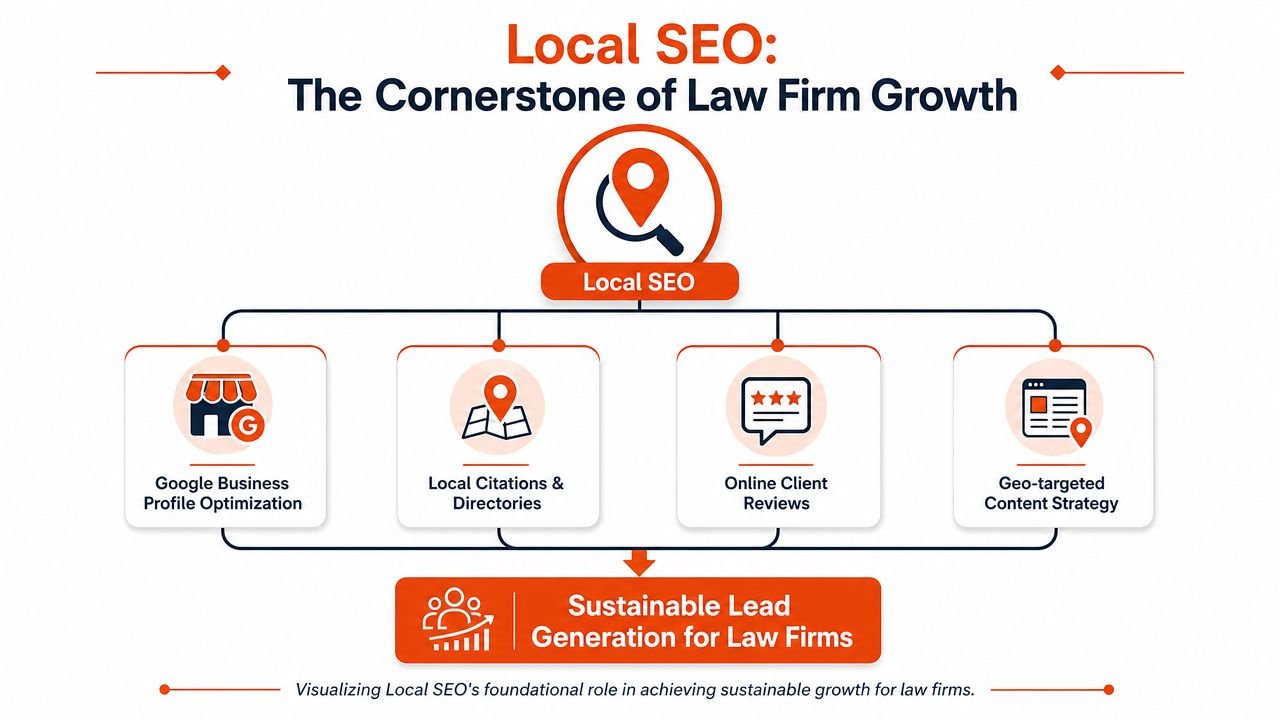
Serious firms treat local search as infrastructure. They build visibility in the map pack, create pages that match buyer intent, and make sure every trust signal supports the click. That is how SEO, reviews, and conversion performance start working together instead of operating as separate projects.
Win the Map Pack first
Google Business Profile deserves executive attention. It often gets the first click, and in many cases it gets the call without a website visit.
Set it up like an acquisition asset:
- Define your services clearly: List the practice areas you want to sign, not a vague description of the firm.
- Keep NAP data consistent: Your name, address, and phone number should match across your website and core legal directories.
- Generate reviews continuously: A stale review profile weakens trust. A steady flow of recent reviews improves click-through and pre-qualifies prospects.
- Use real photos and regular updates: Prospects make fast judgments about credibility and professionalism.
If you need a repeatable process, use this local SEO checklist for local businesses across every office, service area, and priority practice.
Build pages around case intent
Many firms sabotage local SEO with generic site structure. One broad “Personal Injury” page will not carry an entire market. One “Family Law” page will not rank well or convert well for the searches that produce consultations.
Build pages around the way prospects search when they are close to hiring. That usually means a service plus a city, county, or neighborhood. It also means addressing the issue directly. DUI defense, child custody modification, wrongful termination, and truck accident claims each deserve their own page when they matter to your pipeline.
Use this standard:
| Approach | What happens |
|---|---|
| Generic service page | Weak relevance, weaker conversions, little differentiation |
| Practice-area-specific local page | Better alignment with search intent and stronger consultation rates |
| Thin city page stuffed with keywords | Poor user experience and low trust |
| Useful city + service page | Higher relevance, better engagement, clearer path to contact |
A good local page does three jobs at once. It signals relevance to Google, answers the prospect’s immediate questions, and gives intake a better lead because the visitor already understands what the firm handles.
Publish content that removes doubt
Legal buyers do not need a lecture. They need clarity.
The best local SEO content answers the questions that block action: Do I have a case? What should I do next? How long will this take? What mistakes should I avoid before speaking to a lawyer? That kind of content brings in search traffic, but, beyond that, it reduces hesitation and improves conversion rates from the traffic you already have.
Write for decision-stage readers, not for other marketers. If a page cannot help a prospect decide whether to call, it does not belong in your lead generation plan.
Treat local SEO as part of the full revenue system
Many firms make a critical error. They invest in rankings, then ignore what happens after the click. That breaks the system.
Your local SEO pages should reflect the same practice area priorities as your ad campaigns. Your review strategy should strengthen both map pack performance and conversion rates. Your CRM should show which locations, services, and page types produce signed cases, not just form fills. Once those pieces connect, local search stops being a vanity channel and starts becoming a predictable source of high-value opportunities.
Drive Immediate Inquiries with Targeted Google Ads
SEO builds an asset. Google Ads creates speed.
If you need consultations this week, paid search is the fastest way to get in front of people already looking for legal help. But most law firm campaigns are badly built. They target broad keywords, write bland ads, send traffic to the homepage, and wonder why the budget disappears.
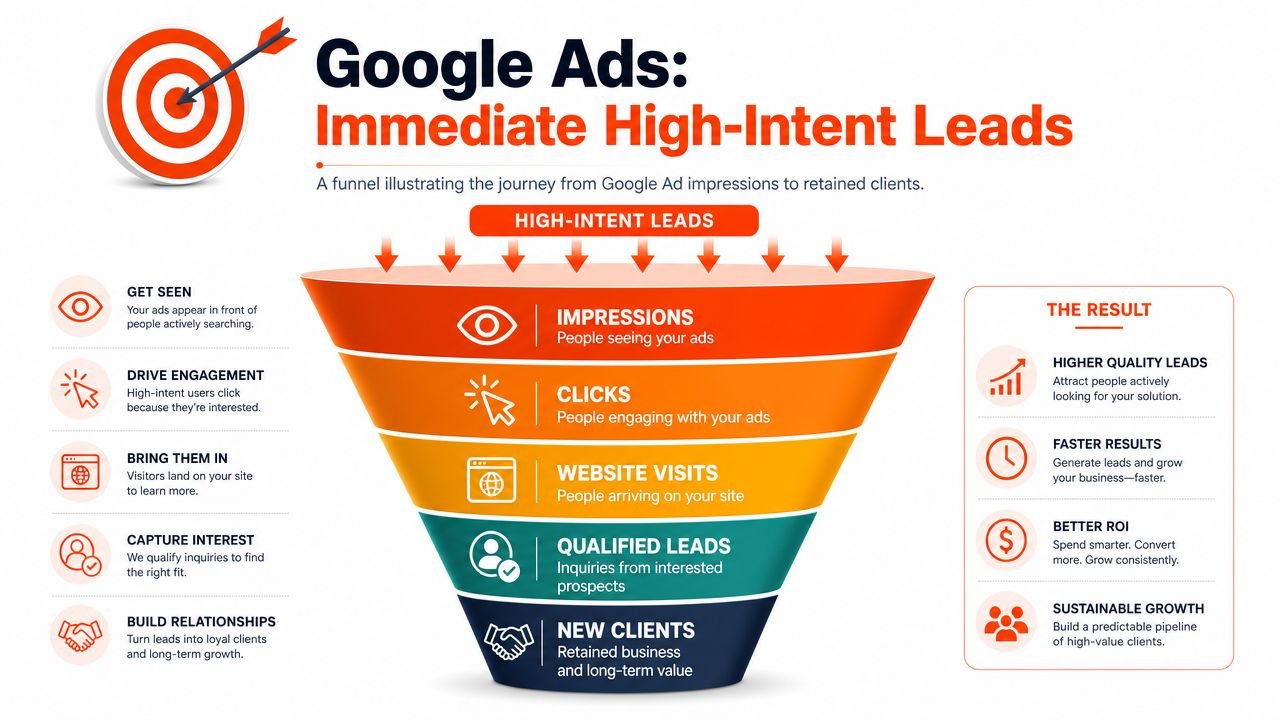
Bad campaigns buy traffic, good campaigns buy qualified conversations
A weak campaign says, “We do legal services. Contact us today.”
A strong campaign is narrow. It targets a specific practice area, a specific geography, and a specific search intent. It routes that click to a page built only for that service. The ad copy speaks to urgency, relevance, and trust. The landing page removes friction.
That difference matters because one of the most overlooked questions in legal marketing is whether firms should optimize for more leads or better-fit leads. Much of the advice online stays at the tactic level and doesn’t address lead quality, intake friction, or the cost of poor-fit inquiries, as noted in this analysis of lead generation for lawyers.
Filter aggressively or pay for the wrong clicks
Law firms waste paid search budget when they refuse to exclude junk intent.
You should be actively filtering out searches tied to education, jobs, definitions, free templates, unrelated legal issues, and locations you don’t serve. You also need campaign structure that separates practice areas instead of lumping everything into one ad group.
A tighter account usually includes:
- Service-specific campaigns: Separate matters by practice area.
- Location control: Focus spend where your firm can serve and close.
- Negative keywords: Stop paying for curiosity clicks and irrelevant searches.
- Call-first extensions and assets: Make it easy for high-intent users to contact you immediately.
If you’re running local campaigns, sharpen your geographic precision with smarter Google Ads location targeting for local lead generation.
A quick visual helps if you’re reviewing your own funnel:
Use landing pages that match the search
Homepage traffic is rarely qualified traffic.
When someone searches for a specific legal problem, the landing page should continue that exact conversation. Same issue. Same geography. Same next step. No confusion.
Include the essentials:
- A headline tied to the search
- Proof of competence
- A short form or call option above the fold
- Clear explanation of what happens next
- Reassurance for hesitant prospects
Mid-funnel prospects often need a second touch before they convert, so remarketing also belongs in the mix. Not because it’s flashy, but because legal buyers often compare firms before they decide.
If your Google Ads account is producing clicks but not consultations, get an expert review before spending another month guessing. A campaign audit usually reveals the waste fast.
Turn Clicks Into Clients with a Conversion-Focused System
Traffic is not the win. A signed client is the win.
A lot of firms assume the hardest part is getting the click. It isn’t. The harder part is converting that click into a real inquiry, responding fast, and following up like a business that wants the case.
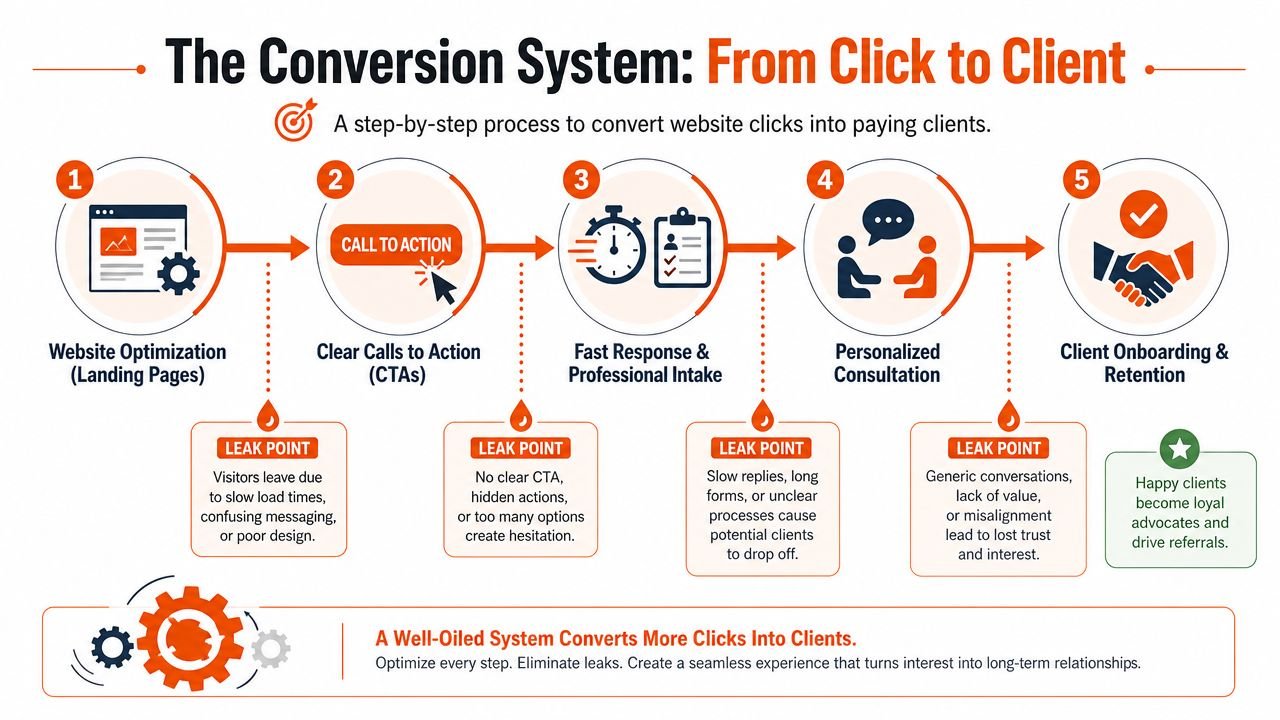
Your website must make the next step obvious
Many law firm websites are polished but passive. They talk about the firm, list awards, and bury the contact options.
A conversion-focused site does the opposite. It reduces decision friction and makes action easy.
That means:
- Prominent calls to action: Call, form, consultation request, and mobile-friendly contact options should be impossible to miss.
- Practice-area relevance: Each page should speak to one legal problem and one audience.
- Trust signals: Reviews, attorney bios, process clarity, and professional design reduce hesitation.
- Landing page discipline: Paid traffic should not get dumped into a general page.
If your site gets visitors but not enough inquiries, review these website conversion rate improvements for lead generation pages and fix the obvious friction points first.
Speed and follow-up decide who signs
At this stage, most firms lose the lead.
One industry roundup reports that 79% of prospects hire the first helpful responder and 42% of leads arrive outside business hours, which is why after-hours coverage matters. You can review that in these law firm lead generation statistics.
The operational gap is just as serious in intake response. A 2025 study found 25% of law firms responded to online leads in under 5 minutes, up from 13% four years earlier. It also found 56% responded within an hour, while 39% took more than 2 hours or did not respond at all. The same study says 87% use a call as their primary response method and 67% use email. Firms using intake CRM software convert 47% more leads than firms tracking manually or not at all, according to the 2025 lead form response time study.
Operational truth: A firm that responds quickly with a real intake process beats a firm with better branding but slower follow-up.
CRM discipline beats manual intake
Busy attorneys don’t consistently run follow-up. They intend to. Then hearings, client work, and inbox chaos take over.
Your process should be automated and persistent. Capture every inquiry. Trigger an immediate acknowledgment. Assign the lead. Start call, text, and email follow-up quickly. Keep tracking every touch.
A practical workflow looks like this:
- Lead captured: form, call, chat, or ad lead enters the CRM immediately.
- Instant acknowledgment: the prospect knows the firm received the inquiry.
- Rapid human outreach: intake calls while intent is still high.
- Multi-channel follow-up: phone, text, and email continue until the prospect responds or is disqualified.
- Disposition tracking: every lead gets marked clearly so ad and SEO decisions improve over time.
Firms that want to tighten this part of the funnel should study resources on optimizing law firm client intake, especially if missed calls and after-hours inquiries are common.
Manage Your Online Reputation and Nurture Referrals
Good lead generation gets the click. Reputation gets the yes.
When a prospect finds your firm through search or ads, they usually don’t convert in a vacuum. They check reviews, scan your Google profile, compare your credibility to other firms, and look for reasons to trust you quickly. That makes reputation management part of conversion, not just brand image.
Reviews are conversion insurance
A firm with weak or stale reviews creates doubt. A firm with consistent, recent, specific feedback feels safer.
You don’t need a complicated reputation program. You need a repeatable one:
- Ask at the right moment: Request reviews when the client outcome or experience is still fresh.
- Make it easy: Send a direct review link and simple instructions.
- Respond professionally: Thank clients and show future prospects that your firm is attentive.
- Monitor patterns: Reviews often reveal friction in communication, intake, or expectations.
If you want to see what strong reputation strategy looks like in practice, study these online reputation management examples for service businesses.
A review profile should do one job well. Remove doubt before the prospect contacts the firm.
Referrals work better when you systemize them
Most firms say referrals are important. Very few treat them like a channel.
A referral network works best when you define who can send aligned matters, stay visible with those partners, and make the handoff simple. Financial planners, accountants, therapists, real estate professionals, physicians, and other attorneys can all be valuable depending on your practice areas.
Keep it disciplined:
- Choose fit over volume: A small number of relevant partners beats a large list of vague contacts.
- Stay top of mind: Share useful updates and remain easy to reach.
- Close the loop: When appropriate, acknowledge referred matters and keep the relationship active.
- Support your digital presence: Referrals often validate you online before they recommend you offline.
A healthy law firm lead generation system doesn’t force you to choose between search and referrals. It uses search to create demand and reputation to help close it.
Track Your ROI and Invest for Predictable Growth
A partner reviews the monthly marketing report and sees more traffic, more calls, and more form fills. Three months later, revenue is flat. That happens when a firm measures channel activity instead of signed cases.
The standard is simple. Every dollar should be tied to retained matters, practice area by practice area, channel by channel.

Measure signed cases, not marketing vanity
Set up a clear chain of accountability from first click to signed engagement.
Track source. Track qualification. Track consult booked. Track consult attended. Track retained client. Once you can see that path, weak points stop hiding behind inflated lead counts.
These are the numbers that matter:
| Metric | What it tells you |
|---|---|
| Cost per lead | How expensive it is to generate an inquiry |
| Cost per signed case | How much you spend to acquire an actual client |
| Lead-to-client conversion | Whether intake and follow-up are producing retained matters |
| ROI | Whether the channel should keep or gain budget |
If your agency reports impressions, clicks, and call volume without tying them to signed cases, they are describing activity. They are not helping you control growth.
Budget decisions improve when the math reflects reality
Realism matters at this stage.
Martindale-Avvo’s survey of 1,557 new law-firm clients found an average of 13.4 leads to produce one new client, while Alanet cites a 5% to 15% conversion range for consumer attorneys. You can review both benchmarks in Martindale-Avvo’s analysis of how many leads it takes to get a client.
That should reset your budget assumptions. A firm expecting a small batch of inconsistent inquiries to produce steady signed cases is underfunding the system. Predictable growth requires enough lead volume, the right case mix, and an intake process that does not let qualified prospects drift away.
Follow-up belongs in the same ROI conversation. If SEO drives strong traffic but intake responds late, SEO looks weaker than it is. If PPC generates consultations but the CRM is not tracking retention by source, paid search can look more expensive than it is. Firms that win connect SEO, Google Ads, intake speed, follow-up cadence, and CRM reporting into one operating system.
What a serious growth partner should show you
A capable growth partner should be able to answer five questions without slides, jargon, or excuses:
- Which channels are producing qualified leads
- Which practice areas produce the best return
- Where prospects are dropping out before they retain
- How intake speed and follow-up affect acquisition cost
- What budget should increase, what should be cut, and why
That level of visibility changes how you invest. You stop treating SEO, PPC, and CRM as separate vendors or separate decisions. You start managing one system built to produce high-value cases at a cost you can defend.
If your firm wants a clearer path to better cases, faster response systems, and measurable growth, talk to VIP TECH CONSULTING. They help service businesses build conversion-focused websites, improve local search visibility, run targeted Google Ads, and turn more traffic into real inquiries. Book a strategy session and get a direct assessment of where your current lead generation system is leaking revenue.