
If you’re a law firm partner watching competitors show up in Facebook feeds while your own campaigns produce weak leads, missed calls, or nothing at all, the problem usually isn’t the platform. It’s the system behind it. Most firms either boost posts, run generic lead forms, or hand the account to someone who knows Ads Manager but doesn’t understand legal intake, compliance risk, or how signed cases happen.
That’s why law firm Facebook ads need to be treated as a client acquisition process, not a media buy. The firms that win on Meta don’t just launch ads. They choose the right case types, build compliant campaigns, route clicks to focused landing pages, and follow up fast enough to turn interest into consultations.
If that’s the gap in your current marketing, keep reading. You’ll see where most campaigns break, what a working system looks like, and when it makes sense to bring in a team that can manage the full process.
Table of Contents
- Why Your Competitors Are Winning Cases on Facebook
- Define Your Client Acquisition Strategy Before Spending a Dollar
- Attract High-Value Clients Without Triggering Ad Rejections
- Turn Clicks Into Consultations with a Post-Click System
- A Realistic Look at Law Firm Ad Budgets and ROI
- Your Next Step to Predictable Growth
Why Your Competitors Are Winning Cases on Facebook
A familiar pattern plays out in law firms every month. Someone boosts a post, launches a generic “Contact Us” campaign, or hires a cheap freelancer to get ads live quickly. The campaign gets clicks. A few leads come in. Then the intake team says the leads are poor, follow-up is inconsistent, and nobody can tell which matters turned into consultations.
Meanwhile, a competing firm keeps showing up in the feed with sharper messaging, cleaner pages, and a tighter intake handoff. They aren’t necessarily using a secret tactic. They’re just treating Facebook as part of a complete acquisition system.
The hard truth is that most advice around law firm Facebook ads stops too early. Existing guidance often says Facebook ads are worth the investment, but it rarely answers the question firms need to know: which case types fit interruption-based social ads, and what filtering has to happen afterward so staff time isn’t wasted on low-intent inquiries, as noted in MyCase’s discussion of Facebook advertising for lawyers.
Most failed campaigns don’t fail because nobody clicked. They fail because the wrong prospects clicked, the page didn’t continue the conversation, or the firm responded too slowly.
That’s why “Facebook ads don’t work for lawyers” is usually the wrong conclusion. A better conclusion is this: a loosely managed campaign won’t produce reliable case intake.
You can see this in practice across common scenarios:
- The boosted-post trap means the firm gets visibility but no real qualification. People engage with content without taking the next step.
- The cheap lead-form setup creates inquiries that look good inside Meta, but the intake team ends up sorting through people who were never a fit.
- The disconnected marketing approach sends traffic to a homepage, where visitors have to figure out what the firm does, whether the firm handles their matter, and how to contact someone.
A better approach starts with strategy, not buttons inside Ads Manager.
If you’re comparing agencies right now, judge them on whether they can map the full path from audience to booked consultation. If they only talk about targeting and creative, you’re still exposed to the same problem.
Define Your Client Acquisition Strategy Before Spending a Dollar
Facebook’s scale is still one of its biggest advantages for legal advertising. One source notes that Facebook had grown to over 3 billion monthly active users by mid-2025, and emphasizes that firms can target by age, geography, interests, behaviors, custom audiences, and lookalikes to build campaigns around specific practice areas rather than broad awareness alone, according to this overview of Facebook ads for law firms.

That reach is powerful, but it also makes sloppy strategy expensive. A firm can reach the right city, wrong audience, or the right audience with the wrong offer. All three waste budget.
Start with the case type, not the ad
Not every practice area belongs on Facebook.
Interruption-based social advertising works best when the legal need can be framed clearly, understood quickly, and connected to an immediate concern. Search-driven channels often fit better when prospects already know they need counsel and are actively comparing firms.
Before any campaign launches, define:
- Which practice area you’re promoting. One campaign should support one service line, not the entire firm.
- What event or pain point creates urgency. The ad has to connect to a recognizably real situation.
- Who counts as a fit. Geography, matter type, and case profile need to be clear before targeting starts.
- What happens after form submission. If that workflow is vague, the campaign is not ready.
A family law campaign, for example, shouldn’t route to a personal injury page. A mass tort campaign shouldn’t use generic consultation language that could apply to anything. Precision at the strategy level improves everything that follows.
Decide what a qualified lead actually means
Many firms say they want more leads. That’s too vague to manage.
The useful definition is narrower: a qualified lead is someone your intake team can evaluate quickly, who appears to match the promoted matter type, falls within your service area, and is ready enough to speak with someone.
That changes how campaigns are built. It changes the questions on the form. It changes what your landing page says. It changes whether your staff can convert the opportunity.
A serious agency should pressure-test these decisions before launch. That includes demand, offer framing, page structure, intake readiness, and reporting. If you want a model for that broader planning process, review how a focused law firm lead generation system connects traffic, qualification, and intake instead of isolating ad management from business outcomes.
Practical rule: If the firm can’t define a qualified lead in one sentence, it shouldn’t spend on Meta yet.
This is the point where experienced management starts to matter. A tactical ad buyer will ask for budget and assets. A strategic partner will ask which matters you want more of, what disqualifies a lead, and how quickly your team can respond.
Attract High-Value Clients Without Triggering Ad Rejections
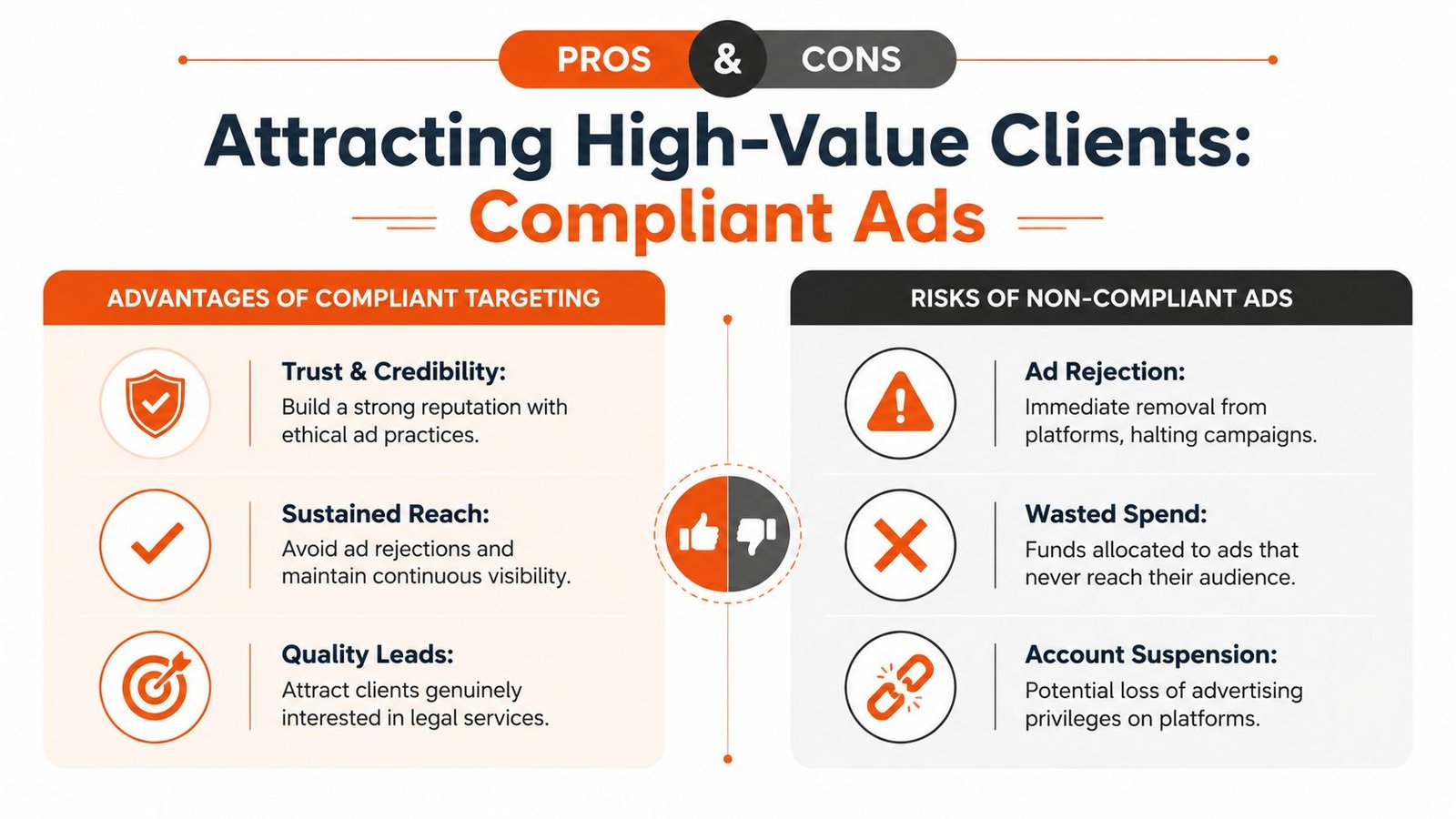
A lot of agencies talk about audiences and creatives as if compliance is a footnote. In legal advertising on Meta, compliance has to be built into the campaign from the beginning. If not, the ad can be rejected, delivery can become unstable, and account-level friction can derail momentum just when the campaign starts learning.
Precision beats broad targeting
Facebook is strong when you use its targeting depth intelligently. That doesn’t mean trying to target everyone who might someday need a lawyer. It means building audiences around actual business goals.
The strongest setups often start with assets the firm already owns:
- Custom audiences built from existing contact lists or prior site visitors.
- Lookalike audiences based on people who resemble past qualified leads or clients.
- Geographic filters matched to where the firm can serve matters.
- Practice-area segmentation so each campaign has a single message and a single conversion path.
Broad campaigns usually produce broad results. That sounds obvious, but many firms still run one ad set for multiple services and expect Meta to sort it out.
Compliance has to shape the copy
Legal ads face a second problem. Meta doesn’t just care about whether the targeting is technically available. It cares about how the ad speaks to the user.
Recent guidance for lawyers warns against personal-attribute phrasing such as “Are you over 50 in need legal advice?” and against guarantees like “100% success rate.” A related 2024 report noted that Meta removed hundreds of legal ads targeting potential plaintiffs, which shows the enforcement risk is real, as highlighted in this discussion of legal ad compliance on Meta.
That changes how experienced advertisers write copy.
Risky patterns include:
- Calling out personal traits directly such as age, health status, or implied victim status
- Making outcome guarantees or exaggerated claims
- Using fear-heavy language that reads like exploitation rather than guidance
- Creating mismatch between ad promise and landing-page content
A campaign that barely stays approved is not a stable acquisition channel.
If an agency doesn’t have a repeatable review process for legal copy, disclaimers, audience setup, and landing-page alignment, the firm is one policy issue away from disrupted lead flow. For firms that want a tighter operational standard, this Facebook advertising compliance guide is a useful reference point for building approval workflows before launch.
What compliant creative looks like in practice
The easiest way to improve ad quality is to stop writing like a billboard lawyer and start writing like a credible advisor.
Compare the difference:
| Approach | Weak version | Better version |
|---|---|---|
| Personal injury | “Were you injured in an accident? Get paid now.” | “Our firm helps people understand their legal options after serious accidents.” |
| Family law | “Are you trapped in a toxic marriage?” | “Guidance for people navigating divorce, custody, and major family transitions.” |
| Estate matters | “Don’t let your family lose everything” | “Estate planning can reduce confusion and protect your wishes.” |
The better version is usually calmer, more specific, and more trustworthy. It also creates a smoother handoff to the landing page because the promise is educational and credible, not inflated.
Short educational videos and testimonials can support trust. They just can’t compensate for bad policy choices or weak message control. That’s where disciplined management separates itself from improvised campaign setup.
Turn Clicks Into Consultations with a Post-Click System
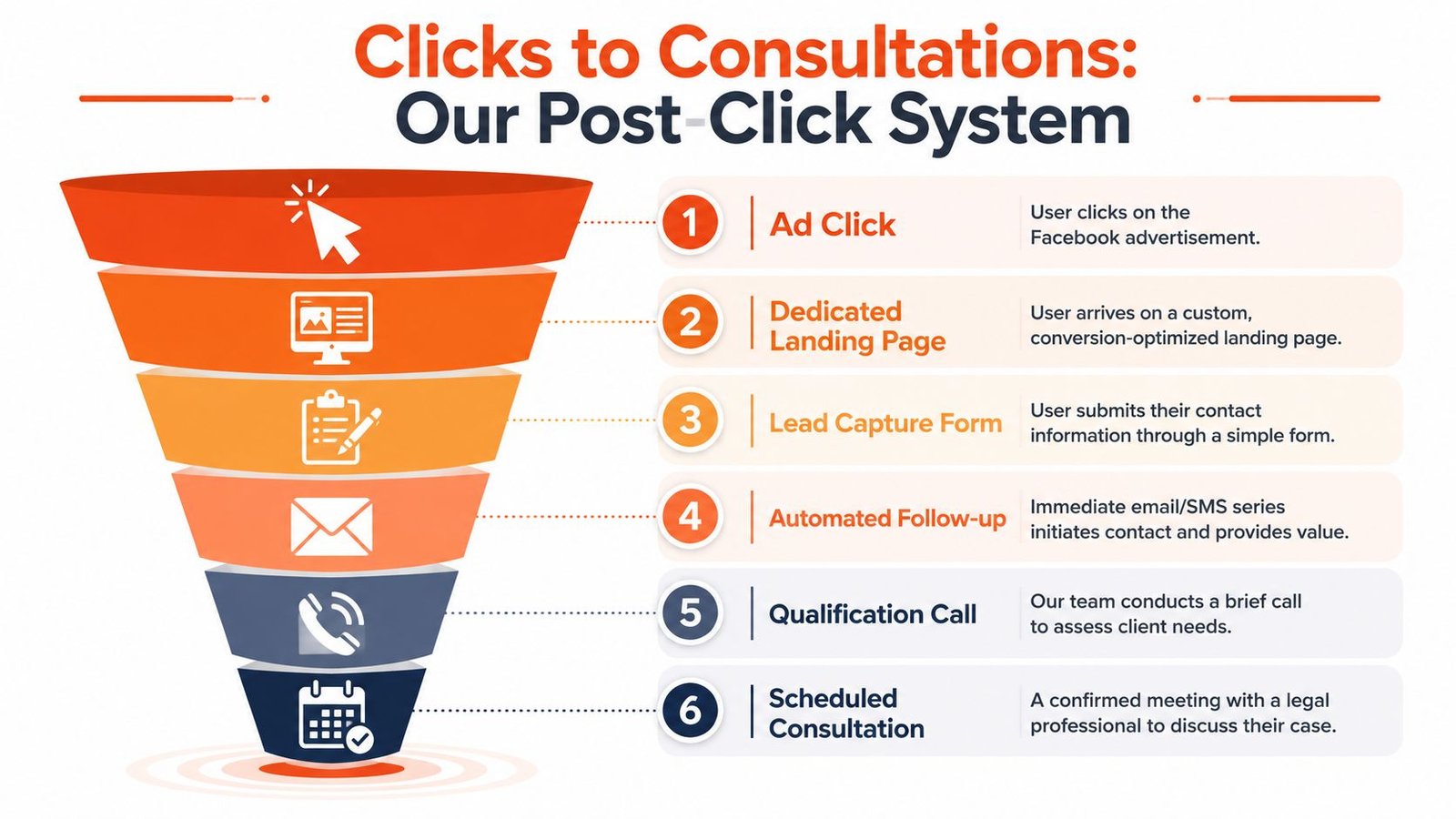
A managing partner approves a Facebook campaign on Monday. Leads come in by lunch. By Tuesday, nobody can confirm which ones were called, which ones were screened out, or which ones turned into booked consultations. The ads did their job. The system after the click failed.
Independent legal marketing analysis has pointed to post-click breakdowns as a common reason law firm Facebook campaigns disappoint. That review also highlights the same operational fixes firms keep postponing: dedicated landing pages, CRM connection, Meta Pixel setup, conversion feedback, intake readiness, and clear success metrics before spend begins, as explained in this analysis of whether Facebook ads work for lawyers.
Why homepages waste paid traffic
A homepage is built for browsing. Paid traffic needs direction.
Someone who clicks a car accident ad should not have to sort through criminal defense, estate planning, and firm news before finding a form. Every extra decision lowers response rates and increases bad leads because the page does not confirm intent fast enough.
A dedicated landing page should do five things well:
- Match the ad message so the visitor immediately sees the same problem, service, and next step
- Stay focused on one practice area instead of presenting the entire firm
- Explain what happens after submission so prospects know whether they should expect a call, a review, or a consultation offer
- Use a short form with useful screening fields so intake gets enough context without driving abandonment
- Build trust with specific proof such as attorney experience, case types served, jurisdiction, and plain-language expectations
For firms reviewing page quality, this guide to a lead generation website build is a useful benchmark for message continuity, page structure, and form design.
The intake process decides whether ads produce consultations
Speed matters, but speed alone is not enough. The fundamental issue is handoff quality.
If a prospect submits a form for a time-sensitive legal matter and receives a generic email six hours later, the firm has already lost ground. If the receptionist answers without knowing the campaign offer, the lead gets mishandled. If intake staff cannot tell a qualified matter from a poor fit, ad spend gets blamed for an operations problem.
Strong post-click systems usually include:
- Immediate routing to the right attorney, intake specialist, or practice-area queue
- Automatic confirmation messages by email or SMS so the prospect knows the request was received
- Screening questions that help staff identify urgency, case type, and geography
- Call handling rules for missed calls, after-hours submissions, and repeat follow-up attempts
- Status tracking inside the CRM so the firm can see whether leads were contacted, qualified, booked, or lost
- Closed-loop conversion reporting back to Meta so campaign optimization reflects actual business outcomes
One bad intake process can make a decent campaign look broken.
Tracking turns opinions into decisions
Without clear tracking, the same argument happens every month. Marketing reports lead volume. Intake complains about quality. Partners ask which matters signed. No one is working from the same record.
Meta Pixel events, CRM stages, call tracking, and consultation reporting are not technical extras. They determine whether the firm can identify which ad, audience, and landing page produced retained cases. They also reduce a serious management risk. If account performance drops, firms without clean data usually respond by changing creative, budgets, and targeting all at once, which makes diagnosis harder and recovery slower.
The firms that win on Facebook usually do something less glamorous than competitors expect. They launch with compliance controls already in place, then build a post-click process that can respond fast, qualify accurately, and report results back to the platform. That is how clicks turn into consultations instead of unworked leads.
A Realistic Look at Law Firm Ad Budgets and ROI
The budget conversation usually starts in the wrong place. Firms ask how much they should spend before they ask what kind of campaign they’re trying to build, what intake can support, and how performance will be judged.
That’s why blanket budget advice is usually unhelpful. Without context, low spend can starve the campaign, and high spend can magnify waste.
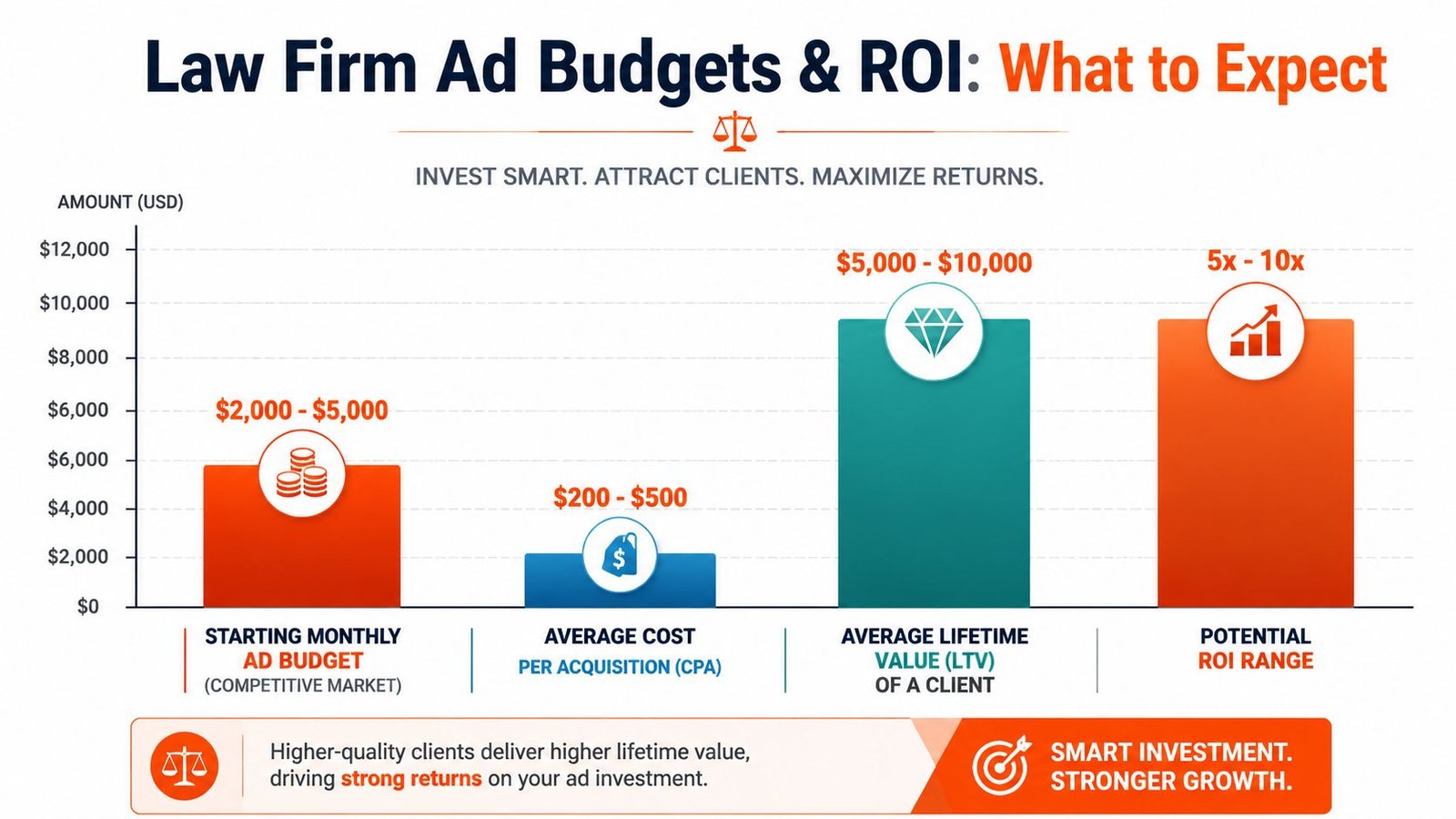
The chart above is a visual aid, not a verified benchmark. The decision should be based on your market, case type, intake capacity, and ability to measure outcomes.
Attention is possible, but attention is not enough
There is a reason legal advertisers continue using Meta. In 2025, the average CTR for the legal services category on Facebook Ads was 2.11%, and benchmark projections put it at about 2.0% in 2026, described as a slight decline as more firms adopt Meta automation and competition rises, according to LocaliQ’s Facebook advertising benchmarks.
That tells you something important. Legal ads can still earn attention on the platform.
It does not tell you whether your campaign will produce qualified consultations.
A good CTR can hide several problems:
- The audience clicked out of curiosity, not intent
- The landing page didn’t continue the offer
- The form attracted low-fit prospects
- The firm couldn’t follow up fast enough
- No downstream tracking connected leads to consultations
The metrics that matter to a managing partner
If you want a realistic view of ROI, stop evaluating campaigns by impressions, clicks, or vanity engagement alone.
Look at a tighter chain:
| Metric | Why it matters |
|---|---|
| Lead quality | Tells you whether the audience and message are aligned |
| Consultation rate | Shows whether the page and intake process are doing their job |
| Qualified matter rate | Filters out noise before it reaches attorneys |
| Signed case visibility | Connects marketing effort to actual revenue decisions |
Disciplined testing matters. You don’t improve performance by changing everything at once. You test one variable, observe what happens, and keep feeding cleaner conversion data back into the system.
For firms trying to get clearer attribution, proper analytics setup is part of the answer. A clean Google Analytics 4 implementation process helps separate channel performance from guesswork and supports better decisions across Meta, search, and landing-page testing.
Good law firm Facebook ads don’t become profitable because the click was cheap. They become profitable because the entire path from click to consultation is measured and improved.
Your Next Step to Predictable Growth
By the time most firms seek help, they’ve already tried the fragmented version. Ads were launched without a clear intake definition. Copy was written without enough attention to compliance. Traffic landed on pages built for general browsing, not conversion. Follow-up happened late or inconsistently. Then the firm concluded the platform was the issue.
That approach keeps producing the same outcome because it treats isolated tasks as strategy.
Predictable growth from Facebook requires a coordinated system:
- A practice-area decision about what should be advertised on social in the first place
- A compliance process that reduces rejection risk before campaigns go live
- A dedicated post-click experience built around one service and one next step
- An intake workflow that responds while the prospect is still engaged
- A measurement framework tied to consultations and qualified matters, not just ad metrics
If you’re comparing providers, look for the team that can own that full chain. Not just ad setup. Not just creative. Not just a monthly report. The work has to connect audience strategy, policy review, landing pages, tracking, and intake operations.
A firm looking for that kind of support can review what a specialized agency for Facebook Ads should handle before signing any agreement. That standard will help you separate tactical vendors from agencies that understand lead flow, compliance risk, and legal-service conversion.
The market won’t wait while your team experiments with disconnected parts. Competitors who already have this system in place are capturing consultations that could have gone to your firm.
The next move is straightforward. Audit the current funnel. Identify where leads are leaking. Fix compliance before launch, not after rejection. Build campaigns around matter types your staff can qualify and convert.
Then put the whole system under one accountable strategy.
If your firm wants a clearer path from Facebook traffic to booked consultations, contact VIP TECH CONSULTING for a strategy conversation. The focus should be simple: identify whether Facebook fits your case mix, uncover where your current funnel is leaking, and map a compliant acquisition system before more budget gets wasted.