
A partner opens the monthly report and sees two bad outcomes. The firm is barely visible for high-value searches, or the budget is getting spent without a clear line to signed cases.
The fundamental challenge of Google Ads for lawyers isn't platform capability. It's campaign profitability.
Google Ads can produce excellent cases for a law firm. It can also burn through budget fast, especially in competitive practice areas where every click is expensive and every weak decision gets punished. Firms lose money here for predictable reasons: broad targeting, poor intake alignment, weak landing pages, and no serious tracking of what becomes a consultation, a retained client, and actual revenue.
This article treats Google Ads as a profit system, not a traffic channel. The firms that win are not the ones with the fanciest account setup. They are the ones that treat paid search like an investment portfolio and make disciplined decisions about case value, cost per consultation, intake speed, and conversion rate.
For a broader view of how paid search fits into a full law firm lead generation system, review the full process from first click to booked consultation.
Table of Contents
- Why Your Competitors Are Winning Clients on Google
- The Strategic Foundation for Profitable Legal Ads
- Your Playbook for Campaign and Keyword Strategy
- Turning Clicks Into Consultations
- Answering Your Toughest Questions About Ad Spend and ROI
- Take Control of Your Client Acquisition Today
Why Your Competitors Are Winning Clients on Google
A prospective client searches “car accident lawyer near me” at 9:12 p.m. Three firms appear. One has a clear message, a strong offer to call now, and a page built to convert urgent legal intent into a consultation. If your firm is missing from that moment, or shows up with weak positioning, the opportunity goes elsewhere before your intake team has a chance to compete.
That is the market reality. In 2025, 86.7% of potential clients reported using Google to research a lawyer, according to Attorney at Work's summary of client research behavior. Google is where legal buyers compare, judge, and shortlist.
The challenge is that many firms approach PPC like a visibility project instead of a profitability system. They buy broad traffic, write generic ads, and send paid clicks to pages that do little to move a serious prospect toward a signed matter. Then they review click volume and call counts as if those numbers answer the only question that matters. Did the campaign produce qualified consultations at an acceptable cost?
Practical rule: In legal PPC, wasted spend usually starts before the ad launches. It starts with poor targeting, weak messaging, and no definition of what a qualified lead looks like.
Consequently, cheap Google Ads management often costs more than it saves. A low monthly fee is irrelevant if your budget is being spent on research queries, unqualified callers, or practice areas that do not support your margin.
Your competitors are not winning because Google handed them a secret advantage. They are winning because they are present at the highest-intent moment and they make a stronger case for action. That edge matters. Prospects often contact multiple firms, but the first credible option usually gets the first consultation and too often the signed engagement.
If your current setup feels expensive, inconsistent, or impossible to trust, measure it against a disciplined law firm lead generation system. The objective is to attract qualified searches and move those prospects through a clear path from query to consultation to client.
The Strategic Foundation for Profitable Legal Ads
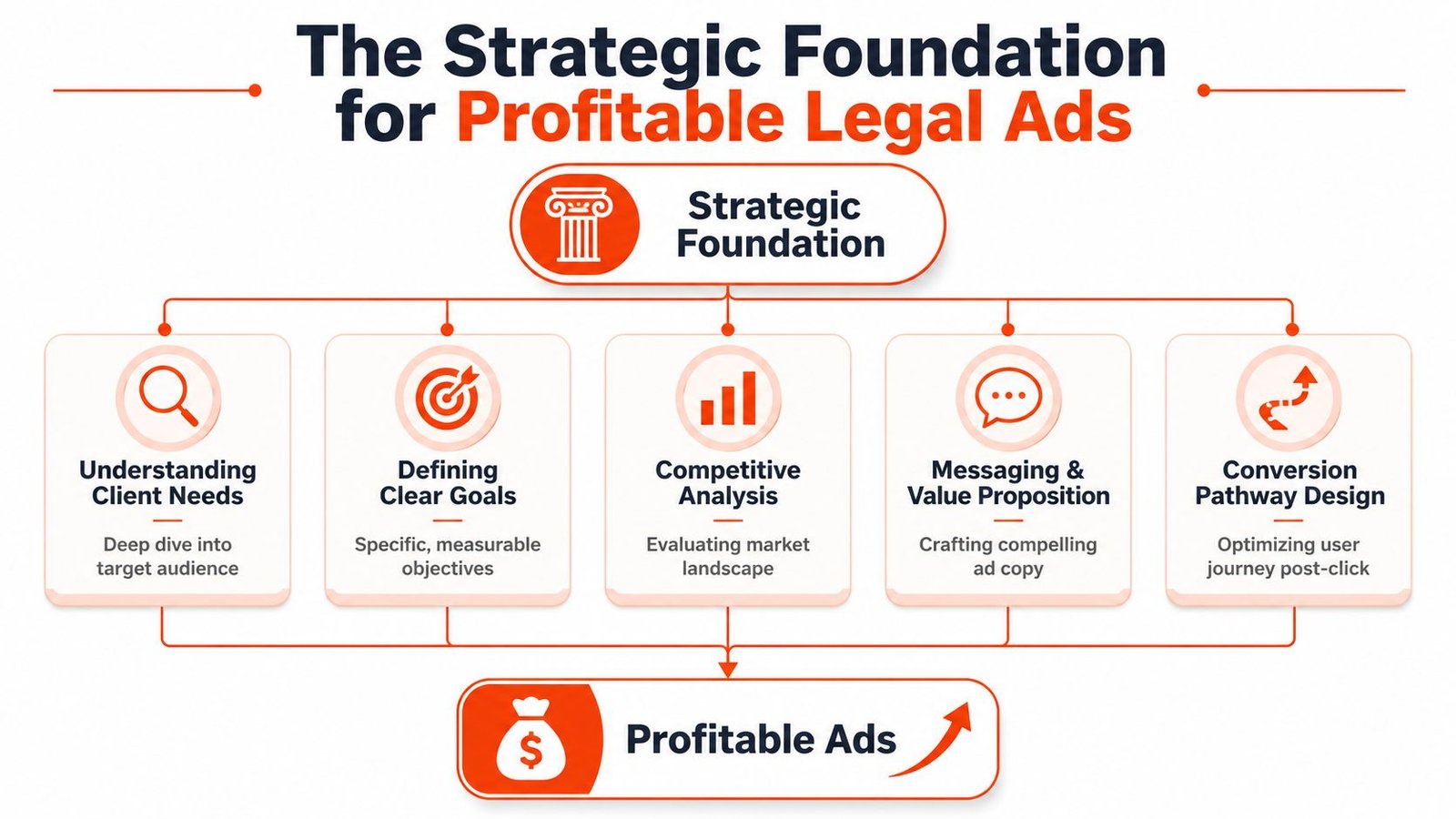
Profitable legal PPC is built before the first click. The firms that win on Google make disciplined business decisions about case value, intake capacity, geography, and positioning before they touch bids, match types, or ad variations.
Intent beats traffic
Traffic looks good in a report. Intent produces signed matters.
A search like "car accident lawyer near me" has obvious commercial value. A search like "how long after a car accident can I sue" may be useful for content marketing, but it can drain a paid budget if your intake team needs consultation-ready prospects now. Law firms that treat both searches the same usually end up funding research behavior instead of buying real hiring intent.
Your foundation should answer three business questions before launch:
- Which matter types can support paid acquisition
- Which searches indicate the prospect is ready to contact a lawyer
- Which locations deserve budget because they can produce profitable cases
Geography matters more than many firms admit. If your office is in a dense metro, sloppy targeting can waste spend on searches from areas you do not serve well, courts you rarely work in, or ZIP codes that do not produce the right case mix. Tight, deliberate Google Ads location targeting for law firms protects margin.
Compliance and trust decide who gets the lead
Legal ads do not compete on copy alone. They compete on credibility after the click.
Google policy limits, practice-area wording, Local Services eligibility, review quality, and brand consistency all affect performance. If a prospect sees weak reviews, mixed business information, or a thin web presence, your cost per lead rises because more paid visitors hesitate, compare, and leave. That is not a traffic problem. It is a trust problem.
A polished ad account cannot compensate for a firm that looks risky or unresponsive once the prospect starts checking you out.
That applies to standard search campaigns and Google Screened placements. Paid traffic exposes operational weakness fast. If intake misses calls, response times drag, or your reputation signals are poor, Google Ads becomes an expensive mirror.
The click has to land somewhere built to convert
Google Ads should function as a profitability system. Search term, ad message, landing page, intake process, and follow-up all need to support the same outcome. A qualified consultation at a cost your firm can defend.
That requires more than technical account management. It requires clear economics and clear standards. If a practice area produces low-fee matters, the campaign needs tighter filters. If a case type is high value, the landing page and intake process need to move with speed and authority. Firms that ignore this alignment often blame Google for losses that started in strategy.
A sound foundation usually includes these elements:
| Pillar | What it needs to do |
|---|---|
| Client intent | Target searches tied to urgent legal needs |
| Clear goals | Define a qualified lead before launch |
| Competitive positioning | Give prospects a reason to choose your firm |
| Message discipline | Keep ad copy relevant, accurate, and compliant |
| Conversion path | Make it easy to call, submit, chat, or book |
Agency selection becomes critical at this stage. Some providers only manage bids and dashboards. That is not enough for a law firm that cares about ROI. Others address strategy, landing page alignment, intake friction, and lead quality along with campaign management. VIP TECH CONSULTING offers that broader PPC and conversion-focused support as part of its legal marketing work.
Your Playbook for Campaign and Keyword Strategy
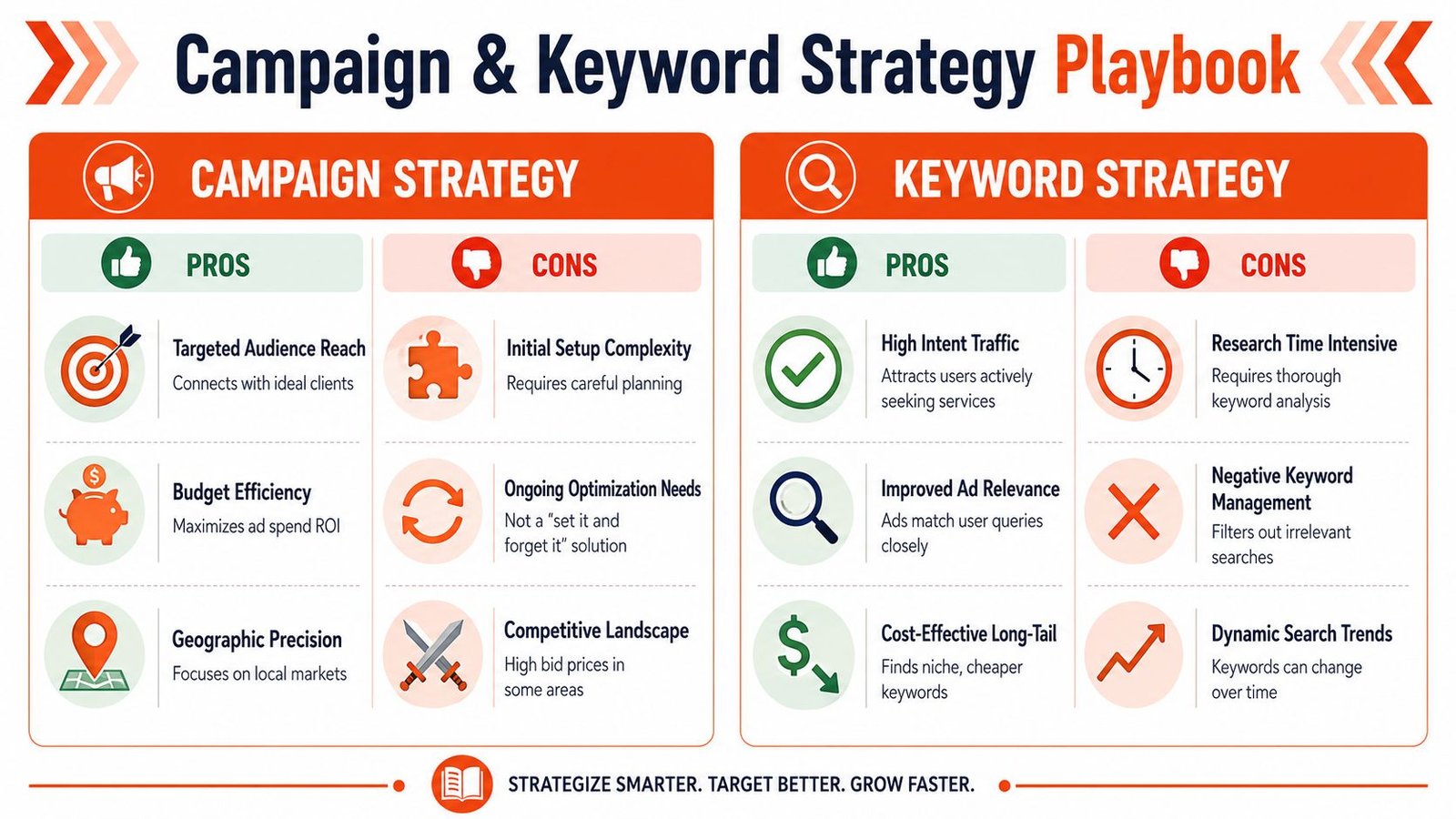
A law firm can lose money in Google Ads before the first week ends if the campaign and keyword strategy are sloppy. Legal clicks aren't cheap enough to learn casually.
One 2025 industry estimate put the average Google Ads cost per click across all industries at $5.26, while the legal sector averaged $8.58. The same estimate suggested $1,500 to $3,000 per month for a solo or small firm getting started, $3,000 to $7,500 for a mid-sized firm, $7,500+ for ambitious growth, and noted that a big-city personal injury firm may need more than $20,000 per month to make a measurable impact. Those figures come from Gavel Grow's legal Google Ads budget guide.
That should change how you think about setup. At these costs, keyword imprecision isn't a minor issue. It's the business model.
Pick the campaign type that matches the matter
Not every campaign type should carry the same role.
Search campaigns are usually the core engine for high-intent legal leads. They capture active demand when someone is looking for counsel now.
Local-focused ad setups make sense when geography is tight and the practice depends on nearby prospects.
Broader automated campaign types may have a place, but they shouldn't be trusted blindly in legal unless tracking is clean and search intent is tightly controlled.
If you're hiring outside help, this is one reason experienced Google Ads campaign management services matter. Someone needs to decide which campaign type fits the practice area, city, and case economics. Google won't do that for you.
Keyword strategy decides whether your budget survives
The easiest way to waste money in legal PPC is to bid on broad vanity terms because they feel important. Terms like “lawyer” or “attorney” can consume spend while attracting weak-fit traffic.
A tighter keyword approach looks more like this:
- Practice-specific searches that name the legal problem
- Location-specific searches that show local hiring intent
- Urgent phrasing that suggests someone wants help now
- Case-type modifiers that narrow the matter
A generic keyword can bring all kinds of searches. A more specific phrase usually brings a prospect with a clearer need. In legal PPC, clarity usually beats reach.
Broad keywords often make partners feel visible. High-intent keywords make firms profitable.
Negative keywords protect your margin
Most firms underbuild their negative keyword lists. That's a mistake because negatives do more than block bad traffic. They keep your search terms relevant enough for the whole account to improve.
Use negatives to exclude searches related to:
- Employment or careers if you don't want job seekers
- Free information seekers if they aren't likely to hire
- Wrong practice areas that create intake friction
- Research-only intent that clogs the budget
This isn't a one-time task. Search term reviews should happen every week once the campaign is live.
A practical setup checklist looks like this:
- Segment by practice area so performance is easier to evaluate.
- Separate branded from non-branded traffic so you don't confuse demand capture with demand generation.
- Use tightly themed ad groups so ad relevance stays high.
- Build negative lists early and expand them from live search term data.
- Send each keyword theme to a matching landing page instead of one generic services page.
That level of structure isn't glamorous. It is, however, what keeps expensive clicks from turning into expensive mistakes.
Turning Clicks Into Consultations
A click has no value by itself. The consultation is what matters. If the visitor doesn't trust what they see, doesn't find the page relevant, or can't contact your office easily, the campaign fails where it counts.

Ad copy has one job
Your ad doesn't need to sound clever. It needs to sound relevant, trustworthy, and immediate.
Good legal ad copy speaks to the problem the searcher is trying to solve. It reflects the practice area, reinforces location when appropriate, and gives the prospect a clear next step. Weak ads stay generic because the writer is trying to appeal to everyone. That's exactly why they underperform.
A few essentials:
- Match the search intent so the user feels they found the right firm.
- Use a direct call to action such as calling or requesting a consultation.
- Keep claims responsible so the messaging stays compliant and credible.
- Avoid fluff because stressed prospects scan fast.
Landing pages win or lose the consultation
Many law firms still send paid traffic to a homepage or broad practice-area page and hope for the best. That's lazy and expensive.
A proper landing page should do a few things immediately:
- Confirm relevance with a headline that matches the ad and search intent
- Show a clear conversion path with visible calls, forms, chat, or booking
- Reduce anxiety with concise copy, attorney credibility, and office details
- Support trust with reviews, reputation signals, and proof points
If your reviews are thin, improving reputation becomes part of conversion optimization. A practical resource on getting Google reviews can help your team create a more consistent review process, which matters because prospects often check reputation before contacting a firm.
If you suspect the underlying issue is post-click performance, not traffic quality, start with a hard look at how to improve website conversion rates. Many firms don't need more clicks first. They need more of their current clicks to turn into consultations.
A landing page should answer three questions fast. Am I in the right place? Can this firm help me? What do I do next?
Here is the benchmark that matters. A successful law firm Google Ads campaign should generally aim for a conversion rate between 5% and 10%, and campaigns need to track phone calls, form submissions, and chats to optimize correctly, according to Dnovo's guidance on Google Ads for lawyers.
That benchmark is useful because it stops firms from mistaking traffic for performance.
A quick visual breakdown helps if your team is evaluating the full path:
Tracking is what makes optimization real
No serious Google Ads campaign for lawyers should launch without conversion tracking from day one. That means calls, forms, chats, and booked consultations have to be measured.
Once enough data is in the account, optimization should become disciplined and weekly:
- Review search terms and add negatives
- Pause weak keywords that drain budget
- Improve page clarity and speed to reduce leakage
- Test ad variants one variable at a time
- Shift budget toward terms producing lead activity
If you're not tracking lead-level actions, you're not managing ROI. You're buying clicks and hoping your intake team tells you good news later.
If you'd like a direct audit, request a review of your campaign and landing page setup before spending another month guessing. That's usually where the biggest leaks show up.
Answering Your Toughest Questions About Ad Spend and ROI
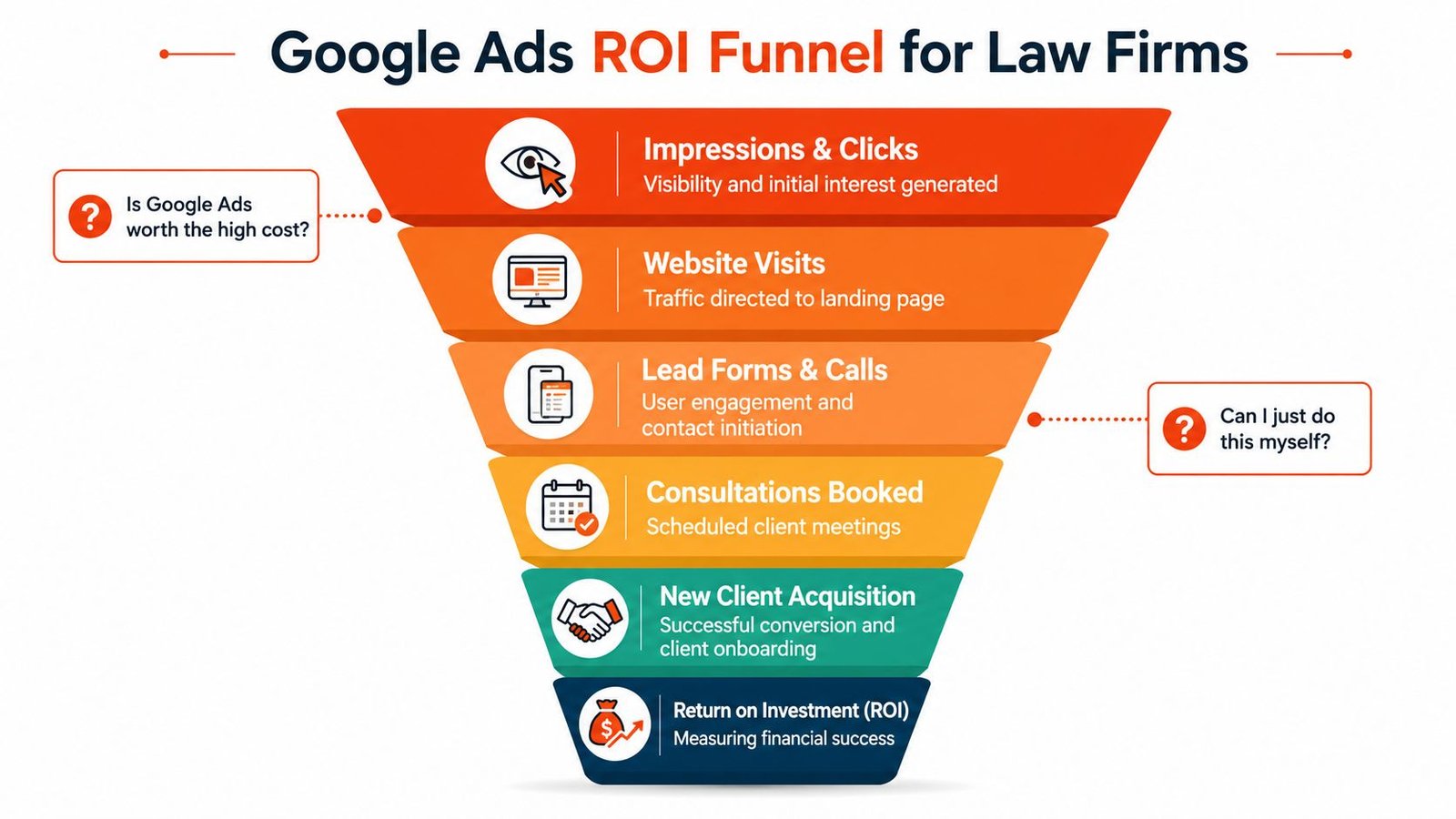
Law firm partners usually ask the right question first. Is this worth the money?
Sometimes yes. Sometimes no. That answer bothers agencies that want every account, but it's the honest one.
Is Google Ads worth it for every law firm
No. Google Ads often fails for law firms that target broad, low-intent keywords like “lawyer” or operate without a clear ROI goal. Success depends on targeting high-intent searches where case value justifies ad spend, as explained in Equivity VA's commentary on Google Ads for lawyers.
That means some firms should not make Google Ads their primary growth channel right now.
Google Ads is a bad primary channel when:
- Your average case value doesn't support expensive clicks
- Your intake process is weak or slow
- Your firm lacks trust signals after the click
- Your market is so competitive that a thin budget can't gather meaningful data
- Local SEO, referrals, or Local Service Ads are already producing stronger lead quality
This isn't anti-PPC. It's pro-profitability. The right strategy starts with channel fit, not platform enthusiasm.
Can you run it yourself
Yes, technically. But that isn't the core question. The core question is whether you can run it well enough to avoid expensive learning mistakes.
Legal PPC requires ongoing judgment. Search term review, ad testing, bid strategy changes, geographic refinement, landing page alignment, and conversion tracking all have to work together. Most firms don't fail because they can't click the right button in Google Ads. They fail because nobody is making high-quality decisions consistently.
A disciplined A/B testing process matters here. Change one variable at a time, split traffic evenly, run both versions simultaneously, and judge CTR, CPC, and conversion rate only after enough data accumulates. Testing multiple changes at once creates fake winners and bad decisions.
If your firm is still asking which ad “feels” better, you're not optimizing. You're voting.
If you're comparing agencies, use a tighter standard than “they know Google Ads.” Ask how they define qualified leads, how they structure legal campaigns, how they test landing pages, and how they decide when a channel shouldn't be scaled. A checklist for how to choose a Google Ads management agency becomes useful in such scenarios.
How to think about budget without fooling yourself
A realistic budget has to match three things. Practice area economics, market competition, and your firm's ability to convert inquiries into retained matters.
Here's the mistake I see most often. A firm sets a budget based on comfort, not based on what the market requires to generate enough signal. Then they declare the channel ineffective before the campaign had a fair chance.
Use this framework instead:
| Situation | Better decision |
|---|---|
| High-value matters and strong intake | Build a focused search campaign around high-intent terms |
| Mixed review profile or weak landing pages | Fix trust and conversion issues before scaling spend |
| Small budget in a major market | Narrow geography and case type instead of spreading thin |
| Broad service offering | Prioritize the most commercially viable practice areas first |
Professional management doesn't guarantee ROI. It reduces avoidable waste and helps you make sober decisions faster. That's the true value. Good management protects capital while showing you whether the channel deserves more investment.
Take Control of Your Client Acquisition Today
A partner reviews last month's marketing report, sees plenty of clicks, and still cannot tie the spend to retained cases. That is how law firms end up treating Google Ads like a necessary gamble instead of a profit channel.
The firms that win do not win because they spend blindly. They win because they run Google Ads like an investment. Every decision ties back to case value, intake performance, and cost per signed client. That is the standard you should hold.
Google Ads can produce a steady flow of qualified consultations for a law firm. It can also burn through budget fast. The difference comes down to control. Control over targeting. Control over conversion tracking. Control over intake follow-up. Control over when to scale and when to cut.
If your account is underperforming, stop asking for more activity. Ask for a clearer path to profit.
Start here:
- Audit the account at the search term level
- Pause spend that does not map to real case intent
- Tighten geography, ad copy, and landing page alignment
- Track calls, forms, and consultation requests properly
- Review lead quality with intake, not just platform metrics
- Increase budget only after signed-case economics make sense
This is a profitability playbook, not a traffic play. A campaign that generates cheap leads nobody retains is still a bad campaign. A campaign with higher click costs can be the better investment if it produces the right matters consistently.
If your current provider cannot explain, in plain English, which searches produce qualified consultations and what each retained client is costing you, fix that now.
If you want a direct assessment of where your Google Ads budget is leaking and what to correct first, contact VIP TECH CONSULTING for a strategy session. You should leave that conversation with a clear view of whether Google Ads deserves more investment from your firm, or whether your current setup needs repair before you spend another dollar.