
If your business isn’t showing up when someone searches for your service in Miami, you’re losing customers every day. Not eventually. Today.
Most owners I talk to are already spending money somewhere. Google Ads. Meta Ads. A website redesign. Maybe a cheap SEO package that produced reports but not calls. The pattern is always the same. Visibility is weak, lead quality is inconsistent, and competitors with stronger Google presence keep taking the demand that already exists.
That’s why smart businesses look for seo services for small businesses right when they’re close to making a buying decision. They don’t need theory. They need a clear plan that turns search visibility into calls, bookings, and qualified leads.
If you want to know where you’re losing visibility right now, start by reviewing your local SEO opportunities in Miami.
Table of Contents
- If You’re Not on Google’s First Page You’re Invisible
- What to Expect from Professional SEO Services
- Our ROI-Focused SEO Process for Miami Businesses
- Is SEO Worth the Investment for a Small Business
- How We Drive Growth for Businesses Like Yours
- How to Choose the Right SEO Agency in Miami
- Miami Small Business SEO FAQs
If You’re Not on Google’s First Page You’re Invisible
A Miami business can have a solid reputation, a decent website, and a real service advantage, then still lose the sale because a competitor appears first in search and on Maps.
That’s the problem. This isn’t about vanity rankings. It’s about buyer intent. When someone searches for a service, they’re often comparing options fast. If your business is buried, you don’t make the shortlist.
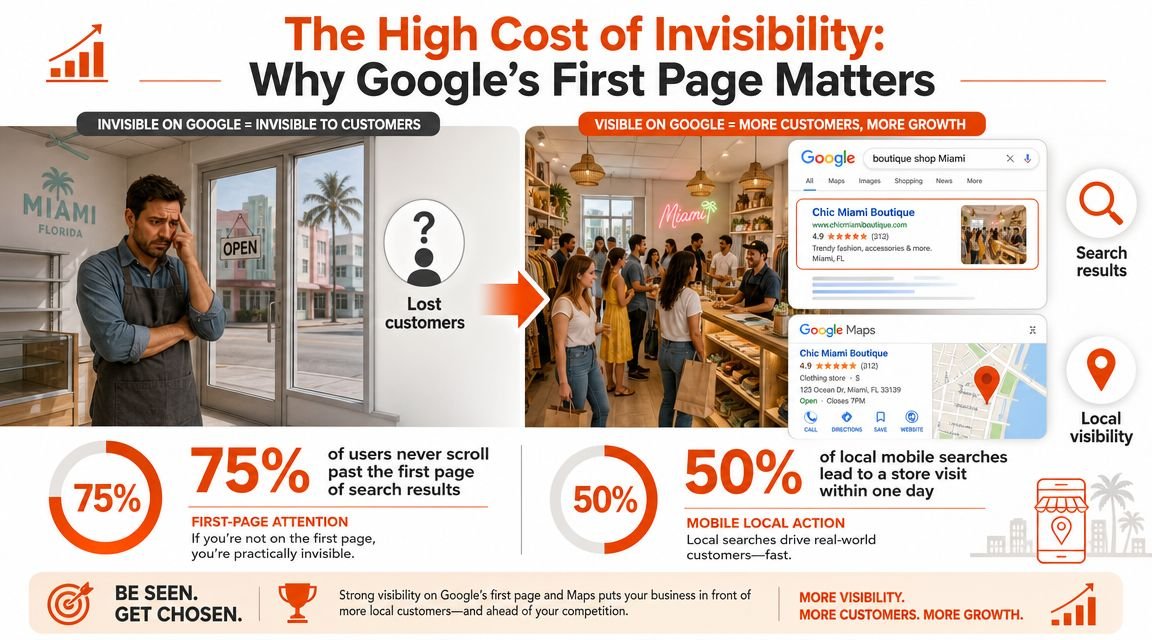
Miami makes this worse because the market is crowded. Local service companies, restaurants, legal practices, med spas, contractors, consultants, and retail shops are all competing for the same searches. If your Google Business Profile is weak, your service pages are thin, or your site has technical issues, Google has no reason to put you in front of ready-to-buy searchers.
What invisibility actually costs you
A business owner usually notices the symptom first:
- Leads are inconsistent
- Ads feel expensive
- Website traffic doesn’t convert
- Competitors keep showing up for “near me” searches
- Calls depend too much on referrals
Those aren’t separate problems. They usually point to the same issue. Your search visibility is weak where buyers are making decisions.
Practical rule: If a prospect can’t quickly find your business, trust your reviews, and reach the right page, they’ll call the company that made it easier.
SEO fixes that when it’s done correctly. Not as a buzzword. As a system for capturing demand that already exists.
For small businesses, that often starts with technical fixes, optimization of 5 to 10 core pages around buyer-intent keywords, and a stronger Google Business Profile presence, as outlined in this small business SEO service overview. That matters even more in a market like Miami, where map pack visibility and “near me” searches directly influence calls, bookings, and consultations.
If your current marketing is generating impressions but not enough real opportunities, your next move should be simple. Get your visibility audited, fix what’s blocking local discovery, and build around the pages and profiles that generate revenue.
What to Expect from Professional SEO Services
A real SEO service should make your business easier to find, easier to trust, and easier to contact. If an agency can’t explain its work in those terms, you’re probably buying busywork.
The strongest seo services for small businesses don’t start with blog volume or vague ranking promises. They start with the pieces that control whether Google can access your site, understand your services, and show your business when local buyers are ready to act.
The foundation comes first
Technical SEO is the floor, not the ceiling. If the floor is weak, everything built on top of it underperforms.
Core technical SEO elements include site speed, mobile usability, and crawlability. If a site is slow or difficult for search engines to crawl, they may delay indexing or undervalue the site’s relevance, which suppresses visibility even when the content is good, according to this guide on technical SEO services for small businesses.
That translates into practical work like:
- Fixing broken links: Dead ends waste authority and frustrate visitors.
- Cleaning up redirect chains: Too many hops slow users and crawlers down.
- Correcting titles and meta descriptions: Missing or duplicate metadata confuses search engines.
- Resolving indexation blockers: If important pages can’t be indexed, they can’t rank.
- Improving mobile experience: Most local searches happen on phones, and weak mobile UX kills conversions.
If your site builder is part of the problem, it’s worth reviewing resources on mobile website tools for creators so you understand how platform choices affect speed, responsiveness, and ease of updates.
The parts that actually drive leads
Once the foundation is stable, the rest of the work has to line up with business intent.
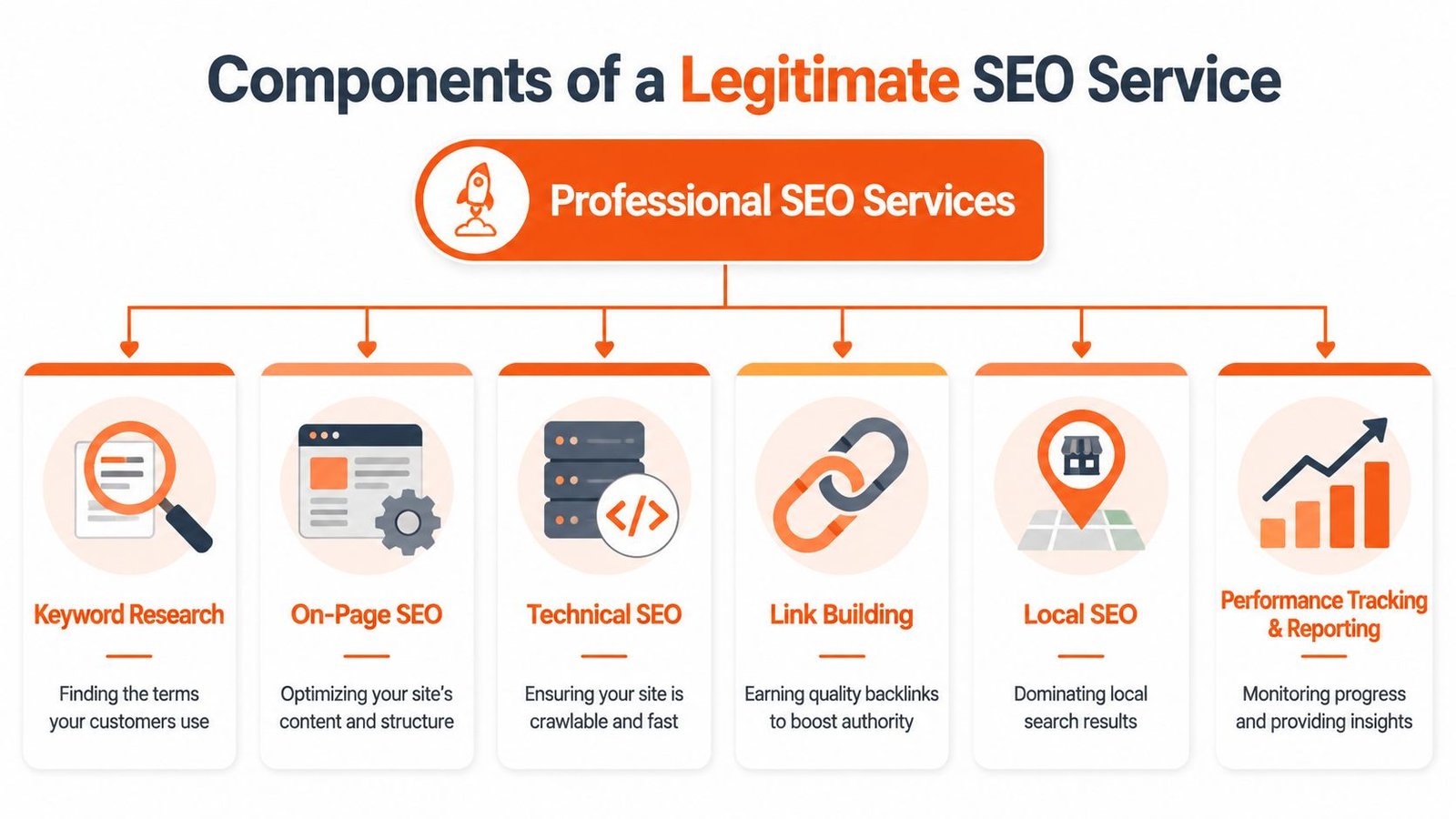
Here’s what a professional campaign should include:
| SEO area | What it does for the business |
|---|---|
| Keyword research | Finds the terms buyers use when they’re close to contacting you |
| On-page optimization | Aligns service pages with search intent and conversion goals |
| Local SEO | Improves visibility in Maps and location-based searches |
| Content creation | Builds topical coverage around services and customer questions |
| Authority building | Strengthens trust through relevant mentions and backlinks |
| Tracking and reporting | Connects SEO work to leads, calls, and real business outcomes |
A good provider should also know when to focus on local visibility before broader content production. If you’re comparing agencies, use a concrete checklist, not a sales pitch. This local SEO checklist for small businesses is a good benchmark for what should already be covered before anyone starts selling you on “advanced strategy.”
Most weak SEO campaigns fail for a simple reason. They skip the essentials and jump straight to activities that are easy to invoice but slow to produce leads.
That’s why I push Miami owners to judge providers by sequence, not by package size. The order of work matters as much as the work itself.
Our ROI-Focused SEO Process for Miami Businesses
If your business is buried on page two, you are paying twice. You pay for a website that does not produce enough calls, and you keep paying for ads to make up for traffic you should be earning.
That is the problem we solve first. We do not spread your budget across a bloated monthly checklist. We fix the parts of your search presence that can produce leads now, then build out the longer-term work once the basics are pulling their weight.
What we prioritize first
Miami small businesses with limited budgets need order, not volume. The fastest path to ROI usually starts with local visibility, conversion fixes, and cleaner tracking before you spend months on broad content campaigns.
That means we focus on the assets closest to a sale first.
Audit what is blocking visibility and lead flow
We review your Google Business Profile, core service pages, technical issues, local relevance signals, and the path from visit to call or form submission.Fix the pages that should already be generating inquiries
Your home page, top service pages, and location-specific pages are your money pages. If they are not ranking well or converting well, that gets fixed before anything else.Strengthen the local signals that drive map pack exposure
Categories, services, reviews, business details, and page-level location relevance all need to point in the same direction. That is how you improve visibility for searches with local intent.Set up measurement before expanding the campaign
If tracking is unreliable, you cannot judge ROI or make good budget decisions. Start with clean analytics and conversion tracking. This guide on setting up Google Analytics 4 for accurate SEO reporting is a good place to begin.Add content and authority work after the core lead assets are working
Content expansion and link acquisition matter, but they should support a strong local and conversion foundation, not replace it.
Here’s a quick look at the mindset behind the process:
What You Get
You should know what is being done, why it comes first, and how it ties to revenue. If an agency cannot explain that clearly, keep looking.
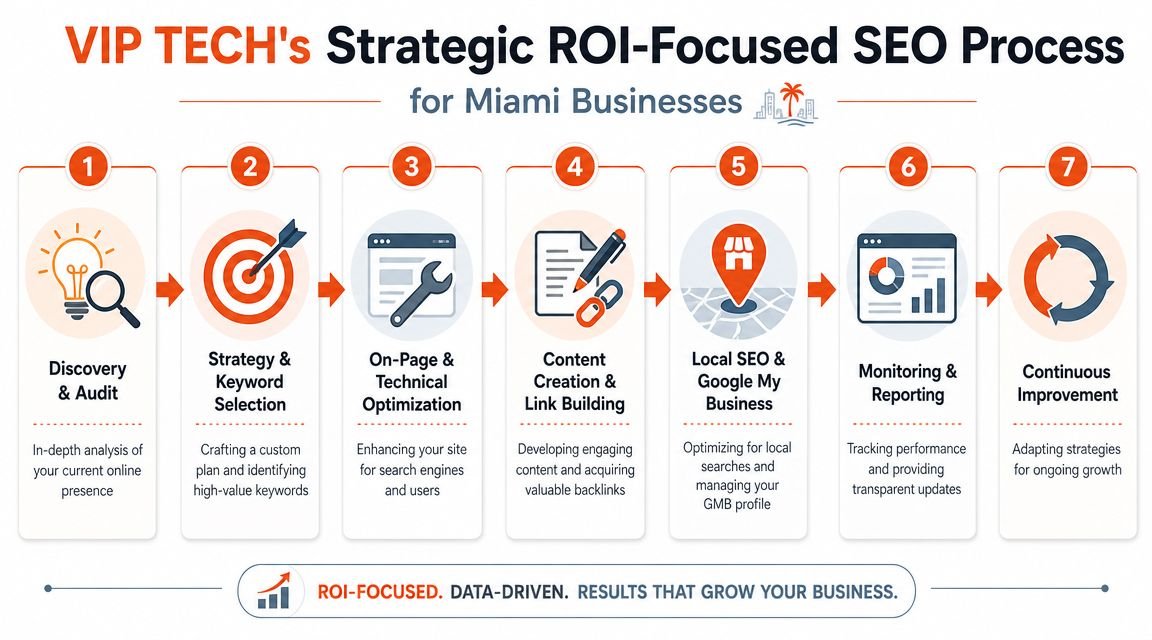
- Discovery and audit: A review of current rankings, technical barriers, local visibility, and conversion paths.
- Keyword selection based on intent: Search terms tied to calls, quote requests, bookings, and consultations.
- On-page updates: Rewrites and structural changes to key pages so they match search demand and convert more visitors.
- Google Business Profile work: Optimization, relevance improvements, and review support.
- Technical cleanup: Site speed, mobile usability, crawlability, internal linking, metadata, and sitemap health.
- Content expansion: Added after core pages and local assets are producing results.
- Reporting tied to outcomes: Calls, forms, qualified leads, and visibility changes.
A Brickell law firm, a Kendall med spa, and a Doral home service company should not get the same first-month plan. Different buying behavior, different search intent, different priorities.
If you are comparing providers, ask one direct question. What are the first priorities you would fix to generate leads faster in my market? A strong partner will answer that immediately, in order, and without hiding behind a generic package.
Is SEO Worth the Investment for a Small Business
A Miami business can spend thousands on ads, get a short burst of clicks, and still stay invisible where buyers make decisions. If your company is not showing up when consumers seek your service, your ad budget is covering a visibility problem it cannot fix on its own.
Yes, SEO is worth the investment for a small business. It becomes one of the highest-return channels you can fund when you treat it as a lead pipeline built around high-intent searches, local visibility, and pages that turn visits into calls.
What the Numbers Say
According to this roundup of SEO statistics for small businesses, small businesses typically spend $1,500 to $3,000 per month on SEO, and average SEO ROI is often cited at 22:1.
The same source reports a sharper point for owners who care about revenue. SEO leads close at about 14.6%, while outbound leads close at 1.7%. Search traffic performs better because it reaches people who are already looking for help, not people being interrupted.
That difference matters when your budget is tight.
A small business does not need every SEO tactic at once. It needs the right sequence. Start with the work that can produce calls and quote requests now. Fix your Google Business Profile, tighten your core service pages, improve local relevance, and clean up the conversion path. After those assets are producing leads, expand into broader content and longer-term authority building. That is how you protect cash flow while building a channel you own.
Where Owners Waste Money
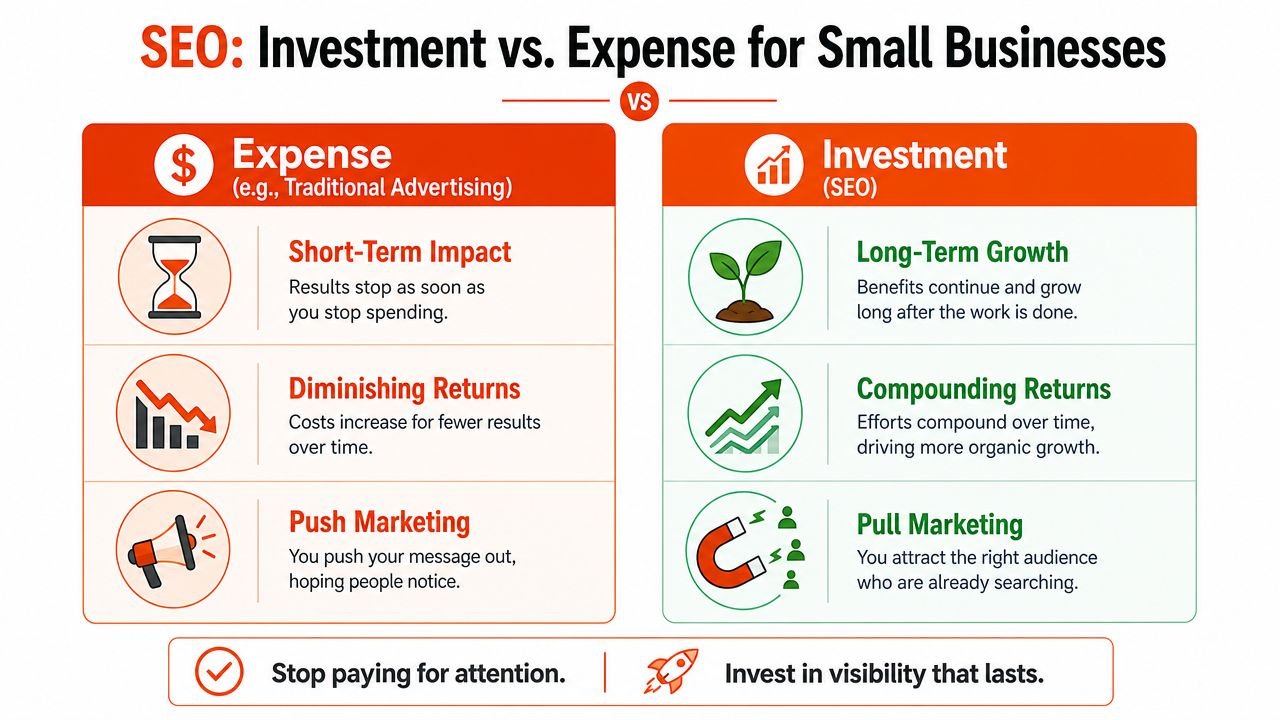
The biggest mistake is expecting SEO to behave like paid ads. It is a different investment. Ads rent attention for as long as you keep paying. SEO builds visibility into assets you keep using month after month, including your site, your service pages, your local listings, and your branded search presence.
The second mistake is spreading a limited budget across low-priority tasks. A Brickell law firm should not spend early SEO dollars the same way a Kendall med spa or Doral roofer would. The fastest return usually comes from the pages and local searches tied closest to immediate buying intent.
That is why the website matters as much as the ranking. If the site cannot turn search traffic into inquiries, you do not have an SEO problem alone. You have a conversion problem. A lead generation website built to turn traffic into calls and form submissions makes the SEO investment work harder.
You can handle simple updates in-house, like photos, business hours, and review requests. You should not split strategy, technical fixes, content targeting, and lead tracking across random freelancers or overworked staff. Fragmented execution slows results and hides what is driving revenue.
SEO is worth it when the work is prioritized around qualified leads, not generic traffic reports.
If you also sell online, platform decisions can affect search performance, product discoverability, and conversion rates. choosing the right ecommerce platform can strengthen or weaken the return you get from SEO before content work even starts.
For a small business owner in Miami, the decision is simple. Keep paying to rent attention every month, or build search visibility that keeps bringing in demand after the click budget is gone. The rational move is to fund SEO in the right order, with local lead generation first and long-term expansion second.
How We Drive Growth for Businesses Like Yours
The businesses that win in Miami usually don’t have magical branding. They have clearer positioning, stronger local visibility, and pages that make it easy for a prospect to take the next step.
That’s why growth work should be tied to real business scenarios, not generic monthly tasks.
Three common Miami scenarios
A professional services firm in Brickell
The site looks polished, but service pages are too broad and don’t match how prospects search. The fix is usually tighter keyword targeting, clearer trust signals, and pages built around consultation-driven intent. The result is better-quality inquiries because visitors land on the right service, not a generic overview.
A restaurant or hospitality brand in Wynwood
The issue often isn’t “SEO” in the abstract. It’s local discovery, review signals, and branded search experience. If someone finds your listing, then hits a slow site or incomplete menu path, you lose the visit before they ever decide. In these cases, reputation management and local search alignment matter as much as rankings.
A home service business in Doral or Kendall
For these businesses, local SEO and conversion work often create the fastest wins. When emergency or high-intent service searches happen, the business that shows up clearly and routes visitors to the right contact action gets the lead.
For companies that also sell online, platform decisions can shape SEO performance, product discoverability, and content flexibility. If that’s relevant to your business model, this guide on choosing the right ecommerce platform is worth reviewing before you invest in traffic.
A lot of owners underestimate how much site structure affects lead generation. If your website attracts visits but doesn’t turn them into calls or form fills, study the fundamentals of building a lead generation website. That’s usually where the conversion gap becomes obvious.
A business doesn’t need more “traffic” if the wrong pages rank, the local profile is weak, or the site makes action harder than it should be.
That’s the core point. Growth comes from alignment. Search intent, local visibility, trust signals, and conversion paths all need to work together.
How to Choose the Right SEO Agency in Miami
Most agencies know how to sell SEO. Fewer know how to tie it to leads, close rates, and local market conditions.
If you’re comparing providers, don’t ask who can “get you to page one.” Ask questions that expose how they think, what they prioritize, and whether they understand a Miami business with limited budget and real revenue goals.
Questions that expose weak providers
Use this checklist in every consultation:
How do you prioritize the first phase of work?
If they can’t explain what gets fixed first, they probably use the same package for every client.What do you measure besides rankings?
You want calls, form submissions, qualified leads, and sales conversations. Rankings alone don’t pay payroll.What’s your plan for Google Business Profile visibility and reviews?
Local businesses need a clear answer here.Will you review my current service pages for conversion issues?
Good SEO without conversion thinking leaves money on the table.How do you handle technical issues?
Ask specifically about crawlability, mobile performance, metadata, internal links, and indexation.Can you show me what reporting looks like?
If reporting is vague before you sign, it will be worse after.What happens if SEO needs support from paid search?
Serious agencies understand when Google Ads should support lead flow while organic visibility matures.
A practical next step is to compare any proposal against a framework for how to choose a digital marketing agency. That makes it easier to separate strategic partners from vendors selling deliverables without ownership.
The red flags are predictable. Cheap pricing with no clear scope. Grand promises with no discussion of your market. Reports full of activity but light on business impact. If you hear a lot about impressions and almost nothing about inquiries, move on.
Miami Small Business SEO FAQs
How long does SEO take in Miami
Miami is competitive, so weak strategy gets exposed fast. You’ll usually see movement in stages, not all at once. Local profile improvements, technical cleanup, and service page fixes can create earlier traction than broad content campaigns. The key question isn’t “how long does SEO take?” It’s “what gets prioritized first?”
Should you choose SEO or Google Ads
If you need leads immediately, Google Ads can help capture demand faster. If you want durable visibility that doesn’t disappear when ad spend stops, SEO is essential. For many Miami businesses, the right answer is both. Ads cover immediate demand while SEO builds your long-term position in organic search and Maps.
What if you serve multiple Miami neighborhoods
Then your strategy has to reflect how customers search by area. A business serving Coral Gables, Coconut Grove, Brickell, Doral, and Kendall shouldn’t rely on one generic page. You need clear service-area signals, page structure that supports local relevance, and a Google Business Profile aligned with the areas you serve.
Can you just outsource a few blog posts and call it SEO
No. Content without technical health, local optimization, and conversion-focused pages usually underperforms. Blogging has value, but only after the high-intent assets are in place.
What should you do next if your visibility is weak right now
Start with an audit, not a guess. Identify what’s suppressing rankings, what’s hurting local visibility, and which pages should already be generating calls. Then fix the priorities in order.
If your business is buried in search results, wasting money on ads that don’t convert, or losing local leads to competitors who show up better, it’s time to fix this problem. VIP TECH CONSULTING helps Miami businesses improve local visibility, strengthen conversion paths, and turn search demand into qualified leads. Book a consultation and get a clear plan for what to fix first.