
If you’re paying for Google Ads or Meta Ads and your phone still isn’t ringing, you don’t have a traffic problem. You have a management problem.
That distinction matters. A small business can get clicks fast. Getting qualified leads, booked jobs, and predictable revenue from paid traffic is harder. That’s where most campaigns fall apart. Business owners see impressions, clicks, and spend. What they don’t see is how much money leaks out through weak targeting, bad keyword selection, poor landing pages, and missing conversion tracking.
That’s why PPC management for small business shouldn’t be treated like a side task. If you’re comparing agencies, looking for a Google Ads partner near me, or trying to decide whether to keep managing campaigns yourself, the core question isn’t whether PPC can work. It can. The question is whether your current setup is built to produce customers, not just activity.
If you want clarity on that before another month of ad spend disappears, book a strategy call and get a second set of eyes on the account.
Table of Contents
- Are Your Google Ads Bleeding Money Instead of Bringing Leads
- The Blueprint for PPC That Actually Generates Customers
- What Our Professional PPC Management Process Includes
- The Real Cost of DIY vs Hiring a PPC Agency
- Measuring Success How We Track Your ROI
- Start Generating Leads Not Just Clicks
Are Your Google Ads Bleeding Money Instead of Bringing Leads
A business owner in Miami launches ads because business feels slower than it should. The campaign gets traffic. Search terms start rolling in. Spend goes up every day. But calls don’t increase, form fills stay flat, and nobody can clearly explain which clicks were worth paying for.
That happens constantly.
The account isn’t broken in an obvious way. It’s bleeding money in small, repeated ways. Broad keywords pull in people who were never going to buy. Ads send traffic to the homepage instead of a focused service page. Search traffic from outside the service area slips through. No one adds negative keywords. No one checks whether the campaign is producing calls, chats, or booked appointments.

What wasted spend looks like in the real world
Poor PPC usually doesn’t fail with drama, but rather with subtle underperformance.
A local service business might bid on terms that are too broad for its actual offer. A law firm might pay for research-driven clicks instead of consultation-ready searches. A restaurant might run location-blind campaigns that show ads to people too far away to ever visit. An e-commerce store might get traffic from weak ad copy that attracts curiosity instead of buying intent.
The owner sees movement in the dashboard and assumes progress is happening. It isn’t.
Practical rule: If your campaign is generating clicks but not producing clear business actions, the problem isn’t volume. It’s alignment.
One reason this happens so often is simple. Small business owners are stretched thin. Research cited by Neil Patel notes that 47% of small business owners run their marketing campaigns entirely on their own (see the cited benchmark). That helps explain why so many accounts stay reactive. PPC now depends on constant optimization tied to outcomes like calls and bookings, not just traffic.
Why DIY PPC breaks down fast
Google Ads looks manageable from the outside. That’s the trap.
The interface makes campaign setup feel simple, but profitability depends on dozens of decisions after launch. Match types. geo-targeting. search terms. bidding behavior. device performance. ad relevance. landing page fit. lead tracking. If those pieces don’t work together, your budget turns into expensive market research.
Here are the mistakes that usually cause the damage:
- Broad targeting: Ads show for low-intent searches or outside your real service area.
- Missing negative keywords: You keep paying for irrelevant traffic because no one is actively excluding it.
- Weak destination pages: People click an ad for one service and land on a generic homepage.
- No conversion tracking: You can’t tell which keyword, ad, or campaign created a real lead.
- Set-and-forget management: Campaigns run for weeks with no serious review.
If that sounds familiar, stop guessing. A proper audit usually reveals the waste fast. If you want a second opinion, review what a managed service should cover through Google Ads campaign management services, then book a strategy session before the next billing cycle locks in more bad spend.
The Blueprint for PPC That Actually Generates Customers
Effective PPC isn’t mysterious. It’s disciplined.
The difference between a campaign that burns cash and one that drives leads usually comes down to whether the account was built around business intent or platform convenience. Smart business owners shouldn’t care about fancy terminology. They should care whether the campaign can consistently put the right offer in front of the right buyer at the right moment.
Start with business economics, not ad settings
A serious PPC strategy starts before keywords.
You need to know which services matter most, what a qualified lead looks like, how fast your team responds, which areas you serve, and which offers deserve budget first. Without that foundation, the platform starts making decisions in a vacuum.
A proper setup should answer questions like these:
- Which services are highest value: Not every service deserves equal budget.
- Which searches show buying intent: “Near me,” urgent, service-specific, and problem-aware terms are worth far more than vague browsing queries.
- Which locations are profitable: Paid traffic should focus on areas you can serve well.
- Which actions count as success: Calls, booked consultations, quote requests, purchases, and form submissions matter. Random clicks don’t.
This is also where local strategy becomes non-negotiable. A campaign aimed at a broad region often wastes money that a tightly controlled local account would preserve. If your business depends on local demand, study what strong Google Ads location targeting should look like and compare it to your current setup.
Build campaigns around intent and conversion
Once strategy is clear, execution gets sharper.
High-performing PPC management for small business usually includes focused keyword grouping, ad copy tied to one offer, and landing pages built to remove friction. That’s what turns search demand into actual leads.
A sound blueprint includes:
Intent-first keyword research
Not every relevant keyword is a good keyword. Commercial intent matters more than raw traffic.Offer-driven ad copy
Strong ads speak to the problem, location, urgency, and next step.Dedicated landing pages
A page built for one service and one audience will usually outperform a generic homepage because it reduces confusion.Clean tracking
If calls, forms, and chats aren’t measured correctly, nobody can optimize intelligently.
Good PPC management doesn’t try to buy more clicks. It tries to buy more profitable customer actions.
One practical option for businesses that want this handled professionally is working with a provider like VIP TECH CONSULTING, which offers Google Ads and paid campaign support as part of a broader lead generation approach. What matters most is not the label on the service. It’s whether the process connects keyword intent, ad messaging, landing page experience, and measurable lead tracking without gaps.
What Our Professional PPC Management Process Includes
Most business owners don’t mind paying for PPC management. They mind paying for mystery.
If you’re hiring an agency, you should know exactly what they’re doing, why they’re doing it, and how that work protects your budget. That’s the standard.
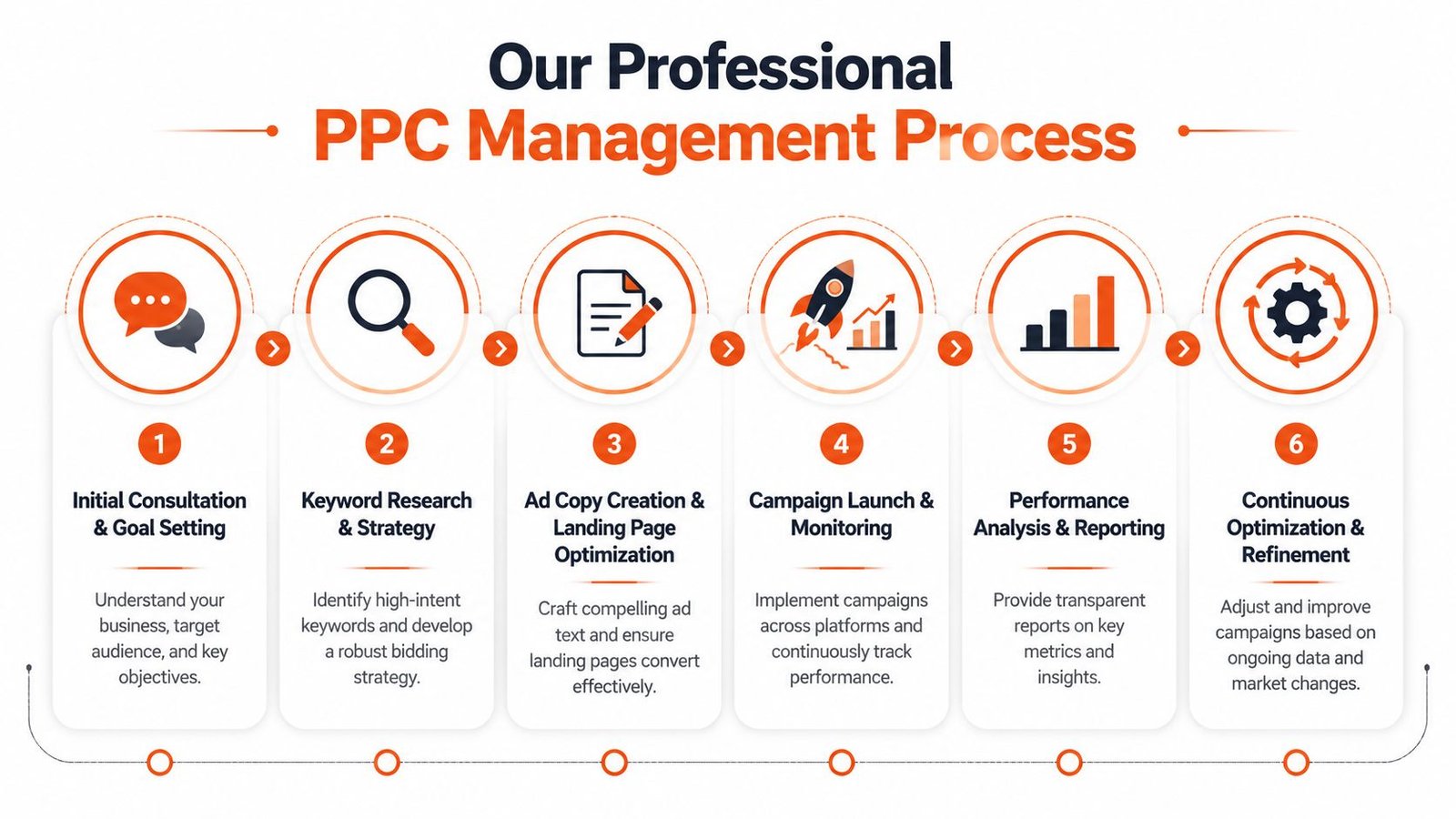
The parts that directly affect lead quality
A professional process should cover the full chain from targeting to conversion. If any link is missing, lead quality drops.
Account and market review
We look at your offers, service areas, competition, current campaigns, and where wasted spend is likely happening first.Keyword planning with exclusions
This means selecting high-intent terms and building negative keyword lists to block irrelevant searches. Skipping this step is one of the fastest ways to waste budget.Audience and location targeting
Search campaigns need precise geography. Meta campaigns need clear audience signals. Retargeting has to follow actual buying behavior, not random traffic.Ad copy and creative testing
Headlines, descriptions, calls to action, and ad angles need testing. The right message for emergency plumbing isn’t the right message for elective cosmetic services.Landing page recommendations
We don’t treat the click as the finish line. If the page is slow, confusing, generic, or missing a clear next action, the campaign underperforms.Conversion tracking setup
Calls, forms, chats, appointment requests, and purchases must be tracked properly. If they aren’t, optimization becomes guesswork.
A business looking for PPC advertising management services should expect all of that, not just campaign launch and a monthly screenshot.
How disciplined management protects your budget
Good managers don’t start by throwing money at the platform. They control risk first.
Guidance from Straight North recommends that small businesses start conservatively, reserve 10-20% of budget for testing, and review performance weekly. The same guidance highlights common mistakes such as failing to use negative keywords, neglecting geo-targeting, and not tracking key metrics like CPA and ROAS (see the PPC strategy guidance).
That approach matters because small accounts can’t absorb sloppy testing. Every wrong click has a cost.
Here is what disciplined management looks like in practice:
| Focus area | What happens | Why it matters |
|---|---|---|
| Search term review | Irrelevant queries get excluded | Prevents repeat waste |
| Weekly optimization | Bids, ads, and targeting get adjusted | Keeps campaigns responsive |
| Lead quality review | Sales feedback gets folded into targeting | Improves downstream results |
| Landing page alignment | Message and offer stay consistent | Increases conversion probability |
Client-side reality: If your agency can’t explain where wasted spend is coming from, they probably aren’t controlling it.
The management fee only makes sense when the process is active, accountable, and tied to lead quality. Anything less is just account maintenance.
The Real Cost of DIY vs Hiring a PPC Agency
DIY PPC looks cheaper on day one. That doesn’t mean it costs less.
The cost shows up in missed calls, weak lead quality, wasted hours, and delayed learning. Small businesses usually don’t lose with one catastrophic mistake. They lose by spending month after month on campaigns that were never built tightly enough to perform.
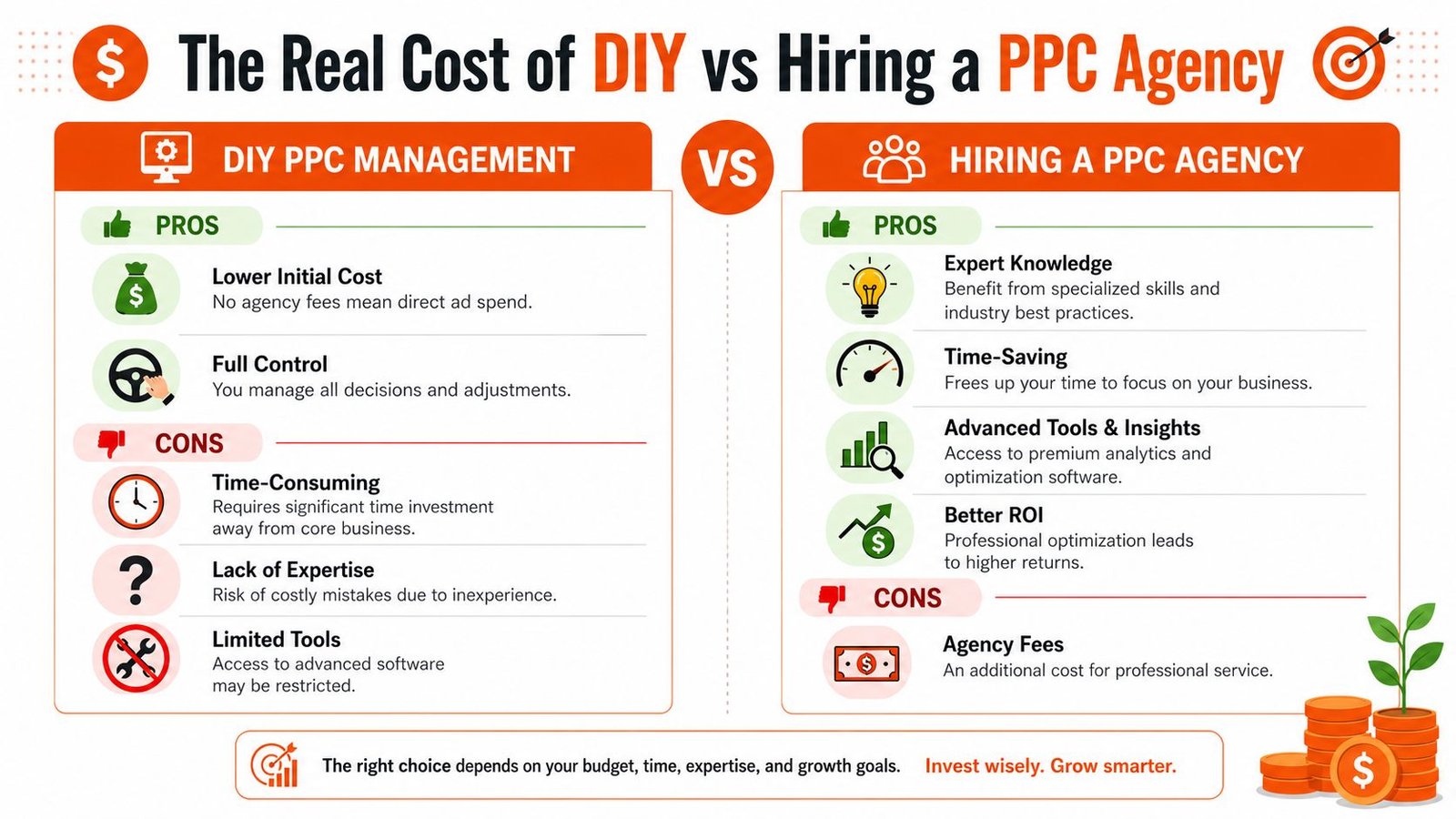
DIY feels cheaper until you price your time and mistakes
If you’re running campaigns yourself, ask a hard question. What is your time worth when it’s pulled away from sales, operations, staff, and customer service?
PPC isn’t just setup. It’s ongoing management. Search term cleanup, bid review, location controls, ad testing, landing page checks, and conversion validation all need attention. If you don’t do that work regularly, the platform keeps spending anyway.
There’s also the complexity problem. Google has pushed automation heavily, and that creates a trade-off. Automation can help with bidding and scale, but it can also reduce visibility into what the platform is doing with your budget if nobody is watching closely. That’s especially risky for local and service businesses where poor search matching can generate the wrong clicks fast, a concern discussed in this coverage of local PPC automation and oversight.
For context, industry data summarized by Network Solutions states that the average PPC management cost is $1,001–$3,000 per month, and around 33% of small businesses spend $100–$5,000 per month on the ads themselves (review the small-business PPC cost data). That isn’t a reason to avoid management. It’s a reason to make sure the spend is controlled and measurable.
A short comparison makes the trade-off clearer:
| Option | What you save upfront | What you risk |
|---|---|---|
| DIY management | Agency fees | Time, slower learning, wasted ad spend |
| Professional management | Internal time | Additional service cost, but with structured oversight |
Later in the decision process, this video is worth watching because it frames the choice in practical terms:
Agency management is about control, not surrendering it
A lot of owners hesitate because they think hiring an agency means giving up visibility. It shouldn’t.
A good agency gives you more control because it gives you better information. You should know what campaigns are active, what offers are being promoted, what lead actions are tracked, and where budget is being shifted. The point isn’t to hide complexity from you. It’s to handle it without asking you to become a part-time media buyer.
When comparing options, don’t ask only about fees. Ask:
- How often is the account reviewed
- How are negative keywords managed
- What counts as a conversion
- How is local targeting controlled
- What happens when lead quality drops
- How is performance reported back to you
If you’re evaluating providers, use a clear checklist before signing anything. This guide on how to choose a Google Ads management agency is a useful place to pressure-test what a provider is really offering.
Measuring Success How We Track Your ROI
Clicks are easy to buy. Profitability is harder to earn.
That’s why serious PPC management doesn’t celebrate traffic by itself. It tracks whether paid traffic produces the actions that grow the business. For a local company, that usually means calls, estimate requests, booked appointments, contact forms, or purchases. If those actions aren’t improving, the campaign isn’t doing its job.
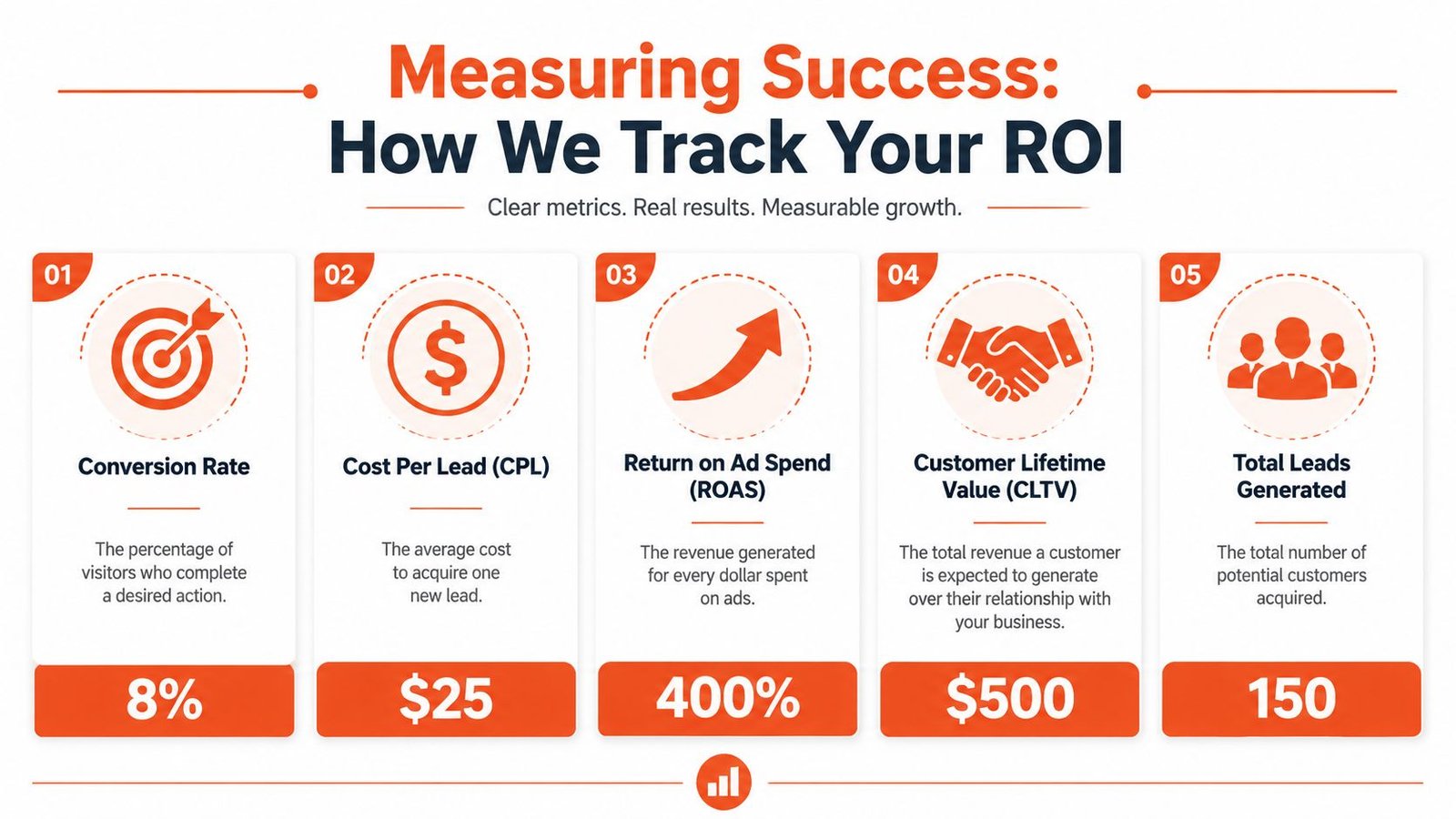
We care about leads, not vanity metrics
Most underperforming accounts focus on the wrong scoreboard.
Impressions can rise while lead quality falls. Click volume can look healthy while your front desk reports poor-fit inquiries. A lower cost per click can still be a bad outcome if the clicks aren’t turning into customers.
The metrics that matter are more practical:
- Conversion rate: How often a visitor becomes a lead or customer.
- Cost per acquisition or cost per lead: What you paid to create a real opportunity.
- ROAS: Whether ad spend is producing meaningful return.
- Lead quality: Whether the inquiries match your services and budget expectations.
- Sales follow-through: Whether the business is responding fast enough to capture the demand it’s paying for.
A campaign can look busy and still be unprofitable. The dashboard isn’t the business.
This is also why proper tracking setup matters. If attribution is messy, decisions get made on incomplete information. Businesses that want cleaner reporting should connect ad performance with analytics, call tracking, and lead actions from the start. If your current measurement setup is weak, this walkthrough on how to set up Google Analytics 4 is a useful baseline.
Benchmarks matter, but profit matters more
Benchmarks are useful for context, not comfort.
Fit Small Business reports an average PPC conversion rate of 2.35%, and notes that Google Ads campaigns are generally considered healthy above 1.8% (see the benchmark reference). Those numbers help frame whether an account is severely underperforming, but they shouldn’t be treated as the finish line.
A local service business with strong margins may accept a different lead cost than an e-commerce brand with thinner margins. A law firm may value one qualified lead very differently than a restaurant running short-term promotions. That’s why strong managers use benchmarks to diagnose. They use business economics to decide.
Bottom-line test: If the campaign brings in profitable customers at a sustainable cost, keep scaling what works. If it doesn’t, fix the system before increasing spend.
Start Generating Leads Not Just Clicks
Small businesses don’t need more dashboard activity. They need more revenue-producing opportunities.
That’s a compelling reason to take PPC seriously. Search ads and paid social can put your business in front of buyers when intent is high, but only if the campaigns are controlled tightly enough to turn that attention into calls, leads, and customers. Poor targeting, weak landing pages, lazy keyword management, and missing tracking don’t just hurt performance. They waste time you can’t get back.
The choice of a Google Ads agency for small business, a local SEO and PPC partner near me, or a team capable of making paid traffic accountable shouldn’t come down to who talks the most. It should come down to who can show a clear process, explain how lead quality is protected, and tie every campaign decision back to business outcomes.
Waiting has a cost. So does staying with a weak agency. So does running campaigns yourself without enough time to manage them properly.
The next step is simple. Get your account reviewed, identify where money is leaking, and get a plan built around qualified leads instead of random clicks. That’s how paid traffic becomes a reliable growth channel instead of a monthly frustration.
Book a free strategy session with VIP TECH CONSULTING if you want a clear assessment of your current PPC performance, where budget is being wasted, and what it would take to turn your campaigns into a steadier source of calls and leads. If your market is competitive, waiting usually means paying more later for the same clicks while your competitors capture the searches you should have owned.