
If your business isn’t showing up when someone searches “near me” in Manhattan, Brooklyn, Queens, or the Bronx, you’re not dealing with a branding problem. You’re dealing with a lead problem.
In New York, the customer who needs a dentist, roofer, lawyer, med spa, HVAC company, or accountant usually doesn’t browse for long. They search, compare a few listings, and contact whoever looks most credible and easiest to reach. If your visibility is weak, your competitor gets the call.
That’s why local SEO services in New York matter. Not as a checklist of SEO tasks, but as a system for generating calls, form fills, direction requests, and booked appointments from high-intent local searches. If you want a realistic view of what’s blocking your visibility, start with a local SEO checklist for service businesses and see where your current setup is falling short.
Table of Contents
- Why Your NYC Business Is Invisible on Google Maps
- The Blueprint for Dominating NYC Local Search
- Our Proven Process for Local SEO Growth
- How We Measure Local SEO ROI in New York
- Real Results for Businesses Like Yours
- How to Choose the Right Local SEO Partner
- Your NYC Local SEO Questions Answered
Why Your NYC Business Is Invisible on Google Maps
If your listing is buried, your business is losing demand that already exists.
That loss is easy to underestimate because its impact isn’t immediately obvious. A potential customer searches “immigration lawyer near me” in Queens or “emergency plumber Manhattan” on mobile, sees a map pack, taps one of the visible options, and never visits your site at all. You don’t know the search happened. You only feel the missed revenue later.
The economics of that are brutal in New York because search visibility compounds. Businesses that appear prominently collect more calls, more reviews, more engagement, and more trust signals. Businesses that don’t appear stay stuck waiting for referrals or paying for every click.
According to local SEO guidance focused on New York businesses, over 53% of all website traffic comes from organic search and more than 75% of users never leave the first page of Google. In plain terms, if your business isn’t visible on page one, most of your market won’t see you.
Why this happens in NYC
Most underperforming local campaigns fail for predictable reasons:
- Weak Google Business Profile setup that doesn’t fully support the services, categories, or locations that drive revenue
- Inconsistent business data across directories, the website, and local listings
- Thin local landing pages that mention New York once and expect to rank across multiple boroughs
- Poor review management where strong customer feedback comes in sporadically or isn’t answered
- Technical drift on the website that slowly erodes local relevance and crawlability
Practical rule: In New York, a small local SEO flaw doesn’t stay small for long. Competitors capitalize on it fast.
A lot of business owners assume they have a traffic problem. Often they have an attribution problem first and a local visibility problem second. Their site may get visits, but the map pack, local landing pages, and Google Business Profile aren’t structured to turn local intent into trackable leads.
That’s where professional local SEO services in New York become valuable. The right provider doesn’t just try to “improve rankings.” They build local search visibility around the actions that matter most to your business. Calls. Quote requests. Appointment bookings. Store visits.
If you’re comparing agencies right now, don’t wait until another quarter passes with vague reporting. Get a clear audit, identify where leads are leaking, and fix the local assets that influence buying decisions.
The Blueprint for Dominating NYC Local Search
Strong local performance in New York comes from discipline, not hacks. The businesses that win treat local SEO like an operating system. Their profile is maintained, their website supports location intent, their reviews are active, and their technical SEO is monitored continuously.
A credible campaign also has to match the pace of the city. As noted in this New York local SEO service overview, effective local SEO in New York requires weekly technical health crawls, daily rank tracking, and ongoing page-level optimization of title tags, meta descriptions, and schema. That tells you something important. This isn’t a one-time setup.
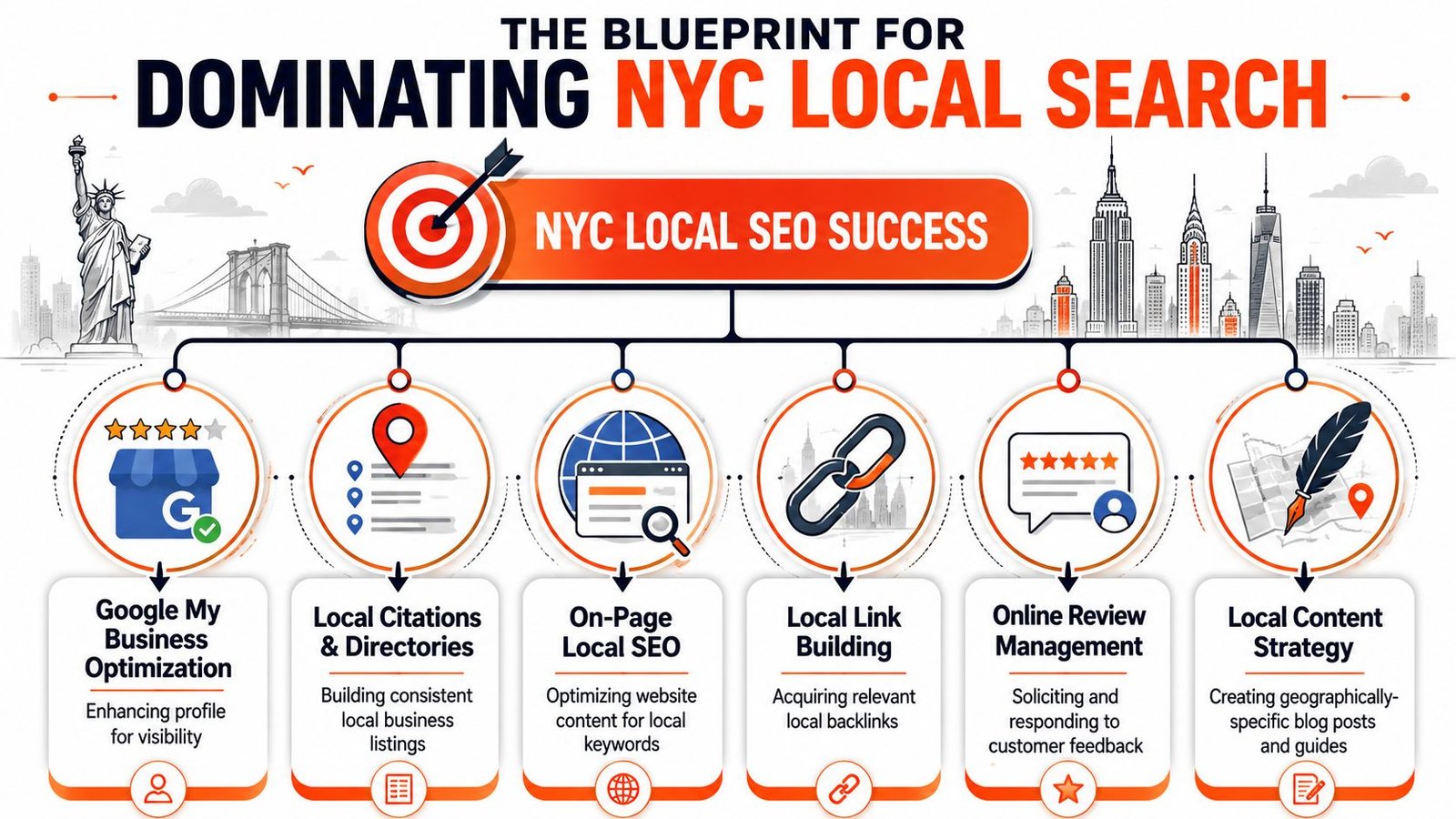
For businesses comparing providers, this is the minimum standard a serious local SEO marketing service should meet.
Google Business Profile has to be treated like a revenue asset
Your Google Business Profile is usually the first sales touchpoint in local search. In NYC, that means it can’t be left half-maintained by an office manager who updates holiday hours once in a while.
A competitive setup includes:
- Primary and secondary category alignment based on your real revenue drivers, not broad guesses
- Service and location specificity that reflects neighborhoods, boroughs, or service areas you intend to win
- Review strategy built around steady acquisition and thoughtful responses
- Media and post management that keeps the profile active and credible
A common mistake is trying to rank one profile for everything. That usually creates weak relevance. A better approach is narrowing the profile and supporting it with the right landing pages.
Your website needs local intent architecture
A homepage that says “serving all of New York” won’t do much on its own.
Your site has to support local search with focused pages and clear internal linking. That often includes location pages, service-area pages, borough-level content, local schema, mapped service copy, and metadata tuned to how people search.
What works:
| Asset | What it should do |
|---|---|
| Location pages | Match neighborhood or borough intent without duplicating copy |
| Service pages | Clarify high-value services and conversion paths |
| Internal links | Connect local pages to relevant services and trust pages |
| Schema and metadata | Reinforce context for both search engines and users |
Most agencies talk about keywords. Better agencies build local relevance into site structure, entity signals, and conversion paths.
The last piece is authority. Citations, local links, and review velocity all reinforce whether Google should trust your business for a given area. Without that support, even a technically sound site can stall.
Our Proven Process for Local SEO Growth
Most agencies make local SEO sound abstract because abstraction hides weak execution. A serious process is specific. You should know what happens in month one, what gets fixed first, how reporting works, and what your team is expected to provide.
That clarity matters more in New York because local search campaigns break down when ownership is fuzzy. The profile needs one strategy. The site needs another. Tracking has to connect both.
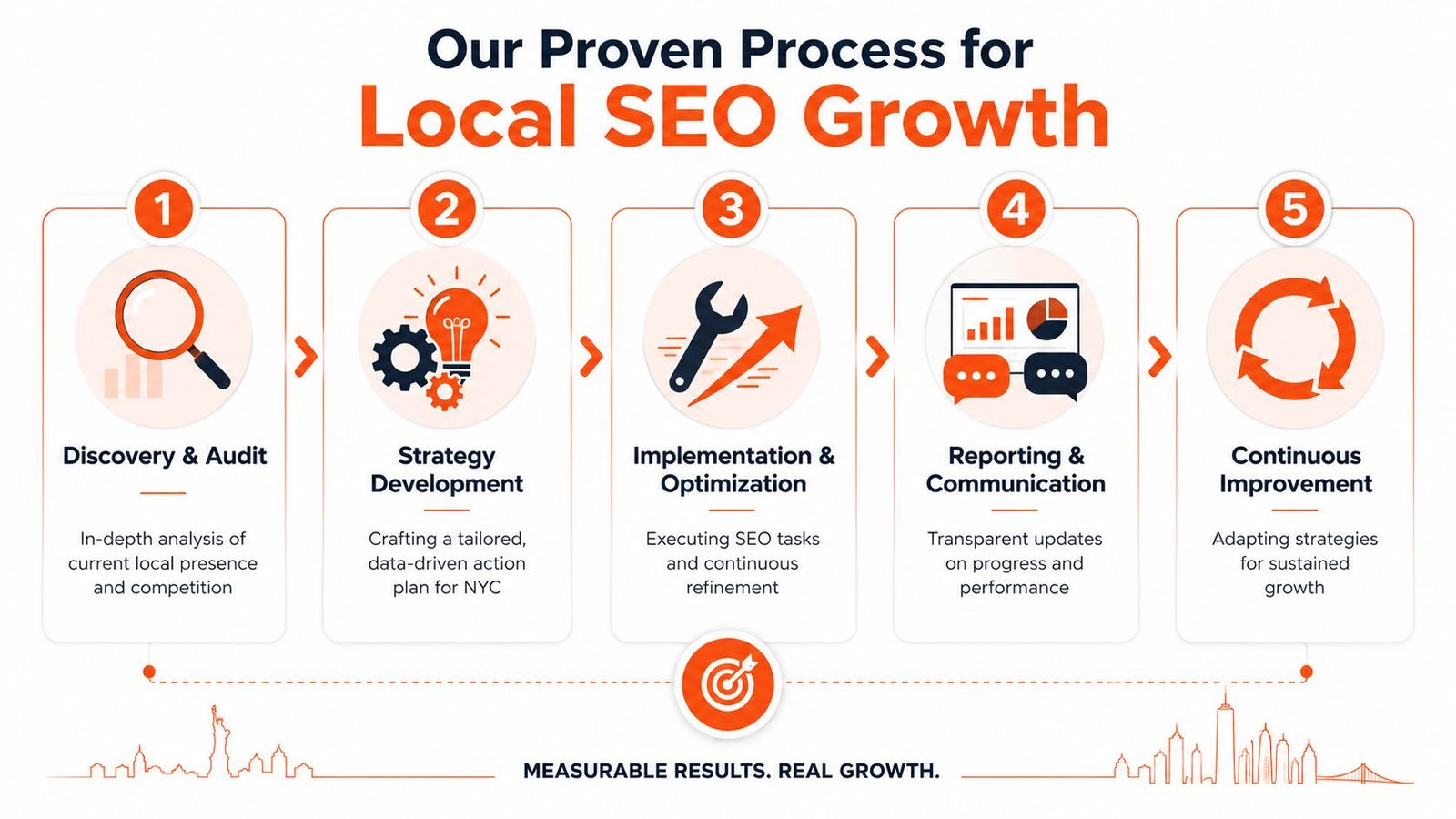
For home service brands, the process also has to account for route-based demand, uneven lead quality, and multiple service areas. That’s why many contractors compare options like local SEO for home services before choosing a provider.
Phase one starts with pressure testing the market
The first step isn’t “add keywords.” It’s understanding where your leads should come from and where competitors are beating you.
A proper opening phase includes deliverables like:
- Local competitive audit covering map pack visibility, review profile, page targeting, and local content gaps
- Google Business Profile review to spot category issues, weak descriptions, missing services, and engagement gaps
- NAP consistency review across your website and major citations
- Tracking audit to determine whether calls, forms, and location actions are measurable
- Strategy session focused on boroughs, neighborhoods, and services with the strongest commercial value
Weak agencies reveal themselves if they can’t explain why one service should target borough-level pages while another should target a citywide page; they don’t have a real local strategy.
A quick look at how this kind of system is explained in practice can help:
Execution is monthly, not occasional
Once the foundation is clear, local growth comes from recurring work. Not random edits. Not isolated blog posts. Not a report full of screenshots.
A typical execution cycle includes:
- Technical fixes for crawl issues, indexing friction, page speed blockers, schema gaps, and metadata weaknesses
- GBP optimization through service updates, image management, post activity, review response workflows, and conversion-oriented profile improvements
- Local landing page refinement so each page matches the intent behind the searches it targets
- Citation cleanup and authority work to tighten trust signals across the local ecosystem
- Content support for service-location combinations that deserve their own search entry points
If an agency says they “set up local SEO” in the first month and mostly maintain it after that, you’re probably buying light account management, not competitive execution.
The reporting layer matters just as much as the work itself. Clients should receive a performance view tied to leads, not a list of tasks completed. That means showing where calls came from, which pages generated forms, what profile interactions increased, and where conversion paths still need improvement.
One provider in this space is VIP TECH CONSULTING, which offers local SEO as part of a broader digital marketing stack that also includes PPC, websites, and reputation management. For NYC businesses, that kind of setup can be useful when local SEO needs to connect with paid search and conversion improvements instead of operating in isolation.
How We Measure Local SEO ROI in New York
The biggest mistake in local SEO reporting is treating rankings like the finish line.
They’re not. Rankings are a visibility signal. They don’t tell you whether a Manhattan personal injury firm got more qualified consultations, whether a Brooklyn med spa booked more treatments, or whether a Queens contractor generated better calls instead of low-intent price shoppers.
That distinction matters in New York because local visibility is fragmented. A business can appear in one neighborhood, disappear in another, surface on mobile but not desktop, and generate map actions that never show up in basic SEO reports. That’s why this local SEO analysis makes an important point: Google emphasizes meaningful interactions such as calls, website visits, and direction requests, which makes conversion-based measurement more useful than position tracking alone.
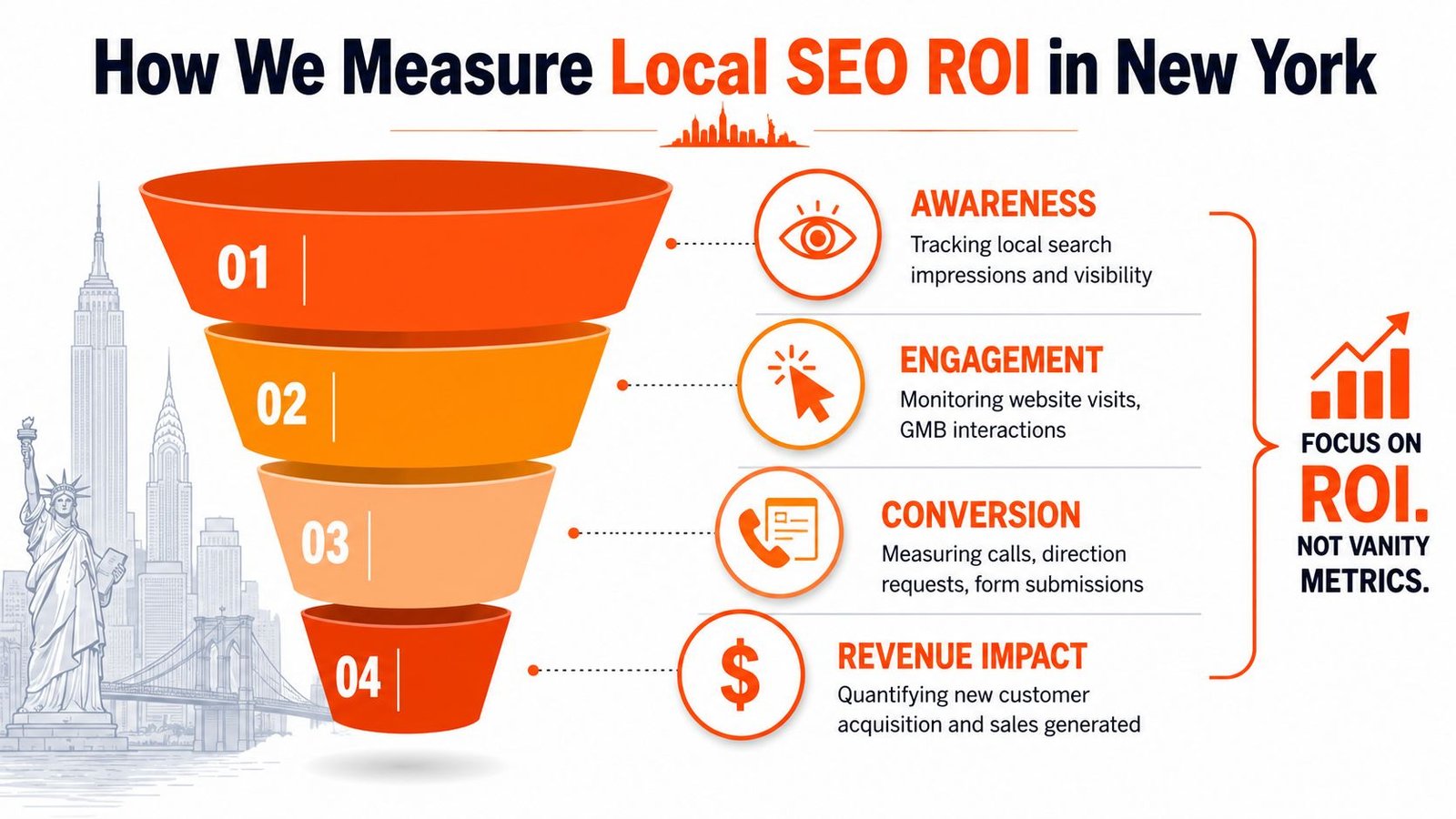
Rankings don’t tell you what your pipeline is doing
A business owner doesn’t pay for position reports. They pay for growth.
Here’s where agencies often mislead clients:
- They highlight keyword movement without showing whether lead volume improved
- They report traffic broadly without separating branded, local, and commercial intent
- They ignore profile actions that often carry the strongest local buying intent
- They don’t connect leads to landing pages so budget decisions stay vague
If your report doesn’t answer “what produced calls and bookings this month,” it isn’t helping you manage ROI.
What gets tracked in a serious local campaign
For a local campaign to be financially useful, tracking needs to cover the actions closest to revenue. That usually includes a combination of profile interactions, website conversions, and landing-page performance.
Key examples include:
- Call tracking from local intent pages so you can see which services and locations generate real inquiries
- Form submissions by landing page to identify which location-service combinations are converting
- Direction requests and website clicks from Google Business Profile because those often signal strong local buying intent
- Lead quality review through CRM notes, intake feedback, or sales team follow-up
- GA4 event tracking setup so conversion paths are measured cleanly, which is why many teams review a guide on setting up Google Analytics 4 for accurate attribution
A local SEO campaign that can’t attribute leads will eventually be judged by opinion. That’s when good channels get cut and weak channels survive.
Take a Queens dental practice as a simple example. If map interactions rise but appointment requests don’t, the issue may not be visibility. It may be weak landing-page messaging, poor appointment UX, or bad call handling. This is why attribution matters. It tells you whether SEO has a traffic problem, a conversion problem, or a sales-process problem.
Real Results for Businesses Like Yours
Local SEO decisions get easier when you stop thinking in terms of tactics and start thinking in terms of business scenarios. Most NYC companies don’t need theory. They need a clear answer to one question. If we invest here, what changes?
The honest answer is that outcomes depend on competition, site quality, review profile, geography, and operational follow-through. No serious strategist should promise a fixed lift before doing an audit. What can be shown clearly is the pattern behind successful campaigns.
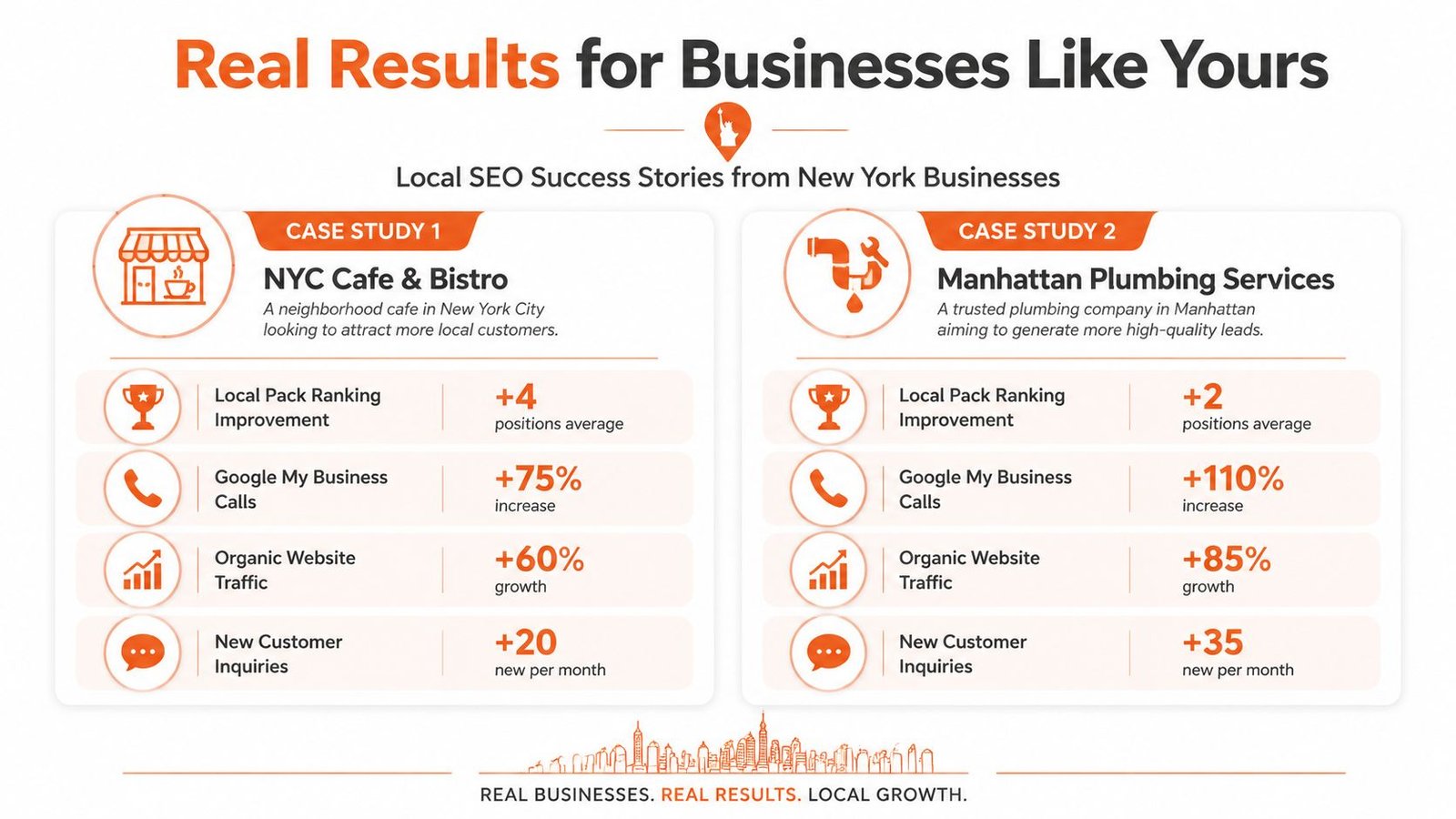
Scenario one professional services in a dense borough
A professional service firm often starts with these problems:
- Too much dependence on referrals
- Weak map visibility outside its immediate block
- Service pages that are generic and citywide
- No usable attribution beyond “we got some calls”
The fix usually isn’t more blog content. It’s tighter local architecture, stronger profile management, and conversion tracking tied to the intake process.
In practice, the changes that matter most are often straightforward:
- Reworking service pages around local search intent
- Improving review acquisition habits so social proof supports both rankings and conversion
- Cleaning up profile categories and services
- Aligning intake forms and phone handling with what local search users expect
Scenario two home services across multiple neighborhoods
Home service businesses run into a different issue. They don’t just need visibility. They need visibility in the right service areas without spreading the site too thin.
A common pattern looks like this:
| Problem | Better approach |
|---|---|
| One generic “areas served” page | Build targeted location-service pages where demand justifies it |
| Broad city targeting | Prioritize neighborhoods and boroughs with real capacity |
| Rankings as the only KPI | Track calls, forms, booked jobs, and lead quality |
| Separate SEO and PPC decisions | Use both channels based on urgency and margin |
Good local SEO doesn’t create demand from nowhere. It captures existing demand more efficiently and makes it easier to see what each search interaction is worth.
If your current provider can’t show that kind of business logic, you’re not really seeing results. You’re seeing activity. Those are not the same thing.
If you want a second opinion before renewing another contract, ask for a consultation and compare the proposed strategy against your actual lead goals, not just your current rankings.
How to Choose the Right Local SEO Partner
New York isn’t short on agencies. Semrush’s directory lists 64 local SEO companies in New York, which makes provider selection crowded from the start, as shown on the Semrush New York local SEO agency listing.
That density creates a simple problem. Many firms sound similar on the surface. They all mention visibility, optimization, and growth. The difference shows up when you ask how they measure success, how they prioritize work, and how transparent they are when results lag.
Questions that expose weak agencies fast
Use these questions in every sales call:
- What do you report on each month. If the answer is mostly rankings, impressions, and traffic, keep pressing. Ask how they track calls, leads, and booked consultations.
- What happens in the first ninety days. A strong agency can describe the audit, fixes, landing-page work, profile optimization, and reporting setup in detail.
- How do you handle multi-borough or multi-location strategy. New York requires choices. Not every service should target every area the same way.
- What is your process for NAP consistency and citation cleanup. If they wave this off, they may be outsourcing critical local work without quality control.
- How do you decide when SEO should be paired with paid search. Mature agencies know local SEO isn’t always the only lever worth pulling.
- Who owns implementation. Strategy without execution turns into delay fast.
A useful reference point is this guide on how to choose a digital marketing agency, especially if you’re comparing bundled SEO and paid media support.
Another filter is how the agency handles trade-offs. If they promise every keyword, every borough, and immediate results, you’re not hearing strategy. You’re hearing sales language.
The right partner should be willing to say no, narrow the target, define the lead goals, and explain what won’t be prioritized yet. That’s what a real plan sounds like.
Your NYC Local SEO Questions Answered
How long does local SEO take in New York
A business in Manhattan can fix basic profile issues and technical errors and still see little revenue impact for a while. That is normal in this market. New York is dense, competitive, and full of businesses that already have strong review profiles, aged domains, and location pages built to convert.
Early gains often show up first in map visibility, branded searches, and a lift in qualified calls. The harder part is turning visibility into booked jobs, consults, or store visits. That usually depends on review quality, landing page intent match, call handling, and whether tracking is set up well enough to prove what changed.
Treat any exact timeline with caution. A serious agency should give you a range after reviewing your category, borough focus, current rankings, and lead tracking setup.
How much should you budget
Budget should match revenue potential and the amount of work required to compete. A single-location business in a narrower niche will not need the same level of effort as a multi-location law firm or home services company trying to win across several boroughs.
In practice, New York local SEO is an operating expense, not a one-time setup fee. You are paying for ongoing work such as profile management, review generation, page improvements, technical fixes, publishing, and reporting that ties leads back to source. If the monthly fee is low enough that none of that can happen consistently, expect shallow execution and weak attribution.
The better budgeting question is simpler. What is one additional qualified lead worth, and how many do you need each month for the campaign to pay for itself?
Can you do local SEO yourself
Yes, if someone on your team has time, follows through, and cares about details.
That works better for businesses in less aggressive categories or smaller service areas. In New York, DIY usually stalls after the basics are done. The Google Business Profile gets set up, a few citations go live, and then the work that compounds gets delayed: review requests, page testing, spam fighting on the map, call tracking checks, service area updates, and content built around real neighborhood intent.
The issue is rarely knowledge alone. It is consistency. Local SEO rewards the businesses that keep shipping improvements after the setup phase ends.
Should you invest only in local SEO
Sometimes yes. Often no.
If you need leads this quarter, local SEO may need support from paid search, landing page testing, or stronger intake follow-up. Rankings can improve while revenue stays flat if the wrong keywords are driving traffic or if calls are not being attributed correctly. That is why I look at channel mix through a cost-per-lead lens first, not a rankings lens.
As noted on this NYC SEO company page, many agencies now pair SEO with PPC and conversion work. That approach makes sense when the goal is booked business, not just better chart screenshots.
Does your agency need to be in New York
No. They need to understand how New York buyers search, compare, and contact businesses.
That means knowing the difference between borough-level intent and neighborhood-level intent, understanding when proximity is doing the heavy lifting in Maps, and reporting in a way that helps you decide where to invest next. A team outside the city can absolutely do that. A team inside the city can still fail if they report on impressions and rankings while you are trying to figure out which locations, services, and pages are generating real leads.
If you’re comparing local SEO services in New York and want a straight answer on what’s likely to generate more calls, leads, and booked consultations, talk to VIP TECH CONSULTING. A focused strategy session can show where your current visibility is leaking revenue, which actions should be prioritized first, and whether local SEO alone is enough or should be paired with PPC and landing-page improvements.