


If your business isn’t showing up when someone searches for your service in Miami, you’re not dealing with a branding problem. You’re dealing with a lead loss problem.
A prospect is on their phone, ready to call, book, visit, or ask for directions. They search. Google shows a map, a few listings, and a short list of businesses that look credible. If you’re missing from that view, your competitor gets the click and probably the customer.
That’s why smart buyers don’t ask, “What is local SEO?” They ask better questions. What should local seo services include? How do you tell the difference between real strategy and recycled reports? What results should you expect, and how should an agency prove ROI?
If you’re comparing providers right now, this is the guide you need. And if you want a direct assessment of where your visibility is breaking down, start with a local SEO checklist for Miami businesses.
Table of Contents
- Why Your Miami Business is Invisible to Local Customers
- What a Complete Local SEO Strategy Actually Includes
- From Clicks to Customers Measuring Real Local SEO ROI
- Our Proven Process for Dominating Miami’s Local Search
- How to Choose the Right Local SEO Partner in Miami
- Common Questions About Investing in Local SEO
- Take Control of Your Local Visibility Today
Why Your Miami Business is Invisible to Local Customers
The missed lead usually looks ordinary
A Miami customer searches on their phone for a dentist, roofer, accountant, med spa, lawyer, restaurant, tutor, or repair company. They need help now, not next week. Within minutes, they compare the map pack, scan reviews, tap one listing, and move on.
Your business gets judged before your website even has a chance.

That is why local visibility directly affects revenue. As noted in Digital Applied’s local SEO statistics roundup, 46% of all Google searches have local intent, and 76% of people who search for something nearby visit a business within 24 hours, while 28% of those searches lead to a purchase the same day. If you are buried in local results, you are missing buyers who were ready to act.
The practical takeaway is simple. If your business depends on calls, bookings, direction requests, or walk-ins, local SEO is part of sales performance, not a side project for your website team.
Why Miami businesses lose local demand
Invisibility usually comes from a broken system, not a bad business.
A thin location page, an unmanaged Google Business Profile, scattered reviews, mismatched citations, weak service-page targeting, and unresolved technical issues all send the same message to Google and to customers. Your business looks less relevant, less trusted, and less ready to serve the search.
Miami makes this worse. Competition is dense, customer expectations are high, and search behavior is fast. If your competitors show cleaner listings, stronger review signals, and clearer service relevance, they get the click first.
The same pattern shows up in other call-driven categories. These strategies for home service businesses are worth reviewing because they highlight a basic truth. Lead flow drops fast when discovery, trust, and response systems are disconnected.
Business owners usually spot the problem after revenue starts wobbling. Calls dip. Form submissions become inconsistent. Foot traffic gets harder to predict. Then they search their own priority terms and see competitors taking the map results, the organic clicks, and the high-intent traffic.
At that point, buying local SEO services is not about getting reports. It is about fixing a customer acquisition channel that is already underperforming. If you want a clear starting point before you hire an agency, review this local SEO checklist for Miami businesses.
What a Complete Local SEO Strategy Actually Includes
Buying local SEO without understanding the deliverables is how businesses end up paying for activity instead of results.
A real local campaign is built around how Google evaluates local businesses. Google looks at proximity, relevance, and prominence, as explained in Sitebulb’s guide to technical SEO considerations for local businesses and local rankings. A serious agency builds its work around those three factors. That means improving how clearly you match local searches, how trustworthy your business appears across the web, and how well your location and services are supported by your website and profiles.
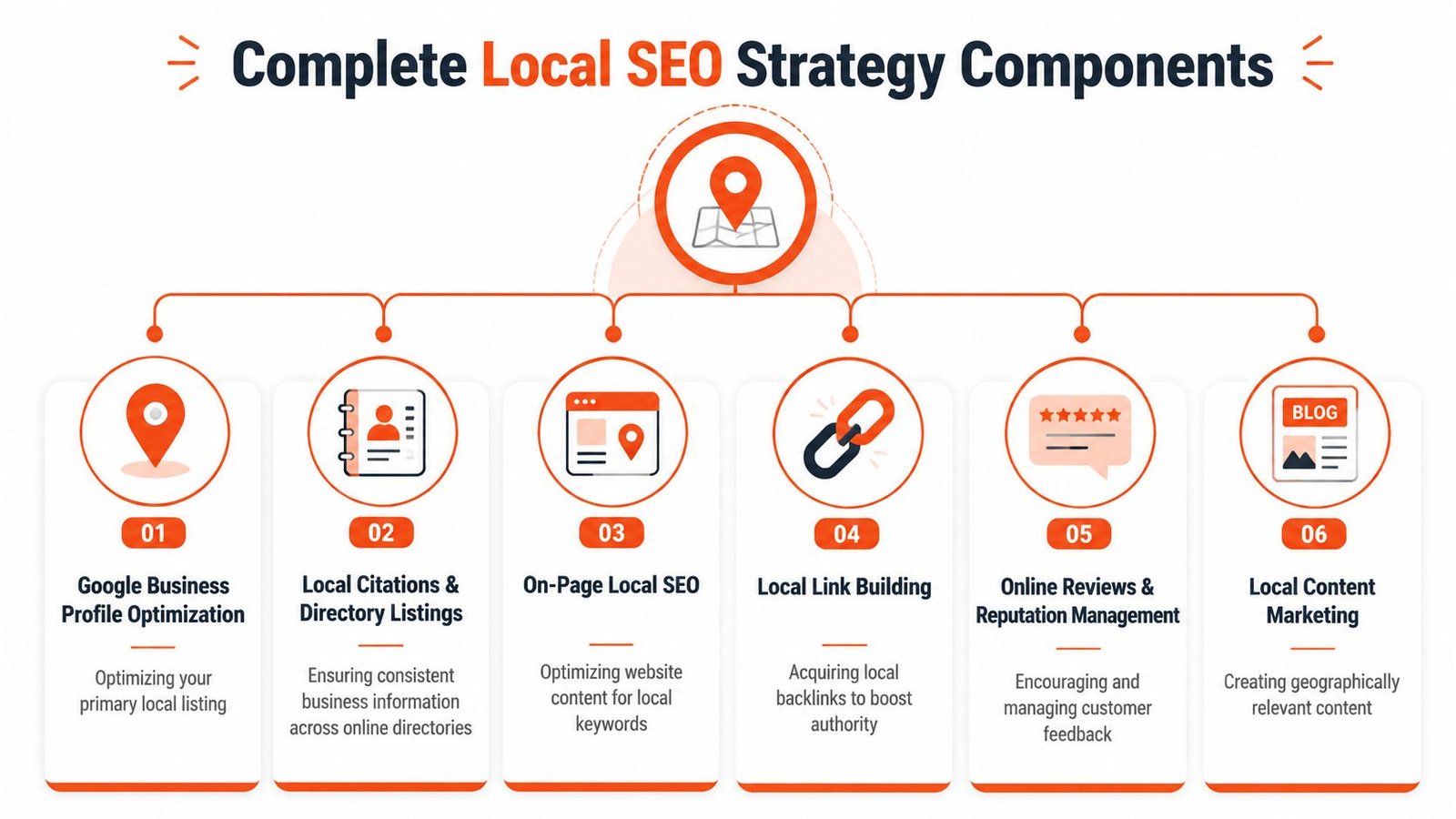
If a provider talks only about rankings, they are selling an incomplete service. In Miami, incomplete work gets buried by businesses with cleaner data, stronger reviews, better pages, and tighter execution.
The Six Parts of a Complete Local SEO Service
A professional local SEO program should cover six areas. If even one is weak, performance usually stalls.
Google Business Profile management
Your Google Business Profile drives map visibility, phone calls, direction requests, and first impressions. The work should include category setup, service configuration, business description updates, image management, Q&A monitoring, posting, and routine accuracy checks. If this profile is neglected, you lose visibility and conversions at the same time.Citation and NAP consistency
Your business name, address, and phone number must match across directories, local listings, and major platforms. Inconsistent information creates trust problems for search engines and friction for customers trying to contact you.Localized on-page SEO
Your site needs pages aligned to actual buying searches. That includes service pages, location relevance, internal linking, page titles, headings, and copy built around local intent. Swapping a city name into duplicate templates is weak SEO and usually weak sales copy too.Technical SEO for local search
Page speed, mobile usability, crawl health, indexation, schema, and site structure all affect local performance. Many local campaigns underperform because the website cannot support the visibility the agency is trying to build.Review acquisition and reputation management
Reviews shape both trust and click-through rate. A good process asks for reviews consistently, sends customers to the right platforms, and includes response management that improves credibility instead of leaving your profile unattended.Local authority building
This includes earning relevant mentions, building location-based content, and getting backlinks that support local prominence. The exact mix depends on the business, but every competitive market requires some form of authority growth.
Strong local SEO is structured. It is an operating system for local customer acquisition, not a one-time cleanup.
Use this table when you compare providers:
| Area | What you should expect |
|---|---|
| Business profile | Ongoing optimization, updates, service changes, and issue management |
| Website | Local service pages, technical fixes, schema, internal linking, and content improvements |
| Off-site signals | Citation cleanup, consistency monitoring, and authority building |
| Conversion layer | Review process, call tracking, form tracking, and direction-click reporting |
Ask every agency to show you exactly how they handle each category, how often they work on it, and how they report the outcome. If they cannot explain the process in plain language, they probably do not have one.
A detailed service page for local SEO marketing services in Miami should make the scope clear before you ever sign a contract. If the scope is vague, the execution will be vague too.
From Clicks to Customers Measuring Real Local SEO ROI
Rankings are not the KPI that pays your bills
A business owner doesn’t wake up wanting higher visibility reports. You want more qualified calls, more appointments, more booked jobs, more reservation demand, and more direction requests from people ready to buy.

That’s why most agency reporting misses the point. InMoment notes in its piece on local SEO and ROI measurement that a major gap in the industry is proving ROI beyond rankings. The article also emphasizes that while local intent is massive, most agencies still fail to connect their work to calls, bookings, and form fills in a way owners can trust.
That criticism is fair. A ranking jump means very little if weak tracking keeps you from knowing which location, page, or profile action produced the lead.
What a trustworthy ROI view should include
A real local SEO reporting system should connect visibility to actions that matter. For most Miami businesses, that means tracking:
- Phone calls from organic search and business profile activity
- Form submissions by page and service
- Appointment or reservation requests tied to landing pages
- Direction clicks and location-intent actions
- Lead quality by service line or location
- Channel overlap so SEO isn’t confused with paid traffic
That’s also why analytics setup matters early, not after the campaign has been running for months. If your tracking is weak, your conclusions will be weak. A clean GA4 setup for lead tracking is part of the infrastructure, not an optional add-on.
If an agency can’t explain how they track calls, forms, bookings, and page-level intent, they can’t explain ROI.
Here’s a simple example. A Coral Gables restaurant doesn’t just need more visibility for branded terms. It needs more reservation intent, more menu views from local searchers, and more direction requests during high-demand hours. A law firm in Brickell needs call tracking tied to practice-area pages. A med spa in North Miami needs to know which local pages generate consult-ready inquiries, not just traffic.
This quick walkthrough is useful if you want to see how business owners think about SEO performance in practical terms:
One provider that offers this kind of cross-channel service mix is VIP TECH CONSULTING, which works across local SEO, paid search, and analytics-focused lead generation for Miami businesses. That matters because local search rarely lives in isolation. Owners need to know how SEO contributes to total demand, not just map impressions.
Our Proven Process for Dominating Miami’s Local Search
What working with a serious agency should look like
A Miami business owner usually knows the pattern. An agency sells a monthly retainer, sends polished reports, and keeps the actual work fuzzy. Three months later, rankings may have moved, but calls, bookings, and qualified leads have not.
That is not a process. It is outsourced ambiguity.

Miami rewards businesses that show up clearly and consistently at the exact moment a customer is ready to act. BrightLocal’s local SEO statistics resource reports that 80% of US consumers search online for local businesses weekly, and 86% of people look up a business’s location on Google Maps. If your visibility, reviews, landing pages, and Google Business Profile are being handled loosely, you are losing demand every week.
A real local SEO engagement follows a defined operating system.
Discovery and commercial alignment
The agency needs to understand how your business makes money before it touches a title tag or business listing. That means identifying your highest-value services, strongest service areas, seasonality, margins, and what counts as a qualified lead.Local visibility and conversion audit
This should cover Google Business Profile performance, citation consistency, local landing pages, technical SEO issues, review profile strength, map pack competitors, and conversion friction on key pages. If the audit stops at rankings, it is incomplete.Priority roadmap
You need a sequence of work tied to business impact. Fixing duplicate listings, weak service pages, review gaps, and broken local signals should be ranked by likely return, not dumped into a generic monthly checklist.Execution across channels that affect local search
Strong agencies improve the profile, site, content, technical setup, reviews, and local authority signals together. Miami is too competitive for isolated tactics.Monthly analysis tied to revenue signals
You should see what changed, what improved, what stalled, and what the agency is doing next. Good reporting connects local SEO work to calls, form fills, booked appointments, and lead quality.
Clear process beats polished reporting every time.
What you should receive during the engagement
If you are buying local SEO services, buy a delivery model, not a promise.
You should have one accountable point of contact. You should know what was completed this month, what is being worked on next, and what is blocked. You should get recommendations specific to your locations and services, not recycled advice that could apply to any business in any city.
You should also expect direct answers when results are uneven. If map visibility improves but leads stay flat, the agency should diagnose the cause quickly. That may be a landing page issue, weak review trust, poor offer alignment, tracking errors, or low-intent traffic. Serious operators explain the problem and adjust the plan.
If you are comparing providers, use a structured agency evaluation process before you sign anything. This guide on how to choose a digital marketing agency gives you the right standard.
VIP TECH CONSULTING is one example of an agency that positions its work around strategy, execution, and measurable lead generation rather than generic monthly activity. That is the standard to look for. If a firm cannot show you how it plans, what it delivers, and how it measures business impact, keep shopping.
How to Choose the Right Local SEO Partner in Miami
Questions that expose weak agencies fast
A lot of agencies sell local SEO as if it’s a monthly mystery box. They count on the client not knowing what to ask.
Ask these questions and listen carefully to the answers:
How do you measure ROI beyond rankings
If they can’t speak clearly about calls, form fills, bookings, direction clicks, and lead quality, they’re not ready to manage a serious campaign.What does your process look like in the first ninety days
You’re looking for sequencing, not buzzwords.How do you handle Google Business Profile management, citation cleanup, local content, and technical SEO together
Weak agencies only talk about one piece.Who is my day-to-day contact
Sales confidence means nothing if delivery disappears after onboarding.How do you report progress when results are mixed
Good partners don’t hide behind vanity wins.
A useful filter is this. Ask them to explain what they would do if your map visibility improved but your calls didn’t. An experienced team will talk about conversion friction, tracking accuracy, review trust, landing-page alignment, and search intent mismatch.
Red flags you should not ignore
Some warning signs are immediate.
| Red flag | What it usually means |
|---|---|
| Guaranteed rankings | They’re selling certainty they don’t control |
| No discussion of tracking | They report activity, not business impact |
| One-size-fits-all packages | Your market, service mix, and radius aren’t being considered |
| No technical review | They’re ignoring site issues that limit results |
| Vague communication | You’ll struggle to get straight answers later |
The right agency should make you more informed during the sales process, not more confused.
If you’re evaluating multiple providers, use a structured checklist like this guide on how to choose a digital marketing agency in Miami. It helps separate polished sales language from an actual operating model.
Common Questions About Investing in Local SEO
Can you do it yourself
Yes, you can handle parts of it yourself. Many owners can update a Google Business Profile, ask for reviews, or clean up basic listings.
The problem is consistency, technical depth, and time. Local SEO touches site structure, page intent, citation accuracy, analytics, reviews, content, and competitive positioning. Most business owners don’t lose because they’re incapable. They lose because they can’t run operations and manage a full local search system at the same time.
How long does it take
You can see early improvements before you see dominance. Those are different things.
Profile cleanup, citation fixes, on-page changes, and technical corrections can improve the foundation relatively quickly. Stronger market position takes sustained work. In a city like Miami, competitors don’t sit still, and Google doesn’t reward one-time effort.
Local SEO is a compounding channel. The businesses that stay visible usually keep refining, not just launching.
How pricing usually works
Most agencies price local seo services as a monthly retainer, a project fee, or a hybrid of both. The right model depends on what needs to be fixed, how many locations you have, how competitive the market is, and whether tracking, content, or technical work is already in place.
Cheap retainers are usually expensive mistakes. They often buy generic tasks, weak communication, and reports that sound busy without proving anything.
The better way to think about cost is simple. Is this channel bringing in qualified leads at a healthy acquisition cost compared with your alternatives? If the answer is yes, it’s an investment. If you want a stronger understanding of how authority and trust affect this equation, read this guide on E-E-A-T in local SEO for Miami businesses.
Take Control of Your Local Visibility Today
Your customers are already searching. The only real question is whether they’re finding you or your competitors.
In Miami, local search isn’t casual browsing. It’s active buying behavior. If your map presence is weak, your service pages are thin, your tracking is unclear, or your reviews are unmanaged, you’re giving away demand you should be capturing.
The fix isn’t more guesswork. It’s a structured local SEO system with clear priorities, clean execution, and reporting tied to leads. That’s how you buy local seo services intelligently. Not by chasing promises, but by choosing a partner that can show you the work, explain the logic, and measure the outcome.
If you’re serious about improving local visibility, now is the right time to act. Every week you wait gives another Miami competitor more chances to earn the calls, visits, and bookings that should be yours.
Book a strategy session with VIP TECH CONSULTING if you want a direct review of your local visibility, your Google Maps presence, and the gaps that are costing you leads right now. The conversation should end with clarity, not a sales pitch.