
Your ads are live. Your budget is spending. Your front desk still has open slots next week.
That is not a traffic problem. It is a system problem.
A medical practice can get clicks and still lose money if the account is built like a generic local campaign. In healthcare, patient acquisition depends on more than bids and keywords. Your ads have to match high-intent local searches, your landing pages have to build trust fast, your tracking has to connect calls and forms to real appointments, and your online reputation has to support the decision before a patient ever contacts your office. If even one of those pieces is weak, Google Ads turns into an expensive guessing exercise.
That is why medical PPC should be treated as part of a larger patient acquisition system. The practices that win do not rely on ads alone. They align Google Ads with local SEO signals, strong review velocity, accurate conversion tracking, and compliant messaging that does not trigger avoidable problems. That combination gives you something far more valuable than more clicks. It gives you a defensible engine for consistent patient growth.
If your reports are vague, your lead quality is uneven, or your team cannot tell which searches produce booked appointments, get a Google Ads audit for medical practices before you spend another month funding avoidable waste.
Table of Contents
- Why Your Google Ads Are Burning Cash Not Booking Patients
- The Blueprint for a High-Performance Medical Ad Account
- Reaching High-Intent Patients Not Just High-Cost Clicks
- Crafting Ad Copy and Landing Pages That Build Trust and Pass Compliance
- From Ad Spend to ROI Your Playbook for Bidding and Measurement
- The Final Piece Your Unified Local Visibility Stack
- Stop Guessing and Start Growing Your Patient List
Why Your Google Ads Are Burning Cash Not Booking Patients
Most medical practices don’t have a traffic problem. They have a patient qualification problem.
Your ads are probably showing for searches that look related to medicine but don’t signal real buying intent. That includes people looking for jobs, research, schools, free services, insurance information, or broad symptom queries with no immediate intent to book. If your campaign structure is sloppy, Google will happily spend your budget on all of it.
The second problem is where the click lands. Too many practices send paid traffic to a homepage with five menu options, three competing calls to action, generic stock photos, and zero urgency. That’s not a conversion path. That’s a distraction machine. A patient who searched for a specific treatment wants a direct answer, a credible provider, and a fast way to book.
The third issue is one most owners never see until it hurts them. Healthcare campaigns fail when ad copy, landing page claims, privacy language, and provider credibility signals don’t line up. In this space, weak compliance habits don’t just lower performance. They create approval issues, limit scale, and make your campaign fragile.
Cheap management is expensive
A lot of practices hire the wrong kind of help. They hire a generalist freelancer, hand the account to a receptionist, or let a broad agency run medical campaigns like they run plumbers and gyms.
That’s how you end up with:
- Bloated keyword lists that attract curiosity clicks instead of appointment-ready searches
- One-size-fits-all ads that say nothing useful about specialties, urgency, or provider trust
- No real conversion tracking beyond surface-level form fills
- Homepage traffic instead of service-specific landing pages
- No negative keyword discipline to block junk searches
- No integration with local visibility signals that affect patient trust
Your competitors don’t need a better service than you. They just need a cleaner account, tighter targeting, and a faster booking path.
What a broken account usually looks like
If any of this sounds familiar, your campaign likely needs a rebuild, not a tweak:
| Warning sign | What it usually means |
|---|---|
| Plenty of clicks, weak call volume | Wrong keywords or weak landing page intent match |
| Calls come in, but lead quality is poor | Broad targeting and poor exclusions |
| Ads were approved, then performance stalled | Thin creative, weak trust signals, or poor optimization |
| Reports focus on clicks and impressions | No serious patient acquisition tracking |
| Nobody can explain why one campaign gets more budget | The account is being managed reactively |
You don’t fix this by raising spend. You fix it by replacing guesswork with structure.
If you want someone to identify exactly where your budget is leaking, request a free Google Ads account audit.
The Blueprint for a High-Performance Medical Ad Account
A strong medical ad account should look like a well-run practice. Clear departments. Clear responsibilities. Clear patient flow.
Most accounts fail because everything is crammed together. One campaign covers multiple services. One ad group contains unrelated searches. One landing page tries to sell everything. That setup kills relevance, weakens quality, and makes budgeting impossible.
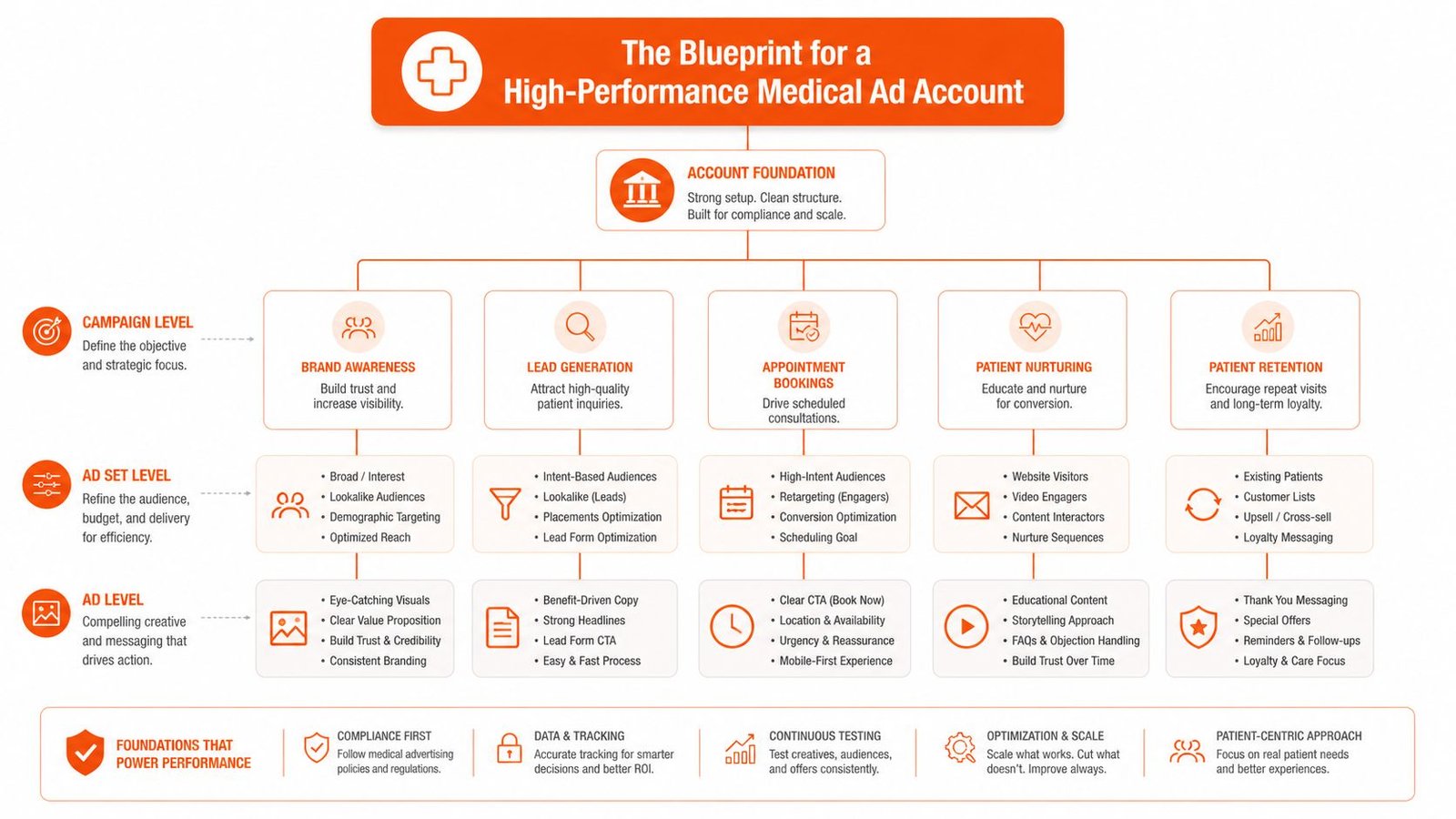
A better structure starts with the financial reality of paid search. Google Ads delivers an average ROI of 800%, or about $8 in revenue for every $1 spent, when campaigns are built around high-intent searches and local targeting according to Demandforce’s guide to Google Ads for doctors. That kind of return doesn’t come from dumping all services into one account bucket. It comes from precision.
Your account should mirror your practice
If you offer dermatology, pediatrics, orthopedics, med spa services, or urgent care, those should not live in the same generic campaign.
A professional structure usually separates campaigns by service line, then narrows further by treatment focus or patient intent. For example:
- Service-based campaigns for dermatology, orthopedics, pediatrics, or primary care
- Procedure or condition ad groups such as acne treatment, skin rash visit, knee pain doctor, or allergy testing
- Branded campaigns that protect your practice name when people search for you directly
- Competitor or specialty-adjacent campaigns only when strategy and policy allow it
- Remarketing layers for people who visited but didn’t book
Many owners often get fooled. They think a simpler account is easier to manage. It is easier. It’s also harder to optimize because the data is mixed, the messaging is generic, and the budget can’t be controlled with any confidence.
Intent segmentation is where profitability starts
Not every patient search means the same thing. “Best dermatologist near me” has different intent from “acne scar treatment Miami.” Both can matter, but they shouldn’t share the same ad copy, bid strategy, or landing page.
Split traffic by intent, not just by specialty.
Common intent buckets worth separating
Near me and local finder searches
These users want access, proximity, and convenience. Your ads should emphasize location, availability, and call options.Treatment-specific searches
These users want a solution for one condition or procedure. Send them to a dedicated page with one clear CTA.Provider trust searches
Queries around “board-certified,” “specialist,” or branded provider names need authority-focused messaging.Urgency-driven searches
Same-day, walk-in, or rapid scheduling queries need immediate-response messaging and phone-first conversion paths.
Practical rule: If a search deserves its own message, it deserves its own ad group.
Tracking is part of the build not an add-on
A lot of agencies bolt tracking on later. That’s backwards.
You need to know which keyword drove the call, which call became an appointment, and which service line produces profitable patients. Without that, optimization turns into opinion.
At minimum, a serious setup should track:
- Phone calls from ads and landing pages
- Form submissions tied to the right campaign and service
- Booked consultations or appointment requests
- Offline outcomes when your team confirms the patient scheduled
This is also where tools and implementation matter. A clean analytics setup, CRM integration when available, and structured campaign taxonomy make management far easier. Platforms such as CallRail, Google Ads conversion tracking, Google Analytics 4, and medical-practice CRM workflows can work together if someone sets them up correctly. Providers that need outside help often use a specialist agency or a focused partner such as VIP TECH CONSULTING for campaign build, landing page alignment, and lead tracking across local service businesses and clinics.
What good structure changes immediately
A well-built account gives you control over three things that directly affect growth:
| Area | Weak setup | Strong setup |
|---|---|---|
| Budget allocation | Spend gets spread randomly | Spend follows service-line priorities |
| Ad relevance | Generic messaging across searches | Search-specific messaging improves fit |
| Reporting clarity | You see activity | You see which services and searches produce patients |
That’s the difference between “we’re running ads” and “we know what’s producing patients.”
Reaching High-Intent Patients Not Just High-Cost Clicks
If your keyword strategy is loose, your campaign will attract attention instead of appointments.
That’s the easiest way to burn money in healthcare PPC. A broad list of medical terms feels productive because impressions and clicks come fast. But your front desk can’t bill impressions. You need searches from people who are actively trying to find care in your service area.
Most practices buy traffic instead of patient intent
The right way to handle keywords is to cluster them around specialty, condition, treatment, and location. That creates tighter ad groups and sharper messaging. It also gives you control over where budget goes.
According to Sona’s medical practice Google Ads guide, medical practices that use precision keyword clustering and aggressive negative keyword management can prevent 20% to 30% of budget waste from low-intent clicks, and localized campaigns can produce 2x to 3x higher click-through rates.
That’s why a serious keyword map usually includes combinations like:
- Service plus city such as “pediatrician Miami”
- Condition plus provider type such as “knee pain doctor”
- Procedure plus local modifier such as “allergy testing near me”
- Trust-driven local searches such as “board-certified dermatologist near me”
Broad match without oversight is one of the worst habits in medical PPC. It lets Google expand into queries that may be medically adjacent but commercially useless.
Your negative keyword list is a profit tool
Negative keywords are not cleanup. They’re a core targeting system.
If you don’t actively exclude irrelevant searches, your account will drift. That drift usually goes toward curiosity traffic, job seekers, and information seekers who were never likely to book.
Terms that commonly deserve exclusion
- Employment intent such as jobs, careers, salary, hiring
- Education intent like school, training, certification, textbook
- Free-seeker intent including free clinic or free consultation when that offer doesn’t exist
- Research intent such as definition, PDF, journal, study
- DIY intent when users want home remedies rather than care
Not every term belongs on every exclusion list. The point is discipline. Review search terms every week. Cut waste quickly. Stop paying for noise.
The search terms report tells the truth faster than the campaign dashboard does.
Local targeting needs tighter boundaries
Medical practices don’t need broad reach. They need qualified local reach.
A campaign that targets an entire metro area without considering drive time, office location, service line, and patient behavior usually spends too widely. Location settings, radius targeting, zip-level exclusions, and location extensions should reflect where patients will realistically travel from.
Your targeting should also match how different services behave. A cosmetic consultation may justify a wider service radius than routine primary care. A pediatric clinic may need messaging and audience signals aligned with parents. An orthopedic practice may perform better with campaigns segmented by procedure and intent instead of one catch-all setup.
If you want a tighter framework for service-area control, review this guide to Google Ads location targeting for local campaigns.
A practical keyword decision filter
Before adding any keyword, ask four questions:
| Question | If the answer is no |
|---|---|
| Does this search suggest the user wants care, not information? | Don’t bid on it |
| Can I write a highly relevant ad for it? | Put it in a different group or skip it |
| Do I have a landing page that matches it? | Build one before spending |
| Would I want my front desk handling this lead? | Exclude it |
That filter saves more budget than most bid tweaks ever will.
Crafting Ad Copy and Landing Pages That Build Trust and Pass Compliance
A medical ad doesn’t win because it’s clever. It wins because the right patient sees it, trusts it, and takes action without hesitation.
Most practice ads are forgettable. They say things like “quality care,” “trusted team,” or “professional service.” That language is empty. Every clinic says it. Patients don’t respond to generic reassurance. They respond to specifics that reduce uncertainty.
Generic ads get ignored
Strong medical ad copy should reflect decision factors behind a booking.
That often means emphasizing availability, provider credibility, treatment focus, and convenience. Useful lines are usually simple and direct. Same-day appointments. Board-certified specialists. Convenient Miami location. Call now to schedule. These are not glamorous headlines. They work because they answer practical patient questions.
Ad extensions matter too. Sitelinks, call extensions, location extensions, and callouts make the ad larger and easier to act on. They also reduce friction by giving searchers immediate paths to services, directions, and calls.
Patients don’t click the ad that sounds smartest. They click the one that feels safest and easiest to act on.
Your landing page is your digital front desk
If the ad earns attention, the landing page has to close the gap between interest and action.
A high-converting medical landing page should do a few things immediately:
- Match the ad promise so the visitor knows they landed in the right place
- Name the service clearly instead of forcing the visitor to hunt
- Show trust signals such as credentials, provider information, patient-friendly language, and reviews where appropriate
- Use one primary call to action like booking, calling, or requesting an appointment
- Work cleanly on mobile because a lot of medical ad traffic comes from phones
Sending paid traffic to a generic homepage is one of the most common mistakes in healthcare advertising. A focused page performs better because it removes choice overload.
If your current site isn’t built for paid traffic, start with a proper lead generation website structure for service businesses.
Compliance problems kill campaigns quietly
Many agencies often reveal a critical limitation. They know how to launch ads. They don’t know how to launch healthcare ads safely.
As noted in Precision Marketing Partners’ overview of medical practice Google Ads, many guides stay vague about how reviews, licensing signals, privacy disclosures, and disclaimer structure affect ad performance. That gap matters most for sensitive categories such as cosmetic, mental health, or fertility-related services.
If your landing page lacks clear privacy language, provider credentials, or treatment limitations where needed, your campaigns can run into restrictions or weaker performance. Even when ads are approved, a weak trust presentation hurts conversion.
A few essential elements:
Display professional credibility clearly
Include provider names, certifications, specialties, and office details where relevant.Make privacy easy to find
Don’t bury privacy language or patient communication expectations.Use careful claims
Avoid exaggerated medical promises and vague superlatives.Handle reviews responsibly
Reputation is part of conversion, but it has to be presented thoughtfully. If you’re reworking how your practice handles review visibility, removals, and privacy concerns, this guide on online reputation for doctors is worth reviewing.
Practices that get this right don’t just get more clicks. They convert more of the right patients and avoid preventable policy headaches.
If you want someone to review your landing pages for conversion and compliance risk, schedule a consultation before your account drifts further.
From Ad Spend to ROI Your Playbook for Bidding and Measurement
Good bidding doesn’t rescue a bad account. It amplifies a good one.
That’s where many practices get stuck. They hear terms like Target CPA or Maximize Conversions and assume Google’s automation will sort everything out. It won’t. Smart Bidding is powerful, but only when the account structure, conversion tracking, and landing pages are already clean.
Smart bidding only works with clean signals
Automation performs best when you feed it meaningful conversion data.
According to Patient Care Marketing Pros on optimizing Google Ads for healthcare services, continuous optimization can improve key metrics by 20% to 50%, and using Smart Bidding, A/B testing, and mobile-optimized landing pages with a single CTA can lift conversions by 30% to 50% while lowering acquisition costs by 25% to 40% in competitive markets like Miami.
Those gains don’t come from switching on automation. They come from managing it correctly.
A healthy bidding system usually includes:
- A primary conversion action tied to a meaningful lead event
- Secondary tracking for calls, forms, and appointment requests
- Weekly review of search terms and ad performance
- Bid strategy choices based on actual business goals, not platform defaults
Budget decisions should follow booked-patient data
Most practices set budgets based on comfort, not opportunity. That’s understandable, but it’s not how you scale.
You should fund the campaigns, keywords, and locations that produce appointment-ready leads and real patient outcomes. That requires more than ad-platform reporting. You need to connect front-desk reality to campaign decisions.
Track what your practice actually cares about
| Metric | Why it matters |
|---|---|
| Qualified phone calls | Shows immediate appointment intent |
| Form submissions | Captures non-call leads from mobile and after-hours traffic |
| Booked appointments | Ties marketing to actual patient flow |
| Service-line performance | Helps you shift spend to higher-value demand |
This is why offline conversion imports matter so much. If someone clicks an ad, calls the office, and books later, the platform should learn from that outcome. Without that signal, Google optimizes toward shallow actions instead of patient acquisition.
If your measurement setup is weak, tighten your reporting with a proper Google Analytics 4 implementation guide for lead tracking.
A campaign isn’t profitable because the dashboard says conversions increased. It’s profitable when your team can tie those conversions to scheduled patients.
Testing is how strong campaigns get stronger
Most ad accounts plateau because no one is testing with discipline.
You should regularly test:
- Ad variations with different trust cues, offer framing, and calls to action
- Landing page headlines that match search intent more closely
- Form length when balancing lead volume and lead quality
- Call-first versus form-first layouts by service line
- Device and schedule adjustments based on when your team can respond well
Not every test needs to be dramatic. Often, the winning improvement is simple. Tighter message match. Cleaner mobile layout. Better call handling during business hours. More accurate conversion feedback into Google Ads.
That’s how spend turns into an investment instead of a recurring frustration.
The Final Piece Your Unified Local Visibility Stack
A lot of agencies manage Google Ads like it exists in isolation. That’s outdated.
Patients don’t think in channels. They search, scan the page, compare what they see, and click the option that feels most credible. That means your paid ads, Google Business Profile, review profile, and local presence should reinforce each other.
Patients click the result that looks most credible
A search for a doctor or clinic often shows a mix of paid ads, map results, and other local elements. If your ad appears but your Google Business Profile looks neglected, the patient notices. If your reviews look stale, the patient notices. If your business details are inconsistent, the patient notices.
That inconsistency reduces trust before the click even happens.
This is the local visibility gap most providers miss. As noted in Officite’s medical practice marketing discussion, many guides fail to explain how ad spend, keyword targeting, Google Business Profile signals, and Local Service Ads can work together. When healthcare advertisers coordinate those assets, they tend to see lower cost per lead and stronger appointment conversion, but few agencies turn that into an actual clinic workflow.
Ads GBP and LSAs should support each other
A strong local stack usually looks like this:
- Google Ads captures urgent, high-intent search demand for services and treatments
- Google Business Profile supports map visibility and trust with accurate categories, services, photos, posts, and reviews
- Local Service Ads can add another trust layer where available and appropriate
- Landing pages keep messaging consistent with both ad intent and local service expectations
This creates what I call defensive visibility. Your practice shows up in more than one place, with aligned messaging, location credibility, and easy conversion paths. Competitors have to beat you across multiple surfaces, not just one ad auction.
That level of coordination is hard to do casually. It requires someone watching search behavior, local intent, review presentation, and budget overlap at the same time.
If you’re evaluating whether Local Service Ads belong in your mix, this overview of Google Local Services Ads for local lead generation is a useful starting point.
Stop Guessing and Start Growing Your Patient List
By now, the pattern should be obvious. Most medical Google Ads campaigns fail for structural reasons, not because the channel doesn’t work.
The practices that win don’t rely on random keyword lists, broad traffic, generic ads, or homepage clicks. They use a system. Tight campaign architecture. High-intent keyword control. compliance-aware landing pages. Clean tracking. Smarter bidding. Strong local trust signals.
If your current provider can’t show you how those pieces connect, you’re not buying strategy. You’re buying ad maintenance.
You can try to patch this together internally, but that usually creates a half-built machine. One decent landing page. A few acceptable ads. Some call tracking. No full picture. That’s why so many practices stay stuck in “running campaigns” mode without ever building predictable patient acquisition.
Here are the first tests worth running if you want clearer answers fast:
| Experiment | What to Test | What to Measure |
|---|---|---|
| Service page alignment | Send one ad group to a dedicated service landing page instead of the homepage | Call quality, form completion, booked consultations |
| Search intent cleanup | Add a stronger negative keyword list and tighten match types | Lead quality, wasted search terms, cost efficiency |
| Local trust upgrade | Align ad messaging with stronger provider credentials and local trust signals | Click quality, call intent, appointment rate |
If you’re serious about growth, stop letting your ad budget fund experimentation by amateurs. Get a strategic plan, tighten the account, and build the kind of system that brings in the right patients consistently.
If your medical practice needs a Google Ads system that produces qualified calls, booked consultations, and measurable ROI, talk to VIP TECH CONSULTING. We help local businesses build conversion-focused campaigns, landing pages, and tracking systems so ad spend turns into real growth instead of vague reporting.