If you're running Facebook ads for your local business and getting likes, clicks, or the occasional message but not steady leads, the problem usually isn't Facebook. It's the way the campaign was planned.
Most local businesses in Miami don't need more ad activity. They need a tighter acquisition system. That means choosing the right channel, building an offer people want, tracking what happens after the click, and cutting what doesn't produce booked calls, appointments, or store visits. If you're comparing agencies right now, that's the standard you should use.
If you want help fixing a campaign that's already wasting budget, start by looking at our Facebook ad management service. The right setup should make the next decision obvious.
Table of Contents
- Why Your Facebook Ads Are Leaking Money
- The Strategic Blueprint Before You Spend a Dime
- Precision Targeting to Reach Eager Local Customers
- Creating Local Ad Offers That Actually Convert
- Measuring What Matters to Prove Your Ad ROI
- Your Local Lead Generation Machine The VIP Tech Process
Why Your Facebook Ads Are Leaking Money
You're boosting posts, running a few campaigns, maybe even seeing traffic hit your site, and still wondering why the phone isn't ringing.
That's the leak.
Most local business owners think the problem is creative. They swap an image, rewrite a headline, increase budget, and hope performance turns around. It rarely does, because the actual problem sits higher up the chain. Bad channel choice. Weak offer. Wrong objective. No follow-up system. No serious tracking.
Clicks don't pay your payroll
A click is not a lead. A lead is not a customer. If your agency reports traffic and engagement while your calendar stays half empty, you're paying for motion, not outcomes.
That's why most Facebook ads for local businesses underperform. They optimize for what looks busy inside Ads Manager instead of what generates revenue where it counts.
Practical rule: If your campaign goal isn't tied to calls, booked appointments, quote requests, or in-store action, you're probably funding visibility instead of growth.
This gets worse in small service areas. Most agencies never ask the uncomfortable question. Should you even be on Meta first?
One useful contrarian benchmark says that if your targeting area has fewer than about 500,000 people, Google Ads may be the better fit for capturing existing demand, while Meta is often better for demand creation in broader local markets, as explained in this local channel selection discussion. That's a strategic decision, not a button-clicking decision.
The wrong offer burns the right audience
A local restaurant saying “Visit us today” is weak. A roofer saying “Quality roofing services” is forgettable. A dentist saying “We care about our patients” sounds like everyone else.
People don't respond to generic business descriptions. They respond to relevance, urgency, and clarity.
If you want a simple example of how local service offers become more profitable when the message is tied to economics instead of vague branding, this breakdown from Estimatty on profitable cleaning ads is worth reading.
Here's the blunt truth. Most local campaigns fail long before the ad goes live.
They fail when nobody defines:
- What counts as success
- Which channel should carry the budget first
- What offer deserves promotion
- How leads will be tracked after the click
If those pieces aren't locked in, your ads aren't a growth system. They're a recurring expense.
The Strategic Blueprint Before You Spend a Dime
Facebook isn't some side platform anymore. It became a core ad channel years ago. Facebook reported $84.2 billion in ad revenue in 2020, with 25% growth that year, and separate research cited by KlientBoost notes that 76% of small businesses use Facebook in their social media marketing strategy, which is exactly why local campaigns need real planning to stand out, not casual setup in Ads Manager through this Facebook ads statistics roundup.

Most local campaigns fail before launch
A lot of owners think strategy means choosing an audience and setting a budget. That's not strategy. That's basic campaign setup.
A real blueprint starts with business math and sales reality. If your staff misses calls, your landing page is slow, or your offer is weak, paid traffic amplifies the problem. It doesn't solve it.
You also need clean account structure. Business Manager access, ad account ownership, page permissions, domain verification, and event tracking need to be handled correctly from the start. Sloppy setup creates reporting gaps and avoidable account issues.
Good Facebook ads for local businesses start outside Ads Manager. They start with the offer, the funnel, and the tracking stack.
What a real pre launch plan includes
Before budget goes live, the campaign should answer five questions:
What is the actual conversion?
Is it a phone call, quote request, booked appointment, reservation, or store visit? If the answer is “more awareness,” that usually means the campaign isn't ready.What happens after the click?
Sending paid traffic to a weak homepage wastes intent. Most local campaigns need a focused landing page, not a general website path. If the site isn't built to convert, even strong ads underperform. That's why the landing page matters as much as the ad itself.How will the business track attribution?
At minimum, every destination URL should use UTM parameters so traffic can be identified properly in analytics. Without that, you'll struggle to separate Meta-driven leads from organic traffic, direct visits, or branded search.What message deserves testing first?
You don't launch with one ad and hope. You build controlled testing around one core promise and competing angles.What role does Meta play in the funnel?
Sometimes it's prospecting. Sometimes retargeting. Sometimes it's support for Google Ads and branded search. Mature local advertisers don't force one channel to do every job.
A serious agency should also set expectations on creative testing structure. One useful workflow is to launch with 3–5 creatives per ad set, then isolate one variable at a time during A/B testing, such as the headline, image, or CTA, while keeping every URL tagged with UTMs, according to this Meta testing workflow guide.
That process sounds simple. It isn't. It takes discipline. That's why DIY campaigns often drift into random edits and noisy data.
Precision Targeting to Reach Eager Local Customers
Local targeting isn't about reaching a broad audience. It's about reaching the right people before your budget gets diluted.

In a market like Miami, broad local targeting can look smart on paper and fail fast in practice. Neighborhoods behave differently. Income ranges differ. Commuter patterns matter. A campaign for a med spa, restaurant, criminal defense attorney, moving company, or auto shop shouldn't target the city the same way.
Radius targeting alone is lazy
The default move is simple. Drop a pin, choose a radius, add age range, launch.
That approach is easy. It's also blunt.
A local campaign gets sharper when you layer:
- Service geography based on where you can fulfill profitably
- Customer type such as homeowner, renter, parent, traveler, or business owner
- Intent signals from site visits, page engagement, and prior lead activity
- Exclusions to prevent wasted spend on existing customers, irrelevant segments, or low-value areas
A law firm doesn't need everyone in Miami. It needs people in the right locations, with the right problem, during the right moment of urgency. A local restaurant doesn't need “food lovers.” It needs nearby people likely to act on a specific offer soon.
That's why lead generation campaigns work better when targeting follows business logic instead of platform defaults. For businesses that want a campaign built around inquiries rather than vanity metrics, our page on Facebook ads for lead generation shows how that structure should work.
Warm audiences usually outperform cold traffic first
Cold targeting has a place. It just shouldn't be your only plan.
Most local businesses already have valuable audiences sitting unused:
- Website visitors who didn't convert
- People who engaged with Instagram or Facebook content
- Past customers who may buy again or refer
- Lead lists from forms, calls, bookings, or quote requests
Those audiences already know who you are. They usually need a stronger reason to act now.
Then comes expansion. Lookalike-style expansion works best when it's based on quality source data, not random engagement. If your seed audience is weak, your prospecting gets weaker.
A competent targeting strategy also watches for local saturation. Tight geographic markets fatigue quickly. The same residents can see the same offer too often. When that happens, performance drops, not because Meta stopped working, but because the campaign wasn't refreshed and segmented properly.
In local advertising, precision beats reach. A smaller audience with a real reason to buy is worth more than broad exposure to people who won't act.
Creating Local Ad Offers That Actually Convert
Most ad creative fails because the offer is weak, not because the design is ugly.

A local owner says, “Let's run ads for our brand.” That sounds reasonable. It usually produces soft engagement and very little pipeline. Local buyers respond to specificity. They want a clear benefit, a reason to act, and an easy next step.
Generic ads get noticed and forgotten
Compare these examples.
| Weak ad | Stronger local offer |
|---|---|
| “Visit our restaurant today” | “Two-for-One Tuesday for nearby locals. Reserve your table tonight.” |
| “We provide roofing services” | “Free 15-minute roof inspection for homeowners dealing with storm damage.” |
| “Professional med spa treatments” | “Book your first consultation this week and get a clear treatment plan.” |
| “Trusted movers in Miami” | “Get a same-day moving quote with fast response from a local crew.” |
The second version in each case gives the buyer something concrete. It lowers friction. It creates a next step.
Facebook can be very cost-efficient for testing. One benchmark reports average lead-gen cost around $1.88, another cites an average CPC near $0.43 and CPM of $16.12, and LocaliQ also notes that about 17 clicks for $10 is a useful benchmark based on average CPC assumptions in its small business marketing statistics. That low entry cost is useful only if the offer deserves testing.
A bad offer tested cheaply is still a bad campaign.
Good offers reduce friction
Here's what high-converting local offers usually do:
- Solve one immediate problem: “Free inspection,” “same-day quote,” “book a table,” or “claim a local special” works better than broad brand language.
- Match the sales cycle: A roofer can ask for an inspection. A salon can ask for a booking. A lawyer may ask for a consultation. The CTA should fit the buying step.
- Use clear buttons: “Book Now” and “Get Quote” usually beat vague curiosity clicks because they force commercial intent.
- Feel local: Mention the neighborhood, delivery area, service radius, or customer situation so the ad feels relevant, not mass produced.
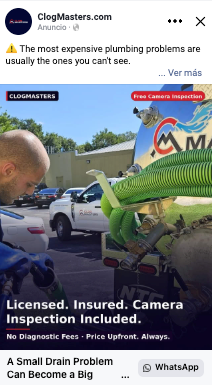
This video gives a good visual sense of what strong Meta creative looks like in practice for local campaigns.
The landing experience matters just as much. If the ad promises a quote, inspection, reservation, or consultation, the page must make that action easy. If you need a clearer conversion path, our guide on how to build a lead generation website shows the structure behind that handoff.
Measuring What Matters to Prove Your Ad ROI
The biggest complaint business owners have about Facebook ads is fair. They spent money, saw clicks, and still couldn't prove what came back.
That's because most reporting stops where the platform gets comfortable.

Clicks are not proof
Likes, reach, clicks, and even form fills can mislead you. A local campaign isn't successful because people interacted with it. It's successful when it creates incremental business you wouldn't have gotten otherwise.
That distinction matters even more when the sale happens offline. A customer sees the ad, calls later, books through staff, or walks in days after exposure. Basic platform reporting won't tell the full story.
A strong analysis from ClicksGeek makes this point directly. A core challenge for local businesses is proving incremental lift for offline conversions, which is why methods such as CRM matching and geo-holdout tests matter in addition to normal ad tracking, as explained in this guide to Facebook ads best practices for local business.
If you can't tie ad spend to revenue, you don't have a marketing system. You have a media bill.
How to connect ads to real revenue
The fix is a measurement framework that extends beyond Meta.
A useful setup often includes:
- UTM-tagged URLs so analytics platforms can identify campaign traffic properly
- Call tracking so phone leads can be tied to channels and campaigns
- CRM matching to connect ad leads with actual sales outcomes
- Offer codes or mention tracking for store visits and local promotions
- Geo-holdout thinking when you need cleaner evidence of lift in one local area versus another
For service businesses with longer sales cycles, cost per lead isn't enough. You also need lead quality. Which campaigns produced booked jobs, signed retainers, paid consultations, or recurring customers?
If you're trying to improve attribution on the analytics side, our walkthrough on setting up Google Analytics 4 is part of that foundation.
And if you want a practical example of thinking through cost per lead with revenue in mind, especially for service businesses that depend on calls and booked jobs, this piece on how to track marketing ROI for movers is a useful companion.
The agencies worth hiring don't hide behind screenshots from Ads Manager. They show you what happened after the lead entered the pipeline.
Your Local Lead Generation Machine The VIP Tech Process
A local owner launches Facebook ads, sees clicks come in, and assumes the campaign is working. Then the phone stays quiet, the front desk misses leads, and the monthly spend turns into a lesson in bad assumptions.
That is the problem. Local ads fail when they are run like isolated campaigns instead of a sales system.
VIP Tech's process is built to stop that waste. It starts with the business goal, chooses the right channel for that goal, builds an offer people will respond to, tracks what happens after the click, and fixes the handoff between marketing and sales. That is how local advertising turns into booked jobs, consultations, and revenue.
What the process includes
A serious managed service should make decisions clearer, not bury you in reports.
The process should cover:
- Channel selection: Use Meta, Google Ads, or both based on how local customers buy. If customers are actively looking for the service now, Google usually gets priority. If demand needs to be created or retargeted, Meta plays a bigger role.
- Offer strategy: Build campaigns around one clear action, such as a booked estimate, consultation, call, or claimable local promotion.
- Tracking setup: Connect ad clicks, calls, forms, and CRM outcomes so you can see which campaigns produce revenue, not just cheap leads.
- Creative testing: Test angles, hooks, and formats with control. Change one variable at a time so you know what improved performance.
- Lead handling review: If your staff is slow to respond, your ads will underperform even when targeting and creative are solid.
That is why many local businesses are better served by a partner that handles the full system. VIP Tech Consulting's local business marketing services bring paid media, tracking, website performance, and lead flow into one process so each part supports the others.
What business owners need to hear
Yes, you can run ads yourself.
No, that does not mean you should. If you are guessing at channel choice, boosting posts, judging success by clicks, or changing campaigns every few days, you are paying tuition to Meta.
Stability takes time and discipline. Good campaigns are not built by constant tinkering. They improve through controlled testing, clean reporting, and fast feedback from the sales side about lead quality.
Operations matter more than owners want to admit. If calls go unanswered, forms sit in an inbox, or leads wait until tomorrow for a response, ad performance drops even if the campaign was set up well. Businesses that need faster response times can automate client calls with AI to capture more inbound demand before it slips away.
A good agency relationship should feel simple because the system behind it is disciplined. You should know which channel is being used, what offer is running, how success is measured, and what gets adjusted when results stall.
If you're comparing agencies and want a straight answer on whether Facebook, Google, or a combined local strategy makes the most sense for your market, book a consultation with VIP TECH CONSULTING. Miami is competitive, wasted ad spend adds up fast, and the businesses that win fix the system before they raise the budget.