
If your ecommerce site looks decent but doesn’t rank, load fast, or turn visits into orders, it’s not an asset. It’s a leak in your sales process.
That’s the core issue with ecommerce development miami searches. Most business owners aren’t looking for code. They’re looking for a store that brings in calls, online orders, foot traffic, repeat customers, and fewer daily headaches. In Miami, that matters more because the market is crowded, buyers are impatient, and competitors move fast.
If you’re already comparing agencies, don’t wait until another slow quarter to fix the foundation. Get a plan for the store, the SEO, and the ads together. If local visibility is part of the problem, start by looking at what a proper Local SEO strategy for Miami businesses should support.
Table of Contents
- Your Miami Store Is Open But Are Customers Walking In
- What Professional Ecommerce Development Includes
- Choosing Your Engine Shopify vs WooCommerce
- Costs Timelines and What to Expect
- Turning Visitors into Customers with CRO and Local SEO
- How to Choose the Right Miami Ecommerce Agency
- Build Your Miami Ecommerce Growth Engine
Your Miami Store Is Open But Are Customers Walking In
Miami is full of opportunity, but opportunity alone doesn’t pay the bills. Miami-Dade County has become the #1 destination in the U.S. for small business growth, with nearly 4,900 new business applications per 100,000 residents filed in the past year, according to Miami-Dade County. That means more energy, more buyers, and a lot more competition.
If you’re a retailer, restaurant, beauty brand, local service company, or specialty shop, your online store isn’t competing with one business down the street. It’s competing with every business that shows up first on Google, loads faster on mobile, and makes checkout easier.
A generic site hurts you in ways most owners don’t notice right away:
- Weak local visibility: You don’t appear for product or service searches tied to Miami neighborhoods.
- Poor mobile experience: Shoppers leave before they even see what you sell.
- Messy checkout flow: Customers hesitate, click away, and buy from someone else.
- No marketing foundation: Google Ads, Meta Ads, and email campaigns perform worse because the site isn’t built to support them.
Your store can look good and still underperform. Buyers don’t reward effort. They reward speed, clarity, and convenience.
A lot of business owners think they need “a better website.” Usually, they need something more specific. They need a store built as a sales system. That means product structure, search visibility, user flow, payment setup, conversion tracking, and local intent all working together.
In Miami, that matters because customers often discover businesses through a combination of Google search, Maps, Instagram, and branded follow-up searches. If your ecommerce setup breaks anywhere in that chain, you lose the sale.
That’s why I don’t recommend treating ecommerce development as a design project. Treat it as a revenue project. If you’re serious about taking market share, get a real audit of your store before you spend another month sending traffic to the wrong setup.
What Professional Ecommerce Development Includes
Most stores fail before the first ad campaign starts. The structure is wrong, the pages aren’t built for search, the category layout confuses users, and the checkout experience creates friction. Professional ecommerce development fixes those problems before they become expensive.
Your store needs a platform that fits the business
The first decision is the platform. Shopify and WooCommerce are common choices for a reason. They can both support serious growth when they’re set up correctly. The problem isn’t the platform by itself. The problem is choosing one without understanding how you’ll manage products, content, promotions, SEO, and future changes.
A professional build should include:
- Platform selection: Choosing Shopify or WooCommerce based on your catalog, workflow, and marketing needs.
- Catalog architecture: Product categories, filters, variants, and tags that help people find what they want fast.
- Payment setup: Clean integration with the payment methods your customers expect.
- Tracking foundation: Analytics, event tracking, and conversion data set up from day one.
If you’re in a niche with recurring campaigns, retention offers, and brand-specific merchandising, it also helps to study adjacent operating models. For example, this resource on ecommerce account management for wellness brands is useful because it shows how post-launch management ties operations, campaigns, and store performance together.
The build has to support selling not just browsing
Design matters, but only when it supports action. Good UX means customers can search, compare, trust, and buy without getting stuck. Strong ecommerce development also includes technical SEO, speed-focused page structure, clean collection pages, and content sections that support both rankings and conversions.
A proper ecommerce build should cover the basics most freelancers skip:
- Search-ready structure: Category pages, product URLs, metadata, and internal linking that give search engines a clear map.
- Trust elements: Reviews, policies, contact details, and clear shipping or pickup information.
- Mobile-first layout: Product pages that work just as well on a phone as they do on a desktop.
- Marketing integrations: Google Ads, Meta Ads, email tools, and remarketing support.
Practical rule: If your developer can’t explain how the store will support SEO, paid traffic, and conversion tracking, you’re hiring a builder, not a growth partner.
That distinction matters. A business owner doesn’t need code for code’s sake. They need a store that brings in demand and handles it cleanly. If you want to see what that kind of build looks like in practice, review a service that combines store architecture with marketing support, such as ecommerce web development services.
Choosing Your Engine Shopify vs WooCommerce
Platform debates get noisy fast. Ignore most of that. The question is simple. Which platform will help you launch faster, manage easier, market better, and scale with fewer problems?
The wrong platform creates expensive problems
Shopify is usually the cleaner choice for owners who want simplicity, centralized management, and fewer technical maintenance issues. WooCommerce is often the right choice when content, flexibility, and custom workflow control matter more.
The platform itself isn’t what drives performance. The setup does. According to GoodFirms’ Miami ecommerce development listings, Miami ecommerce developers see firms achieve 95% revenue growth in 3 months and a 75% reduction in cart abandonment by implementing personalized UI/UX and conversion rate optimization on platforms like Shopify and WooCommerce. That tells you where the value is. Not in the logo on the platform dashboard, but in how the store is built and optimized.
For a broader buyer’s view, this guide to the best ecommerce platforms for small businesses is worth reviewing alongside agency recommendations.
A quick explainer helps if you’re still narrowing the choice:
Shopify vs WooCommerce for Miami businesses
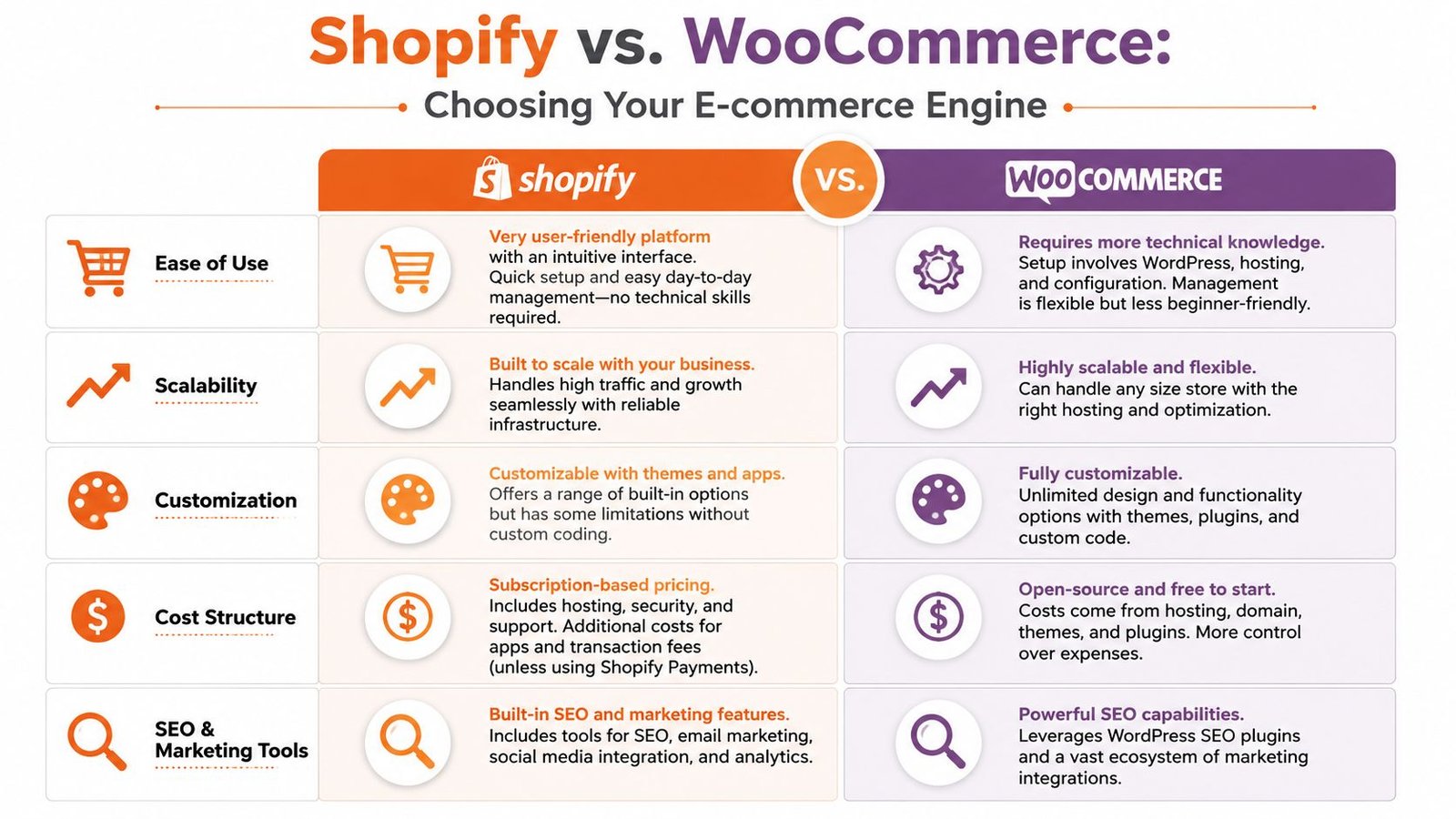
| Factor | Shopify | WooCommerce (with WordPress) |
|---|---|---|
| Ease of use | Better for owners who want a simpler dashboard and less technical upkeep | Better for teams comfortable managing WordPress and more moving parts |
| Scalability | Strong fit for brands that want a cleaner path to growth with fewer maintenance tasks | Strong fit for businesses that need deep customization and content flexibility |
| Customization | Flexible, but works best within Shopify’s ecosystem and app stack | More open-ended for custom features, content structures, and tailored workflows |
| Cost structure | Subscription-based model with app costs and platform-managed hosting | Hosting, plugin, development, and maintenance costs vary by setup |
| SEO and marketing tools | Solid ecosystem for email, paid media, product merchandising, and sales apps | Excellent for content-heavy SEO strategies when the site is built correctly |
My recommendation by business type
I recommend Shopify if you are:
- A local retailer that needs to launch quickly and run promotions without technical friction.
- A hospitality brand selling merch, gift cards, reservations, or packaged products online.
- A founder-led business that wants less maintenance and a cleaner admin experience.
I recommend WooCommerce if you are:
- A content-driven business that needs service pages, blog strategy, and ecommerce in one system.
- A custom catalog business with unusual product logic or a more customized buying experience.
- A local brand that wants tight control over SEO content and WordPress-based marketing assets.
Don’t choose based on what your friend uses. Choose based on who on your team will run the store every week.
If you want the deeper decision criteria, this breakdown on choosing the right ecommerce platform Magento, WooCommerce, or Shopify is a practical next read before you commit.
Costs Timelines and What to Expect
Uncertainty kills deals. Business owners delay ecommerce projects because they think the process will drag on, spiral in scope, or turn into a confusing technical mess. A good agency removes that uncertainty early.
For Miami’s market, custom ecommerce development on platforms like WooCommerce or Shopify typically spans 3-6 weeks for a full launch, covering design, payment gateway setup, testing, and deployment, according to DigitalWeb Miami. That timeline is realistic when the scope is clear and the client responds quickly.
A real project should feel organized
A proper ecommerce project doesn’t start with design mockups. It starts with business goals.
The workflow should look something like this:
Discovery and planning
You define products, collections, customer actions, shipping logic, and marketing priorities.UX and content structure
The team maps category pages, product templates, trust sections, conversion points, and core content.Development and integration
The store is built, payment methods are connected, and tracking tools are installed.Testing and refinement
Mobile checks, checkout testing, page reviews, and conversion flow fixes happen before launch.Launch and support
The agency monitors issues, makes adjustments, and helps with early optimization.
That process should be visible to you. If the agency can’t explain what happens each week, the project will feel chaotic.
What you should expect from the agency
You don’t need jargon. You need clarity.
Ask for these deliverables up front:
- A defined scope: What pages, product types, integrations, and features are included.
- A launch timeline: Not vague promises. A working schedule with review points.
- A revision process: You should know how feedback gets handled.
- Post-launch support: Because something always needs tuning after launch.
A store launch isn’t the finish line. It’s the point where your marketing finally has a proper place to send buyers.
If you’re at the point where cost and timing are the last objections, this is the moment to get a quote, not keep guessing. A short strategy call can tell you whether you’re looking at a straightforward rebuild or a more involved migration and growth setup.
Turning Visitors into Customers with CRO and Local SEO
Launching the store is step one. Revenue comes from what happens after launch.
A lot of Miami businesses waste money because they separate the site from the marketing. The developer builds pages. Another vendor runs ads. Someone else “does SEO.” Nobody owns the full customer path. That’s how you end up paying for traffic that doesn’t convert.
Traffic without conversion is wasted spend
Conversion rate optimization matters because every friction point costs you money. Weak product pages, confusing navigation, slow checkout, poor trust signals, and bad mobile layouts all reduce the return on your marketing budget.
There are practical fixes that move the needle:
- Tighten product and collection pages: Clear headlines, useful descriptions, better filtering, and stronger calls to action.
- Improve checkout flow: Remove distractions, simplify form fields, and reduce hesitation.
- Use smarter automation: AI chat, product prompts, and support tools can answer buyer questions faster.
- Track user behavior: Use actual session data and campaign results to refine the pages people see most.
The AI side is no longer optional for many stores. According to the Miami Herald’s reporting on AI in ecommerce, 40% of U.S. retailers adopted AI chatbots in the last year, and accessible AI tools in platforms like Shopify can drive 15-25% efficiency gains and lower customer acquisition costs for Miami SMBs without enterprise-level budgets.
If a shopper has one question and your site doesn’t answer it fast, your ad spend just funded someone else’s sale.
For store owners trying to improve performance before a full rebuild, this guide on how to improve ecommerce conversion rates is the right place to start.
Local SEO closes the gap between search and sale
Miami businesses often underestimate local intent. A shopper may not type your brand name. They search for a product plus a location, a service plus “near me,” or a category plus a neighborhood.
That’s why ecommerce development in Miami should support local SEO from the beginning:
- Location relevance: Category pages and supporting content should align with how buyers search in Miami.
- Google Business alignment: Your website and local listing need matching signals.
- Landing pages with intent: Collections, service-related offers, and local pages should be built for both rankings and conversions.
- Ad and SEO coordination: Your Google Ads and Meta campaigns should send traffic to pages designed for local buyers, not generic homepage traffic.
A Wynwood boutique, a Coral Gables restaurant selling takeout or gift cards, and a North Miami specialty retailer all need different search strategies. The site has to reflect that. Otherwise, your store is online, but it’s not positioned to win local demand.
How to Choose the Right Miami Ecommerce Agency
Miami is home to over 270 vetted ecommerce development companies, according to Clutch’s Miami ecommerce developer directory. That’s enough choice to make a bad decision easy.
Most business owners compare price, design style, and how polished the pitch sounds. That’s not enough. You need to know whether the agency can build a store that supports rankings, paid traffic, and conversion, not just launch a site.
Use this filter before you sign anything
Ask direct questions. If the answers are vague, move on.
Use this checklist:
- Do they talk about business outcomes? They should discuss leads, sales, conversion flow, and search visibility.
- Can they connect development to marketing? Your store should support SEO, Google Ads, Meta Ads, and remarketing from the start.
- Do they have a process? You want a clear scope, feedback cycle, and launch path.
- Can they explain platform fit? They should tell you why Shopify or WooCommerce makes sense for your situation.
- Will they support post-launch growth? Stores need ongoing tuning, not abandonment after launch.
One Miami-based option in this category is VIP TECH CONSULTING, which offers Shopify and WordPress ecommerce development along with Local SEO, Google Ads, Meta Ads, and ongoing support. That’s the type of service mix business owners should look for because it connects the build to lead generation and revenue operations.
The agency you hire should be able to explain how your store will get found, how it will convert, and how it will keep improving after launch.
Cheap builds usually become expensive fixes
Yes, you can hire a cheap freelancer. Yes, you can use a template. If your goal is to get something online fast with minimal expectations, that’s fine.
If your goal is growth, it’s usually the wrong move.
Cheap builds often create hidden problems:
- Weak SEO structure: Harder to rank later.
- Poor tracking setup: You can’t trust campaign data.
- App clutter or plugin bloat: The site slows down and becomes fragile.
- No strategic guidance: You still don’t know how to generate consistent sales.
A good agency should save you from false economy. If you need a framework for evaluating your options, this guide on how to choose a digital marketing agency gives you the right questions to ask before signing a proposal.
Build Your Miami Ecommerce Growth Engine
If you’re searching for ecommerce development miami, you’re probably not looking for another pretty website. You’re looking for a store that ranks, converts, supports ads, and makes it easier to grow.
That’s the right way to think about it.
Your ecommerce site should help you win local search, capture demand from Google and social, convert traffic without friction, and give your team a system they can manage. If it doesn’t do those things, rebuilding it isn’t a vanity project. It’s a business decision.
Miami is competitive. Buyers compare fast. A weak store costs you sales every week you leave it untouched.
If you’re close to making a decision, stop collecting generic proposals and start looking for a partner that can connect platform choice, SEO, paid traffic, CRO, and post-launch support into one clear plan. That’s what turns ecommerce from a website expense into a growth engine.
If you’re ready to stop guessing and get a practical roadmap, book a strategy session with VIP TECH CONSULTING. You’ll get a direct review of your current store, your visibility gaps, and the fastest path to a store that drives more leads, sales, and repeat business in Miami.