
If your restaurant isn’t showing up where hungry people are looking right now, you’re handing customers to the place down the street.
You see it every week. Their patio is full, their Google Business Profile is active, reviews keep coming in, and their reservation link works without friction. Meanwhile, your food may be better, your service may be tighter, but your tables still sit empty on the nights that should be busy. That’s why hiring the right digital marketing agency for restaurants matters. This isn’t about vanity traffic. It’s about bookings, orders, and revenue you can track.
If you’re comparing agencies and want a system that connects SEO, Google Ads, Meta Ads, reviews, and real sales, stop guessing and get a clear plan. Start by reviewing what drives restaurant growth in this guide and, if you want a benchmark for your own setup, compare it against these restaurant digital marketing strategies.
Table of Contents
- Why Your Competitors Are Getting Booked Solid Online
- The Difference Between a Generic Agency and a Restaurant Growth Partner
- The Restaurant Growth Checklist What to Demand from Your Agency
- How We Deliver Measurable ROI to Miami Restaurants
- From Empty Tables to Waitlists Our Client Success Stories
- Your 90-Day Roadmap to Restaurant Growth
- Ready to Fill Your Restaurant and Dominate Local Search
Why Your Competitors Are Getting Booked Solid Online
You’ve seen it. A nearby restaurant is packed on a weeknight, there’s a line at the door, and your dining room is half full. That usually isn’t luck. It’s digital visibility doing its job.
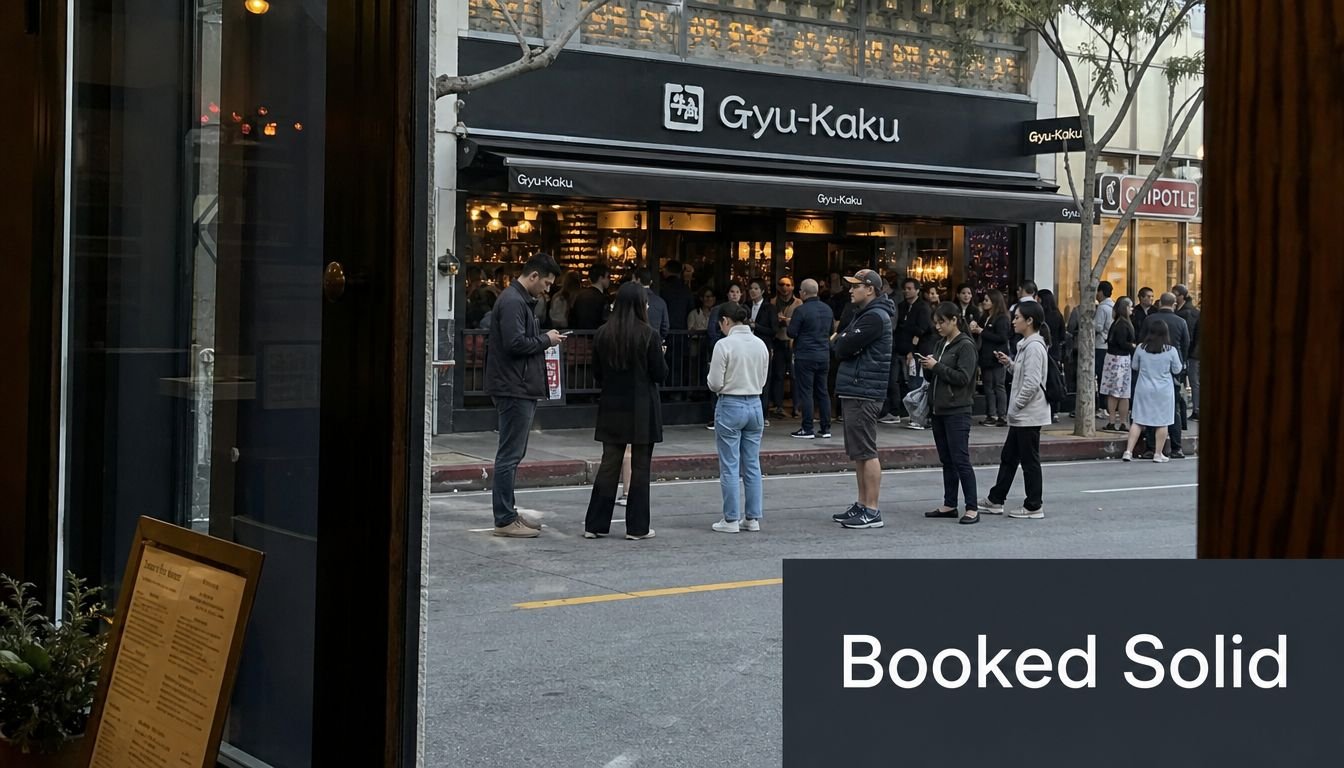
The customer journey starts before they see your menu
A hungry customer searches on Google Maps, taps a profile, scans a few photos, checks reviews, and books a table or places an order. If your restaurant isn’t visible in that moment, you don’t get considered.
That’s why local ranking matters so much. Raising a restaurant’s Local SEO pack ranking from position 5 to position 2 directly generates a 30% increase in reservation footprint and referral traffic according to this breakdown of restaurant local SEO performance. Small ranking gains can produce real booking growth.
If you want a wider view of what strong operators do well online, this roundup of effective restaurant marketing strategies is worth scanning. It reinforces the same point. Restaurants that make discovery easy get more chances to win.
Visibility without friction wins
A lot of restaurant owners assume marketing means posting more on Instagram. That’s incomplete. Diners with intent don’t want a clever caption. They want fast answers.
They want to know:
- Where you are: Is the listing accurate on Google Maps?
- What you offer: Is the menu easy to find on mobile?
- What others think: Are recent reviews coming in?
- How to act now: Can they reserve or order in a few taps?
Hungry diners don’t browse like shoppers. They decide fast, and they choose the place that removes the most friction.
The danger isn’t just low traffic. It’s being invisible when purchase intent is highest. In Miami, that means another restaurant gets the walk-ins, the reservations, and the repeat business that should have been yours.
If your restaurant isn’t getting enough calls, bookings, or map visibility, don’t wait for the next slow month to address it. Get your online funnel audited now and find out where customers are dropping off.
The Difference Between a Generic Agency and a Restaurant Growth Partner
Most agencies sound good on a sales call. They talk about awareness, impressions, engagement, and reach. Restaurant owners don’t need more marketing vocabulary. They need more booked tables and more completed orders.
Generic agencies chase traffic
A generic agency often runs the same playbook for a restaurant, a law firm, and an e-commerce brand. That approach misses how restaurant buying behavior works.
Restaurants have a different demand pattern. Restaurants hold the highest industry benchmark for website conversion rates at 6.1%, and the search term “restaurants near me” generates a 3x higher click-through rate, according to these industry benchmarks for digital marketing performance. That means restaurant traffic is unusually high intent. If the funnel is weak, you’re wasting some of the best traffic you can get.
A generic agency may send traffic to a homepage that buries the menu, hides the reservation button, or loads slowly on mobile. Then they call the campaign successful because clicks increased. That’s not success. That’s leakage.
If you’re sorting through providers, this guide on how to choose a digital marketing agency will help you ask better questions before you sign anything.
Restaurant growth partners track seats and orders
A real restaurant growth partner thinks differently. They ask questions generic agencies usually skip.
| Focus area | Generic agency | Restaurant growth partner |
|---|---|---|
| Primary KPI | Traffic, impressions | Reservations, orders, calls |
| Landing pages | General pages | Geo-targeted pages tied to intent |
| Mobile experience | Nice to have | Revenue-critical |
| Integrations | Often ignored | Reservation, POS, CRM, GA4 |
| Reputation | Basic monitoring | Review acquisition and recovery workflows |
The right partner understands tools and platforms that affect restaurant sales directly. That includes Google Business Profile, OpenTable, Resy, Meta Ads, Google Ads, Yelp, and your own ordering flow.
Practical rule: If an agency can’t explain how they’ll lower friction between ad click and reservation, keep looking.
You can do some of this in-house. Most owners shouldn’t. Not because it’s impossible, but because the margin for error is too expensive when your local competitors are already capturing high-intent traffic.
The Restaurant Growth Checklist What to Demand from Your Agency
If you’re interviewing agencies, don’t ask whether they “do marketing.” Ask what system they’re building to produce reservations, calls, and orders. If they can’t answer clearly, they’re not the right fit.
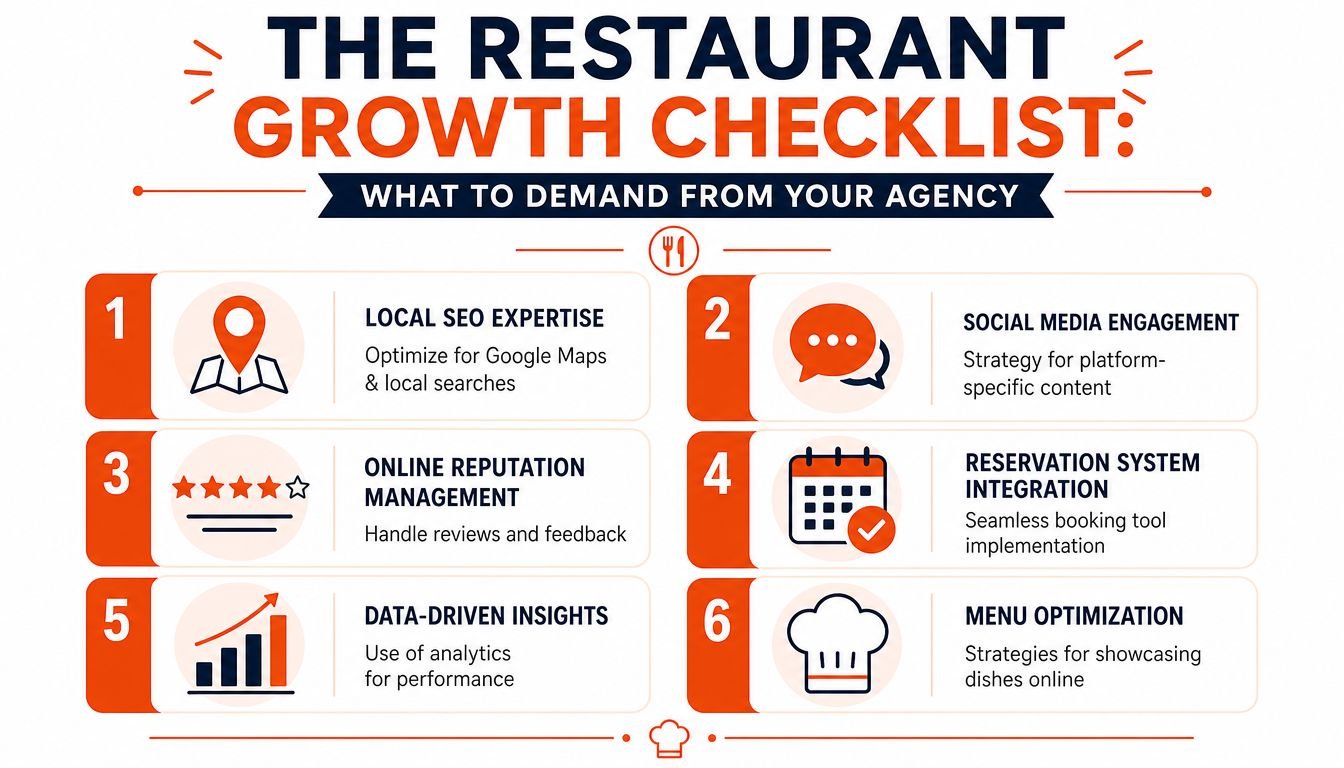
Google Maps visibility and local intent
Your agency should own local search, not treat it like a side task.
That means they should handle:
- Google Business Profile optimization: Categories, services, photos, posts, menu links, and reservation links need to be complete and current.
- Location relevance: They should target the city, neighborhood, and “near me” intent that drives restaurant discovery.
- Review velocity: Systematic review generation targeting at least 10 new Google reviews per month is a critical benchmark for local ranking, while mobile website load times under 3 seconds are essential according to this restaurant local SEO guidance.
If you want a practical benchmark list to compare against your current setup, use this local SEO checklist for restaurants.
Reservation and ordering flow
Many campaigns fail due to issues encountered after the initial click. The ad gets the click, but the website or booking path kills the conversion.
Your agency should check whether diners can:
- Reserve without confusion: OpenTable or Resy links should be obvious and functional.
- Order without extra steps: Pickup and delivery paths should be simple on mobile.
- Find the menu fast: No forcing users through multiple screens to see core items.
- Call immediately: Click-to-call should be prominent on every high-intent page.
A clean handoff from Google or Meta to the reservation or ordering tool is what turns intent into revenue.
To see how this looks in practice, watch this walkthrough:
Ads that target diners, not random clicks
Good restaurant ads don’t just “reach people nearby.” They align keyword intent, timing, creative, and landing experience.
Look for an agency that can explain:
- Google Ads intent matching: Search campaigns for reservation-ready and order-ready terms.
- Meta retargeting: Follow-up ads for people who viewed menu pages or started a booking flow.
- Offer testing: Brunch, happy hour, family specials, event-driven dining, or seasonal menu demand.
- Location segmentation: Different messaging for tourists, locals, and neighborhood regulars.
Reviews that drive revenue
A lot of agencies say they do reputation management. Ask what that means. If it only means “we monitor reviews,” that’s weak.
You want a system that includes:
- Review requests: Sent after positive experiences
- Response workflows: Fast public replies to both positive and negative reviews
- Issue recovery: Internal handling when a poor experience needs follow-up
- Sentiment patterns: Spot recurring service or menu complaints early
Reviews don’t just influence trust. They shape whether people ever click your listing in the first place.
Midway through your agency search is the right time to get specific. Ask for the deliverables, the timeline, the reporting cadence, and who directly manages the account. If the answers are vague, the results will be too.
How We Deliver Measurable ROI to Miami Restaurants
Miami is crowded, fast-moving, and unforgiving online. Diners search by neighborhood, cuisine, and urgency. If your tracking is loose, your budget disappears into “activity” that never ties back to sales.
Miami competition demands tighter tracking
A restaurant in Brickell doesn’t compete the same way as one in Wynwood, Coconut Grove, or North Miami. Search behavior shifts by area, time of day, and customer intent. That’s why generic reports aren’t enough.
The standard that matters is this: by integrating Point-of-Sale (POS) analytics with CRM and Google Analytics, agencies can track cost-per-acquisition against actual revenue, as explained in this restaurant analytics and KPI guide. That changes the conversation completely.
Without that integration, an agency can tell you an ad got clicks. With it, they can tell you whether those clicks produced profitable bookings, higher-value orders, or repeat visits.
If paid search is part of your growth plan, review what a focused campaign structure looks like with Google Ads for restaurants.
What a serious reporting system looks like
A proper restaurant reporting stack should connect the channels that influence revenue. Not in theory. In the actual reporting your team sees.
Here’s what that usually includes:
- Google Ads data: Which campaigns drove high-intent search traffic
- Meta Ads data: Which audiences responded to offers, retargeting, and local promotions
- GA4 behavior data: What pages users landed on, where they dropped off, and what converted
- CRM data: Who booked, who returned, and which campaigns produced repeat diners
- POS data: What customers spent after the click
That’s the difference between a marketing vendor and a growth operator. One sends charts. The other helps you make budget decisions with confidence.
If your agency can’t connect campaign spend to actual restaurant revenue, they’re asking you to trust marketing on faith.
Owners don’t need more dashboards. They need clear answers to three questions. What brought people in, what produced profit, and what should get more budget next month.
From Empty Tables to Waitlists Our Client Success Stories
The easiest way to judge a restaurant marketing strategy is to look at the before and after. Not just creative. Not just impressions. Business movement.
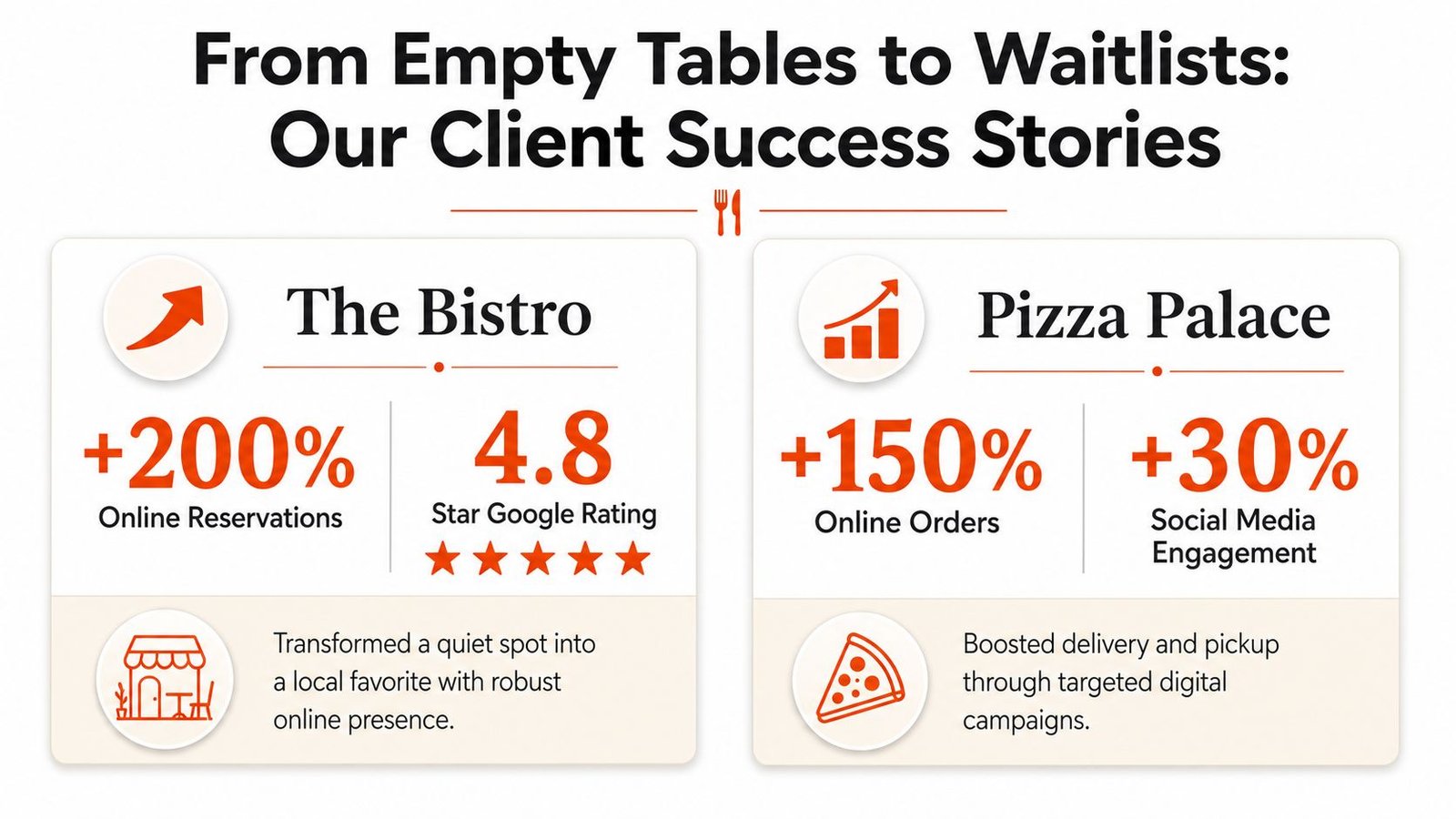
South Beach bistro
This restaurant had strong food photography, a decent menu, and weak organic visibility. The problem wasn’t quality. The problem was keyword focus.
After tightening the location-specific keyword set and aligning pages to search intent, the strategy followed what worked in a 2025 study of 2,000+ restaurant locations, where top-performing groups selecting around 10 primary keywords per location achieved a +74% increase in organic traffic within just 3 months, based on this restaurant local SEO analysis.
The lesson is simple. Restaurants don’t need dozens of vague terms. They need a sharp set of local, cuisine, and intent-driven keywords tied to real pages.
Wynwood neighborhood concept
This restaurant had a familiar problem. Lots of social activity, weak map visibility, and too much dependency on walk-by traffic.
The turnaround came from local SEO cleanup, stronger category targeting, fresh Google Business Profile activity, and a tighter review acquisition process. Once the listing became more competitive, the restaurant started showing up more consistently for nearby diners searching with intent.
What changed operationally:
- More direct calls: Diners found the listing and called before deciding
- Better reservation flow: Users moved from discovery to booking with less friction
- Stronger local trust: New reviews and better profile completeness improved first impressions
Brickell delivery-first operation
This concept leaned heavily on third-party delivery apps and had little control over its own customer acquisition. The smarter move wasn’t abandoning those apps. It was building direct demand through branded search, menu-focused landing pages, and retargeting.
The result was a stronger owned channel strategy. More customers reached the restaurant directly instead of relying only on aggregator platforms.
Restaurants grow faster when they control discovery, conversion, and customer data instead of renting demand from third-party platforms.
These examples matter for one reason. They show that the right strategy isn’t abstract. It fixes specific leaks. Ranking gaps. weak booking flows. poor keyword targeting. shallow reporting. That’s what moves a restaurant from inconsistent traffic to dependable demand.
Your 90-Day Roadmap to Restaurant Growth
Most restaurant owners delay hiring because they don’t know what happens after signing the agreement. That uncertainty kills momentum. A good agency should remove it with a clear rollout.
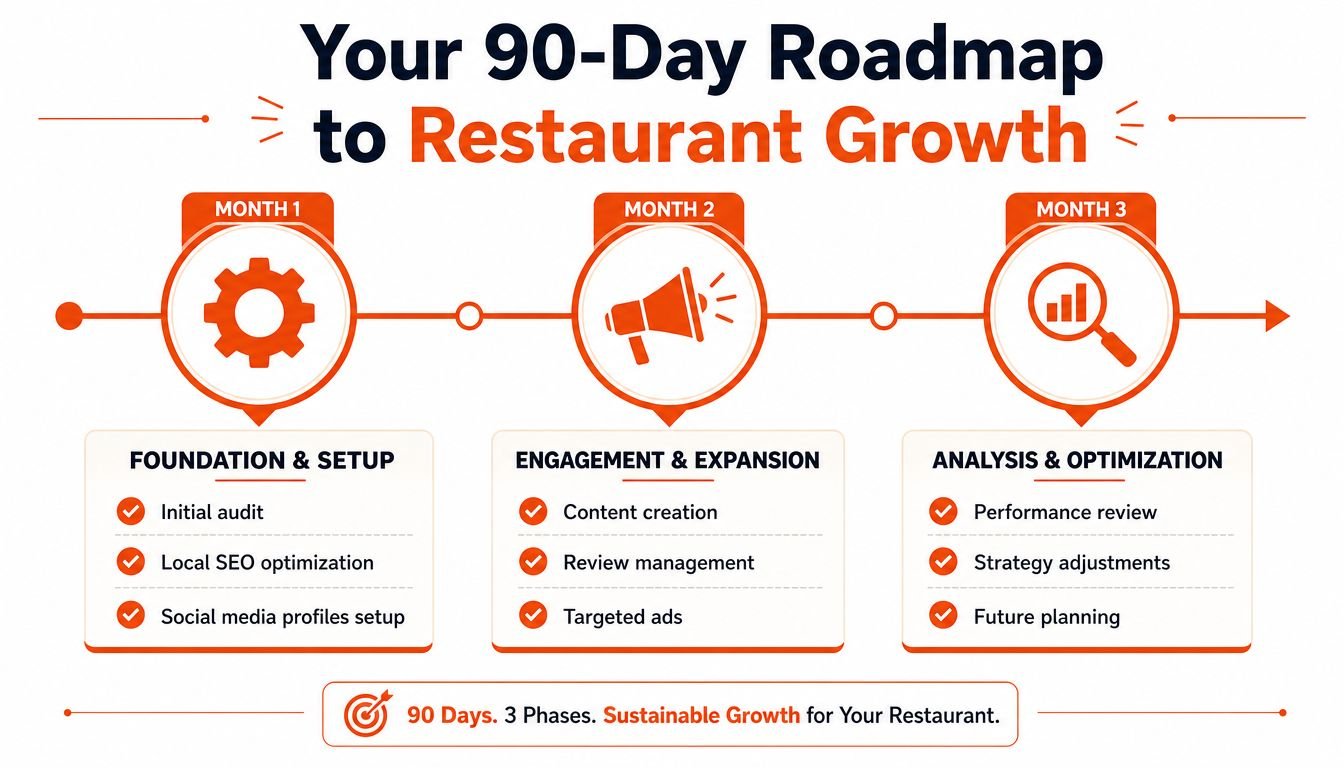
Days 1 through 30
The first month is about fixing what’s broken and tightening the foundation.
Typical priorities include:
- Audit the funnel: Google Business Profile, website paths, menu visibility, forms, calls, and reservation links
- Clean up local SEO: Categories, service areas, location pages, citations, and on-page signals
- Repair mobile friction: Speed, click-to-call, booking access, menu visibility, and page structure
- Set up tracking: GA4 events, ad platform conversions, call tracking, and revenue mapping where available
This stage often produces quick wins because many restaurants lose customers on basic issues they don’t notice day to day.
Days 31 through 60
Once the foundation is in place, demand generation starts.
That usually includes:
| Channel | Main action | Business goal |
|---|---|---|
| Google Ads | Launch high-intent search campaigns | Capture reservation and order demand |
| Meta Ads | Retarget site visitors and local audiences | Bring back interested diners |
| Local SEO | Publish and optimize location-relevant content | Increase map and organic visibility |
| Reputation | Start active review generation and response workflows | Improve trust and click-through |
At this stage, the agency should already be making adjustments based on what users do, not what everyone assumes they do.
Days 61 through 90
By the third month, the goal shifts from launch to refinement.
The agency should be able to answer:
- Which campaigns are bringing the strongest intent
- Which pages are converting best
- Where users still drop off
- Which offers deserve more budget
- What operational feedback shows up in reviews
This is also where the relationship either proves itself or falls apart. If reporting still sounds vague by this point, the setup was weak from the start.
The first 90 days should produce clarity. You should know what’s working, what isn’t, and where the next gains will come from.
If you’ve been trying to do this yourself, that’s the main tradeoff. Not effort. Time. Slow months add up while you troubleshoot ads, rankings, reviews, and website problems one by one.
Ready to Fill Your Restaurant and Dominate Local Search
Your competitors aren’t winning online because they post more. They’re winning because they built a tighter system. They show up in local search, remove friction from booking and ordering, manage reviews actively, and track what turns into revenue.
That’s what you should expect from a digital marketing agency for restaurants. Not vague promises. Not pretty reports. A working acquisition system tied to calls, bookings, online orders, and repeat customers.
If your Google Business Profile is weak, your website is slow on mobile, your ads aren’t tied to real outcomes, or your reviews aren’t being managed with intent, you already know the result. Lost covers. Lost orders. Lost regulars.
Before you hire anyone, make sure they can solve the full chain:
- Get found in local search
- Turn intent into action
- Protect and improve reputation
- Report on revenue, not fluff
For restaurants that want to tighten local visibility first, review what strong Google Business Profile management for restaurants should include.
Miami is too competitive to stay invisible. Every day you wait, another restaurant takes the search, the click, and the customer that could have been yours. If you’re serious about filling more tables and increasing direct orders, the next move is simple. Schedule a strategy conversation and get a plan built around your location, your funnel, and your revenue goals.
If you want a partner that treats restaurant marketing like a revenue system instead of a collection of random tactics, talk to VIP TECH CONSULTING. Book a free, no-obligation strategy session and get a clear plan for more local visibility, more reservations, and more profitable growth.