
Your store can look polished, your pricing can be competitive, and your products can be better than what competitors sell. If your product pages still don’t show up when buyers search, none of that matters. You lose the click, the add-to-cart, and the sale before the shopper even sees your brand.
That is the core problem with SEO for ecommerce product pages. Most stores don’t have a product problem. They have a visibility problem, a crawl problem, a content problem, or a structure problem. If you’re comparing agencies or searching for help near me, you’re probably already feeling that gap in revenue.
If you want a practical overview of where your pages may be underperforming, review these ecommerce SEO best practices and then decide whether your current setup is built to rank and convert.
Table of Contents
- Why Your Products Are Invisible on Google and Losing You Sales
- Building the Foundation for High-Converting Product Pages
- Beyond the Basics Technical SEO to Outrank Competitors
- Solving Hidden Problems Most SEO for Ecommerce Overlooks
- Our Proven Process for Driving Ecommerce SEO Results
- Common Questions About Investing in Product Page SEO
- Start Turning Product Pages Into Your Top Sales Channel
Why Your Products Are Invisible on Google and Losing You Sales
A common situation looks like this. A store launches on Shopify or WooCommerce with clean design, decent photography, and dozens or hundreds of SKUs. Then traffic stalls. Branded searches might work, but product-level searches barely move, category pages absorb whatever visibility exists, and high-intent buyers end up on competitor listings instead.
That isn’t a minor SEO issue. It’s a revenue leak.
According to Charle Agency’s ecommerce SEO statistics, organic search drives 43% of all ecommerce traffic, and 23.6% of all ecommerce orders are directly linked to organic traffic. If your product pages aren’t optimized, you’re invisible to nearly half your potential customers.

What usually goes wrong
Most underperforming product pages fail in predictable ways:
- Thin product copy: The page says almost nothing beyond a manufacturer blurb.
- Weak titles: Product names, model details, and buyer intent aren’t aligned.
- Duplicate variants: Size or color pages compete against each other.
- Broken internal discovery: Products exist, but search engines and shoppers struggle to reach them.
- Missing structured data: Google can’t confidently extract price, availability, or reviews.
Cheap providers usually stop at surface edits. They tweak title tags, compress a few images, and call it optimization. That won’t fix the pages that matter most.
Practical rule: If a product page can’t clearly answer what the item is, who it’s for, whether it’s in stock, and why it deserves the click, Google has no reason to feature it.
A more current view of what works in ecommerce SEO now helps frame the shift. Rankings still matter, but product SEO now depends on data quality, technical execution, and whether search engines can trust what your page is saying.
If you’re already comparing providers, don’t wait until another quarter passes with the same weak product visibility. A serious audit usually reveals the problem fast, and high-intent stores shouldn’t delay that conversation.
Building the Foundation for High-Converting Product Pages
Most ecommerce SEO campaigns fail before the advanced work even starts. The base layer is wrong. The store targets the wrong search terms, writes bland titles, and relies on duplicate manufacturer text that gives buyers no reason to choose that page over the next ten results.
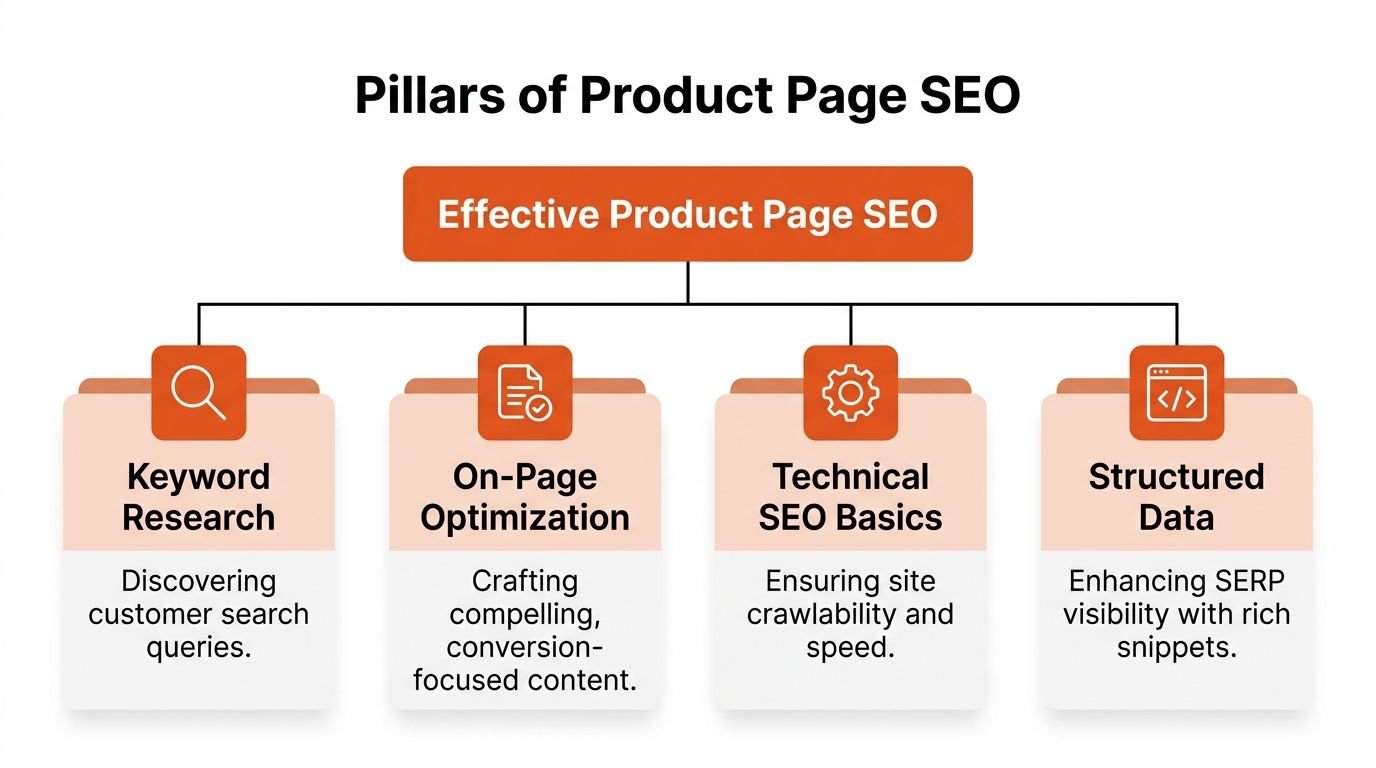
Keyword targeting has to match buying intent
Product pages shouldn’t chase broad blog-style queries. They should match the terms people use when they are close to purchase.
A verified data point from Seobility’s guide to ecommerce product pages shows that 68% of all online searches are categorized as intent-driven, meaning users are explicitly trying to buy, shop, or contact. That matters because vague copy doesn’t convert commercial searches. Product pages need to line up with phrases buyers use when they’re ready to act.
The mechanics matter too. Verified guidance tied to this YouTube reference notes that product pages that front-load the target keyword in the meta title and in the first sentence improve visibility for commercial intent searches compared with burying the keyword later.
On-page elements need to sell and rank
Good on-page SEO isn’t just about inserting keywords. It has to sharpen relevance and increase click appeal.
A strong product page usually includes:
- A precise title tag: Product name first, major modifier close behind, no wasted filler.
- A direct H1: Not a generic collection label or internal SKU-only heading.
- A useful meta description: Written like a short pitch, not auto-generated junk.
- A clean URL slug: Readable, specific, and aligned with the page topic.
- Image alt text: Descriptive enough for search engines and accessibility.
If you’re trying to improve revenue instead of vanity metrics, this also has to connect with conversion work. These conversion-focused ecommerce improvements show why SEO and conversion rate optimization can’t be treated as separate projects on product pages.
Unique content fixes both rankings and conversion
Many stores lose ground by using the same supplier copy as every other seller, then wonder why rankings stall.
Verified data allows a stronger claim here. Crafting unique, high-quality product descriptions of 500 to 800 words and using canonical tags correctly for variants can increase conversion rates by up to 200% by avoiding duplicate content penalties and improving user experience, as cited in the provided verified dataset with this reference URL.
That doesn’t mean every SKU needs bloated text. It means the page needs enough original substance to justify ranking. Practical content often includes use cases, compatibility details, materials, fit notes, shipping expectations, and real purchase questions.
The stores that win don’t publish more pages. They publish pages that deserve to be indexed.
For additional reading on how product page structure affects buying behavior, these Tagada conversion insights are worth reviewing. The lesson is simple. Product pages have to persuade humans and clarify meaning for search engines at the same time.
Beyond the Basics Technical SEO to Outrank Competitors
Strong copy helps, but technical execution is what separates a page that ranks occasionally from one that consistently earns rich visibility. This is the part many ecommerce teams underestimate because the page looks fine in a browser. Search engines don’t judge appearance alone. They judge clarity, speed, and machine-readable signals.

Rich results start with precise schema
If your product page doesn’t expose price, availability, and reviews in a format Google can parse, you make it harder to stand out before the click even happens.
Verified data states that implementing structured data for price, availability, and ratings can increase click-through rates from search results by up to 30%, according to Crystallize’s product page SEO article. That lift comes from richer search presentation, not from wishful thinking.
The practical implementation usually centers on JSON-LD with the right fields populated:
| Element | Why it matters |
||—|
| Product schema | Tells search engines what the item is |
| Offer data | Clarifies price, currency, and availability |
| AggregateRating | Supports review visibility when eligible |
| BreadcrumbList | Helps search engines understand page hierarchy |
Teams often install an app and assume the job is done. It usually isn’t. Common failures include stale availability data, missing SKU values, malformed review markup, and variant pages outputting inconsistent Offer properties.
Speed problems cost rankings and sales
A slow product page doesn’t just annoy users. It loses money.
Verified technical guidance in the dataset states that product page conversion rates drop by approximately 4.42% for every additional second of load time between zero and five seconds. That same guidance also identifies a practical threshold: keep Largest Contentful Paint under 2.5 seconds.
The problem is rarely one thing. It is usually a stack of preventable issues:
- Heavy image payloads: Uncompressed product galleries and oversized hero images
- JavaScript bloat: Review widgets, recommendation carousels, and app scripts loading too early
- Poor lazy loading: Below-the-fold assets competing with essential content
- Weak caching: Category and product paths rebuilding too often
If your team needs to diagnose those bottlenecks, these website speed optimization tools are a useful starting point.
A quick visual walkthrough can help clarify what technical cleanup looks like in practice:
Mobile execution has to be clean
Most ecommerce product-page failures show up first on mobile. Sticky elements cover calls to action. Variant selectors break. Galleries jump. Review widgets push the buy box down.
Field note: If a shopper can’t select a variant, read the price, and add to cart without friction on a phone, the page is not ready to compete.
Mobile-first SEO isn’t a slogan. It is operational discipline. The page has to load quickly, render cleanly, and expose the buying path immediately.
Solving Hidden Problems Most SEO for Ecommerce Overlooks
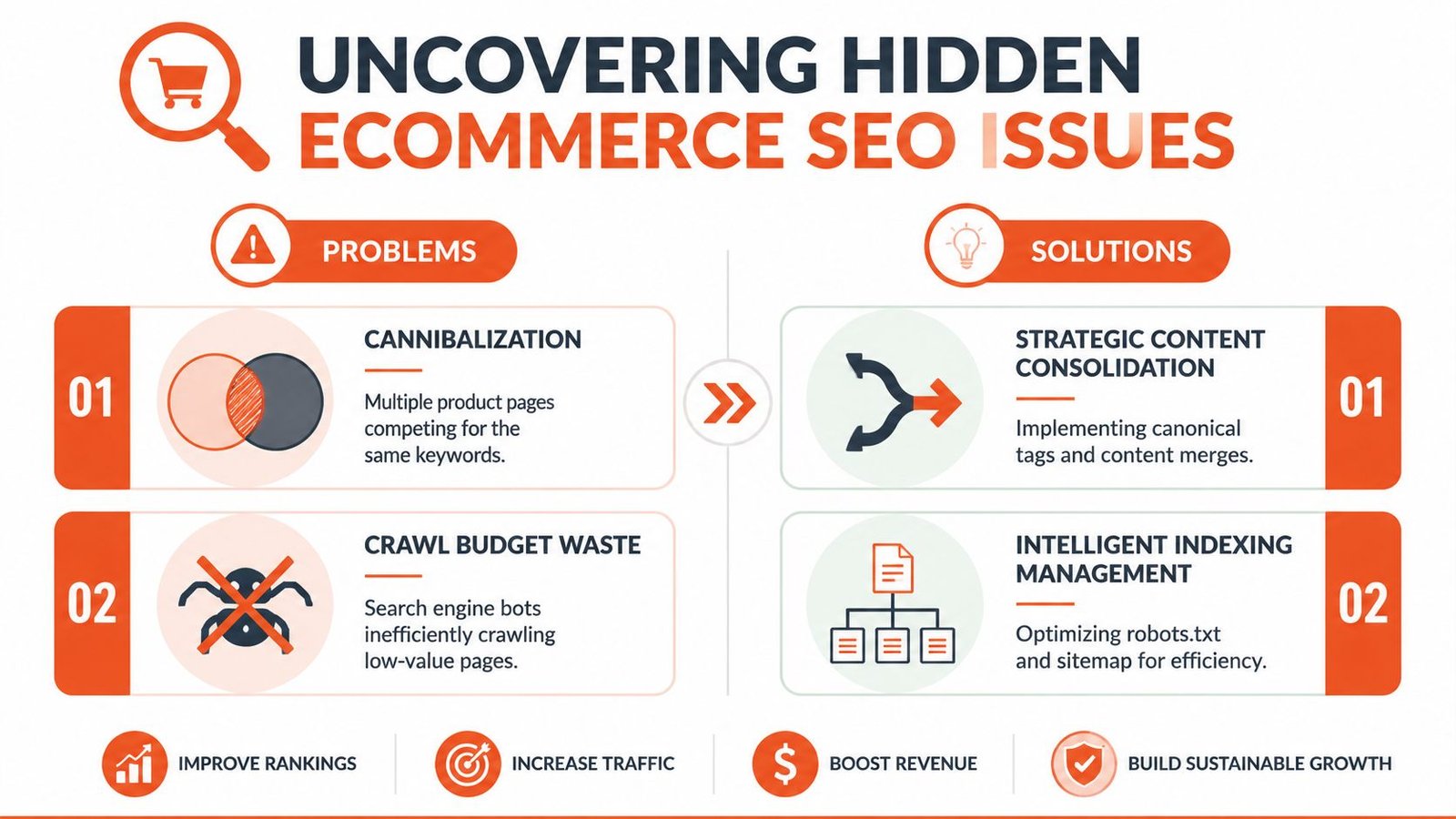
Basic checklists don’t catch the issues that subtly reduce revenue. A page can have a decent title tag, original copy, and product schema, then still underperform because of structural or search-result changes that many providers never audit.
Zero-click visibility is now part of product SEO
One of the biggest blind spots is the rise of zero-click product discovery. Verified data from BrightEdge states that 62% of product searches end without a click because of Google’s AI summaries and native shopping features. Most guides still teach ranking as if traffic were guaranteed once you appear.
It isn’t.
That changes how product pages should be built. Search engines increasingly extract the answer directly from structured product data, visible price signals, availability, and review context. If those elements are weak or inconsistent, your page may rank but still lose exposure inside the search result itself.
A practical response includes:
- Tight product data: Price, stock status, and ratings must be current.
- Clean entity signals: Product name, brand, SKU, and category relationships must be unambiguous.
- Page sections that answer buyer questions: Specifications, compatibility notes, and policy details help machine understanding.
- Measurement discipline: Use event tracking and search-console patterns, then compare them with Google Analytics 4 setup practices so you can see where visibility exists even when clicks soften.
Orphaned SKUs quietly erase revenue
The second hidden issue is the orphaned SKU problem. This often appears after redesigns, platform migrations, faceted navigation changes, or category restructuring.
A product still exists. The URL still loads. But internal links no longer route authority or discovery to that page in a reliable way. Search crawlers struggle to find it, users never reach it through navigation, and the store owner assumes demand dropped.
Verified data in the dataset identifies this as a widespread issue after structural updates. Cheap SEO providers often miss it because they focus on visible page elements instead of crawl paths, internal linking logic, and indexation hygiene.
A product page can be technically live and still be commercially invisible.
That is why advanced ecommerce SEO has to include crawl analysis, internal-link auditing, variant architecture review, and post-migration validation. Without that layer, stores keep optimizing pages that search engines barely prioritize.
If you’re evaluating agencies near me or comparing ecommerce SEO services, this is one of the easiest ways to tell who understands enterprise-style product complexity and who is just reselling a generic checklist.
Our Proven Process for Driving Ecommerce SEO Results
A serious ecommerce SEO engagement needs a system. Not scattered fixes. Not random blog recommendations. A repeatable process is what finds the leaks, prioritizes the work, and ties product-page changes to actual commercial outcomes.
What happens first
The first phase is a technical and content audit. During this audit, most hidden damage surfaces.
Verified data from Siteimprove shows that 45% of retail sites suffer from orphaned product pages after site updates, making those pages invisible to internal links and search crawlers. That is exactly the kind of issue a proper audit should uncover before anyone starts rewriting titles.
The audit typically reviews:
- Indexation health: Which product URLs are crawled, indexed, excluded, or duplicated
- Internal linking logic: Whether category pages, filters, related-product blocks, and breadcrumbs support discovery
- Keyword alignment: Whether product pages target commercial terms instead of mismatched informational queries
- Variant handling: Whether canonical tags and selectors are implemented correctly
- Schema integrity: Whether product data is complete and valid across templates
For a broader look at how content planning supports this kind of work, Rebus’s e-commerce SEO guide is a useful external reference.
What you actually get
The value of a strong process is clarity. Clients shouldn’t have to guess what the work includes.
A professional ecommerce SEO workflow usually includes:
- A prioritized action plan: The highest-impact fixes are identified first, not buried under low-value tasks.
- Template-level implementation: Product page changes are applied in a scalable way where possible.
- Content briefs for important SKUs: High-margin or high-demand products get specific optimization plans.
- Performance reporting: Rankings alone aren’t enough. Teams need visibility into organic entrances, product-page engagement, and assisted revenue trends.
- Ongoing testing: Titles, content order, trust elements, and structured data outputs need refinement over time.
Content operations matter here too. If the store publishes products frequently, the SEO system has to connect with a repeatable editorial workflow. These content marketing strategy principles help explain why product SEO needs process, not one-off edits.
Why this process closes revenue leaks
The best agencies don’t overwhelm clients with jargon. They remove uncertainty.
A reliable process answers the questions decision-makers care about:
| Concern | What a strong process should provide |
||—|
| What is broken | A documented list of ranking and crawl issues |
| What gets fixed first | Priority based on revenue impact and implementation effort |
| Who does what | Clear ownership between SEO, dev, and content teams |
| How progress is tracked | Reporting tied to search visibility and business outcomes |
That level of structure reduces delays, prevents wasted effort, and gives stakeholders confidence that the work is tied to sales, not just rankings.
Common Questions About Investing in Product Page SEO
Can’t I just do this myself or use a plugin
You can handle basic tasks in-house. Many stores do. Plugins can generate default schema, manage meta fields, and help with image compression.
They can’t diagnose every revenue-killing issue covered above. They don’t decide which SKUs deserve unique copy first. They don’t resolve orphaned inventory architecture on their own. They don’t fix weak internal linking logic after a migration. Tools assist. They don’t replace strategy.
How long does it take to see results
Some changes create early traction quickly, especially when pages have obvious technical errors or missing relevance signals. Broader gains take longer because search engines need to recrawl, process, and re-evaluate the site.
The right expectation is this. Product page SEO compounds. The stores that stay disciplined with technical cleanup, content depth, schema integrity, and reporting build a stronger sales channel over time than stores that chase short bursts of traffic.
Is professional SEO worth the investment
If product pages are central to revenue, the better question is what inaction is costing you now.
Organic search is already one of the primary ecommerce channels, as cited earlier. When product pages underperform, you don’t just lose rankings. You lose high-intent buyers who were already searching for what you sell. For most serious ecommerce brands, the cost of continued invisibility is higher than the cost of fixing it.
If your store depends on paid traffic alone, your margins stay under pressure. Strong product-page SEO gives you a more durable acquisition channel.
Start Turning Product Pages Into Your Top Sales Channel
Your product pages are either working as sales assets or sitting in your catalog as missed opportunities. There isn’t much middle ground. If the pages aren’t visible, technically sound, and persuasive at the moment a buyer searches, competitors take the sale.
That is why SEO for ecommerce product pages can’t be treated like a small checklist item delegated to a plugin or a cheap monthly package. Effective work involves intent targeting, unique product content, schema precision, speed tuning, zero-click visibility, and structural fixes that protect every SKU that matters.
For those seeking an SEO agency near me, comparing ecommerce SEO services, or looking for a team that understands both rankings and lead generation logic, the next step should be simple. Get a professional review of your product-page setup before another month of traffic and sales slips away.
The market is competitive. Buyers are searching now. The stores that fix visibility problems first usually keep the advantage.
If you’re ready to turn underperforming product pages into a stronger revenue channel, contact VIP TECH CONSULTING to book a strategy session. The team helps ecommerce and local brands identify ranking gaps, fix technical SEO issues, improve conversion paths, and build campaigns that generate more calls, leads, and sales.