


If you’re a local business owner, are you struggling with an empty phone, a quiet storefront, and a frustrating lack of new leads? The problem isn't your service; it's your visibility. Most businesses lose money because their online strategy fails, allowing competitors to capture ready-to-buy customers searching 'near me' every single day.
Choosing the wrong approach, or doing nothing, means you're actively giving revenue away. This isn't just about being online; it's about being found when it matters most. For instance, to illustrate how local SEO specifically benefits service-based businesses, consider applying these strategies to an industry like plumbing with our guide to SEO for Plumbers. The principles are the same: dominate your service area or lose out.
This definitive local SEO checklist is designed not just to inform, but to provide a clear, actionable roadmap to reclaim those lost customers and establish your authority in the local market. For businesses actively seeking a solution and ready to make a decision, this guide will show you precisely what a professional, results-driven local SEO strategy must include to turn searches into sales. We will cover the essential steps from Google Business Profile optimization to advanced local link building and reporting, giving you the framework needed to stop being invisible and start generating more calls, leads, and customers.
1. Google Business Profile Optimization
Creating and fully optimizing a Google Business Profile (formerly Google My Business) is the non-negotiable foundation of any serious local SEO checklist. This free tool is your business's digital storefront on Google, allowing you to appear directly in Google Maps and the Local Pack—the map with three listings at the top of search results.
For any local business, a meticulously managed profile is what separates you from the competition in "near me" searches. It is the primary driver of foot traffic, phone calls, and website visits from potential customers who are ready to act. Neglecting it is like having a locked front door during business hours; you become invisible to the most qualified local searchers.
Practical Implementation and Examples
A well-optimized GBP goes far beyond just listing your name and address.
- Local Restaurants: Businesses that use Google Posts to feature daily specials or weekend events can see a 30-50% increase in reservation inquiries and direct calls from motivated diners.
- Professional Services (Legal/Consulting): A law firm that populates its profile with specific service areas, team photos, and positive client reviews attracts more qualified leads looking for specific expertise.
- Local Trades (HVAC/Plumbing): A plumbing company can define its service area on its profile. This ensures they appear in searches like "plumber in [nearby city]" even if their physical office is elsewhere, dramatically expanding their lead generation reach.
Actionable Optimization Tips
To make your Google Business Profile a lead-generation machine, focus on these critical tasks:
- Immediate Verification: Verify your profile as soon as it's created. Unverified listings have almost no visibility.
- Consistent Posting: Post updates at least once a week using Google Posts to announce promotions or highlight a service. This signals to Google that your business is active and engaged.
- Visuals are Key: Upload at least 15-20 high-quality photos. Include your storefront, team, services in action, and happy customers to build trust instantly.
- Review Management: Respond to every single review, positive or negative. A thoughtful response shows you value customer opinions and boosts engagement metrics that Google tracks.
- NAP Consistency: Ensure your Name, Address, and Phone number (NAP) are identical across your GBP, website, and all other online directories. Even small variations confuse search engines and hurt rankings.
- Q&A Section: Proactively populate the Questions & Answers section with common customer questions and your own clear, helpful answers.
Optimizing your profile is a continuous process. If managing these details feels overwhelming, partnering with a specialist can ensure your profile consistently works to attract new customers and generate revenue.
2. Local Citation Building and Directory Listings
After optimizing your Google Business Profile, the next critical step in a strong local SEO checklist is building consistent citations. Local citations are online mentions of your business's core information: Name, Address, and Phone number (NAP). These mentions across authoritative directories like Yelp and industry-specific platforms act as votes of confidence, signaling your business's legitimacy to Google.
For any local business, a robust citation profile is essential for competing in the local search results. Each consistent mention on a reputable site reinforces your geographic relevance. This tells Google that you are a genuine local entity, which directly impacts your ability to rank in the Local Pack and on Google Maps for high-value searches.
Practical Implementation and Examples
Consistent citations are a powerful signal for both search engines and potential customers.
- Local Restaurants: A restaurant listed accurately on Yelp, OpenTable, and local dining guides not only gains map visibility but also attracts direct reservations from customers browsing those platforms.
- Professional Services (Legal/Consulting): A law firm that builds citations across 50+ directories, including industry-specific sites, can see a significant increase in qualified inquiries as its local authority grows.
- Local Trades (HVAC/Plumbing): HVAC contractors who appear consistently in service directories often dominate "HVAC near me" searches because their NAP data is verified across multiple trusted sources.
Actionable Optimization Tips
To build a citation profile that boosts your local authority, concentrate on these essential tasks:
- Start with Core Directories: Begin with the most influential platforms: Google Business Profile, Yelp, Facebook, Apple Maps, and Bing Places. These are foundational.
- Ensure NAP Consistency: Your Name, Address, and Phone number must be identical everywhere. Avoid using abbreviations like "St." in one place and "Street" in another, as this creates confusion for search engines.
- Prioritize Niche and Local Directories: Focus on industry-specific directories (e.g., Avvo for legal, Houzz for home services) and local listings. These hyper-relevant citations carry significant weight.
- Claim Existing Listings First: Before building new profiles, search for your business on major directories to find and claim any existing auto-generated listings. This prevents duplicate profiles and ensures you control your information.
- Monitor and Update Regularly: Use a tool or conduct manual checks to find and correct inconsistencies. If you move or change your phone number, updating citations is a top priority.
- Scale with an Expert: Building hundreds of citations manually is inefficient. A local SEO expert can ensure your business information is accurate and widespread, turning online directories into a reliable source of new customers.
3. Local Keyword Research and Optimization
Identifying the exact search terms customers use to find businesses like yours is a critical piece of any local SEO checklist. This process, known as local keyword research, uncovers geo-modified searches ('plumber in [city]'), 'near me' queries, and other local-intent phrases. Optimizing your website's content for these hyper-local terms is how you attract high-intent traffic ready to convert.
This is the difference between attracting general online browsers and engaging customers actively searching for your services in their immediate area. Targeting a broad keyword like "accounting services" wastes resources on a national audience, while focusing on "CPA near me" connects you directly with qualified local leads, dramatically improving your marketing ROI.
Practical Implementation and Examples
Effective local keyword strategy goes far beyond simply adding your city name to your services.
- Restaurant Sector: A restaurant optimizing its site for "Mexican restaurants in [neighborhood]" and "best tacos near me" can dominate the local map pack, driving dinner reservations directly from search results.
- Legal Services: A personal injury law firm that targets specific, high-intent phrases like "car accident lawyer [city]" and "slip and fall attorney [county]" generates more qualified calls from people needing immediate legal help.
- Professional Services (Accounting): An accounting firm that shifts its focus from a generic term to "CPA for small business near me" can see a 3x better conversion rate and a significantly lower cost-per-lead.
Actionable Optimization Tips
To turn your website into a magnet for local customers, implement these keyword tasks:
- Use Professional SEO Tools: Employ platforms like Semrush or Ahrefs to find geo-modified keywords that have actual local search volume and low competition.
- Get Hyper-Local: Include specific city and neighborhood names in your primary keywords (e.g., 'digital marketing agency [neighborhood]' instead of just 'digital marketing agency').
- Target 'Near Me' Variants: Analyze Google Search Console to find high-intent 'near me' queries your site already gets impressions for and create content to fully capture that traffic.
- Analyze Competitors: Use keyword research tools to see what local terms your competitors are ranking for. This often reveals valuable gaps in your own strategy that you can exploit.
- Focus on Long-Tail Keywords: Target longer, more specific phrases like "best family law attorney for divorce." These have lower competition and much higher conversion intent.
4. Website Technical SEO and Schema Markup
Technical SEO is the invisible foundation that ensures your website is structured for both search engines and users. It involves adding specific code called schema markup, which acts as a translator, telling Google exactly what your business is, where it’s located, and what it offers. This is a critical component of any local seo checklist.
For local businesses, this behind-the-scenes work is what makes your website a powerful tool for Google. A technically sound site with correct local schema helps Google understand your relevance to searches like "attorney in [neighborhood]" or "best tacos in [city]," giving you a clear advantage over competitors with poorly structured sites. It ensures that when Google crawls your website, it understands every detail with perfect clarity.

Practical Implementation and Examples
Proper technical setup directly translates to better search visibility and more customer actions.
- Local Dental Practices: After a dental practice added LocalBusiness and service area schema, its impressions in Google Maps searches increased by 65% as Google could better match the clinic to relevant local queries.
- Law Firms: A law firm that implemented AggregateRating schema saw its star ratings appear directly in Google search results. This visual trust signal significantly boosted click-through rates from qualified potential clients.
- Local E-commerce: A Shopify store focusing on a local market optimized its Core Web Vitals for faster mobile loading. This led to a 25% increase in mobile conversions, essential for capturing sales from on-the-go local shoppers.
Actionable Optimization Tips
To make your website's technical structure a driver of local traffic, concentrate on these essential tasks:
- Implement LocalBusiness Schema: Add LocalBusiness schema to your homepage. It must contain your complete NAP (Name, Address, Phone), business description, logo, and defined service areas.
- Add Review Ratings: Use AggregateRating schema if you collect customer reviews on your site. This is what enables star ratings to appear under your listing in search results, building immediate trust.
- Verify Your Markup: Use Google's Structured Data Testing Tool or the Schema.org validator to confirm your markup is implemented correctly and is free of errors.
- Optimize Core Web Vitals: Use Google PageSpeed Insights to analyze and improve your site’s speed, focusing on Largest Contentful Paint (LCP), First Input Delay (FID), and Cumulative Layout Shift (CLS).
- Ensure Mobile-Friendliness: Your website must be fully responsive. Use Google's Mobile-Friendly Test to find and fix any issues that harm the user experience on smartphones and tablets.
- Secure Your Site with HTTPS: Install an SSL certificate. A secure "https://" site is a mandatory standard for security and a confirmed Google ranking factor.
Properly managing technical SEO and schema is complex. If you want to ensure your site's foundation is built to attract local customers, a consultation with a specialist can identify and fix critical issues holding you back.
5. Content Creation and Local Keyword Integration
Creating high-quality, locally-relevant content is a cornerstone of any effective local SEO checklist. This strategy involves producing material that naturally includes geo-specific keywords and addresses local search intent. Excellent content builds your website's topical authority, keeps visitors engaged longer, and attracts valuable backlinks, all of which are strong ranking signals for Google.
For local businesses, content must do more than just sell; it must demonstrate deep local knowledge. By creating content that speaks to specific neighborhoods, community events, and local customer concerns, you prove to both search engines and potential clients that you are an integral part of the local market, not just another faceless company. This is how you win trust and visibility.
Practical Implementation and Examples
Locally-focused content directly translates into qualified leads and sales.
- Immigration Law Firm: A firm that publishes blog posts on topics like "family visa process for local residents" or "EB-5 visa requirements for local entrepreneurs" can rank for high-intent legal keywords and generate inquiries from its target clientele.
- Local Dental Practice: By creating a neighborhood-specific page for "best family dentist in [neighborhood]" featuring team bios and patient testimonials, the practice can dominate search results for that area.
- Local Restaurant: A restaurant blog that covers "best happy hours in [neighborhood]" or "local cuisine trends" ranks for both its own brand and competitor searches, driving significant foot traffic from people actively looking for dining options.
Actionable Optimization Tips
To turn your website into a local authority, concentrate on these content tasks:
- Location-Specific Pages: Create unique landing pages for each key service area or neighborhood you serve (e.g., 'Dog Grooming in [neighborhood A],' 'Dog Grooming in [neighborhood B]').
- In-Depth Blog Posts: Write detailed blog posts (1,500+ words) that solve a specific local customer problem or answer a common question.
- Natural Keyword Use: Weave your local keywords into the page title, headers (H2/H3), the first paragraph, and throughout the body text without forcing them.
- Local Proof: Include local statistics or case studies, such as 'How 3 Local Businesses Doubled Leads with Local SEO,' to build credibility.
- Image Optimization: Optimize image alt text with descriptive, local keywords. Use "best-italian-restaurant-city.jpg" instead of a generic "restaurant.jpg."
- Content Freshness: Update and refresh your top-performing content every 3-6 months. Add new information to signal to Google that your content is current and relevant.
If creating a consistent stream of optimized local content feels like a full-time job, our team can develop and execute a strategy that establishes your authority and drives measurable results.
6. Review Generation and Reputation Management
Customer reviews are a powerful ranking factor and a critical piece of any local seo checklist. They are social proof that directly influences how potential customers perceive your business and how Google ranks you in local search results. A steady stream of authentic reviews on platforms like Google and Yelp builds trust, boosts click-through rates, and ultimately drives conversions.

For a local business, your online reputation is your digital word-of-mouth. A strong, positive review profile can be the single deciding factor that pushes a customer to choose you over a competitor with a lower star rating or fewer reviews. Managing this reputation proactively is not just good customer service; it's a direct investment in your local search visibility and revenue.
Practical Implementation and Examples
A proactive review strategy separates market leaders from the rest of the pack.
- Local Dental Practices: A clinic that automates review requests after each appointment can generate 5-10 new reviews monthly. A practice with over 200 five-star reviews will often rank #1 locally and convert 40% more website visitors into new patients.
- Local Restaurants: A restaurant with a 4.8-star rating from 500+ reviews will consistently outrank competitors with 4.2 stars in both Google Maps and Yelp, often driving 60% more online reservations.
- Professional Services Firms: A consulting firm that responds to every Google review within 24 hours demonstrates exceptional client care. This simple act can lead to a 35% higher engagement rate and stronger customer loyalty.
Actionable Optimization Tips
Turn your customer feedback into a powerful marketing asset with these steps:
- Automate the Ask: Set up automated emails or text messages to be sent to customers a day or two after a service. Include a direct link to your Google review page to make it easy.
- Train Your Team: Instruct your staff to ask satisfied customers for a review in person. A simple, "We'd love to hear your feedback on Google if you had a great experience," can significantly increase response rates.
- Monitor All Platforms: Use tools to monitor reviews across Google, Yelp, and other relevant industry sites. Daily monitoring ensures you can respond quickly.
- Respond to Every Review: Aim to reply to all reviews within 24-48 hours. Thank customers for positive feedback and address negative comments professionally and empathetically.
- Handle Negative Reviews with Care: For negative feedback, apologize for their experience, offer a concrete solution, and invite them to discuss the matter offline. This shows other potential customers that you take concerns seriously.
- Never Fake or Incentivize Reviews: Offering discounts or free items for reviews is against most platforms' policies and can destroy your credibility. Authenticity is key.
7. Local Link Building and Local Authority
Earning high-quality backlinks from other local and authoritative websites is a powerful signal of trustworthiness for Google. This element of your local SEO checklist is about building a reputation online. When other respected local sites link to yours, Google sees it as a vote of confidence, improving your own authority and search rankings.
For local businesses, this means gaining links from sites your customers already trust, like local news, industry associations, or neighborhood blogs. These local links carry special weight in local search algorithms, directly impacting your visibility. A strategic approach to link building positions your business as a community leader, drives qualified referral traffic, and separates you from competitors who ignore off-page signals.
Practical Implementation and Examples
A thoughtful link-building strategy involves creating real-world partnerships.
- Local Restaurants: A restaurant partners with local food bloggers and event venues for sponsorships. This effort earns links from multiple local websites, helping it dominate searches for "best restaurants in [city]."
- Professional Services (Legal/Consulting):_ A law firm secures links from the local Bar Association and is featured in the local paper as an expert source. Its domain authority increases, leading to #1 rankings for specific legal searches.
- Local Trades (HVAC/Plumbing): A consulting firm guest-posts on several local business publications and joins the chamber of commerce. This builds high-authority local links and increases inbound local leads by 50% in one year.
Actionable Optimization Tips
To turn your business into a local authority, focus on building a strong, relevant backlink profile with these tasks:
- Create a "Link Opportunities" List: Identify local directories, chambers of commerce, business associations, news outlets, and complementary businesses to target.
- Sponsor Local Events: Get involved in charity runs, festivals, or business luncheons. This often results in valuable links from event websites and local news coverage.
- Join Business Organizations: Memberships in groups like the Chamber of Commerce or neighborhood business associations typically come with a directory listing and a link.
- Become a Local Source: Reach out to local news and business journalists with story ideas or expert commentary. Media outlets are always looking for local experts to cite and link to.
- Partner with Complementary Businesses: Work with non-competing local businesses on cross-promotions that include link exchanges. For example, an event planner can link to a trusted restaurant partner.
- Develop Local Content: Create valuable resources like local statistics, neighborhood guides, or industry reports that local bloggers and media outlets will naturally want to reference and link to.
8. Mobile Optimization and User Experience (UX)
With over 60% of local searches happening on mobile devices, optimizing your website for phones is a critical component of any effective local seo checklist. Customers looking up hours or searching for services "near me" are on their phones, and they expect a fast, seamless experience. Google's mobile-first indexing prioritizes your mobile site for ranking, meaning a poor mobile user experience directly harms your visibility and kills conversion rates.
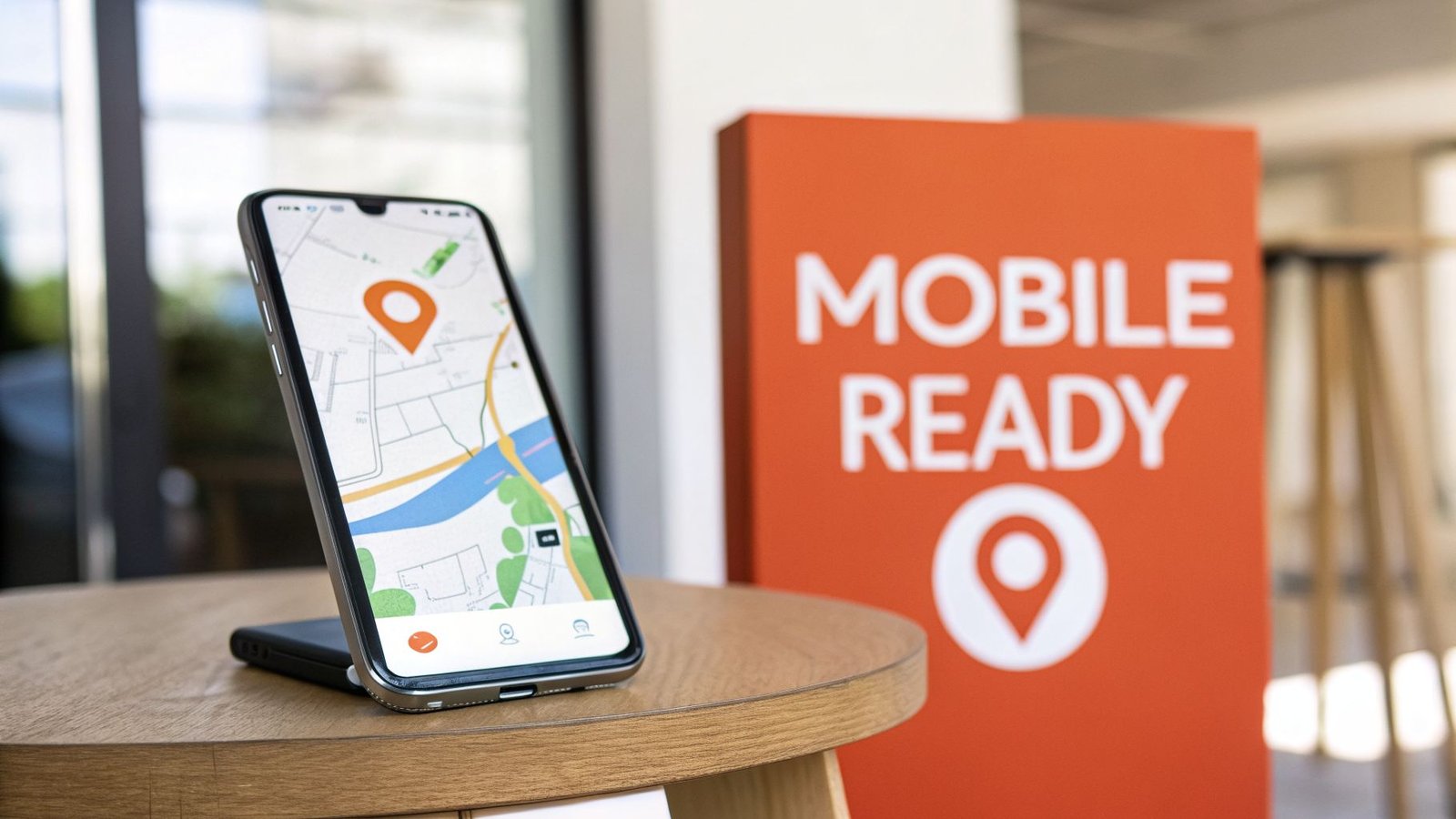
A clunky mobile site with slow-loading pages and hard-to-find information will send potential customers straight to a competitor. A fast, intuitive mobile experience, on the other hand, converts searchers into leads, phone calls, and foot traffic.
Practical Implementation and Examples
A mobile-friendly website is designed for action, not just information.
- Local Restaurants: By adding a prominent "call" button and map integration to its mobile site, one local restaurant saw its mobile conversions increase by 45%. It now generates over 70% of its reservations directly from mobile users.
- Local Trades (HVAC/Plumbing): After improving its mobile page speed and placing a "click-to-call" button at the top of the screen, a plumbing company increased its phone leads from mobile searches by 55%.
- Professional Services (Dental): A dental practice simplified its mobile appointment form and added a sticky "Book Appointment" button. This single change resulted in a 60% increase in mobile appointment requests.
Actionable Optimization Tips
To turn your mobile site into a lead-generating asset, focus on these essential tasks:
- Simplify Mobile Navigation: Use a clean "hamburger" menu and ensure tap targets like buttons and links are large enough for a thumb (at least 48px).
- Prioritize Speed: Use Google's PageSpeed Insights to diagnose performance issues. Focus on improving Core Web Vitals, especially Largest Contentful Paint (LCP), by compressing images.
- Enable Click-to-Call: Make your phone number a clickable link and place it "above the fold" so users can call you without scrolling.
- Streamline Forms: Reduce the number of fields on your mobile contact forms. Often, "Name," "Email/Phone," and "Message" are all you need to start a conversation.
- Test on Real Devices: Don't rely solely on desktop simulators. Test your website on actual iPhones and Android devices to uncover real-world usability problems.
- Integrate Maps: Embed a Google Map on your contact page to provide easy, one-tap directions for customers on the go.
If your website isn't delivering a superior mobile experience, you are actively losing customers. A professional audit can identify and fix these issues, ensuring your site works to grow your business.
9. Google Ads Local Campaign Management (PPC)
While organic growth is a long-term goal, paid advertising through Google Ads offers immediate visibility at the top of search results. A well-managed local pay-per-click (PPC) campaign is a vital part of a complete local SEO checklist because it complements your organic efforts by capturing high-intent customers the moment they search. It is the fastest way to generate leads, calls, and foot traffic.
This means you can instantly appear in front of customers actively looking for your services. Instead of waiting months for SEO to gain traction, you can run geo-targeted ads that put you ahead of competitors, ensuring your budget is spent only on reaching potential customers in your specific service area, whether it's a single neighborhood or the entire county.
Practical Implementation and Examples
Strategic local ad campaigns drive measurable results and a strong return on investment.
- Local Trades (Plumbing/HVAC): A plumbing company using Google Local Services Ads can generate over 20 qualified leads per month, paying only for verified leads from customers who actually contact them, not just for clicks.
- Professional Services (Legal): A personal injury law firm running geo-targeted Google Search Ads for keywords like "car accident lawyer [city]" can generate 5-10 qualified phone calls daily, achieving a significant return on their ad spend.
- Healthcare Practices: A dental practice can run targeted Google Ads for "emergency dentist near me," leading to a steady stream of new patient appointments with a conversion rate of over 30% from ad clicks.
Actionable Optimization Tips
To turn Google Ads into a powerful customer acquisition channel, concentrate on these key actions:
- Use Local Services Ads: If you are in an eligible industry (home services, plumbing, electrical), prioritize Local Services Ads. The pay-per-lead model is often more cost-effective and generates high-quality inquiries.
- Geo-Modified Keywords: For Search Ads, bid on keywords that include a location, such as "accountant in [city]," not just "accountant." This focuses your budget on the most relevant audience.
- Enable Location Extensions: Always add location extensions to your ads. This shows your address and phone number, making it easy for local searchers to find and contact you.
- Schedule Your Ads: Run ads only during your business hours. There is no benefit to paying for clicks at 3 AM if you cannot answer the phone or respond to the lead.
- Track Everything: Set up conversion tracking for every important action, including phone calls, form submissions, and online bookings. This is the only way to accurately measure your return on ad spend (ROAS).
- Start Small and Scale: Begin with a modest daily budget to test performance. As you confirm profitability, you can scale your investment confidently.
Managing a PPC campaign requires continuous monitoring and adjustment. If you find the process complex, partnering with a specialist can ensure your campaigns are optimized to produce consistent leads and revenue for your business.
10. Local SEO Monitoring, Reporting, and Continuous Optimization
Local SEO is not a one-time project; it requires ongoing monitoring, regular reporting, and continuous optimization based on performance data. This is a critical part of any effective local SEO checklist because algorithms change, competitors adapt, and customer behavior evolves. Tracking local rankings, search visibility, traffic, and leads helps you understand what's working and identify areas for improvement.
For local businesses, failing to monitor performance is like navigating without a compass. You might be moving, but you have no idea if you're heading toward your goal. Regular analysis catches issues like algorithm penalties, new competitors entering the market, or broken business listings before they can damage your hard-earned rankings and profitability.
Practical Implementation and Examples
A data-driven approach allows for precise, impactful adjustments that drive real business growth.
- Local HVAC Company: By using monthly local rank tracking, an HVAC business discovered and fixed dozens of inconsistent citations. This simple but focused effort resulted in a 35% increase in organic phone calls within four months.
- Local Dental Practice: A dental office implemented a review monitoring system and committed to responding to all feedback within 24 hours. Their online reputation improved, leading to a 25% increase in appointment requests from new patients.
- Multi-location Retailer: A retailer with stores across a region used location-level reporting to analyze performance. They reallocated their marketing budget to support underperforming locations, leading to improved conversions and foot traffic.
Actionable Optimization Tips
To turn data into a strategic advantage, integrate these tasks into your monthly workflow:
- Unified Dashboards: Set up a dashboard that combines data from Google Search Console, Google Analytics, rank tracking software, and call tracking. This provides a single, clear view of performance.
- Focus on Business Outcomes: Report on leads, phone calls, and conversions, not just traffic. The goal of local SEO is to generate measurable business results.
- Schedule Monthly Audits: When conducting your local SEO monitoring, leveraging a comprehensive local SEO audit template can help you systematically evaluate your performance. Check for citation accuracy, new reviews, and technical SEO issues to catch problems early.
- Set Up Smart Alerts: Use your tools to create alerts for significant changes, such as a sudden drop in map pack impressions or a negative review, to trigger an immediate investigation.
- Benchmark Against Competitors: Track your direct local competitors to understand their strategies and identify opportunities to outperform them.
- Prioritize Next Steps: Every report should conclude with recommended actions, prioritized by potential impact. This turns insight into a clear plan.
- Test and Measure: Before rolling out a major change, test it in a controlled way (e.g., A/B testing a landing page) and measure the impact on your key metrics.
Local SEO Checklist: 10-Point Comparison
| Strategy | Implementation complexity | Resource requirements | Expected outcomes | Ideal use cases | Key advantages |
|---|---|---|---|---|---|
| Google Business Profile Optimization | Low–Medium — setup + ongoing maintenance | Time for verification, photos, review management; minimal cost | Improved Maps visibility, more calls and foot traffic | Local storefronts and service-area businesses | Free, direct control over Google listing |
| Local Citation Building and Directory Listings | Medium — audit + consistency work | Time or citation services, accurate NAP data | Better local rankings and referral traffic | Businesses needing broad directory presence | Signals trust and consistency to search engines |
| Local Keyword Research and Optimization | Medium — research + on‑page updates | SEO tools, analyst time, content edits | Higher targeted organic traffic and conversions | Businesses targeting geo-specific searches | Targets high-intent, lower-competition queries |
| Website Technical SEO and Schema Markup | High — technical implementation required | Developer time, performance tools, audits | Improved crawlability, rich snippets, faster pages | Sites with technical issues or low indexing | Foundation for SEO; boosts CTR and indexing |
| Content Creation and Local Keyword Integration | Medium–High — ongoing content production | Writers, local research, content calendar | Topical authority, backlinks, sustained traffic growth | Competitive markets and multi-location businesses | Builds E-E-A-T and long-term visibility |
| Review Generation and Reputation Management | Low–Medium — systems + response workflow | Review tools, staff time, monitoring | Higher rankings, trust, and conversion rates | Consumer-facing services and retail | Strong social proof; major local ranking factor |
| Local Link Building and Local Authority | High — outreach and relationship building | Outreach time, PR, partnerships, content assets | Increased domain authority and referral traffic | Businesses seeking local credibility and PR | High-impact local links that boost rankings |
| Mobile Optimization and User Experience (UX) | Medium–High — design & performance work | Dev resources, testing devices, performance tools | Higher mobile conversions, lower bounce rates | Mobile-heavy queries, restaurants, appointment businesses | Improves conversions and mobile-first ranking signals |
| Google Ads Local Campaign Management (PPC) | Medium — campaign setup and ongoing optimization | Ad budget, PPC manager, tracking & analytics | Immediate visibility and measurable leads | Time-sensitive promotions or ramping traffic quickly | Fast results with precise geo-targeting and control |
| Local SEO Monitoring, Reporting, and Continuous Optimization | Medium — ongoing process and analysis | Analytics and rank-tracking tools, reporting time | Continuous improvement, early issue detection, ROI tracking | Businesses committed to long-term local growth | Data-driven prioritization and performance transparency |
From Checklist to Revenue: Your Next Step to Local Dominance
You now have a complete, prioritized local SEO checklist. This isn't a list of suggestions; it's a strategic framework that separates the businesses that show up in local searches from those that remain invisible. We have detailed the specific actions required for success, from optimizing your Google Business Profile to running targeted local ad campaigns.
But here's the truth: knowing what to do is only the beginning. The real gap for most local businesses isn't knowledge, it's consistent, precise execution. The difference between ranking on page one of Google Maps and being buried on page five often comes down to small, consistent details—the accuracy of a citation, the optimization of a single image, or the response to one customer review.
Stop Guessing and Start Generating Leads
Mastering this local SEO checklist is the key to creating a predictable stream of high-intent customers. When a potential client searches for "[service] near me," you want to be the immediate, obvious choice. This requires a dedicated, ongoing effort that touches on technical SEO, content strategy, and customer service.
Many business owners ask, "Can I do this myself?" The answer is, perhaps. But the more important question is, at what cost?
- The Learning Curve: The time spent trying to master Google's ever-changing algorithm is time not spent running your business.
- Costly Mistakes: A single incorrect NAP entry or a poorly configured local ad can waste months of effort and hundreds of dollars.
- Lost Opportunity: Every day your business isn't optimized is a day your competitors are capturing ready-to-buy customers who should have been yours.
The value isn't in having a checklist; it's in the flawless, efficient implementation of it. This is where professional expertise becomes a competitive advantage, turning a list of tasks into a powerful revenue-generating system. In a competitive market, hesitation is expensive. Don't let another customer find your competitor first.
Ready to stop guessing and start seeing measurable growth from your local marketing efforts? The team at VIP TECH CONSULTING specializes in transforming this local SEO checklist from a document into a dynamic strategy that delivers real-world results. We handle the complexities of local SEO so you can focus on what you do best: serving your customers.
Schedule your complimentary consultation with VIP TECH CONSULTING today and discover how we can build a dominant local presence for your brand.
