


Knowing how to write meta descriptions for SEO isn’t just a technical task; it’s a critical sales opportunity. If you’re struggling to turn search traffic into actual leads, your 155-character meta description is often the culprit. It’s your digital sales pitch on the Google results page, and getting it wrong means potential customers click on your competitors instead.
A weak, auto-generated description costs you clicks, phone calls, and revenue. A sharp, persuasive one, however, can boost your traffic and sales, even if your ranking doesn’t change. For businesses looking to grow, mastering this is non-negotiable.
Your Meta Description Is a Digital Handshake

Before a prospect ever sees your website, they see your meta description. It’s the digital handshake that determines if they trust you enough to click or simply keep scrolling. For local businesses in competitive markets, this isn’t a minor detail—it’s a pivotal moment in your customer acquisition process.
The problem is most businesses ignore it. They leave the description blank, letting Google pull random, often disjointed text from the page. This is a costly mistake. You’re allowing an algorithm to manage your first impression, which directly hurts your ability to generate leads from search.
Why Ignoring Meta Descriptions Is a Costly Mistake
An unoptimized meta description doesn’t just look unprofessional; it directly impacts your bottom line. When you neglect this crucial element, you face serious consequences:
- Lower Click-Through Rates (CTR): You can rank #1, but if your description is unconvincing, users will skip your listing. A low CTR signals to Google that your result is irrelevant, which can eventually damage your rankings.
- Lost Leads and Revenue: Every user who skips your link is a potential customer clicking on a competitor’s website. If you’re a local service provider, that’s a phone call you never received and revenue you just handed to someone else.
- A Disconnected Brand Message: You lose the prime opportunity to tell searchers why you are the best solution, address their immediate problem, and give them a compelling reason to choose you now.
Getting this right is a fundamental step in Mastering Organic Search Engine Optimisation because it dictates how potential customers perceive your business in search results. It’s your best tool for converting a passive searcher into an active lead. Our full SEO explainer dives deeper into how these details build a powerful growth engine.
By taking control of this small but mighty piece of text, you give your business a decisive advantage. You’re making a strong first impression precisely when it matters most—right in front of prospects actively seeking your services. If you’re tired of leaving money on the table, it’s time to make every character count.
How to Write Meta Descriptions for SEO: The Anatomy of a High-Converting Snippet
Writing a great meta description is less about filling a box in your CMS and more about crafting a tiny, powerful advertisement. It’s your first and only chance to convince someone that your page has the solution they need.
Getting this right isn’t just an SEO “best practice”; it’s a direct lever you can pull to increase traffic and generate qualified leads. Let’s break down the essential ingredients that separate a forgettable description from one that demands a click.
Stick to the Right Length to Avoid Getting Cut Off
The first, most fundamental rule is a simple one: stay within the character limit. Google provides limited real estate, and a description that gets cut off with a “…” looks unprofessional and often hides your main point or call to action.
The optimal length is a concise 150-160 characters. This ensures your full message is visible on most devices without being truncated. A perfectly sized description can significantly improve your click-through rates, which for a local business can mean the difference between booking a new client and being completely overlooked.
Weave in Your Keywords Strategically
You must include your primary keyword in the meta description. When a user’s search query matches the text in your description, Google bolds it. This makes your listing pop on the results page, instantly signaling that your content is highly relevant.
Imagine a potential customer searching for “local SEO services.” If they see that exact phrase in your meta description, it immediately validates that your business offers the solution they need. This process starts with solid research; you can sharpen your skills with our guide on how to improve your keyword research for SEO.
A winning meta description has several key parts that work together. Getting the balance right is crucial. Here’s a quick breakdown of what to focus on.
Meta Description Anatomy Do’s and Don’ts
| Component | Do (Best Practice) | Don’t (Common Mistake) |
|---|---|---|
| Value Proposition | Clearly state the benefit. Answer “What’s in it for me?” for the user. | Simply list features or describe the page content blandly. |
| Keyword | Include the primary keyword naturally early in the description. | Stuff keywords awkwardly or repeat them multiple times. |
| Tone of Voice | Use an active, engaging, and authoritative voice that builds trust. | Write in a passive, robotic, or overly formal tone. |
| Call-to-Action | End with a clear, compelling instruction like “Get a Free Quote” or “Book a Call.” | Leave the user guessing what to do next. |
Following these simple rules will put you far ahead of competitors and ensure your descriptions actively work to grow your business.
Communicate a Compelling Value Proposition
Your description must answer the searcher’s unspoken question: “Why should I click this link?” Don’t just state what the page is about; sell them on the value. Focus on the outcome, the solution, or the unique benefit they will receive.
A great meta description moves beyond features and focuses on results. Instead of saying, “We offer plumbing services,” try “Fast, reliable 24/7 emergency plumbing to fix leaks and prevent water damage. Get a quote now.”
The second option speaks directly to a user’s urgent problem and presents an immediate, compelling solution. This is how you attract high-intent customers.
Always Include a Clear Call-to-Action (CTA)
Finally, never leave a searcher hanging. Tell them exactly what you want them to do next with a strong call-to-action. A clear directive creates urgency and bridges the gap between seeing your listing and visiting your site.
Here are a few powerful examples for different businesses:
- For service businesses: “Request a Free Consultation,” “Book Your Appointment Today,” or “Get a Free Quote Now.”
- For local companies: “Order Online for Pickup,” “Reserve Your Table,” or “Call Us for Same-Day Service.”
- For informational content: “Learn the 5 Easy Steps,” “Discover the Secrets,” or “Read Our Expert Guide.”
That final nudge is often all it takes to turn a passive scroller into an active lead. If you want a team of experts to handle this for you, we specialize in crafting SEO strategies that drive measurable business growth. Contact us today to see how we can help.
A Practical Guide to Writing Meta Descriptions That Actually Work
Let’s move from theory to practice. Knowing the rules is one thing, but consistently writing meta descriptions that drive clicks and generate leads is a different skill entirely. This is where we turn abstract concepts into a repeatable process you can use for every page on your website.
The first question to ask is: What is the searcher’s intent? You have to understand their mindset. Are they looking for information, a local business, or a specific service? The answer shapes your entire description. Someone searching for “emergency plumber near me” has a completely different urgency than someone Googling “how to fix a leaky faucet.”
This flowchart breaks down the three core pillars of a great meta description: hitting the right length, using the right keywords, and including a compelling call-to-action (CTA).
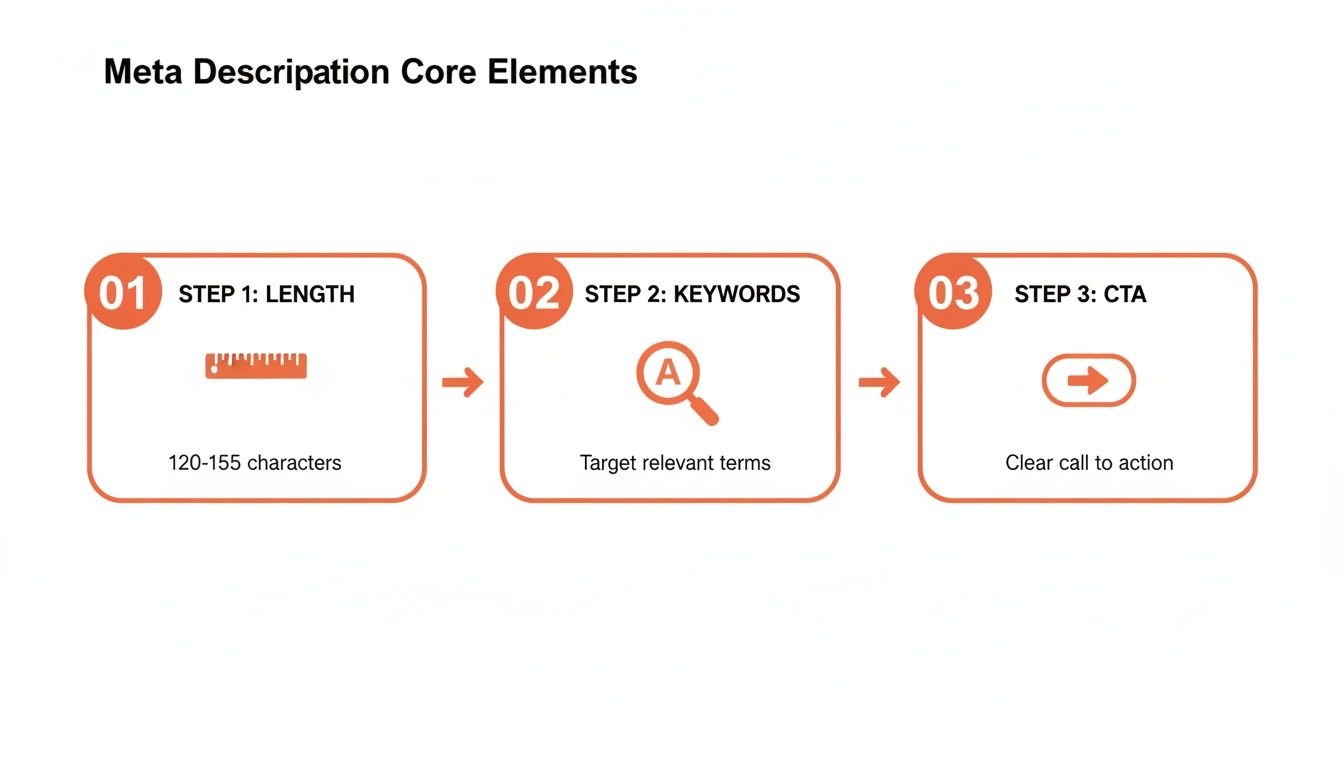
Think of it as a balancing act. You need the technical precision to satisfy search engines and the persuasive copy to convince a human to take action.
Tailoring Your Copy for Different Page Types
Once you’ve identified the user’s intent, you can craft copy that weaves in your target keywords naturally. Remember, the goal is to sound human and genuinely helpful, not to cram in as many keywords as possible, which can harm your credibility.
Here are a few real-world examples you can adapt for your own business to generate more leads:
- Homepage (Local Service): “Need reliable commercial HVAC repair? We offer 24/7 emergency service & certified technicians to keep your business running. Get a free estimate today!”
- Service Page (Professional Firm): “Our experienced family law attorneys provide compassionate guidance for divorce & custody cases. Schedule a confidential consultation to protect your rights.”
- Local Business (e.g., a bakery): “Award-winning custom cakes and fresh pastries baked daily. The perfect choice for birthdays and events. Order online for local delivery or pickup!”
Each example gets straight to the point. It addresses a specific need, highlights a key benefit (like 24/7 service or online ordering), and tells the user exactly what to do next. This is how you convert a casual searcher into a paying customer.
Key Insight: A well-written meta description can significantly boost your click-through rates. For a local business, a sharper description can help you steal a significant piece of traffic from competitors, turning search visibility into real-world customers.
Keep It Unique and On-Brand
While it’s useful to have formulas, your brand’s authoritative voice should always shine through. Are you a formal, high-end professional firm or a friendly, local service provider? Your tone must reflect that.
Above all, every single meta description on your website must be unique. This is non-negotiable. Duplicate descriptions are a major red flag for search engines and signal a lazy approach to SEO. Each page has a unique purpose, and its description needs to reflect that. This is a fundamental part of writing SEO articles that perform well over the long haul.
Mastering this process—identifying intent, drafting compelling copy, and ensuring uniqueness—will make a tangible difference in your lead generation. For a deeper look, see how a solid template can optimize your SEO positioning. Or, if you’d rather have an expert team take care of it for you, contact us for a consultation.
Advanced Tactics to Maximize Your Click-Through Rate
You’ve mastered the basics of meta descriptions. Now, let’s discuss the professional techniques that provide a measurable edge in competitive search results. This is where we move beyond simply including keywords and start leveraging user psychology and smart technical implementation.
One of the most effective strategies is to inject emotion and urgency into your copy. Use words that create a sense of urgency (“Now,” “Limited Time”), spark curiosity (“Secrets,” “Discover”), or build immediate trust (“Guaranteed,” “Proven”). Your goal is to make your search snippet feel like an opportunity that’s too good to pass up.
Stand Out with Rich Results and Schema Markup
Compelling copy is only half the battle. Your search result also needs to look different from the other blue links on the page. That’s where structured data, also known as schema markup, comes in.
Schema is code you add to your site that tells search engines exactly what your content is. When they understand it better, they can reward you with “rich results”—those eye-catching snippets with extra information.
You have definitely seen these before:
- Star Ratings: An absolute must for local businesses and products. They instantly signal quality and social proof.
- FAQs: Lets you answer common questions directly in the search results, establishing your authority before the click.
- Service Information: A game-changer for local businesses, showcasing key offerings at a glance.
A listing with bright yellow stars or a helpful FAQ dropdown is far more compelling than a plain wall of text. While implementing schema can be technical, the payoff in visibility and clicks is almost always worth it. But remember, these enhancements won’t matter if your page is slow. Always monitor performance with good website speed optimization tools.
What to Do When Google Rewrites Your Meta Description
It’s one of the most frustrating things in SEO: you spend time crafting the perfect meta description, only for Google to ignore it and write its own. Don’t take it personally—it happens frequently. In fact, some studies show Google rewrites a staggering 63% of meta descriptions. For a business targeting specific local keywords, that number can feel even higher. You can dig into more SEO statistics on Wordstream.
Why does Google do this? It usually boils down to a few reasons:
- Your description didn’t match the query: Google decided a different piece of text from your page was a better fit for what the user was searching for.
- It looked like keyword stuffing: If your description is packed with keywords and sounds robotic, Google will often replace it with something more natural.
- The length was wrong: If it’s too long or too short, Google may create its own.
Expert Take: While you can’t force Google to use your meta description, you can heavily influence its choice. The best defense is a good offense. Ensure your description is hyper-relevant to the page’s topic, fits the 155-character sweet spot, and directly speaks to the user’s intent. A well-written, user-focused description is still your best chance at sticking.
By using powerful language, leveraging schema to make your results pop, and understanding Google’s tendencies, you’re not just writing meta descriptions for SEO anymore. You’re engineering a higher click-through rate.
If these advanced strategies feel outside your expertise, our team lives and breathes this work. Schedule a consultation, and let’s talk about boosting your lead generation.
Implementing and Measuring Your Success

You’ve crafted the perfect meta description. That’s a huge first step, but it’s just theory until it goes live. The real results come when you publish your work and start measuring its impact. This is where you separate guesswork from a true business growth strategy.
If you’re serious about getting more leads and customers from SEO, you must analyze the data. Fortunately, implementing your new descriptions is usually the easy part.
Adding Meta Descriptions to Your Website
If you’re running a WordPress site, you likely have an SEO plugin like Yoast or Rank Math installed. These tools make the process incredibly simple. Just open the editor for the page or post, scroll down to the plugin’s SEO settings, and you’ll find a field labeled “Meta Description.” Paste your copy there and use the preview to see how it will appear in search results.
On Shopify, it’s just as straightforward. When editing a product or page, find the “Search engine listing” section at the bottom. Click “Edit” to find the fields for the SEO title and the meta description.
Local Business Alert: Don’t neglect your Google Business Profile! Your GBP “business description” acts as a super-powered meta description for local searches. This is your chance to capture customers making “near me” searches by highlighting your services, service area, and what makes you the best choice in town.
Tracking Your Performance with Google Search Console
Once your descriptions are live, the real work begins: measuring their effectiveness. Your best tool for this is Google Search Console (GSC)—a free, indispensable platform from Google.
Inside GSC, navigate to the “Performance” report. This dashboard is where you see how individual pages are performing in search. Focus on three key metrics:
- Impressions: The number of times your page appeared in search results.
- Clicks: The number of people who clicked on your link.
- Click-Through Rate (CTR): The percentage of impressions that resulted in a click. This is your money metric.
A page with high impressions but a dismal CTR is a massive red flag. It means people see your result, but your meta description and title aren’t compelling them to click. This is the perfect opportunity to test a new, punchier description designed to convert.
By monitoring CTR, writing meta descriptions becomes an ongoing process of refinement, not a one-and-done task. You can identify your weakest links, strengthen them, and watch more qualified traffic—and leads—come your way. To see how we break down site performance, take a look at our detailed site review example.
If you’re ready to stop guessing and start measuring, a professional audit can uncover your biggest growth opportunities. Contact us today for a consultation.
Frequently Asked Questions About Meta Descriptions
Even after you’ve grasped the fundamentals, some finer points about meta descriptions can be tricky. These are the questions that businesses consistently ask when seeking to improve their SEO performance. Getting the answers right can significantly impact your lead generation.
Does Google Still Use Meta Descriptions for Ranking?
The short answer is no—at least, not directly. Google has been clear that meta descriptions are not a direct ranking factor.
However, they are a massive indirect factor. A great meta description improves your click-through rate (CTR). A high CTR is a powerful signal to Google that tells the algorithm your page is a relevant and valuable result for that search query. Over time, this positive user engagement can absolutely contribute to higher rankings. It is your primary tool for “selling the click.”
What Happens If I Don’t Write a Meta Description?
If you skip writing a meta description, you leave your first impression in the hands of an algorithm. Google will grab a snippet of text from the page that it thinks is relevant.
The results are almost always clunky, unconvincing, and fail to persuade a user to click. Relying on auto-generated descriptions means you’re giving up control over your brand message at the most critical moment, which is a massive missed opportunity for lead generation.
Should Every Page on My Website Have a Unique Meta Description?
Yes, absolutely. Every single page on your site requires its own unique meta description, written specifically for that page’s content and target keyword. Copy-pasting descriptions across your site is a classic sign of low-quality SEO and harms your ability to attract targeted traffic.
A page selling “Local SEO services” needs a completely different pitch than a blog post about “how to get more customers online.” Unique descriptions ensure every page is perfectly positioned to attract its ideal audience and earn the click.
How Often Should I Update My Meta Descriptions?
There’s no need to constantly change them, but you should revisit them strategically. The best practice is to monitor your key pages in Google Search Console.
If you identify a page that has high impressions but a low CTR, the meta description is the first thing you should optimize. It’s clearly not performing its job.
Testing new copy with a stronger call-to-action or a clearer benefit can make a huge difference in driving more qualified traffic. This is how the process of how to write meta descriptions for SEO becomes a living, results-focused part of your digital growth strategy.
Optimizing meta descriptions is a small task with a big impact on your bottom line. If you’d rather have experts handle the nuances of your SEO strategy to drive more leads and revenue, VIP TECH CONSULTING is here to help. Contact us today for a free, no-obligation consultation.