


If you’re struggling to turn website traffic into sales, you’re not just losing clicks—you’re losing revenue. Most ecommerce businesses leak money because of small, overlooked issues that frustrate buyers and send them to competitors. Choosing the wrong strategy, or no strategy at all, means leaving your most valuable customers on the table.
Before you can improve ecommerce conversion rates, you have to get real about your current performance. Are you hovering around the typical 1.4% for new stores, or are you closer to the 4% mark of an established brand? That number isn’t just a metric; it’s the starting point for a strategy that will actually increase your revenue.
Finding Your Starting Line: How to Improve Ecommerce Conversion Rates with Data
Jumping into changes without a clear starting point is just guessing. A successful conversion rate optimization (CRO) strategy is built on data, beginning with how your store performs today. This isn’t just about a number; it’s about what that number means for your business.
The average ecommerce conversion rate has settled between 2.5% and 3%. This shows that smart, focused optimization works. Based on our experience with hundreds of stores, here’s a general breakdown:
- Newer stores often see rates around 1.4%.
- Established ecommerce sites typically land in the 2.5% to 4% range.
For a local business, knowing these benchmarks helps turn abstract percentages into real-world goals. You can see how your performance stacks up by reviewing industry-wide analysis on ecommerce conversion rates from Red Stag Fulfillment.
Why This Number Is Your North Star
Comparing your store to these averages gives you instant context. If your conversion rate is below 1.4%, it’s a red flag. This often points to friction in your user experience, confusing product pages, or a clunky checkout process.
On the other hand, if you’re at 3%, your focus can shift from major fixes to advanced tactics. Your baseline conversion rate takes the guesswork out of your marketing and lets you measure the impact of every change, whether it’s a new Google Ads campaign or an SEO overhaul.
Understanding this baseline helps you:
- Set Realistic Goals: Aim to increase your current rate by 20% next quarter, not hit 10% overnight.
- Spot Low-Hanging Fruit: A gap between your rate and the industry average points to obvious problems you can fix for quick wins.
- Justify Marketing Spend: When you know your numbers, you can calculate the ROI from investing in professional SEO or a targeted Meta Ads strategy.
Use this quick overview to benchmark your performance:
| Store Maturity Level | Average Conversion Rate |
|---|---|
| Early Stage / New Store | ~1.4% |
| Growing / Mid-Market Store | 2.5% – 3.5% |
| Established / Top Performer | 4.0%+ |
These benchmarks provide a valuable reality check. Knowing where you fit helps map out a path forward. For frameworks to get started, see this proven guide to increase your ecommerce conversion rate.
Once you have this data, you can build a strategy targeting your unique weaknesses. Our guide to website conversions helps turn this data into action. If you’re unsure how to interpret your analytics, getting a professional opinion can provide the clarity to move forward with confidence.
Conducting a CRO Audit to Uncover Hidden Revenue
Most e-commerce sites are leaving money on the table. The culprit is usually not a catastrophic failure, but a series of small friction points that kill sales. A Conversion Rate Optimization (CRO) audit is your first move to find and fix these leaks.
Forget a massive redesign. This process is like being a detective, using data to see where customers get stuck. You can spot high-impact, low-effort fixes that give your bottom line an immediate boost.
The process boils down to three core ideas: measure where you are, benchmark against where you could be, and then build a strategy on real data.
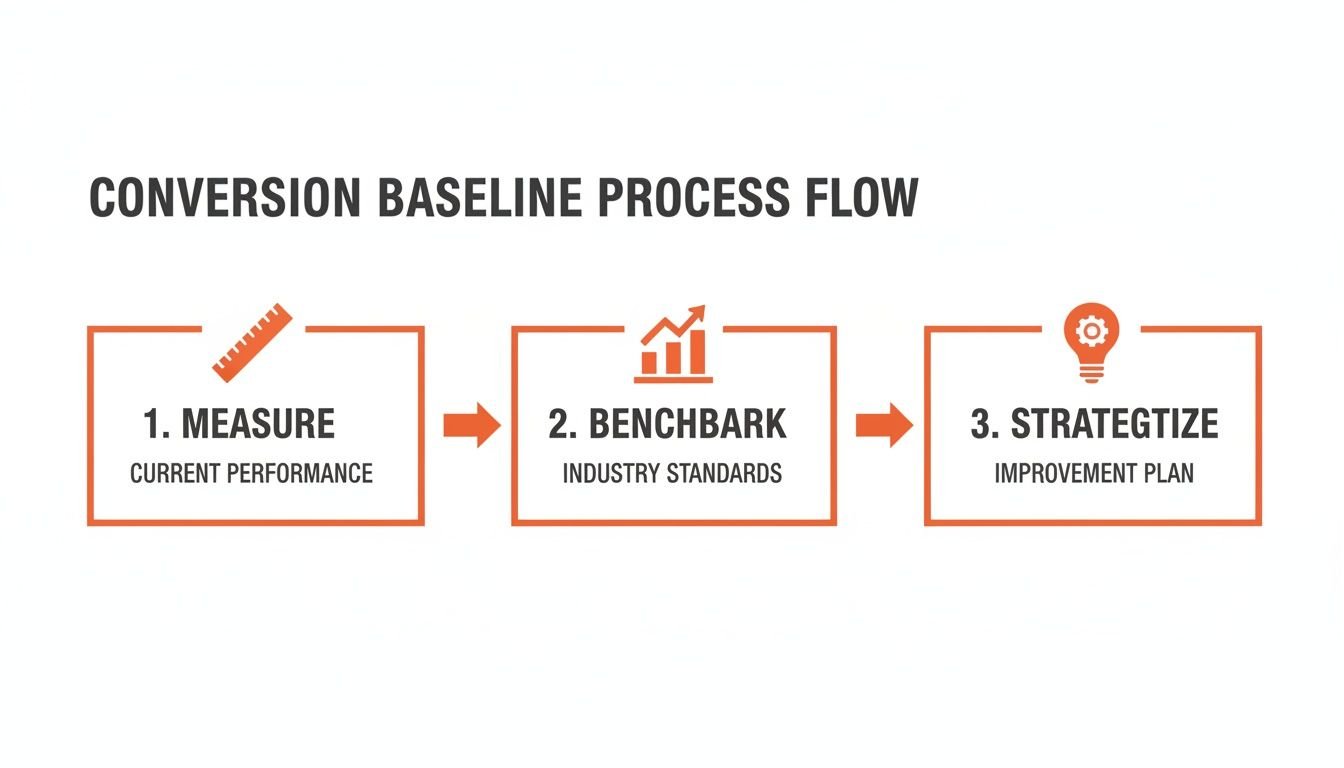
Your strategy must follow the data. Guessing where the problems are is a recipe for wasted time and money.
Analyzing Your Sales Funnel with Google Analytics 4
Your audit starts in Google Analytics 4 (GA4). The goal is to follow the customer’s path and find where they leave. The “Funnel exploration” report is your best tool for this.
By mapping essential steps—from landing on a product page to purchase—you can see the precise drop-off rate at each stage. For instance:
- 90% of users view a product.
- Only 30% add it to their cart.
- Just 10% reach the checkout page.
- A mere 5% complete the purchase.
This data instantly highlights the “add to cart” step as a huge bottleneck. Is the button hard to find? Are product options confusing? These questions point to actionable solutions. We see the same issue with local service businesses that have confusing contact forms, sabotaging leads in the same way.
Pinpointing Mobile Usability Errors
More than half of online revenue comes from mobile devices. A clunky mobile experience is a critical failure. A common mistake is assuming your site works for everyone because it works on your phone.
Different screen sizes and network speeds create different experiences. In GA4, segment reports by device category (Desktop vs. Mobile vs. Tablet). If one underperforms dramatically, you’ve found a major leak.
A low mobile conversion rate is a critical issue. If desktop visitors convert at 4% but mobile visitors are at 1%, you have a massive revenue leak that needs to be fixed immediately.
Common mobile culprits include:
- Slow-loading product images.
- Tiny, hard-to-tap buttons, especially during checkout.
- Aggressive pop-ups with no clear close button.
- Navigation menus that are difficult to use on a small screen.
Finding these issues is half the battle. To see how a professional breaks down a site, a detailed site review example provides a great framework. A CRO audit replaces guesswork with a data-backed plan, ensuring you work on changes that move the needle.
Turning Browsers into Buyers on Product and Checkout Pages
Your product and checkout pages are where sales happen—or fall apart. All your marketing efforts lead to this final moment. We’ve seen countless brands lose sales in these last few steps.
The goal isn’t just to display a product. It’s about building trust, answering questions preemptively, and making the path to purchase incredibly simple.

Nail the Product Page to Build Confidence
A product page has one job: convince someone they need what you’re selling. This means getting inside their head and squashing doubts before they surface.
Forget generic descriptions. Write copy that speaks to your customer. What problem are you solving? Show them what makes your product the only choice.
Visuals are just as crucial. High-quality, multi-angle photos are the minimum. To bring your product to life, include:
- Contextual Shots: Show your product in action.
- Close-Up Details: Let people see the quality.
- Scale References: Give a sense of size.
- Product Videos: Nothing sells better than a video demonstrating benefits.
Finally, layer in social proof. Customer reviews, ratings, and testimonials are your secret weapon. People trust other people, and seeing that others have bought and loved your product is often the final nudge they need.
Make Your Checkout Process Frictionless
A clunky checkout is the ultimate conversion killer. Nearly 70% of carts are abandoned. Your mission is to make giving you money as easy as possible.
One of the biggest hurdles is cart abandonment. Knowing how to reduce shopping cart abandonment is key. The top culprits are unexpected costs and forced account creation.
The moment a customer decides to buy, every additional click or form field increases the odds they will leave. Simplicity is a direct driver of revenue.
Fix it by focusing on these three areas:
- Simplify Your Forms: Only ask for what you absolutely need. Each extra field is another chance for them to bail.
- Always Offer Guest Checkout: Forcing account creation is a wall between you and the sale. Let first-time buyers check out as guests.
- Be Transparent with Costs: Show all shipping fees and taxes in the cart—before checkout begins. This builds trust and prevents sticker shock.
This isn’t just for e-commerce. We helped a local service business increase lead form submissions by simplifying their contact form. Reducing friction works.
Your e-commerce platform can help or hinder these efforts. Our guide on choosing the right ecommerce platform is a great resource. If you’re struggling with conversions, our team can dig into your analytics to find hidden friction points and create a clear plan for improvement.
Focus on High-Intent Traffic to Drive Real Sales
Getting more traffic feels like a win, but if sales aren’t moving, it’s a vanity metric. We’ve seen many business owners frustrated when clicks don’t turn into customers. This is a traffic quality problem, not a quantity one.
Someone searching Google for “buy handmade leather dog collar” is ready to buy. Someone casually clicking an Instagram link is just browsing. Understanding user intent is the key to real conversion growth.
Not All Clicks Are Created Equal
Where your traffic comes from has a massive impact on conversions. The numbers tell a clear story.
Traffic Source vs. Average Conversion Rate
| Traffic Source | Average Conversion Rate | Strategic Implication |
|---|---|---|
| Referral | 5.4% – 5.8% | Traffic from trusted sites is gold. Focus on partnerships. |
| Google Ads | 1.6% | Highly targeted but requires a specific strategy and landing pages. |
| Paid Social Media | 1.0% | Great for brand awareness but poor for direct, cold sales. |
Referral traffic converts at a rate nearly 6x higher than paid social media. As you can see from detailed e-commerce conversion data, pouring your budget into social ads without a broader strategy is often a recipe for disappointment.
This doesn’t mean ditching paid channels. It means using each for its unique strengths and focusing your campaigns on ROI.
How to Attract Customers Ready to Buy
Successful brands build a cohesive system where marketing channels work together. Here’s how you can do it.
-
Win Over Local, “Ready-to-Buy” Customers: For any brand with a service area, Local SEO is non-negotiable. When someone searches for “best SEO company in Miami,” they have an immediate need. Showing up at the top puts you in front of a customer ready to spend money.
-
Use Google Ads for Surgical Precision: Nothing beats the precision of Google Ads for immediate impact. Target specific, long-tail keywords that signal strong buying intent—like “ecommerce SEO services for small business.” Match that intent with a specific destination.
-
Bring Back Interested Shoppers with Meta Ads: Use ads on Facebook and Instagram from Meta for re-engagement. Targeting users who have visited your site or abandoned a cart is far more effective than selling to a cold audience.
This works best when you also know how to increase organic traffic to your website, providing a sustainable pipeline of qualified visitors.
The Power of Dedicated Landing Pages
Here’s one of the most impactful changes we make for clients: stop sending paid ad traffic to your homepage. Your homepage is a general store; your ad is a special-purpose tool.
Every ad campaign needs its own dedicated landing page. This page should feel like a continuation of the ad itself, with the same visuals and offer. By stripping away distractions, you create a frictionless path from click to conversion.
If your ad campaigns get clicks but no sales, the problem is often where you’re sending the traffic. Getting this right turns clicks into revenue. Our team specializes in integrated SEO and PPC strategies. If you’re ready for a real return on ad spend, schedule a consultation and let’s build a plan that works.
Using A/B Testing and Personalization for Sustainable Growth
Once you’ve plugged the most obvious holes in your sales funnel, the big, easy wins start to dry up. This is a good thing—it means you’re ready for the next phase of growth.
Long-term success isn’t about massive overhauls. It’s about disciplined, iterative improvements through A/B testing and creating smarter, personalized experiences. This is where you graduate from a one-size-fits-all website to a dynamic platform that adapts to your customers.
Building Your A/B Testing Roadmap
A/B testing, or split testing, is your best friend. The concept is simple: create two versions of a webpage, show each to a different group, and see which one drives more sales. It’s the most effective way to take the guesswork out of website changes.
The biggest mistake is testing things that don’t matter. A winning test on a button color might give you a 1% lift, but a winning test on your core headline could boost conversions by 15%. Focus is key.
Start with elements that have the highest potential to impact revenue.
High-Impact Areas to Test First:
- Headlines & Value Propositions: Test different ways of communicating what you do. Does a benefit-driven headline like “Handmade Leather Goods That Last a Lifetime” outperform a feature-focused one?
- Call-to-Action (CTA) Copy: The words on your buttons matter. Test a direct command like “Shop Now” against a value-oriented phrase like “Find Your Perfect Bag.”
- Product Page Layout: Try moving reviews below the product title or testing a “sticky” Add to Cart button.
- Promotions & Offers: Pit a “20% Off” discount against a “Free Shipping” offer to see which incentive motivates your audience.
When looking at results, statistical significance is crucial. You need to run the test long enough to be confident the outcome wasn’t a fluke. For anyone running paid traffic, platforms like Google have great built-in tools. You can learn more by setting up Google Ads Experiments for your campaigns.
The Next Frontier: True Personalization
While A/B testing helps you find the best experience for the average user, personalization creates the best experience for each user. It’s how you make your website feel like it was built just for them.
This doesn’t require a massive budget. Modern tools on platforms like Shopify and WordPress make it straightforward to get started.
Personalization is the difference between a website that talks at its visitors and one that has a conversation with them. When you show customers you remember them, you build loyalty that drives repeat business.
Powerful Personalization Tactics You Can Start With:
- Welcome Back Returning Visitors: A simple “Welcome back!” message goes a long way. Better yet, show products related to their last session.
- Use Geolocation for Relevant Offers: If you’re a local business, show a banner offering a special deal to visitors from your area. It’s an instant way to feel more relevant.
- Master Remarketing on Google and Meta: This is one of the highest-ROI marketing activities. Follow up with users who visited your site but didn’t buy. Run ads reminding them of the exact product they left in their cart.
When you combine disciplined A/B testing with smart personalization, you create a powerful growth engine. Testing continually improves your baseline, while personalization makes every visit more valuable.
Objection Handling: Your Top Ecommerce Conversion Questions, Answered
When you start digging into conversion optimization, the same questions about time, results, and strategy always come up. Here are straight answers based on our experience helping countless businesses grow.
How Long Does It Really Take to See Better Conversion Rates?
It depends on what we’re fixing. Simple, high-impact tweaks can deliver a lift almost immediately. Cleaning up a clunky checkout form or improving page load times can boost conversions in just a few weeks. These are the quick wins that build momentum.
However, game-changing growth comes from foundational work. A solid SEO strategy, for instance, takes 3-6 months to bring in consistent, high-quality traffic. A skilled agency will secure those quick wins for you while laying the groundwork for long-term success. The goal isn’t just a sales spike; it’s a more profitable business.
Can I Actually Improve Conversions Without a Full Website Redesign?
Yes, and you should. We almost never recommend a massive redesign unless a site is fundamentally broken. Risky overhauls are expensive and often create more problems than they solve.
The smartest approach is making small, data-backed improvements. We use tools like Google Analytics to find where you’re losing customers—it might be a confusing menu, slow photos, or a frustrating mobile checkout. Then, we fix those specific issues one by one. This methodical approach is less expensive and lets you measure the direct impact of every change.
Should I Focus on SEO or Paid Ads for More Conversions?
This is a false choice. The most successful brands don’t pick one; they make them work together.
Here’s how they should fit together:
- Search Engine Optimization (SEO): This is your long-term asset. SEO builds your store’s authority, bringing in a steady stream of “free,” high-converting traffic from shoppers actively looking for what you sell.
- Paid Ads (Google & Meta): This is your accelerator. Paid advertising on Google Ads and Meta Ads delivers immediate, scalable traffic, perfect for launching products, targeting specific customers, and running remarketing campaigns.
A strong SEO foundation even makes your paid ads cheaper and more effective by improving your Quality Score. The real strategy isn’t choosing one channel over the other—it’s integrating them so you’re there for your customer at every step of their journey.
Ready to stop guessing and start building a data-driven strategy to boost your sales? Our team specializes in finding the highest-impact opportunities for ecommerce brands. We dig into your analytics, find hidden revenue leaks, and create a clear action plan that gets results.
Schedule your free, no-obligation strategy session today and let’s talk about growing your business.