


Figuring out how to create a content marketing strategy is the critical first step to stop wasting money and start generating qualified leads. If your current marketing feels like shouting into the void—random posts, ads that don't convert, and content no one sees—it’s because you're operating without a clear, results-driven plan. This lack of strategy is costing you customers and revenue every single day.
The High Cost of Marketing Without a Plan
Are you struggling with a marketing budget that disappears with little to show for it? Most businesses lose money not from a lack of effort, but from a lack of direction. Random social media updates, Google Ads that attract clicks but no calls, and blog posts that go unread are symptoms of a deeper problem: operating without a coherent content strategy.
Choosing the wrong approach—or having no approach at all—can cost you dearly. It means your ideal customers are searching for solutions online and finding your competitors instead of you. It means your sales team wastes time on unqualified leads who will never buy. Without a strategic roadmap, you are essentially gambling with your business's future.
Why a Documented Strategy is Non-Negotiable
A well-crafted strategy is what transforms marketing from a frustrating expense into a predictable engine for growth. The difference between a business that struggles and one that succeeds online often comes down to one thing: a documented plan.
Having ideas in your head isn't a strategy. A written plan forces clarity, aligns your efforts, and provides a clear benchmark for what works. This is why 97% of top-performing B2B marketers rely on a documented content strategy. They understand that a plan turns random actions into a system that consistently attracts, engages, and converts ideal clients.
This is the shift from hoping for leads to building a reliable system that generates them. For a local service business, this means creating content that dominates local search results for terms like "plumber near me," driving phone calls directly from Google. For a B2B company, it means developing articles that answer the exact questions prospects are asking, positioning you as the go-to expert and generating qualified inquiries.
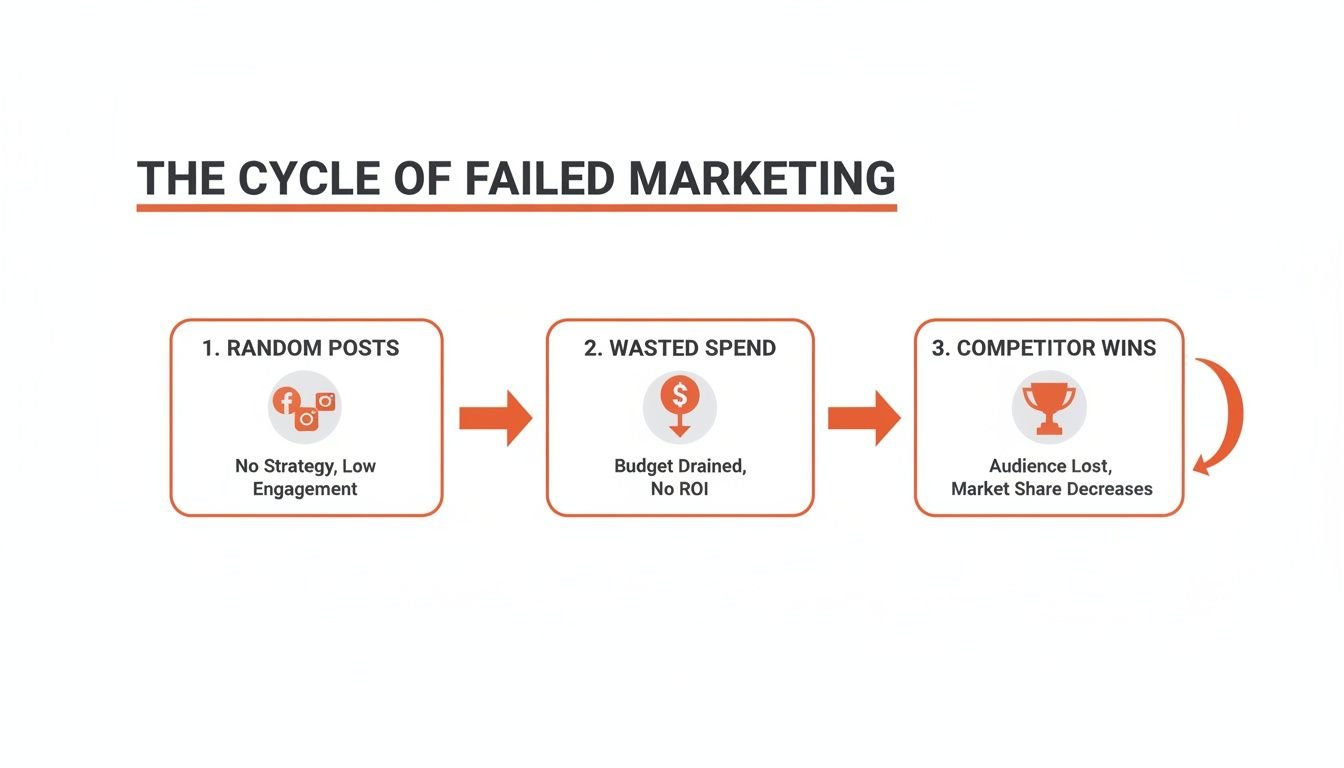
This cycle of wasted effort is common, but it's not unavoidable. It's time to break that cycle by introducing a professional, results-driven framework that connects every marketing dollar to tangible business growth. Without it, you are simply funding your competitors' success.
Defining Your Ideal Customer and Goals That Matter

A great content marketing strategy never starts with content ideas. It begins by answering two critical questions: Who is my ideal customer? And what specific action do I want them to take? Without clear answers, your marketing will remain generic, ineffective, and unable to connect with the people who are actually ready to buy.
Trying to create content for "everyone" is the most common and costly mistake we see. It leads to content that resonates with no one.
Creating Customer Personas That Drive Action
To create content that converts, you must move beyond basic demographics and get inside your customer's head. A customer persona is a detailed profile of your ideal buyer, built from real insights, not assumptions.
Before writing a single word, you must understand:
- Their Core Frustrations: A local business owner isn't just "busy." They are worried about making payroll, losing customers to competitors, and finding reliable marketing help that delivers a positive ROI.
- What They Actually Search For: They aren't typing "digital marketing services." They are searching for "how to get more customers online," "local SEO services for small business," or "best Google Ads company near me." Your content must meet them there.
- Their Ultimate Goals: They don't just want more website traffic; they want a full schedule, a ringing phone, and the peace of mind that comes with predictable revenue growth.
- Their Buying Triggers: When choosing a marketing partner, they are looking for demonstrated expertise, a clear process, and proof of results. They want confidence, not empty promises.
Answering these questions allows you to craft content that speaks directly to their pain points, making them feel understood and positioning your services as the logical solution.
Setting Goals That Impact Your Bottom Line
Once you know who you’re talking to, you must define your "why." Vague goals like "increase brand awareness" are vanity metrics that don't pay the bills. Your content marketing goals must be specific, measurable, and directly tied to revenue.
A strong goal connects content directly to a business outcome.
Weak Goal: "Get more traffic to our blog." This is meaningless. Traffic from people who will never buy is a waste of resources.
Powerful Goal: "Generate 15 qualified consultation requests per month from businesses searching for Google Ads management." This goal is specific, measurable, and tied directly to a high-value service.
This level of focus is essential. For example, a local roofing company's goal shouldn't be to get more followers. A better goal is to "generate 10 qualified quote requests per month from homeowners in our service area searching for 'roof repair near me'." This sharp focus ensures every piece of content has a clear, profit-driven purpose.
If you are struggling to define your audience or set goals that lead to tangible growth, expert guidance can make all the difference. We specialize in building strategic plans that stop wasting resources and start delivering the customers you need. You can find more approaches in these 15 content marketing strategies to boost your online presence.
The Core Channels: How to Create a Content Marketing Strategy with SEO, Google Ads & Meta Ads
Once you know who you're targeting, the next step is choosing where to reach them. Spreading your budget too thin across a dozen platforms is a surefire way to fail. The key to generating high-intent leads is to focus your resources on the channels where your customers are actively looking for solutions.
Our experience shows that the most consistent and profitable growth for businesses comes from a powerful, integrated strategy focused on three core channels: SEO, Google Ads, and Meta Ads.
SEO and Local SEO: Capturing High-Intent Searchers
Search Engine Optimization (SEO) is your long-term strategy for sustainable, organic growth. When a potential customer in your city searches for "best local accountant" or "emergency plumber near me," effective SEO ensures your business appears at the top of the results.
For any business serving a specific geographic area, Local SEO is non-negotiable. Optimizing your Google Business Profile (GBP) to dominate the local map pack can become your single best source of high-quality leads, driving phone calls and customers directly from Google.
SEO content, like an authoritative blog post answering a common customer question, is a digital asset that works for you 24/7. It builds your authority and brings in qualified traffic for years, long after it’s published.
This is how you capture prospects with high commercial intent—they have a problem now and are actively searching for the solution you provide.
Google Ads: Instant Visibility for Ready-to-Buy Customers
While SEO builds long-term authority, sometimes you need leads now. Google Ads provides that instant visibility. This pay-per-click (PPC) platform allows you to place your business at the very top of Google for your most profitable keywords, effective immediately.
Imagine a business owner whose website just crashed. They are searching with urgency for "emergency web support." A well-placed Google Ad ensures your agency is the first one they see and call.
Google Ads is perfect for:
- Targeting bottom-of-funnel keywords to connect with users ready to make a purchase.
- Driving immediate leads and sales from the moment your campaign goes live.
- Generating valuable data on which keywords and offers convert best, which then fuels your long-term SEO strategy.
Meta Ads: Creating Demand and Nurturing Leads
What about potential customers who don't know they need you yet? This is where Meta Ads (Facebook & Instagram) excels. These platforms are less about capturing existing demand and more about creating it.
Meta's powerful targeting allows you to get your brand in front of specific audiences based on their interests, demographics, and online behaviors. For example, a local gym can run ads targeting people in their zip code who have shown an interest in fitness and wellness.
Meta Ads are excellent for building local brand awareness and running retargeting campaigns to stay in front of people who have visited your website. By nurturing these prospects with helpful content and testimonials, you guide them toward becoming a customer. The choice between platforms can be complex; we break it down in our Google Ads vs. Facebook Ads comparison.
Creating and Distributing Content That Actually Converts

Strategy without execution is just a document. The real work—and the real results—happen when you consistently create and distribute content that is designed to convert prospects into customers. This is where most businesses fail, letting good intentions fall victim to a lack of process.
A documented content calendar is your command center. It transforms marketing from a reactive scramble into a methodical system for building a library of revenue-generating assets.
Key Content Formats for Lead Generation
Your content must be tailored to the platform and the prospect's stage in the buying journey. Here are the formats that consistently deliver results for our clients:
- Authoritative Blog Posts: These are the backbone of any serious SEO strategy. A genuinely helpful article that answers a real customer question—like "how to get more customers for my restaurant"—builds trust and attracts high-intent search traffic. We've seen firsthand how to increase organic traffic to your website by focusing on these foundational pieces.
- Case Studies & Testimonials: This is your social proof. Nothing is more persuasive than showing a prospect you've already solved their exact problem for someone else. A case study detailing how you helped a local business increase leads by 50% is far more powerful than any marketing claim.
- Targeted Ad Copy: For Google and Meta Ads, the words you use are everything. The copy must grab attention, speak to a specific pain point, and include a clear call to action that drives clicks from qualified prospects.
- Lead Magnets (Guides, Checklists): Offering a valuable, downloadable resource in exchange for an email is a powerful way to convert a website visitor into a warm lead. This gives you permission to nurture them toward a sale.
The Power of Smart Content Repurposing
Creating one great piece of content takes significant effort. The biggest mistake is to publish it once and forget it. To maximize your ROI, you must master content repurposing.
A single in-depth blog post can be the source material for an entire month’s worth of marketing. This "create once, distribute everywhere" mindset is how you dominate your market without burning out your team.
For example, a comprehensive guide on "Local SEO for Dentists" can be repurposed into:
- Social Media Graphics: Pull 5-7 key stats or tips and turn them into shareable images for Facebook and Instagram.
- Short-Form Videos: Create several 30-second TikToks or Reels on micro-topics like "3 Ways to Get More Patient Reviews" or "Why Your Google Business Profile is Your #1 Asset."
- Paid Ad Creative: Use the most compelling tip from the guide as the hook for a targeted Meta Ad campaign aimed at dentists in your service area.
This multi-channel approach ensures your core message reaches your ideal customers everywhere they are, reinforcing your expertise and moving them closer to a decision. If you're ready to build a content engine that actually drives business, our team can put this powerful framework into action for you. A well-built website is also key, which you can learn about in our website conversion guide.
Measuring What Matters: From Clicks to Conversions
Once your strategy is live, the critical question becomes: is it working? For any business owner, knowing if your marketing investment is paying off is non-negotiable. We avoid vanity metrics like "likes" and "shares" and focus exclusively on the numbers that directly impact your bottom line.
Content marketing is never a "set it and forget it" activity. Without clear measurement against business goals, you are flying blind and wasting money.
Our Data-Driven Optimization Process
One of the biggest concerns business owners have is, "What if it doesn't work?" The reality is, a data-driven strategy is designed to adapt. It never truly "fails" because our process is built on a continuous cycle of analysis, insight, and optimization.
A data-driven strategy isn't about being right the first time. It's about having the expertise to identify what's not working and fix it fast to guarantee long-term ROI.
We use tools like Google Analytics and Google Search Console to track the metrics that matter:
- Lead Acquisition Cost (LAC): How much does it cost to generate one qualified lead?
- Conversion Rate: What percentage of visitors are taking a desired action (e.g., filling out a form, making a call)?
- Organic Keyword Rankings: Are we gaining visibility for the search terms that drive revenue?
If a blog post isn't generating leads or an ad isn't converting, we don't guess why. We analyze the data to understand the problem—is it the wrong keyword, a weak call-to-action, or poor targeting? Then we optimize. This commitment to continuous improvement ensures your marketing investment delivers measurable, sustainable growth. For more on advanced targeting, you can explore the use of AI for advertisers.
Why Choose Us for Your Content Marketing Strategy?
When you are actively looking for a solution, you need a partner who is confident, experienced, and completely focused on results. We build and execute content marketing strategies designed to attract high-intent prospects and convert them into customers.
- Proven Expertise: We are specialists in SEO, Local SEO, Google Ads, and Meta Ads. This is all we do, and our track record speaks for itself. We know what it takes to generate leads and revenue for businesses like yours.
- Results-Driven Process: Our entire process is built around achieving your business goals. We don’t focus on fluff metrics; we focus on leads, sales, and your return on investment.
- Transparent Communication: You will always know what we're working on, why we're doing it, and how it's performing. We provide clear reporting that connects our activities directly to your bottom line.
- Proactive Optimization: We don't just launch campaigns and hope for the best. We constantly monitor performance, analyze data, and make strategic adjustments to ensure you are always getting the best possible results.
We understand the common mistakes businesses make and have developed a proven methodology that separates professional, profitable marketing from amateur efforts.
Handling Your Key Questions
When considering a professional content strategy, a few objections often come up. Here are our direct answers.
"How long until I see results?"
This depends on the channel. With Google Ads and Meta Ads, you can see leads and traffic almost immediately. For SEO, it typically takes 4-6 months to see significant traction. SEO is a long-term asset that builds sustainable, "free" traffic over time, while paid ads deliver instant results. A smart strategy uses both.
"Can't I just do this myself?"
While you can try, creating and executing a successful strategy requires deep expertise in SEO, paid advertising, data analysis, and persuasive copywriting. Most business owners find that the time and specialized knowledge required are too great. Partnering with our agency allows you to leverage our experience to get results faster and avoid costly mistakes, freeing you to focus on running your business.
"What if it doesn't work?"
This is a valid concern, but our data-driven process is designed to mitigate that risk. We don't guess. We track everything, identify what isn't performing, and optimize based on real-world data. Our success is tied to your success, and our process is built to ensure we are constantly moving toward your goals.
Ready to stop guessing and start growing with a content strategy built for profitability? The market is competitive, and every day you wait is a day your competitors get further ahead.
The team at VIP TECH CONSULTING specializes in building and executing content marketing plans that drive real business results through expert SEO, Google Ads, and Meta Ads management. Schedule your free strategy session today and let's build your path to predictable growth.