


If you’re learning how to choose a digital marketing agency, your first step is to shift your entire mindset. Stop thinking about marketing activities and start demanding measurable business outcomes. Choosing the right partner isn’t about getting more clicks or traffic; it’s about finding a team that can deliver what you really need: more qualified leads, more phone calls, and a direct impact on your revenue.
The wrong choice doesn’t just stall your growth; it actively costs you money, time, and market share that your competitors are all too happy to claim.
The High Cost of Choosing the Wrong Digital Partner
Picking the wrong marketing agency is one of the most painful and expensive mistakes a business can make. If you’re struggling with a drained ad budget, a trickle of low-quality leads, or complete invisibility on search engines, you’ve experienced this firsthand. Many businesses are trapped by agencies that deliver confusing reports filled with vanity metrics instead of actual results.

This kind of failure does more than waste your investment. It gives your competitors a direct advantage, allowing them to climb higher on Google and capture the customers that should be yours. Every month spent with an ineffective agency is a month you fall further behind.
The Real Price of a Bad Partnership
Getting stuck with the wrong agency can set a business back months, if not years. The damage extends far beyond the monthly fee.
We’ve seen the consequences of poor digital marketing strategies play out time and time again:
- Wasted Ad Spend: An agency burns through your Google Ads budget on poorly targeted keywords, attracting clicks from users with zero intent to buy. Your ad spend climbs, but your sales remain flat.
- Lost SEO Momentum: An inexperienced team fails to secure rankings for crucial local searches. Your Google Business Profile remains buried, and your competitors dominate the “Map Pack” for profitable “near me” searches.
- Damaged Brand Reputation: They launch sloppy Meta Ads with weak creative and poor targeting. Instead of attracting new customers, the ads only serve to annoy your target audience.
- No Tangible ROI: Six months into the partnership, the only thing you have to show for it is a report boasting about website visitors, with no new sales or qualified leads.
A true growth partner is an extension of your team. Their success is tied to yours, and every action is guided by one question: “How does this drive revenue and growth for our client?”
Shifting to a Results-First Mindset
The digital marketing landscape is vast, but much of the money spent yields little to no return. This is why you must demand proof of performance and focus on tangible business outcomes.
A well-executed Local SEO and Google Ads campaign, for instance, should directly lower your customer acquisition cost. We’ve seen firsthand how a strategic approach can lead to a 34% reduction in cost-per-lead (CPL) for a client simply by refining their ad targeting and campaign structure.
A real growth partnership isn’t about promises; it’s about a clear, data-driven plan to achieve your specific business goals. The right agency is obsessed with your key performance indicators (KPIs)—the metrics that directly impact your bottom line. They are transparent, provide reports that connect their efforts to your revenue, and constantly seek to improve results. This is the standard you must hold.
For business owners also considering their website’s performance, our guide on how to find a web designer can provide additional helpful insights.
How to Choose a Digital Marketing Agency: Define Your Goals First
Before you start looking for an agency, you must define what success looks like for your business. Starting the search without clear objectives is like asking a contractor to “build something” without providing blueprints. It’s a recipe for miscommunication and wasted resources.
The most common mistake is asking for vague outcomes like “more traffic” or a “better online presence.” These are marketing activities, not business goals. A proficient agency will immediately push back, asking, “More traffic for what purpose?” or “A better presence to achieve what specific outcome?”
A great agency partnership is built on solving your unique business problems, not just selling you a list of services. Their role is to deliver outcomes, not just complete tasks.
From Vague Wishes to Concrete Objectives
To find a partner who will actually grow your business, you must translate broad needs into specific, measurable goals. This simple shift empowers you to filter out agencies that lack strategic focus.
Here’s how this works for local businesses:
- A local law firm doesn’t just need to “rank for keywords.” They need “15 qualified, high-value case inquiries per month from a targeted Google Ads campaign.”
- A plumbing company won’t grow with “more followers.” They need “an average of 5 new customer calls per day from their Local SEO and Google Business Profile efforts.”
- A Miami restaurant shouldn’t ask for “more clicks.” A better goal is “20 more online reservations per week generated from their website and local listings.”
When you enter a consultation with specific goals, the conversation immediately elevates from services to strategy and real-world results.
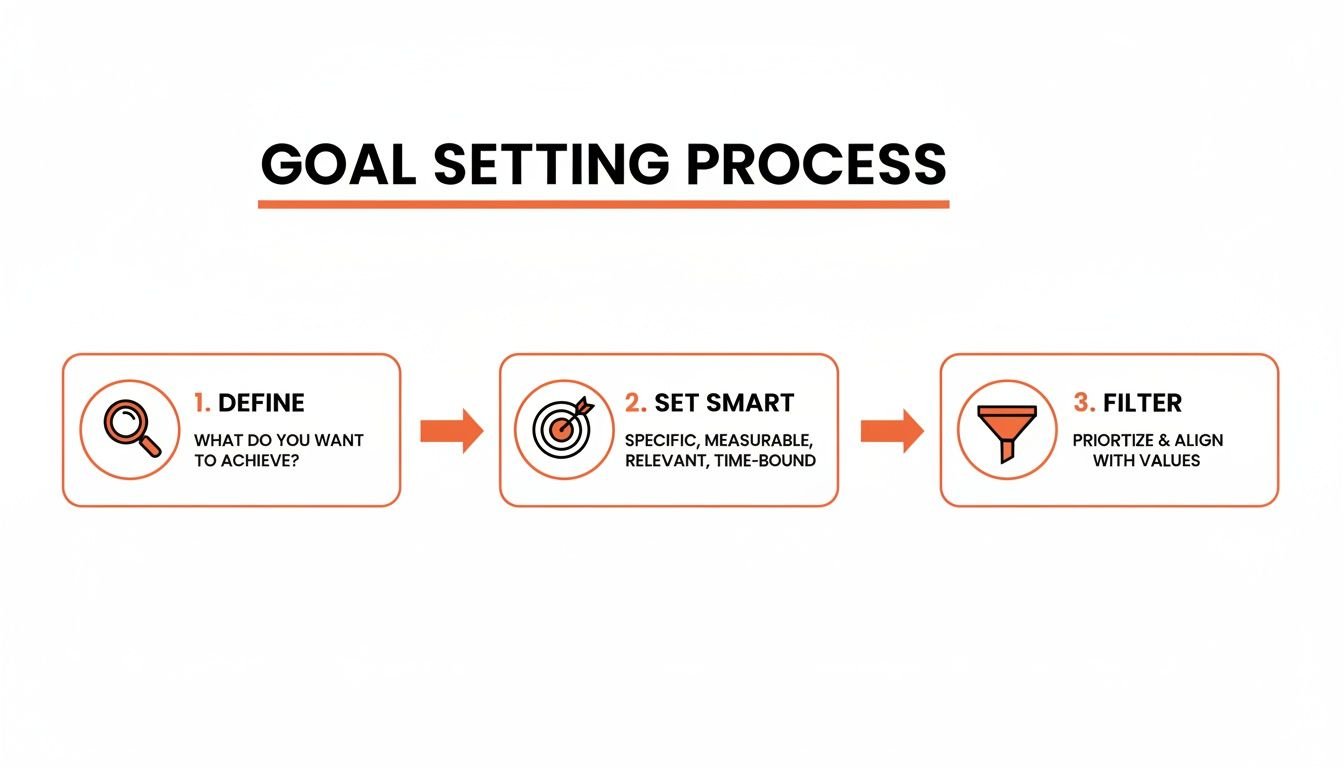
Setting SMART Goals for Your Campaigns
Using the SMART framework is the most effective way to solidify your objectives. It creates clear benchmarks that hold both you and your agency accountable for performance.
Your goals must be:
- Specific: Clearly define what you want to achieve. Instead of “increase leads,” aim for “generate 25 qualified leads for our commercial roofing service.”
- Measurable: Define the metrics for success. For example, “achieve a 30% increase in contact form submissions from organic search.”
- Achievable: Set ambitious but realistic targets. Aiming for 200 leads in the first 90 days when you currently get two is not a sustainable plan.
- Relevant: Ensure the goal directly contributes to your business’s growth and profitability.
- Time-bound: Set a clear deadline. For instance, “achieve a 2:1 return on ad spend within the first six months of the campaign.”
With SMART goals, you can ask a powerful question: “Here are our targets for the next quarter. What is your strategy to help us get there?” This separates true strategists from order-takers. For a deeper dive into attracting the right visitors, explore our guide on how to increase organic traffic to your website.
Vet Core Capabilities: SEO, Local SEO, and Paid Ads
Once your goals are set, the next challenge is to separate agencies that talk about results from those that can actually deliver them. A polished sales pitch is worthless if the team lacks the expertise to execute a winning strategy.
You must dig deep into their capabilities in the channels that matter most for business growth: SEO, Local SEO, and paid advertising.
How to Evaluate SEO and Local SEO Expertise
Many agencies promise a #1 ranking but fail to explain their methodology. Real, sustainable SEO is built on technical proficiency, authoritative content, and, for local businesses, complete dominance in local search.
A capable agency should confidently walk you through their process for:
- Technical SEO: This is the foundation. Can they audit your site and fix issues like slow page speed, mobile usability problems, and crawl errors that prevent Google from seeing your content? A technically flawed website will never achieve its ranking potential. Learn more about why speed matters in our guide on how to improve website loading speed.
- Authoritative Link Building: Ask them directly about their backlink strategy. Vague answers or mentions of “link networks” are major red flags. A top-tier agency will have a clear, ethical plan for earning high-quality links from relevant and trusted sources.
- Google Business Profile (GBP) Mastery: For any local business, your GBP is your most valuable digital asset. An expert agency will have a portfolio of examples showing how they’ve optimized profiles to dominate the local “Map Pack,” driving a consistent flow of calls and customers.
The Litmus Test: Ask them, “Can you show me a case study where you improved local search visibility and generated leads for a service business in a competitive market?” A professional will be eager to share the data. An amateur will offer excuses.
Assessing Paid Ad Skills (Google & Meta Ads)
Paid advertising is the fastest way to burn through your marketing budget if managed improperly. Any agency can spend your money—the right one can turn that spend into a predictable, profitable, and scalable source of revenue.
You need a partner obsessed with two metrics: lowering your Customer Acquisition Cost (CAC) and maximizing your Return on Ad Spend (ROAS). They should be transparent about the social media tools agencies utilize and be able to prove their performance.
A strong paid media team excels in three areas:
- Audience Targeting: They move beyond basic demographics. Ask how they build custom and lookalike audiences from your existing customer data to find new prospects who mirror your best clients. For a local service business, this could mean targeting specific zip codes with high-income households.
- Creative and Copy Testing: The best agencies never stop testing. They have a structured process for A/B testing every element—ad creative, headlines, calls-to-action—to continuously improve performance.
- Budget Management: They should have a clear methodology for allocating your budget to the best-performing campaigns, ad sets, and keywords. No dollar should be wasted on underperforming assets.
A great question to ask is: “Walk me through your process for optimizing ad creative and landing pages to improve conversion rates.” A confident team will detail their testing framework, proving their focus on results.
Decoding Case Studies and Spotting Red Flags

Every agency has “success stories,” but most are filled with marketing fluff instead of substance. Your job is to cut through the noise and identify which agencies drive genuine business growth.
A great agency won’t waste your time with vanity metrics like “increased brand awareness” or a jump in social media followers. These numbers don’t translate directly to revenue. You need case studies that speak the language of your bottom line.
What a Real Success Story Looks Like
The most meaningful case studies focus on money, leads, and real-world impact. They feature hard numbers tied to tangible business goals.
Look for metrics like:
- Lead Generation: “Increased qualified organic leads by 150% in six months for their primary service.” This demonstrates an ability to attract and convert the right audience.
- Cost Efficiency: “Reduced cost-per-lead on Google Ads by 40% while maintaining lead volume.” This proves they can make your budget work smarter.
- Local Impact: “Drove a 200% increase in phone calls from their Google Business Profile.” For a local business, this is a direct line to new customers.
These are not just statistics; they are stories of strategic success. An agency that proudly showcases these results understands what business owners truly need.
Warning Signs You Can’t Ignore
Knowing what to look for is only half the battle; you also need to recognize the red flags. If you encounter any of the following, proceed with caution.
A transparent agency is a confident one. If they are evasive about their process or unwilling to share clear data, it’s often because their results don’t back up their claims.
Watch out for these common red flags:
- Guaranteed #1 Google Rankings: This is the biggest lie in SEO. No one can guarantee rankings on Google. Anyone who claims otherwise is either dishonest or using risky tactics that could get your site penalized.
- A “Secret Sauce” Process: When you ask how they get results, do they offer a clear explanation or talk vaguely about “proprietary methods”? A true partner will gladly walk you through their strategy.
- No Long-Term Clients: A portfolio of short, one-off projects is a warning sign. Great marketing delivers sustained results over time. Look for testimonials from clients who have been with the agency for years.
- Focus on Activities, Not Outcomes: Is their pitch about the tasks they will perform (“we’ll write four blog posts”) instead of the results they will deliver? You’re investing in growth, not a to-do list.
A detailed site review is often the first step in a transparent partnership. To see the level of strategic detail required from the start, view our site review example.
Questions to Ask on Your Consultation Call
The consultation call is your opportunity to cut through the sales pitch and determine if an agency is a true growth partner or just another vendor. A productive call should feel like your first strategy session.
A prepared agency will have already researched your website and competitors. More importantly, they will ask you insightful questions about your customers, profit margins, and long-term goals. If they only talk at you, it’s a major red flag.
Gauging Strategic Thinking
Push past generic service lists and test their ability to connect their work to your bottom line. These questions will force them to demonstrate their strategic capabilities:
- “Based on my goals, what would be your top one or two priorities for the first 90 days, and why?”
A sharp agency will provide a specific, justified answer. For a local business, they might say, “First, we would overhaul your Google Business Profile to capture high-intent local customers immediately. Then, we would launch a targeted Google Ads campaign for your highest-margin service.” - “What is an opportunity that my top local competitors are missing?”
This question reveals if they’ve done their homework. A strategist will offer concrete examples, such as, “Your main competitor has a slow mobile site,” or “They aren’t running any Meta Ads to target the 25-40 demographic in your service area.”
Probing for Process and Accountability
A confident agency will be transparent about their processes. If you receive vague answers, it may indicate disorganization and a higher risk of poor execution.
Use these questions to assess their operational strength:
- “How do you measure and report on the ROI for a Google Ads campaign?”
The only acceptable answer goes beyond clicks and impressions. They should immediately discuss conversion tracking, cost per lead (CPL), and return on ad spend (ROAS). - “Walk me through what you do when a campaign isn’t hitting its goals.”
Not every campaign is a success from the start. A great partner has a process for diagnosing issues. They should mention analyzing audience segments, A/B testing creative, and re-evaluating keyword targeting, demonstrating a proactive, problem-solving approach.
The quality of an agency’s answers—and their questions for you—is a preview of the partnership. If the call feels shallow and salesy, the relationship will be too.
Understanding Communication and Partnership Fit
Finally, you need to know what it will be like to work with them. Clear communication is fundamental to a successful partnership, as our guide on FAQs in web design and digital marketing explains.
Ask these practical questions:
- Who will be my day-to-day point of contact, and what is their background?
- How often will we have check-in calls, and can I see a sample report?
- What is the process for handling urgent questions between scheduled meetings?
By the end of the call, you should have a clear sense of confidence. You will know if you’ve found a team that can execute, measure what matters, and act as a true extension of your business.
Common Questions About Hiring a Marketing Agency
Even after thorough research, some questions remain. Committing to an agency is a significant step, and it’s natural to have last-minute concerns. Let’s address the most common ones directly.
Can I Just Do This Myself?
While the DIY spirit is commendable, professional digital marketing is a full-time discipline that requires deep expertise across multiple platforms. An agency’s true value lies in strategy, experience, and efficiency.
- A Cohesive Strategy: A good agency ensures your SEO, Google Ads, and Meta Ads work together to create a multiplier effect, delivering results far greater than the sum of their parts.
- Giving You Time Back: Every hour you spend on marketing is an hour not spent running your business. An agency handles the complexities, allowing you to focus on what you do best.
- Access to Pro-Level Tools: Agencies invest in advanced tools for analytics, research, and campaign management that are typically out of reach for a single business.
While you can handle some marketing tasks, a dedicated agency will deliver better results, faster, turning your marketing budget into a predictable engine for growth.
How Long Does It Take to See Results?
The honest answer is: it depends on the channel. Beware of anyone who promises instant, across-the-board success.
A trustworthy agency sets clear, realistic expectations. They provide a roadmap for both quick wins and long-term growth, never over-promising to secure a contract.
Here is a realistic timeline:
- Paid Ads (Google & Meta): You can see traffic almost immediately. However, achieving a consistent, profitable Return on Ad Spend (ROAS) typically takes 1-3 months of testing and optimization.
- Local SEO & SEO: Search engine optimization is a long-term strategy. You may see positive movement within 3-6 months, but achieving top rankings for competitive keywords often takes 6-12 months of consistent effort.
What Happens if We Don’t Hit Our Goals?
A strong partnership is built on accountability. If performance falls short, a professional team doesn’t make excuses—they find solutions.
A proactive partner will immediately conduct a deep-dive analysis to identify the issue, whether it’s ad creative, landing page performance, or audience targeting. They will communicate their findings, explain the new strategy, and set revised benchmarks.
The US digital advertising industry is projected to reach $64.2 billion by 2026. In this competitive landscape, you need a partner obsessed with results. Modern agencies leverage AI and data to gain an edge, leading to significant improvements like a 34% reduction in cost-per-lead. When choosing a digital marketing agency, prioritize those who are transparent, ROI-focused, and adaptable. You can read the full research on these industry trends to understand why this is so critical. This data-driven approach is the hallmark of a reliable partner.
Ready to stop guessing and start growing? At VIP TECH CONSULTING, we build results-focused digital marketing strategies that generate leads, calls, and customers. If you’re ready for a partner who is as committed to your bottom line as you are, schedule your free strategy session today.