


If your Google Ads campaigns are spending money but failing to deliver local customers, there's a high probability you're losing budget to a common, costly mistake. Many businesses find their ad spend vanishes on clicks from people who are nowhere near their service area and can never become a customer.
This isn't bad luck; it's a direct result of weak location targeting. Choosing the wrong settings means you're effectively paying to advertise to people you can't serve. The consequence is a drained budget, low-quality leads, and the frustrating sense that your marketing isn't working.
This guide will show you how to fix that. We'll move beyond generic advice and provide the strategic framework our agency uses to transform underperforming local campaigns into lead-generating machines.
The Most Common Mistake: Burning Your Budget on Out-of-Area Clicks
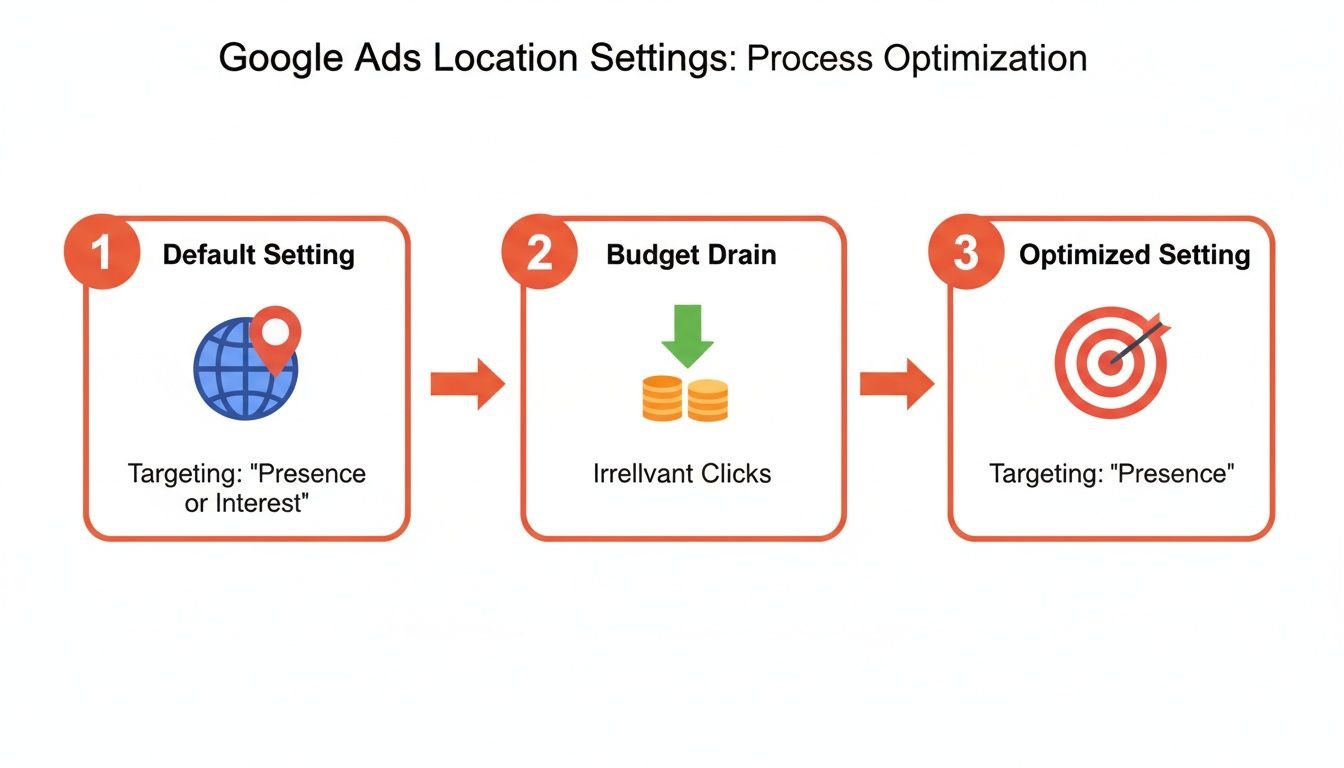
Most businesses lose money on Google Ads because of one default setting: "Presence or interest."
When you create a new campaign, Google automatically shows your ads to two groups:
- People physically located in your targeted area. (Good)
- People who have shown interest in your targeted area. (Bad for local businesses)
That "interest" category is where your ROI dies. It means a student in another state researching a project, a tourist planning a future trip, or a competitor from across the country can see and click your ads. For a local law firm, contractor, or medical practice, every click from outside your service area is 100% wasted ad spend.
The risks of using inexperienced providers or DIY methods often lead to this exact pitfall. They stick with the default, unaware that 5-15% of their budget is evaporating on clicks with zero chance of conversion.
| Setting | Who Sees Your Ads | Typical Outcome for Local Business |
|---|---|---|
| Presence or interest (Default) | People in your area OR people interested in it (tourists, researchers). | A mix of local leads and irrelevant, costly clicks from far away. |
| Presence (Optimized) | Only people physically located in or regularly visiting your targeted area. | Highly relevant clicks from genuine local prospects ready to buy. |
The solution is to tell Google you are a professional who understands your market. By switching your campaign settings to "Presence," you immediately stop the budget drain and ensure your ads are only shown to people who can actually hire you. This is a fundamental step in running effective Google Ads for local businesses and the first thing our experts check.
Building a Hyper-Focused Geographic Targeting Strategy
To truly master Google Ads location targeting, simply entering your city name isn’t enough. That’s an amateur move that guarantees wasted spend. A professional, results-driven approach involves building a precise digital boundary around your most profitable service areas. This is how you ensure every dollar is aimed at prospects who can generate revenue.
This process is about creating a detailed blueprint of your ideal customer's territory by layering multiple geographic rules. This is how our agency transforms broad, leaky campaigns into precision-guided lead-generation tools.
Why Professional Strategy Matters: Layering Locations
A proper service combines targeting methods to create a refined, custom-shaped zone that mirrors your actual service area. This level of control is something DIY campaigns often miss.
Here’s how we implement this for our clients:
- Radius Targeting: We establish your core service area. A local contractor might start with a 15-mile radius around their office to capture the most profitable jobs with minimal travel time.
- ZIP Code Targeting: We get more specific by analyzing your past data. We've helped financial advisors add specific high-net-worth ZIP codes that were 25 miles away but consistently produced high-value clients.
- City or Neighborhood Targeting: We get even more granular. A high-end restaurant in Miami can target affluent neighborhoods like Brickell and Coral Gables exclusively, matching their brand to the right audience.
By combining these methods, we build a targeting map based on real-world business intelligence, not generic administrative lines. This immediately separates a professional campaign from a basic one.
The Power of Strategic Exclusions
Telling Google where to show your ads is only half the battle. A professional strategy also tells it where not to. Location exclusions are your best defense for protecting your return on investment.
Every business has "digital dead zones"—areas that never produce good leads. By proactively excluding them, you immediately stop wasting money on clicks that have zero chance of converting.
For example, we often advise law firms to exclude neighboring counties where they can't practice. This simple step plugs a significant budget leak. Likewise, a plumber can exclude a part of town with heavy traffic that makes service calls unprofitable.
Building a detailed location strategy isn't a "set it and forget it" task. It requires a deep understanding of your market and a commitment to data analysis. To see how Google Ads location targeting fits into a larger growth plan, explore this comprehensive guide to digital marketing for local businesses. If your campaigns lack this precision, it's time to partner with an expert.
Using Bid Adjustments to Dominate Profitable Areas

Setting your geographic boundaries is just the starting line. True profit from Google Ads location targeting comes from actively managing your bids based on performance. This is how you move from simply showing up to strategically owning your most valuable markets.
Without bid adjustments, you're telling Google that a click from a low-converting neighborhood is worth the same as one from an affluent area that consistently sends you high-value clients. This is a massive missed opportunity.
Why Choose Us: A Data-First Approach to Bidding
Our agency’s process is rooted in data. We don't guess; we analyze. The first place we look is the Geographic Report in your Google Ads account. This report provides the ground truth: clicks, cost, and most importantly, conversions for every location you’re targeting.
This is where we find your "goldmine zones." Our experience shows that for most local service businesses, up to 80% of conversions come from just a few specific ZIP codes or neighborhoods.
We look for key performance indicators:
- High Conversion Rates: Which locations are turning clicks into phone calls and form fills?
- Low Cost-Per-Acquisition (CPA): Where are you acquiring customers for the least amount of money?
- High Click-Through Rates (CTR): Where does your ad message resonate most strongly?
These are the areas to double down on. If a certain part of town is feeding you great leads, you must ensure your ads appear more often and in higher positions than your competitors. That requires a proactive bidding strategy.
What's Included: Our Bid Adjustment Process
When we identify a top-performing area—say, ZIP code 33139 is generating high-quality leads—we take immediate action by applying a positive bid adjustment.
By setting a +20% bid adjustment, we signal to Google that we’re willing to pay up to 20% more for a click from that specific ZIP code. If your max bid is $10, it now effectively becomes $12 for that prime location, dramatically increasing your odds of winning the ad auction for high-value searches.
This isn't just about spending more; it's about turning performance data into a lever for profitability. We strategically invest your budget where we know it generates real phone calls and customer inquiries.
Conversely, we are ruthless with underperforming areas. If a neighborhood is eating your budget with clicks but never converting, we apply a negative bid adjustment (e.g., -50% or -90%) to slash spend or remove you from the running without fully excluding the location.
To dive deeper into how these adjustments fit into a winning campaign, our team’s guide on mastering Google Ads bidding strategies is an excellent resource.
Effective Google Ads location targeting is a continuous cycle of analysis and refinement. If you need an expert team to analyze your geographic reports and build a bid strategy that drives growth, contact us for a consultation. Let’s maximize your local ad spend.
Turn "Near Me" Searches into Foot Traffic with Location Extensions
For any business depending on local customers, winning the "near me" search is critical. While campaign targeting puts your ads in the right area, location extensions are the feature that converts nearby searchers into actual visitors. It's the bridge connecting your digital ad directly to your physical storefront.
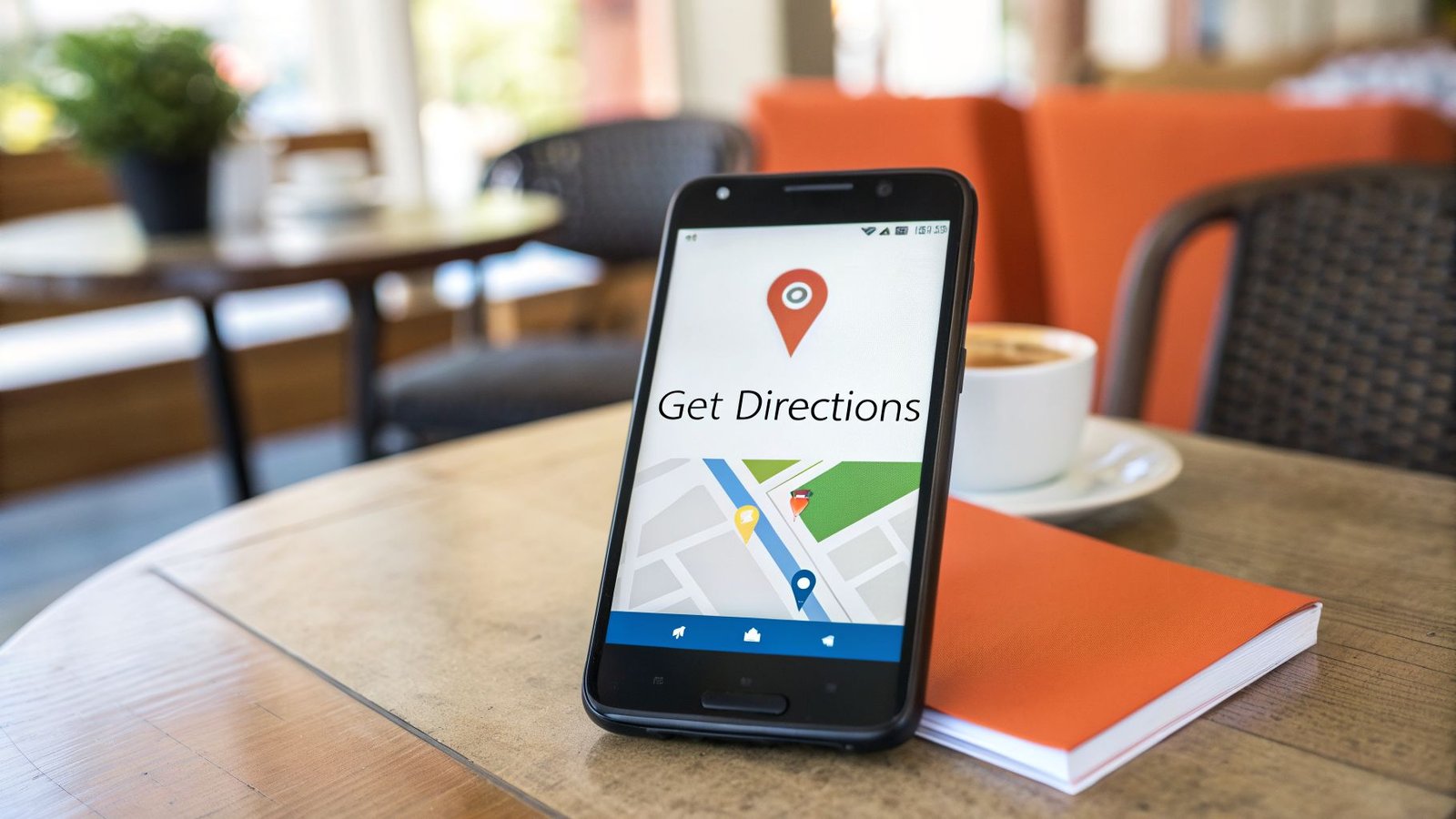
Location extensions link your Google Business Profile to your Google Ads account, upgrading your standard text ad into a powerful local business listing. This is a game-changer for driving foot traffic and generating immediate leads.
Objection Handling: "Can't I Just Do This Myself?"
While you can link your GBP yourself, a professional integration ensures it works seamlessly with the rest of your strategy. Amateurs often enable the extension but fail to optimize the underlying GBP listing, leading to poor results. Our service ensures your listing is complete, accurate, and compelling.
When a location extension is active and optimized, searchers instantly see:
- Your business address, confirming you're a real local business.
- A map pin, showing your exact location.
- A click-to-call phone number for immediate contact.
- Business hours and star ratings to build trust and urgency.
This information builds instant credibility. On mobile, the effect is even more potent. A user can get directions or call your business with a single tap, removing all friction between seeing an ad and taking action.
Properly using location extensions is how you dominate "near me" searches. In competitive fields like restaurants or law, 60% of smartphone users have contacted a business right from the search results, using features like directions or click-to-call.
This direct path from search to conversion is incredibly valuable. Our experience with businesses like yours shows that a well-optimized Google Business Profile for restaurants—a strategy that applies to nearly any local business—can drive significant ROI.
If you don't use location extensions, you force customers to work harder. They have to click to your site, find your address, and copy it into a map app. Each step is a chance for them to give up and choose a competitor. Don't leave money on the table.
Keeping Your Location Targeting on Track and Fixing Costly Mistakes
Setting up your Google Ads location targeting is just the beginning. The real gains come from treating it as a dynamic part of your campaign that requires regular monitoring and fine-tuning. A "set it and forget it" approach is a guarantee of wasted money.
The first place our experts always look is the Geographic Report in the Google Ads dashboard. This is your ground truth, showing exactly where your money is going and which of those areas are actually driving conversions.
How to Spot Trouble in Your Geographic Report
When we analyze location data, we're not just looking for what's working—we're hunting for what's not. The goal is to find and plug any budget leaks.
A classic red flag is a location that's consuming ad spend but generating zero conversions. You are paying for clicks from people with no intent to become customers.
Keep an eye out for these warning signs:
- High Spend, No Conversions: Any location soaking up your budget without leads needs immediate action.
- Low Click-Through Rate (CTR): If people in a certain area see your ads but don’t click, the offer may not resonate with that local audience.
- Sky-High Cost-Per-Acquisition (CPA): If your CPA in one city is double what it is elsewhere, you're overpaying for those customers and hurting profitability.
Catching these issues early allows you to act fast, either by lowering bids in that underperforming area or excluding it completely to protect your budget.
Troubleshooting Common Location Targeting Slip-Ups
Even experienced advertisers can make mistakes. Here are the most common—and expensive—errors we fix for new clients.
1. Casting Too Wide a Net
Thinking a bigger radius means more customers is a trap. It usually just leads to wasted spend. For a local plumber, a click from 30 miles away is worthless if the job is unprofitable due to travel time.
Expert Tip: Start with a tight, conservative radius around your core service area. You can expand later if data supports it, but it’s much harder to reclaim money wasted on clicks from too far away.
2. Forgetting to Add Exclusions
A costly oversight is failing to use location exclusions to block ads in neighboring cities you don't serve. This is low-hanging fruit for saving money.
3. The Default Setting Trap
This is a silent budget killer. The location setting can revert to the default "Presence or interest," meaning you're suddenly paying for a broad, unqualified audience. We make it a routine to double-check that all campaigns are set to "Presence."
By constantly monitoring performance, we turn a static location list into a responsive, profit-driving system. If you suspect your campaigns suffer from these issues, our professional Google Ads audit process can quickly pinpoint the leaks.
Why Choose Us: Your Strongest Asset for Local Growth
You can try to manage Google Ads location targeting yourself, but a single overlooked setting can drain your entire ad budget. Partnering with a dedicated agency means bringing on a team of specialists obsessed with one thing: delivering measurable results and a positive return on your investment.
We see it constantly: well-intentioned campaigns leaking money because no one is digging deep enough into the performance data. Our job is to stop that drain by uncovering hidden pockets of high-intent customers right in your service area.
What's Included: Our Data-Driven Process
From day one, our experienced team implements advanced, data-driven strategies. Instead of blanketing your entire city with one bid, we pinpoint the exact ZIP codes driving profit and bid more aggressively there while pulling back from areas sending you low-quality clicks.
This is a continuous cycle of optimization that keeps you ahead of your competitors.
Our service includes:
- Profit Zone Identification: We analyze conversion data—not just clicks—to find the neighborhoods that are most valuable to your business.
- Intelligent Bidding: We use location-based bid adjustments to ensure your ads are prominent where it matters most, maximizing every dollar.
- Proactive Monitoring & Reporting: We are always in your geographic reports, patching budget leaks and adapting your strategy to market shifts.
- Expert Navigation: Our experience and certifications mean we avoid common, costly mistakes from the start.
When you partner with an agency, you gain a team focused solely on maximizing your return on ad spend. This frees you to run your business, confident that your marketing dollars are working as efficiently as possible.
To ensure your campaigns are always dialed in for maximum local ROI, the value of professional Google Ads management becomes undeniable.
The market is competitive, and every day you wait is a missed opportunity. If you're ready to stop guessing and start getting tangible results from your local ads, contact us.
Final Questions Before You Get Started
When business owners are ready to make a decision, a few final questions often come up. Let's address them directly.
Just How Specific Can My Targeting Be?
Incredibly specific. A professional strategy goes far beyond city-level targeting to outsmart your competition. This is a key part of our service.
We utilize a full suite of tools:
- Radius Targeting: To create a core service boundary (e.g., 10-mile radius).
- ZIP Code Targeting: To focus spend on the most profitable postal codes.
- Neighborhood Targeting: To hand-pick specific, high-value areas.
- Strategic Exclusions: To actively block ads in unprofitable zones you don't serve.
What’s the Difference Between "Presence" and "Presence or Interest"?
This setting is critical and a common DIY mistake.
"Presence or interest" (the default) shows ads to people in your area AND people just interested in it. This wastes money on tourists and researchers.
"Presence" is the setting our agency almost always uses for local businesses. It restricts ads to people physically located in your chosen locations, ensuring you only pay for relevant, local clicks.
Expert Insight: Switching your campaigns to "Presence" is one of the fastest ways to cut wasted ad spend and improve lead quality. It’s a non-negotiable for serious local advertisers.
How Do I Know Which Locations Are Working?
You never have to guess. Our process is built on transparency and data. We regularly analyze the "Locations" report in Google Ads to track performance.
For every targeted area, we monitor:
- Clicks & Impressions
- Total Cost
- Conversions
- Cost-Per-Acquisition (CPA)
- Conversion Rate
We use this data to refine your strategy continuously, increasing bids in your "goldmine" locations and cutting spend in underperforming ones. This is how we move from simply running ads to strategically managing a high-performing lead generation asset.
Ready to stop wasting money on out-of-area clicks and start attracting high-quality local customers? The team at VIP TECH CONSULTING specializes in building and managing hyper-focused Google Ads campaigns that drive measurable results. We’ll implement the advanced strategies needed to maximize your ROI.
Schedule your free strategy session today and let's create a local advertising plan that works.