
If your dining room is quiet on weeknights while a competitor nearby has a waitlist, the problem usually isn’t the food. It’s visibility.
That’s why google ads for restaurants matters. Diners don’t browse the way they used to. They search, compare, tap for directions, book a table, or place an order in minutes. If your restaurant isn’t showing up at that moment, someone else gets the sale.
A lot of owners try to fix this themselves. They launch a Smart Campaign, choose broad keywords, send traffic to a generic homepage, and hope Google figures it out. That’s not a strategy. It’s a fast way to pay for bad clicks, weak leads, and incomplete tracking.
Professional management changes the game because restaurant advertising only works when it’s connected to the full customer journey. Your ads need to match your Google Business Profile, your menu pages, your reservation flow, your ordering system, and your actual business goals.
If you already know you need help and you’re comparing providers, that’s the right place to be. The right setup can turn Google into a predictable customer acquisition channel. The wrong setup just burns budget.
Table of Contents
- Your Competitor Is Full on a Tuesday Night. Are You?
- The Modern Restaurant Growth Engine Explained
- Why a Miami Ads Expert Outperforms DIY Every Time
- Your Custom Restaurant Advertising Blueprint
- Answering Your Questions About Google Ads Investment
- Start Filling Your Tables This Week
Your Competitor Is Full on a Tuesday Night. Are You?
A slow Tuesday used to be normal. Now it’s often a visibility problem.
When diners search for a place to eat, they usually don’t know your brand yet. They search by need, location, and timing. That means your restaurant wins or loses before anyone sees your front door.
According to WordStream’s 2025 Google Ads benchmarks, “Food near me open now” searches grew 875% year-over-year, and “Food near me” queries grew 99% year-over-year. If you’re absent from those searches, you’re not missing casual browsers. You’re missing people ready to decide now.
Why DIY usually makes this worse
Most restaurant owners don’t fail because they didn’t care. They fail because Google Ads punishes vague setup.
Common mistakes show up fast:
- Broad keywords attract the wrong clicks and drain budget on people who were never going to visit.
- Weak location targeting puts ads in front of users outside your real service area.
- No conversion tracking means you can’t tell whether calls, bookings, direction requests, or orders came from ads.
- Generic landing paths send hungry customers to pages that make them work too hard.
Practical rule: If your ad account can’t clearly show which clicks turned into calls, reservations, orders, or direction requests, you’re guessing.
That’s why “just trying some ads” is expensive. You don’t need traffic. You need intent, relevance, and conversion tracking tied to real revenue.
What the right response looks like
The fix isn’t more ad spend. It’s tighter execution.
A strong restaurant campaign starts with local intent, sharp keyword control, and a path that gets the customer from search to action with as little friction as possible. It also needs to line up with your Google Business Profile and your ordering or booking system. If those pieces are disconnected, your ads won’t carry the load.
If you’re comparing options right now, start by reviewing proven restaurant marketing strategies in Miami and look at whether your current setup is built to capture high-intent local demand, not just generate clicks.
The Modern Restaurant Growth Engine Explained
The best google ads for restaurants setup isn’t a single campaign. It’s a system.
That system should do four jobs at once. Capture people searching right now, stay visible across Google properties, convert mobile users fast, and measure what produces revenue. When those pieces work together, Google stops being a gamble and starts acting like a repeatable growth channel.
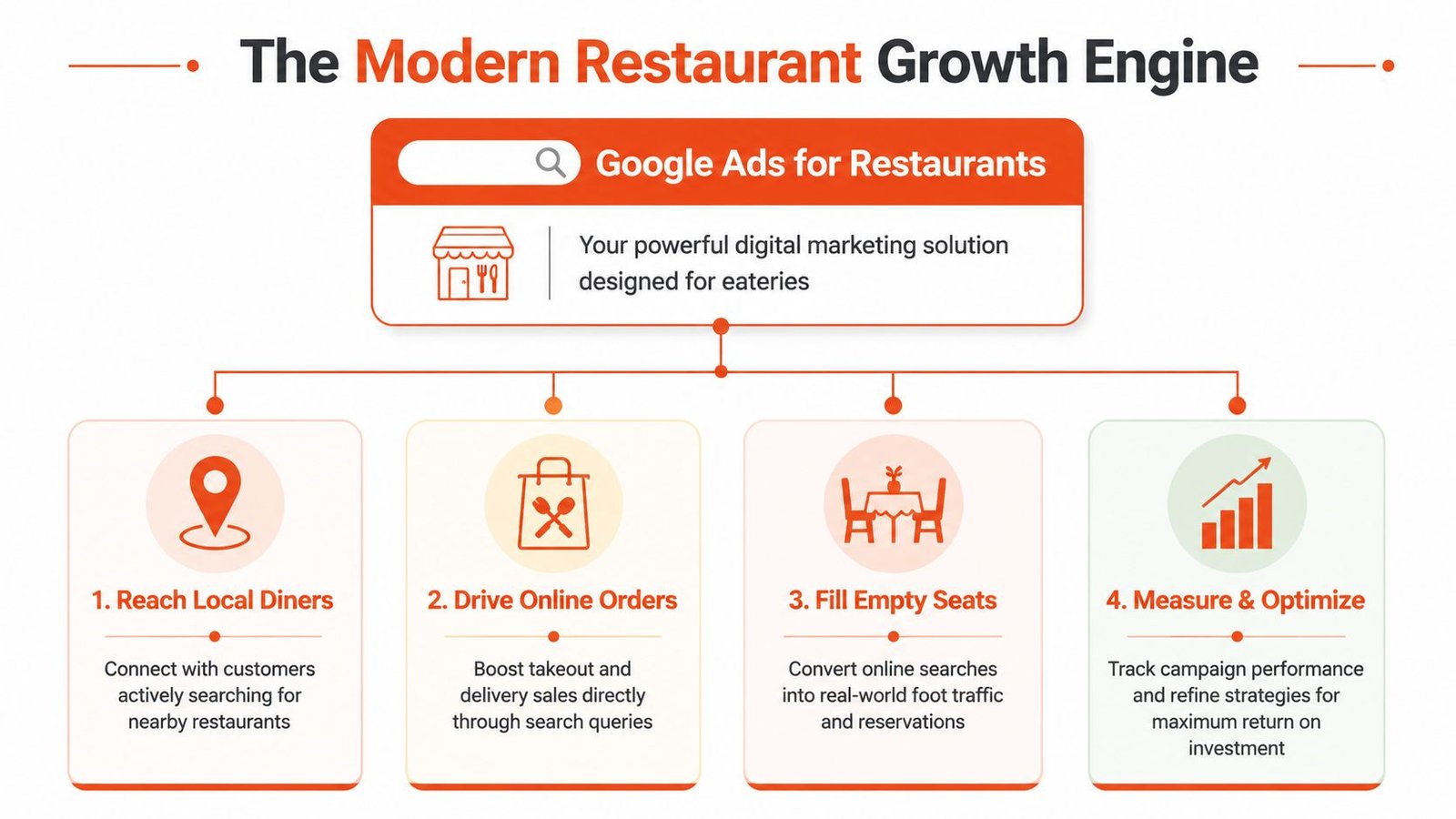
Restaurants have a strong reason to take this seriously. The industry sees an average cost-per-click of $2.05, compared with the all-industry average of $5.26, along with a 7.58% conversion rate, according to the benchmark data cited earlier. That’s why this channel can work so well when the account is managed properly.
Search captures intent
Search campaigns are the core money-maker.
When someone searches for a cuisine, a neighborhood spot, a happy hour option, or a place that’s open now, they’re close to making a decision. Search lets you intercept that decision with precise messaging and a direct path to call, book, or order.
A strong Search setup usually includes:
- Cuisine and intent terms such as neighborhood, occasion, and dish-related searches.
- Separate campaigns for dine-in and takeout so your ads match the action you want.
- Ad assets tied to decisions like menus, reservations, calls, and locations.
Performance Max expands reach
Search captures existing demand. Performance Max helps you reach people before they type the final query.
That matters when you’re promoting brunch, private dining, seasonal specials, delivery, or events. Performance Max can place your creative across Search, Maps, YouTube, Display, and other Google inventory, which makes it useful for restaurants that need both immediate demand capture and broader local awareness.
A lot of operators miss this because they think only in terms of keyword ads. That’s too narrow. Good restaurant growth comes from a full acquisition system, not a single campaign type.
For operators thinking beyond ads alone, this piece on turning restaurant dreams into reality is a useful reminder that profitability usually comes from strong operations and smart demand generation working together.
Local intent has to end in action
A click has no value if the customer hits a dead end.
Your ad should move the user into one of a few clear actions:
| Intent | Best destination |
|---|---|
| Ready to dine in | Reservation page or tap-to-call |
| Looking for nearby options | Google Business Profile with directions |
| Wanting takeout or delivery | Direct online ordering page |
| Comparing restaurants | Menu page with location proof and reviews |
The account structure matters, but the handoff matters more. If the click lands on a weak profile, slow page, or confusing menu path, you paid for a lost opportunity.
That’s why serious providers don’t treat ads in isolation. They look at the full funnel. If you want a broader view of how those pieces connect, these digital marketing strategies for restaurants are a useful benchmark for evaluating whether your current setup is built to convert.
Why a Miami Ads Expert Outperforms DIY Every Time
Miami is not a forgiving market.
You’re competing with established restaurants, aggressive local players, seasonal demand swings, tourists, locals, last-minute searchers, and mobile users making fast decisions. Generic campaign management doesn’t hold up in that environment.
Clicks don’t matter if the profile is weak
Most agencies talk about campaigns. The better ones start with the foundation.
Your Google Business Profile affects what happens after the ad impression and after the click. A weak profile with poor photos, outdated hours, thin menu information, or weak review management undermines paid performance. That’s not a side issue. It’s part of the conversion path.
The reason this matters is simple. 88% of local mobile searches lead to a call or visit within 24 hours, according to 7shifts. If your ad is visible but your profile is weak, you’re paying to send high-intent traffic into friction.
A Miami specialist usually outperforms DIY because they understand that local paid media needs to be tied to:
- Google Business Profile optimization
- Location extensions and map visibility
- Reservation and online ordering integrations
- Local intent by neighborhood, not just by city
- Fast response to what’s happening in-market
DIY breaks at the tracking layer
Most restaurant owners don’t struggle with creating an ad. They struggle with measuring what happened after the click.
That’s where professional management earns its keep. The work includes setting up call tracking, direction-request tracking, booking attribution, and order-path visibility. Without that, you can’t distinguish profitable campaigns from expensive noise.
Here’s the difference in practical terms:
| DIY approach | Expert approach |
|---|---|
| Runs one mixed campaign | Splits campaigns by goal and intent |
| Uses broad defaults | Uses tighter local targeting and exclusions |
| Counts clicks | Tracks calls, bookings, orders, and direction requests |
| Leaves GBP disconnected | Aligns ads with profile, menu, and action path |
If your current provider sends you reports full of impressions and clicks but can’t tie spend to reservation, order, or call activity, they’re reporting activity, not performance.
If you’re evaluating agencies, this guide on how to hire a Google Ads agency is a solid filter. It’ll help you separate actual operators from vendors who just know the interface.
Your Custom Restaurant Advertising Blueprint
You shouldn’t have to guess what’s included when you hire a professional. Good management is concrete.
A real service for google ads for restaurants should cover the campaign, the profile, the tracking layer, and the conversion path. Anything less leaves gaps that cost you customers.

What serious management should include
Google Business Profile audit and hardening
Your profile needs accurate hours, strong categories, current photos, service details, and action-ready links. This improves the quality of traffic your ads send into Maps and local search.Hyper-local keyword and competitor analysis
Good accounts target the searches that produce action in your area. Not generic national phrases. Not lazy broad match sprawl. Tight local targeting is one of the clearest signs that a campaign is built for profit.Separate campaign buildouts by intent
Dine-in, takeout, delivery, catering, events, and branded searches don’t behave the same way. They shouldn’t live in one bucket.Ad copy built for conversion
Strong ads highlight the decision triggers that matter. Cuisine, location, open-now relevance, direct ordering, reservation convenience, and offer clarity.Conversion tracking setup
Calls, bookings, orders, direction requests, and key website actions should all be visible in reporting. If they aren’t, you can’t optimize with confidence.Landing page and path recommendations
Sometimes the ad isn’t the issue. The issue is that the user lands on a slow page, a cluttered menu, or a booking flow with too many steps.
What you should expect from the working relationship
A competent agency also gives you a clear operating rhythm.
You should expect regular optimization, transparent reporting, and direct recommendations tied to business outcomes. If your provider disappears after launch, you don’t have management. You have setup.
For local operators, smart Google Ads location targeting is one of the most important variables because wasted geography is wasted budget.
Operational standard: A restaurant campaign should be managed like inventory. Cut what doesn’t sell, push what does, and review performance often enough to react before waste compounds.
If you’re talking to agencies now, ask for specifics. What do they track? How do they handle dine-in versus ordering? How do they align ads with your profile and booking path? Vague answers are your warning sign.
Answering Your Questions About Google Ads Investment
Restaurant owners usually ask the same three questions. Good. You should.
Is this actually worth paying for
It is, if the account is built to produce profit instead of vanity metrics.
Across industries, businesses typically see an average return of $2 for every $1 spent on Google Ads, with the higher end reaching up to $8 for every $1 invested, according to Digital Silk. That doesn’t mean every campaign prints money on day one. It means the platform has real upside when the targeting, tracking, and optimization are done correctly.
If you run a restaurant, you should view your investment not as ad spend, but as customer acquisition spend. The question isn’t “Can I afford to advertise?” The question is “Can I afford to let nearby buyers choose someone else every day?”
Can’t I just run Smart Campaigns myself
You can. That doesn’t mean you should.
Smart Campaigns are designed for convenience, not control. They hide too much, automate too much, and make it easy to spend money without learning what drove a result. For a restaurant, that’s dangerous because small mistakes add up fast.
DIY tends to fail in predictable ways:
- Too much automation too early hides weak targeting.
- Weak exclusions allow irrelevant traffic into the account.
- No real segmentation mixes dine-in, orders, and branded traffic together.
- Thin reporting makes optimization reactive and slow.
Restaurant margins don’t give you room for lazy media buying. That’s also why operators who focus on profitability watch costs across the whole business, from ad spend to labor to menu performance. This guide on optimising food costs for UK businesses is a useful example of the same principle. better decisions come from disciplined cost control, not guesswork.
How long does it take to see traction
You can see activity quickly. Reliable optimization takes longer.
The first phase is setup and data collection. Then comes refinement. The account needs enough signal to identify weak queries, improve ad copy, tighten targeting, and direct budget toward what converts. Owners who expect instant perfection usually end up changing things too early or judging the wrong metrics.
Don’t judge a restaurant campaign by how busy the dashboard looks. Judge it by whether qualified calls, bookings, orders, and direction requests are increasing.
If you’re done experimenting and want real campaign oversight, compare what you’re doing now against a professional Google Ads campaign management service. The gap is usually obvious.
Start Filling Your Tables This Week
Restaurants don’t need more theory. They need booked tables, direction requests, phone calls, and orders.
That’s why professional management wins. It connects local search intent to real-world action. It cuts wasted spend, fixes tracking, strengthens the handoff to your profile and ordering flow, and keeps improving the account instead of letting it drift.
What winning restaurants do differently
They don’t treat ads as a side project.
They treat Google as a live customer acquisition channel and manage it accordingly. That means they pay attention to profile quality, campaign structure, mobile behavior, local targeting, and conversion tracking. They don’t stop at “people clicked.” They ask what those clicks produced.
One restaurant case study shows what strategic execution can look like. A modest campaign generated 952 direction requests, produced over $19,000 in sales in 30 days, and delivered a 20x return on ad spend, according to Embark Marketing.
That result doesn’t come from luck. It comes from alignment.
- The offer matches intent
- The targeting matches geography
- The profile supports the decision
- The tracking confirms what worked
- The optimization keeps waste under control
For owners weighing channels, this breakdown of effective advertising channel analysis is worth reviewing. It helps clarify why high-intent search behaves differently from interruption-based media.
The next step is simple
If your restaurant is losing local searches to competitors, waiting won’t help. The market won’t slow down so you can catch up later.
Audit the full system. Your ads. Your Google Business Profile. Your reservation path. Your ordering flow. Your tracking. If one of those pieces is weak, the account won’t reach its ceiling.
A strong local presence starts with your profile, so if you haven’t looked closely at that piece yet, review what effective Google My Business for restaurants should include.
The restaurants that win local search aren’t always the ones with the best food. They’re the ones that are easiest to find, easiest to trust, and easiest to choose.
If you want a clear plan before you spend another dollar, book a strategy session with VIP TECH CONSULTING. You’ll get a practical review of your current visibility, your ad opportunity, and the fastest path to more calls, reservations, and orders.